Juhyung Son, Jihoon Shin (2024). Education and Training Using Digital Twin in Hazardous Chemical Manufacturing Plants. In: Human Factors in Design, Engineering, and Computing. AHFE Open Access, vol. 159, pp. 1949–1958. https://doi.org/10.54941/ahfe1005762
Manufacturing industries face significant challenges in equipping new employees with the requisite skills to operate complex machinery, especially in hazardous sectors like chemical engineering. Traditional on-the-job training poses substantial risks and is limited by space and budget constraints, making it difficult for educational institutions to replicate industrial environments adequately. The acquisition and customization of equipment to meet diverse industry demands are prohibitively expensive, exacerbating these challenges. In response, Digital Twin technology offers an innovative solution. By creating virtual replicas of physical environments, Digital Twins provide a virtually boundless digital space at minimal operational costs. This technology enables avatar-based interaction and collaboration, bridging the gap between theoretical learning and practical industry practice. New employees and students gain immersive experiences that facilitate a nuanced understanding of complex industrial systems, ensuring a smoother transition into real-world work environments. This paper delves into existing theories and literature on Digital Twin technology, focusing on its implications for education and training. We introduce DTLAB, a bespoke digital twin framework tailored for hazardous chemical manufacturing plants. Leveraging cutting-edge technologies, including Virtual Reality (VR), the Internet of Things (IoT), Robotics, Data Technologies (DT), and an AI Virtual Chat-GPT Trainer (AIVCGT), DTLAB creates a hyper-realistic training environment. Participants engage with virtual replicas of chemical plants, benefiting from seamless data exchange between physical and virtual workspaces. Additionally, we employ the AIVCGT approach to evaluate users' learning efficiency and engagement levels within digital twin simulations. This research highlights the potential of Digital Twin technology to transform educational practices, empowering individuals to thrive in an increasingly complex industrial landscape.
Metaverse technology has the potential to create interactive virtual environments that span various platforms and technologies. The principles and innovations underpinning the metaverse are critical in advancing toward the era of digital twins. Advanced technologies, including Virtual Reality (VR), Augmented Reality (AR), Mixed Reality (MR), and Extended Reality
(XR), are essential for broadening our experiences within these virtual settings. Presently, numerous enterprises and academic institutions are investing significantly in digital twin technologies to equip new employees and engineering students with cutting-edge tools.
The metaverse has become a pivotal topic in the evolution of the traditional educational system toward a future-oriented pedagogical model. The advent of metaverse technologies holds the promise of enhancing engagement with learning materials through immersive virtual spaces that facilitate complex simulations. Incorporating these technological proficiencies can bolster students’ participation and outcomes by offering experiential learning opportunities within the metaverse framework. In the context of hazardous chemical manufacturing, the imperatives of safety and precision are paramount. The convergence of Virtual Reality (VR) and Digital Twin technology emerges as a revolutionary approach, affording unparalleled depth of operational understanding and enhanced risk management. A digital twin is a live, virtual model of a physical system, employed to simulate, scrutinize, and refine processes within a secure, manageable environment. The incorporation of VR into this paradigm permits engineering trainees and new hires to engage with the workings of a plant in an entirely immersive three-dimensional space. This fusion facilitates the recognition of potential dangers, inefficiencies, and maintenance demands without the need to confront the intrinsic hazards of chemical production settings directly. By leveraging VR-enabled digital twins, facilities can undertake comprehensive safety training, execute remote diagnostics, and strategize for imminent expansions with a level of precision previously unattainable. This technology not only fortifies safety and operational effectiveness but also fosters ongoing enhancement and ingenuity in the chemical sector.
The aim of this paper is to introduce the Digital Twin Laboratory (DTLAB), a simulation facility designed to offer chemical engineering students and new workers education and training within hazardous virtual work environments. This DTLAB is able to dive into current theories and literature on Digital Twin technology, with a special emphasis on its implications for education and training. The DTLAB focuses on providing instruction pertaining to distillation columns (DC), a prevalent apparatus in chemical plants. The DTLAB promotes collaborative learning through the integration of audio communication and real-time interactions between educators and learners. The development of the DTLAB necessitates the amalgamation of technologies such as Virtual Reality (VR), the Internet of Things (IoT), Robotics, Data Technologies (DT), and an AI-powered Virtual Chat-GPT Trainer (AIVCGT).
RELATED WORK
Virtual Reality (VR) laboratories represent a paradigm shift in interactive educational experiences, offering immersive content that bridges the gap between theoretical knowledge and industry practice. Universities and corporations alike are pioneering technical training programs in fields such as chemical engineering, aerospace, and marine engineering, leveraging VR
Education and Training Using Digital Twin in Hazardous Chemical Manufacturing Plants 1951
to simulate real-world environments. Virtual labs, underpinned by AR/VR technology, are proving to be invaluable in engineering education, especially for equipping students with the skills to navigate hazardous situations with safety as a priority. Novartis has reported the efficacy of a VR lab simulator designed to facilitate the acquisition of life-saving techniques within a controlled virtual environment (Novartis, 2018). Furthermore, VR-based health and safety training applications indicate extensive use in high-risk engineering sectors, encompassing risk assessment, machinery operation, and procedural management (Toyoda et al., 2022; Tjolleng, 2023; Kassem et al., 2017). Such training through VR has shown promise in enhancing learning outcomes when juxtaposed with traditional pedagogical approaches, with certain studies incorporating automated assessments to gauge complex skill sets. HoloLAB Champions exemplifies the potential for VR to transform chemical education by allowing students to engage with virtual laboratory equipment, thereby achieving precise measurements and gaining insight into laboratory procedures (HoloLAB Champions, 2018).
This form of experiential learning not only bolsters conceptual comprehension but also equips students with the skills for practical application in real-world contexts. VR offers a risk-free environment for learners to experiment and learn from their errors, devoid of tangible repercussions (Checa and Bustillo, 2020; Steen et al., 2024; Toyoda et al., 2022). The interactive essence of VR fosters increased student engagement and motivation, culminating in a more efficacious educational journey. By integrating elements of gamification, such as challenges and rewards, applications like HoloLAB Champions render the learning process more captivating and consequential (HoloLAB Champions, 2018). In conclusion, the advent of virtual reality in training heralds a transformative era in education, presenting dynamic and engaging modalities for mastering complex disciplines. As technological advancements persist, the horizon for immersive educational experiences broadens, positioning VR as an innovative and potentially transformative pedagogical instrument.
SYSTEM DESIGN OF DTLAB The DTLAB simulation meticulously emulates a prototypical chemical processing facility to furnish pedagogic experiences for both novices and incumbent staff within a simulated milieu. The construction of the DTLAB entailed an assiduous replication of the structural design and apparatus specifications extant in a bona fide manufacturing plant. The creation of the three-dimensional models for the virtual reality (VR) domain was executed utilizing sophisticated software tools, namely Fusion and Blender, while the interactive VR environment was engineered employing the Unity engine in conjunction with the C# programming language.
1952 Son and Shin
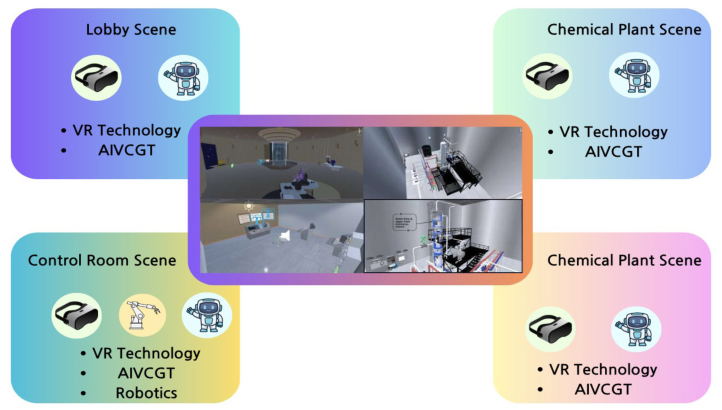
Figure 1: DTLAB Design Component.
As delineated in Figure 1, the configuration and constituents of the DTLAB are explicated for each discrete scenario. The deployment of Internet of Things (IoT) technology enables the robotic actuation of control mechanisms within both the physical chemical factory and the analogous DTLAB environments (as referenced in Figure 1, Control Room Scene). Upon a pupil’s engagement of a control within the DTLAB’s command center, a parallel operation is triggered at the chemical plant through the IoT framework and robotic intermediaries. This congruent interaction affords learners the opportunity to observe the direct consequences of their operational choices in a secure and devoid of risk context (Cascalho et al., 2022; Adel, 2024; Ouyang and Xu, 2024). The integration of IoT and robotic technologies into the educational syllabus substantially augments the learning experience, proffering interactive encounters with state-of-the- art technologies that are synchronous with prevailing industry benchmarks (Valls et al., 2022; Meylani, 2024; Nicu et al., 2024; Ribeiro et al., 2023).
This experiential approach plays a pivotal role in endowing students with the hands-on competencies requisite for their prospective careers in chemical engineering. The simulation of real-world scenarios facilitates an in-depth understanding of technological applications in situ, thereby bolstering their analytical and problem-solving faculties as they navigate complex challenges. The infusion of IoT and robotics into the chemical engineering pedagogy is a strategic measure to prime students for the dynamic vicissitudes of the industry. Furthermore, the Advanced Interactive Virtual Chemical and Genetic Training (AIVCGT) system has been integrated into a myriad of scenarios, including the Lobby, the Chemical Plant, and the Control Room.
DTLAB AND CHEMICAL PLANT TRAINING PROCEDURES Learners immerse themselves in the Digital Twin Lab (DTLAB), an interactive virtual environment meticulously designed to simulate a chemical plant’s
Education and Training Using Digital Twin in Hazardous Chemical Manufacturing Plants 1953
operations. Within this milieu, they encounter an array of multimedia tools such as presentations, slideshows, and videos strategically placed in the entrance area, complemented by practical exercises that include the manipulation of virtual valves within the chemical plant simulation.
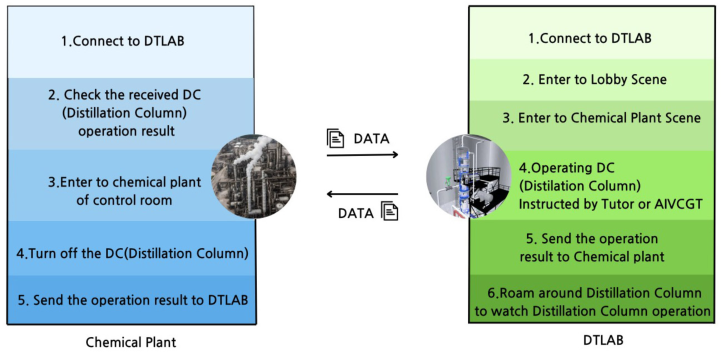
Figure 2: DTLAB and chemical plant trainning hazarous situation procedure.
The DTLAB’s primary objective is to furnish a true-to-life experience that prepares individuals for the nuances of distillation column operation, while simultaneously ensuring a risk-free environment for the rehearsal of emergency protocols. Participants must adhere to a structured training regimen that commences in the virtual lobby and advances through the plant simulation to the control room, mirroring the progression of real- world operational training. Upon entering the virtual lobby, each learner’s avatar is positioned to commence the educational journey, beginning with the assimilation of theoretical knowledge regarding the column’s operational dynamics, safety procedures, and structural components. The incorporation of a multi-user interaction mode bolsters collaborative learning, enabling dynamic communication between trainees and specialists in the field. Initial guidance is delivered by an instructor who establishes a foundational understanding of the chemical processes at play before the learners delve deeper into the DTLAB.
The AIVCGT supplements this by elucidating the operational intricacies of the chemical plant. Interactive instruments, inclusive of annotated lectures and scrollable video content, are at the learners’ disposal, facilitating an engaging educational dialogue with the AIVCGT, which serves to both impart knowledge and evaluate comprehension through a three-phase assessment process.
Following the introductory lecture, instructors organize participants into teams, leading them through the simulated plant to explore critical components such as the preheater, distillation column, and feed tanker.
1954 Son and Shin
During this exploratory phase, the AIVCGT provides supplementary explanations, enhancing the collaborative learning experience and fostering a deeper appreciation of the plant’s operational principles and procedures. The experiential learning continues as students are tasked with operating the distillation column, progressing to the control room to acquaint themselves with the procedural protocols. Here, the interactive forum allows for inquiries and dialogue concerning the distillation column’s protocols, with the AIVCGT vigilantly monitoring the engagement and efficiency of the learners. Upon successful completion of the control room activities, the simulation culminates with the visualization of a water vapor animation emanating from the distillation column a powerful teaching moment that the tutor or AIVCGT capitalizes on to elucidate the underlying principles of vapor dynamics and fluid flow. The DTLAB’s innovative approach to learning is not confined to the virtual realm; the results of the operations are transmitted to the DTLAB and chemical plant databases, fostering an integrated communication platform. This pedagogical strategy employed by the DTLAB is meticulously crafted to amplify learning efficacy and engagement, catering to both novice entrants and seasoned professionals in the chemical industry.
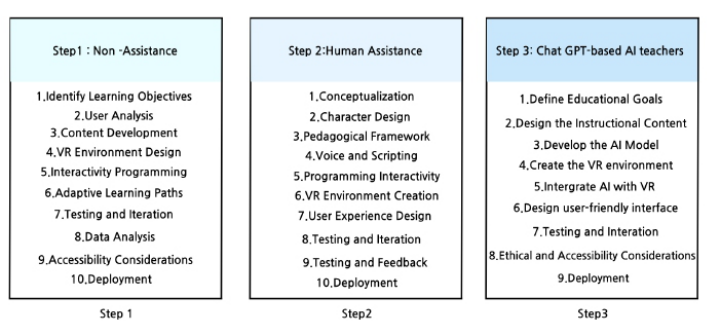
RESEARCH METHODOLOGY We introduced a novel virtual reality (VR)-based digital twin educational model for chemical engineering instruction in the DTLAB, assessing the outcomes through participant evaluations. The AIVCGT pedagogical framework, encompassing STEP1, STEP2, and STEP3, integrates cutting- edge technologies such as VR, the Internet of Things (IoT), artificial intelligence (AI), and digital twins within a simulated learning environment. The objective of the AIVCGT approach is to assess the learning achievements of students and novice professionals, offering a comprehensive blueprint for subsequent research utilization.
Figure 3: AIVCGT evaluation and methodology.
Education and Training Using Digital Twin in Hazardous Chemical Manufacturing Plants 1955
According to the International Air Transport Association, an AI- mediated training evaluation methodology, the Competency-Based Training Assessment (CBTA), has been recommended to identify potential challenges in AI implementation within digital twins (IATA, 2021). Leveraging the proposed research roadmap, we have adapted the AI-centric research framework for the design of the AIVCGT methodology in our DTLAB by integration with VR and AI (Docter MW et al., 2024).
We established a tripartite evaluation framework: (1) assessing the self- directed learning efficacy within DTLAB, (2) evaluating the enhancement of learning outcomes through human tutor assistance in a multi-user setting, and (3) determining whether a collaborative AI-human teaching approach augments learning proficiency relative to the first two steps.
For the empirical assessment of our methodology, we enlisted 30 participants, subdivided into three distinct cohorts: (A) 10 participants engaged with the physical laboratory environment before participating in the DTLAB’s STEP1 experiment, (B) a subsequent group of 10 participants entered STEP2, which involved human assistance, after similar exposure to the physical laboratory, and (C) the final group of 10 participants were allocated to STEP3, entailing an AI-human collaborative teaching environment. Upon completion, experimental results were relayed to DTLAB and corresponded with actual chemical plant operations in real time.
In the first experimental condition, STEP1, participants received an initial lecture in a physical laboratory setting before proceeding to the DTLAB’s non-assisted mode. The foundational knowledge was provided through PowerPoint presentations and videos. Subsequently, participants donned Oculus Quest 2 headsets to enter the VR-based single-user DTLAB sessions. Post-session, participants completed two surveys related to distillation column operation procedures.
In the second experimental condition, STEP2, participants completed distillation column operation tasks with the guidance of a tutor within the DTLAB. After the sessions, surveys were administered to gauge participant understanding and learning performance, thereby evaluating the efficacy of the training program and informing potential enhancements.
Lastly, the third experimental condition, STEP3, involved a Chat GPT-based AI teacher providing foundational knowledge consistent with the DTLAB procedure. Participants interacted with the AI teacher, who facilitated learning within the VR chemical plant simulation, and their task performance was subsequently assessed in the control room scene. Surveys administered post-experiment gauged the participants’ experiences, including their engagement with the AI teacher and comprehension of the material.
This structured experimental design aims to provide a comparative analysis of various teaching modalities within the digital twin framework, with implications for the optimization of educational models in chemical engineering.
1956 Son and Shin
FINDINGS AND DISCUSSION The investigation revealed that the deployment of the DTLAB featuring Step 3 (Chat GPT-based AI instructors) significantly enhanced educational outcomes compared to traditional methods devoid of assistance (Step 1) and those involving human intervention (Step 2). A preponderance of study participants affirmed that DTLAB augmented their motivation, efficacy, and zeal for learning when addressing the mastery question. Furthermore, these individuals reported an upsurge in engagement and interest in the subject matter following the employment of DTLAB, attributing this to the customized feedback provided by the AI instructors. This feedback facilitated an improved comprehension and retention of the educational content.
In summation, the evidence suggests that DTLAB harbors the capacity to revolutionize conventional pedagogical methods. By harnessing AI technology, DTLAB offers a learning experience that is both dynamic and customized, potentially conferring substantial benefits upon students. The positive testimonials from participants imply that DTLAB could emerge as an instrumental resource in ameliorating educational results. Additionally, DTLAB’s adaptability to the diverse learning styles and paces of individual students may facilitate broader academic success.
CONCLUSIONS
The incorporation of AI-powered Chat GPT instructors within the DTLAB framework confers multiple advantages for the acquisition of knowledge and skills. Specifically, AI Chat GPT instructors in virtual reality (VR) environments can yield a profoundly engaging and immersive educational experience. Learners have the opportunity to interact with virtual entities that mimic human responses, thereby rendering the educational process more interactive and appealing. These AI-driven systems are capable of delivering individualized feedback and guidance contingent upon the learner’s actions and choices, an approach that can markedly enhance educational achievements.
This avant-garde educational methodology holds promise for redefining student learning and retention processes in the forthcoming era. It has the potential to instigate a paradigm shift in traditional classroom environments and catalyze the advent of tailored educational experiences on an international scale. By providing an immersive and interactive platform for learning, DTLAB can address the limitations of conventional educational methods and enhance the overall effectiveness of education in diverse fields.
REFERENCES
Adel, A. (2024). The Convergence of Intelligent Tutoring, Robotics, and IoT in Smart Education for the Transition from Industry 4.0 to 5.0. Smart Cities, 7(1), 325–369. https://doi.org/10.3390/smartcities7010014
Education and Training Using Digital Twin in Hazardous Chemical Manufacturing Plants 1957
Cascalho, J., Mendes, A., Pedro, F., Ramos, A., Medeiros, P., & Funk, M. (2022).
Communication in Educational Robots: From Coordination to IoT Systems. In A. I. Pereira, A. Košir, F. P. Fernandes, M. F. Pacheco, J. P. Teixeira, & R. P. Lopes (Eds.), Optimization, Learning Algorithms and Applications (Vol. 1754, pp. 654–666). Springer International Publishing. https://doi.org/10.1007/ 978-3-031-23236-7_45 Checa, D., & Bustillo, A. (2020). A review of immersive virtual reality serious games to enhance learning and training. Multimedia Tools and Applications, 79(9–10), 5501–5527. https://doi.org/10.1007/s11042-019-08348-9 Docter, Margreet W., Tamara N. D. de Vries, Huu Dat Nguyen, and Hanno
van Keulen. (2024). “A Proof-of-Concept of an Integrated VR and AI Application to Develop Classroom Management Competencies in Teachers in Training” Education Sciences 14, no. 5: 540. https://doi.org/10.3390/educsc i14050540 HoloLAB Champions (2018), https://schellgames.com/portfolio/hololab-champions/ IATA. (2021). CBTA expansion within the Aviation System. 2021.06.02_CBTA expansion within the aviation system_final version. https://www.iata.org/content assets Kassem, M., Benomran, L., & Teizer, J. (2017). Virtual environments for safety
learning in construction and engineering: Seeking evidence and identifying gaps for future research. Visualization in Engineering, 5(1), 16. https://doi.org/10. 1186/s40327-017-0054-1 Meylani, R. (2024). Transforming Education with the Internet of Things: A Journey into Smarter Learning Environments. International Journal of Research in Education and Science, 10(1), 161–178. https://doi.org/10.46328/ijres.3362 Nicu, I. R., Nicu, A. I., & Constantinescu-Dobra, A. (2024). Integrating IoT in
Educational Engineering Application Development—An Emerging Paradigm. In S. Vlad & N. M. Roman (Eds.), 8th International Conference on Advancements of Medicine and Health Care Through Technology (Vol. 102, pp. 137–142). Springer Nature Switzerland. https://doi.org/10.1007/978-3-031-51120-2_15 Novartis (2018), https://www.gronstedtgroup.com/novartis-1 Ouyang, F., & Xu, W. (2024). The effects of educational robotics in STEM education: A multilevel meta-analysis. International Journal of STEM Education, 11(1), 7. https://doi.org/10.1186/s40594-024-00469-4 Ribeiro, C. E., Turossi, M. T. C., Trindade, D. D. F. G., Palácios, R. H. C., & Todt, E.
(2023). Use of Robotics and IoT in Basic Education: A systematic mapping study. 2023 Latin American Robotics Symposium (LARS), 2023 Brazilian Symposium on Robotics (SBR), and 2023 Workshop on Robotics in Education (WRE), 695–700. https://doi.org/10.1109/LARS/SBR/WRE59448.2023.10333058 Steen, C. W., Söderström, K., Stensrud, B., Nylund, I. B., & Siqveland, J. (2024). The effectiveness of virtual reality training on knowledge, skills and attitudes of health care professionals and students in assessing and treating mental health disorders: A systematic review. BMC Medical Education, 24(1), 480. https://doi.org/10.1186/ s12909-024-05423-0 Tjolleng, A. (2023). Occupational Safety and Health Training in Virtual Reality
Considering Human Factors. In S. C. Mukhopadhyay, S. M. N. A. Senanayake, & P. W. C. Withana (Eds.), Innovative Technologies in Intelligent Systems and Industrial Applications (Vol. 1029, pp. 273–280). Springer Nature Switzerland. https://doi.org/10.1007/978-3-031-29078-7_24
1958 Son and Shin
Toyoda, R., Russo-Abegão, F., & Glassey, J. (2022a). The effects of educational robotics in STEM education: A multilevel meta-analysis. International Journal of Educational Technology in Higher Education, 19(1), 42. https://doi.org/10.1186/ s41239-022-00349-3 Toyoda, R., Russo-Abegão, F., & Glassey, J. (2022b). VR-based health and
safety training in various high-risk engineering industries: A literature review. International Journal of Educational Technology in Higher Education, 19(1), 42. https://doi.org/10.1186/s41239-022-00349-3 Valls Pou, A., Canaleta, X., & Fonseca, D. (2022). Computational Thinking and Educational Robotics Integrated into Project-Based Learning. Sensors, 22(10), 3746. https://doi.org/10.3390/s22103746
LISTED IN THE AHFE DIGITAL BOOKSTORE CATALOGUE
Explore the complete digital volume
Human Factors in Design, Engineering, and Computing
Read this individual research paper free through the original publisher, or explore the full digital proceedings book.
ISBN 978-1-964867-35-9
Explore this ISBN in the AHFE Bookstore ↗Listed in the July 2026 bookstore catalogue; search by ISBN to confirm current availability · Digital book purchase optional