Marie Ostermeier, Sigfrid - Laurin Sindinger, David Marschall (2024). IMU-based Assessment of Rider Kinematics in Motocross - a pilot study. In: Human Factors in Design, Engineering, and Computing. AHFE Open Access, vol. 159, pp. 2164–2173. https://doi.org/10.54941/ahfe1005784
In vehicle development, the simulation of the mechanical system is already well advanced, while especially in two-wheelers the factor ‘rider’ is mostly simplified or fully omitted. In Motocross sports, the athlete’s posture and weight shift play a substantial role for efficiency and performance. The absence of objective measurement data alongside subjective feedback underscores the need to quantify rider and motorcycle kinematics during different Motocross maneuvers. In this pilot investigation, two male participants were riding on a Motocross circuit with two combustion motorcycle variants for six laps. Inertial measurement units were used to analyze the athletes’ postures during a cornering and jumping maneuver in the field by recording the position and orientation of all body segments as well as the approximation of the approximation of the center of mass. The results showed that between the two analyzed motorcycles, differing knee and hip angles and center of mass characteristics could be observed in specific parts of the maneuvers performed. Movement patterns can be identified and can help to analyze kinematics depending on varying motorcycle characteristics. Based on these results, conclusions about efficiency and performance can be drawn to assess and improve riding technique of motorsports athletes and aid vehicle development. In further steps, the data could be used to build a more realistic rider model for different riding scenarios to improve simulation routines.
Research and development in the mobility sector are increasingly focusing on virtual domains, given the high prototyping costs and complexity of testing procedures. In vehicle technologies, the simulation of structural characteristics, driving dynamics (Plöchl et al., 2014) and aerodynamics of the vehicles is is already well advanced. A human model is typically included to analyze vehicle safety in crash simulations. For the development of two- wheelers, there is no established dynamic human model to represent the factor ‘rider’, which is mostly either simplified to a point mass or fully omitted. Especially in Motocross sports, where the rider’s posture and weight shift play a substantial role for efficiency and performance, the absence of
IMU-Based Assessment of Rider Kinematics in Motocross – A Pilot Study 2165
objective measurement data about rider-vehicle-interactions underscores the need to quantify the system’s behavior during different Motocross maneuvers.
There is a clear gap in the literature regarding Motocross kinematics. Apart from basic physical principles (Giles et al., 1996), no study was found investigating Motocross kinematics in the field. This might be due to the highly dynamic nature of the sport and the complexity and high cost of the measurement equipment needed. The high injury risk of the sport was the motivation for a study by Thiele et al. (2016), investigating a potential connection between neck muscle activity and contact incidents between the Motocross helmet and neck brace. It was found that using a neck brace has different influences on the muscle activity of the muscles m. sternocleidomastoideus and m. trapezius. Combined with the information about the contact incidents, the results indicate the challenge in future neck brace designs to optimize protective functions while reducing restrictions of the movement. Rodrigues et al. (2024) analyzed internal loads (heart rate, blood lactate and perceived exertion) and external loads (acceleration, deceleration, speed and impacts) in hobby and elite riders on two different courses. Differences in loads were found depending on subject group and track variant. Another group of researchers (Simões et al., 2016) compared blood lactate level, high jump ability and grip strength before and after 20 minutes of motocross training. Decreased grip strength and elevated lactate levels were measured and suggest the onset of neuromuscular fatigue. This is in line with previous studies investigating hand flexor fatigue after repetitive gripping activities (Hägg et al., 1997; Marina et al., 2013). Frequent or prolonged exposure to those repetitive movements, like accelerating and braking, often lead to the compartment syndrome or better known as arm pump among motorcyclists (Smeraglia et al., 2021). Previous studies in ergonomics evaluated posture and full body joint angles on a stationary motorcycle test rig. An optimal sitting position was determined and the main contributors to perceived comfort were found to be the hip and lower back (Arunachalam et al., 2022, 2021). Barberi et al. (2023) recreated a three-dimensional full-body model to distinguish between four different poses based on joint angles. Those studies give insight into the ergonomics of sitting on a motorcycle but fail to represent dynamic driving and the characteristics of the Motocross specific technique and field conditions. As this highly dynamic sport can hardly be simulated in a controlled laboratory environment, stationary optical systems, the gold standard in motion capturing, are not applicable. Inertial measurement units (IMUs) were shown to be a valid alternative to capture body kinematics in different applications like gait analysis (Dorschky et al., 2019), running on treadmills (Höschler et al., 2024) or in-field (Genitrini et al., 2024) as well as dynamic sports motions (Brouwer et al., 2020) or physical therapy movements (Teufl et al., 2019).
The aim of this work was therefore to showcase the applicability of IMU- based in-field assessment of Motocross maneuvers on different Motocross variants by obtaining objective data about the posture and center of mass behavior of the riders within a first pilot study.
METHODS
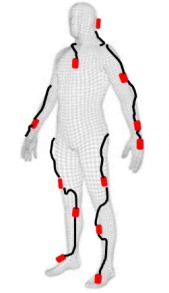
Measurement System To record full body kinematics during the MMotocross ride on the circuit, an Xsens MVN Link system (Movella Inc., Henderson, NV, USA) is used. The utilized setup consists of a Link shirt with designated pockets for the battery and the data logger, as well as cable channels and attachment squares to facilitate placement of the 17 sensors. For the extremities, hook-and-loop fasteners are used for fastening the measurement units and cables to the body. Figure 1 presents a schematic visualizing the sensor locations on the body. A Global Navigation Satellite System (GNSS) antenna is connected and placed in the cable channel on the right shoulder and records at four Hz. IMU data acquisition is done in the On-Body-Recording (OBR) mode that allows data saving in the data logger directly on the rider. OBR enables unlimited range with an update rate of 240 Hz.
Figure 1: Simplified visualization of the IMUs (orange) and the GNSS antenna (blue) on the body. Figure adapted from Shutterstock, 2024.
Test Protocol Two healthy and uninjured male participants took part in the pilot measurement. As regularly competing athletes on international level, the test subjects can be classified as a highly experienced and skilled riders. Two Motocross bikes of the same manufacturer and a displacement of 450 cc, differing in chassis design, were chosen for investigation. They are referred to as V1 and V2 in the following.
Firstly, all necessary anthropometric measurements of the participants’ bodies were taken, so that the biomechanical model in MVN Analyze, the system’s corresponding data acquisition and processing software, is scaled correctly. The sensor system can be put on over the knee guards. The pants and jersey were worn above the applied sensor system. After checking that the mobility of the rider on the motorcycle is not impeded, the calibration can be performed following the recommendations of Movella, which suggests a combination of holding the N-pose and walking in a straight line. To begin
IMU-Based Assessment of Rider Kinematics in Motocross – A Pilot Study 2167
the measurement, the rider was seated on the motorcycle next to the track. The data recording was started on the data logger and the rider entered the track and completed six laps as constant as possible. After coming back, the six laps were completed with the other motorcycle.
Data Processing The recorded data is imported into MVN Analyze from the data logger. The data is subsequently exported for further processing and visualization in MATLAB (MathWorks Inc., Natick, MA, USA). As the objective was to analyze only specific maneuvers, the GPS trajectory with altitude information was used to select data from a specific track section. A corner and a jump were chosen for this investigation, as those require different movement patterns and are among the most important and frequent maneuvers on a track. The center of mass of the rider is calculated relative to the pelvis. As the rider changes the heading over the course of the ride, a heading correction is performed. To do so, the offset in heading between the initial position and each data point is calculated by subtracting the Euler angles derived from Quaternions. Thereby, the effect of the change in riding direction is removed and solely the weight shift relative to the rider facing forward is considered. The expanse of the center of mass (COM) trajectory in the transversal plane as well as the distance covered with respect to the reference frame, are evaluated. For the investigated joint angles, knee and hip flexion were considered within the scope of this pilot study.
RESULTS
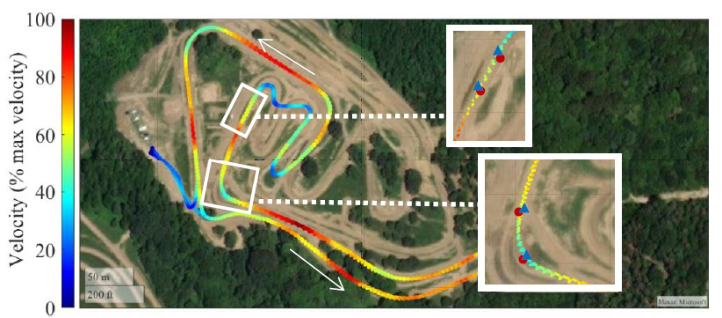
Figure 2 presents the trajectory of the laps completed on the Motocross track, according to the recorded GPS data. The frames mark the regions of interest, a right corner and a jump. On the right, the height profile of part of the track is visualized and shows the elevation in the sections corner and jump.
Figure 2: Visualization of the GPS trajectory with color-coded velocity on the motocross track. The regions of interest, corner and jump, are marked with frames and exemplary key events.
For the first region of interest, a right turn of about 90
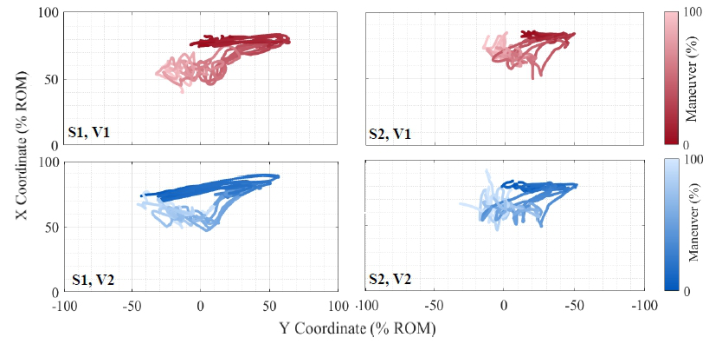
, the center of mass movement in the transversal plane and right knee flexion angles are presented in Figure 3 and Figure 4, respectively, for both test subjects and both motorcycle variants. All values are normalized to the maximum range of motion (ROM) occurring across both riders and vehicles, as well as all laps. At all times, the COM is in front of the pelvis, which is located at the origin of the coordinate system. With the start of the right corner, the COM moves to the right. This is represented by positive y-coordinate values due to the definition of the segment coordinate system. When approaching the apex, the COM moves closer to the pelvis and shifts towards the left during the corner exit. Apart from that overall trend of the COM trajectory, the two subjects show a slightly different pattern. S1 contains the movements within 83.5% and 88.9% of ROM in x direction and 65.2% and 65.5% in y direction for V1 and V2, respectively. S2 covers mostly a smaller area, reaching similar values of around 85.2% of ROM in x direction and 52% in y direction for V1 and V2, respectively. Further, the single laps for S1 follow a more consistent path than those of S2, especially in the first part of the corner, while the trajectory was longer for V2in both subjects. However, for both riders, laps seem more similar for V1 than for V2.
Figure 3: Corner: COM trajectory in the transversal plane. The values are presented as the deviation from the pelvis normalized to the ROM of the COM.
Regarding joint angles, it has to be noted that a joint flexion angle of 0
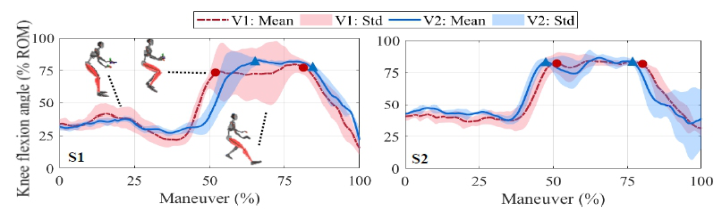
is defined as full extension, and an increasing value is to be interpreted as a higher flexion of the respective joint. Figure 4 shows the knee flexion angle of the right knee during the right turn for S1 (left) and S2 (right). From about 35% of the maneuver, the knee flexion increases, which according to the manikin visualization and video footage is due to sitting down in the apex of the corner. It can be seen that the timing of that differs for the different vehicles. Both riders seem to spend a longer part of the cornering maneuver in seated position with V1. With V2, a clearly more consistent movement sequence across the laps is achieved during especially the approach of the
IMU-Based Assessment of Rider Kinematics in Motocross – A Pilot Study 2169
corner in standing position. For S1 riding V1, a high standard deviation is the result of inconsistent technique around the corner apex, as in some laps the rider extended the leg, which causes substantial deviations in knee flexion angles.
Figure 4: Corner: Right knee flexion angle with markers at the start and end of the sitting phase.
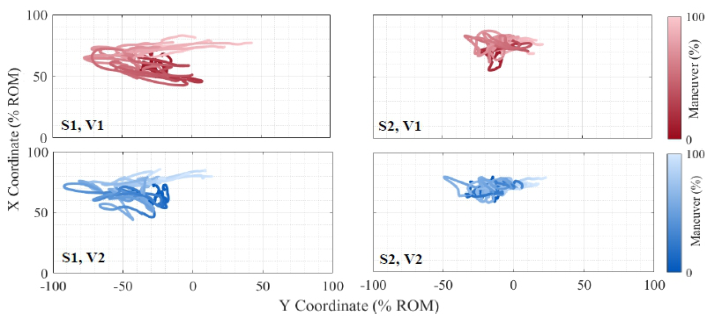
Figure 5 displays the COM trajectory during the jump. For both riders the COM is positioned towards the left. In the aproaching phase of the jump for S1, the COM moves closer towards the pelvis, as the body straightens to prepare for the takeoff. In the air, the COM shifts further away from the body and far to the left, reaching - 77.1% and - 92.1% for V1 and V2, respectively. In the landing phase, the COM moves across the center to the right, 43.4% and 21.5% at the maximum, for V1 and V2, respectively. The data indicates that S2 follows a different jumping technique, featuring a more compact COM behaviour with expansion to the left of only to - 34.2% and - 49.1% of ROM for V1 and V2, respectively. The COM trajectory is clearly shorter and it takes S2 less time to clear the jump. The COM stays further away from the pelvis for S2 with both vehicles, with values over 50% of ROM, in contrast to S1.
Figure 5: Jump: COM trajectory in the transversal plane. The values are presented as the deviation from the pelvis normalized to the ROM of the COM.
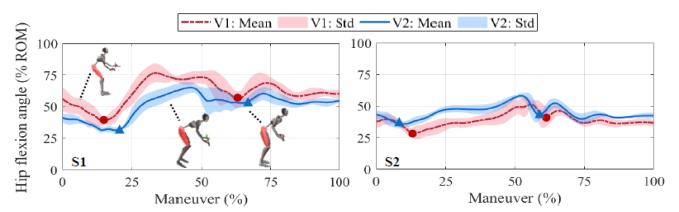
The right hip flexion, as seen in Figure 6, represents how the rider approaches the jump in standing position with a hip flexion of about 55% ROM and 40% ROM for V1 and V2, respectively. For S1, overall higher hip flexion values as well as more pronounced changes in the angles are realized with V1. For S2, the hip flexion is generally lower than in S1, with V2 showing a higher hip flexion, but similar movement pattern with both vehicles. Approaching the take-off of the jump, the hip flexion decreases, representing a straightening of the body. The hip flexion increases during the flight phase as the rider adapts to the shape of the jump. An extension of the hip prepares for the landing, during which a rapid increase in hip flexion represents the shock absorption from the landing. A higher consistency in the movement pattern is visible for V2 according to the slimmer standard deviation. This effect is especially clear for S2.
Figure 6: Corner: Right hip flexion angle with markers at take-off and landing of the jump.
Table 1 summarizes the values of the distance covered by the COM during the corner and jump for the two riders on both motorcycles. For the corner, V2 showed higher mean and standard deviation of the COM trajectory length in both test subjects. For the jump, S1 showed a clearly lower value for V2 than for V1. S1 took more time to perform the maneuvers than S2, while also having a longer COM trajectory. In the corner, longer COM trajectories in V2 also show longer durations. Conversely during the jump, a shorter COM trajectory in V2 is associated with a longer time taken to clear the maneuver in S1, while S2 does not show clear trends.
Table 1. Overview of the distance covered by the COM trajectory and the time taken during corner and jump for S1 and S2 on V1and V2.
Table available in the original PDF paper.
COM Trajectory (cm) Corner Jump V1 V2 V1 V2
S1 Mean 51.8 56.4 52.0 45.8 Std 2.8 3.9 9.6 5.2 S2 Mean 36.6 46.7 33.6 34.7 Std 4.3 4.9 3.3 2.6 Duration (s) S1 Mean 3.5 4.3 3.2 3.5 Std 0.3 0.3 0.2 0.2 S2 Mean 3.7 3.8 3.0 3.0 Std 0.1 0.2 0.2 0.4
IMU-Based Assessment of Rider Kinematics in Motocross – A Pilot Study 2171
DISCUSSION
The presented results show the capabilities and potential of an IMU- measurement system in the field during Motocross riding. Completing several laps on the track has yielded highly reproducible results considering the impossibility to exactly replicate the maneuver due to the irregular conditions of an offroad track. The similarity between runs especially stood out for the jump, which seems to require exact movement patterns and might feature more consistent conditions on that track section, while movement patterns in the corner might not be consistent at all times.
The COM behavior, like its trajectory or the expansion of the area it covers, is a central variable representing the dynamic posture of the rider, as it incorporates all segments of the human body. Therefore, similar trajectories across laps for instance suggest a similar movement pattern during the maneuver. Differences in the COM movement pattern depend on the one hand on track and vehicle characteristics and on the other on anthropometric differences between riders or individual technique. The ROM of the COM represents the space in which the COM moves as a result of posture adaptions. Along with the length of the COM trajectory it can be an indicator for the amount of movement outside of the default posture. If within the same maneuver or track segment the COM travels a longer distance, that could be due to reactions to the terrain to maximize traction or correction of unwanted vehicle orientations. In the presented data during the corner maneuver, V2 showed higher ROM as well as longer trajectory distance, suggesting more movement effort, while also taking more time to complete the maneuver. S2 further shows less reproducibility of the trajectories with both vehicles, which indicates a less refined riding technique compared to S1. For the jump with V2, the COM covers a smaller area with also shorter trajectories, suggesting that this motorcycle design facilitates a more compact and efficient movement pattern of the riders.
The progressions of the joint angles allow for further interpretation of the movements. During the corner, the right knee flexion angle visualizes typical motocross cornering technique, where the rider sits down around the apex of the corner, before standing up again at the corner exit. The decreasing flexion during the sitting phase, especially visible in S2 on V1, represents the extension of the leg while remaining seated and is a typical movement the rider does with the leg facing the inside of the corner. The differentiation of the specific action of standing up, which would also reduce knee flexion, can be done by validating with video footage and the virtual manikin posture. The hip flexion angles during the jumps show great reproducibility across the six laps. This suggests a consistent movement pattern, especially in S2. For both subjects, a higher similarity was achieved with V2, which is in line with the results described for the COM. Clearing an obstacle like a jump requires a certain sequence of movement with less margin for error regarding the timing of the takeoff, compared with a corner entry. Variance could be visible in the length of the jump and different jump executions like jumping straight or whipping to the side. The jump analyzed does not show great variation concerning timing or range of motion which resembles a constant technique
of the rider and the reliability of the measurement system to reproduce well comparable data over several laps.
Ultimately, this work has shown that for specific maneuvers, the rider kinematics can repeatably be recorded and presented to deepen the understanding of riding technique and the influence of external factors like the vehicle characteristics or track conditions. With only two subjects considered, it is not possible to draw universally applicable conclusions with statistical significance. Nevertheless, this first pilot study shows potential trends and connections between the presented variables. To summarize, this pilot study proved the applicability of a full-body IMU-system during highly dynamic Motocross activity and thereby filled a gap in the literature with this novel application. After these first insights into the system’s potential in analyzing rider kinematics, further tests have to be performed to find patterns in the data and draw further conclusions.
OUTLOOK Using those results, deviations from ideal movement patterns can be identified by linking the outcomes with further performance indicators like the velocity or lap times. This could allow for adjustment and improvement of the rider’s technique. Further, vehicle characteristics like chassis stiffness could be correlated to objective postural results in combination with subjective rider feedback to draw conclusions about vehicle and component qualities.
As the IMU system features the possibility to attach additional prop- sensors to record orientation data of the vehicle, a combined model visualizing the kinematics of the rider in relation to the motorcycle is a central goal in the context of rider-vehicle-interaction. As there is currently no established model setting the framework to put the sub-systems rider and vehicle into the correct relation, a methodology for that specific use case will be developed within subsequent research.
REFERENCES
Arunachalam, M., Singh, A. K., Karmakar, S., 2022. Exploring the association of riders’ physical attributes with comfortable riding posture and optimal riding position. Proc. Inst. Mech. Eng. Part J. Automob. Eng. 236, 185–207. https: //doi.org/10.1177/09544070211012553 Arunachalam, M., Singh, A. K., Karmakar, S., 2021. Perceived comfortable posture
and optimum riding position of Indian male motorcyclists for short-duration riding of standard motorcycles. Int. J. Ind. Ergon. 83, 103135. https://doi.org/ 10.1016/j.ergon.2021.103135 Brouwer, N., Yeung, T., Bobbert, M., Besier, T., 2020. 3D trunk orientation measured using inertial measurement units during anatomical and dynamic sports motions. Scand. J. Med. Sci. Sports 31, 358–370. https://doi.org/10.1111/sms.13851 Dorschky, E., Nitschke, M., Seifer, A.-K., van den Bogert, A., Eskofier, B., 2019.
Estimation of Gait Kinematics and Kinetics from Inertial Sensor Data Using Optimal Control of Musculoskeletal Models. J. Biomech. 95. https://doi.org/10. 1016/j.jbiomech.2019.07.022
IMU-Based Assessment of Rider Kinematics in Motocross – A Pilot Study 2173
Genitrini, M., Fritz, J., Stöggl, T., Schwameder, H., 2024. Spatiotemporal parameters and kinematics differ between race stages in trail running—a field study. Front. Sports Act. Living 6. https://doi.org/10.3389/fspor.2024.1406824 Giles, J. R., Ross, C. D., 1996. The physics of motocross. Phys. Teach. 34, 220–222.
https://doi.org/10.1119/1.2344412 Hägg, G., Milerad, E., 1997. Forearm extensor and flexor muscle exertion during simulated gripping work — an electromyographic study. Clin. Biomech. 12, 39–43. https://doi.org/10.1016/S0268-0033(96)00049-6 Höschler, L., Halmich, C., Schranz, C., Fritz, J., Schwameder, H., 2024. Towards
real-time assessment: wearable-based estimation of 3d knee kinetics in running and the influence of preprocessing workflows. Marina, M., Torrado, P., Busquets, A., Ríos, J. G., Angulo-Barroso, R., 2013.
Comparison of an intermittent and continuous forearm muscles fatigue protocol with motorcycle riders and control group. J. Electromyogr. Kinesiol. 23, 84–93. https://doi.org/10.1016/j.jelekin.2012.08.008 Plöchl, M., Edelmann, J., 2014. Driver Models in Automobile Dynamics Application, in: Vehicle System Dynamics: International Journal of Vehicle Mechanics and Mobility ResearchGate, 47. pp. 699–741. Rodrigues, J., Branquinho, L., Forte, P., Valente, N., Sortwell, A., Teixeira, J. E.,
Ferraz, R., 2024. The Effect of Different Motocross Circuit Typologies on Internal Load and External Load Responses in Riders. Int. J. Kinesiol. Sports Sci. 12, 16–23. https://doi.org/10.7575/aiac.ijkss.v.12n.1p.16. Simões, V. R., Crisp, A. H., Verlengia, R., Pellegrinotti, I. L., 2016. Neuromuscular and Blood Lactate Response After a Motocross Training Session in Amateur Riders. Asian J. Sports Med. 7. https://doi.org/10.5812/asjsm.23805 Smeraglia, F., Tamborini, F., Garutti, L., Minini, A., Basso, M. A., Cherubino, M.,
2021. Chronic exertional compartment syndrome of the forearm: a systematic review. EFORT Open Rev. 6, 101–106. https://doi.org/10.1302/2058-5241.6. 200107 Teufl, W., Miezal, M., Taetz, B., Fröhlich, M., Bleser-Taetz, G., 2019. Validity of inertial sensor based 3D joint kinematics of static and dynamic sport and physiotherapy specific movements. PLOS ONE 14, e0213064. https://doi.org/10. 1371/journal.pone.0213064 Thiele, G., Kafka, P., Litzenberger, S., Sabo, A., 2016. On-track Measurements in
Motocross: The Correlation of Neck Muscle Activity and Contact Incidents of Helmet and Neck Brace. Procedia Eng. 147, 613–617. https://doi.org/10.1016/j. proeng.2016.06.254
LISTED IN THE AHFE DIGITAL BOOKSTORE CATALOGUE
Explore the complete digital volume
Human Factors in Design, Engineering, and Computing
Read this individual research paper free through the original publisher, or explore the full digital proceedings book.
ISBN 978-1-964867-35-9
Explore this ISBN in the AHFE Bookstore ↗Listed in the July 2026 bookstore catalogue; search by ISBN to confirm current availability · Digital book purchase optional