Ellen Zhu (2024). Hollywood Regency: American Design Under the Influence of Chinoiserie. In: Human Factors in Design, Engineering, and Computing. AHFE Open Access, vol. 159, pp. 382–389. https://doi.org/10.54941/ahfe1005603
Building on the historical development and design characteristics of Chinoiserie in America, this study examines history as a catalyst for design and investigates how design shapes society and culture. By constructing a historical narrative that links Europe with colonial and post-colonial America from both political and economic perspectives, the research elucidates the profound influence of Chinoiserie on the Hollywood Regency style. Europeans and Americans alike infused Chinoiserie with distinctive, dreamlike qualities, establishing it as a crucial source of inspiration for Hollywood Regency design.
Existing historical studies on Chinoiserie development concentrate on the 17th to 19th centuries, a period during which imported Chinese products were highly coveted by all European social classes. Honour’s (1961) pioneering systematic study of Chinoiserie adopts a purely European perspective, examining how Western artists perceived and depicted the East from the Middle Ages through the 19th century, and positing Chinoiserie as a unique phenomenon in European art history. Chu and Milam (2019) note that while 18th-century Chinoiserie has received considerable scholarly attention, the Chinoiserie of the 19th century has been relatively neglected. Hayman (2021) further elucidates the European fascination with Chinese culture during the 17th to 19th centuries, highlighting how British and other European designers incorporated Far Eastern visual elements to create a fantastical, imagined world.
To meet market demand, European artisans developed a “pseudo- Chinese style” known as Chinoiserie. As this trend declined in Europe, so did academic interest, resulting in limited attention to post-18th-century developments, particularly the American Chinoiserie that emerged in the 20th century. This study uses the Hollywood Regency style as a case study to explore the development and influence of American Chinoiserie.
Westward Spread of Eastern Culture and Demand for Chinese Goods In the 16th century, the flourishing Eastern trade introduced European nobility to Eastern arts and crafts, sparking elaborate fantasies about the East
Hollywood Regency: American Design Under the Influence of Chinoiserie 383
Asian continent. To satisfy the massive market demand, European artisans began producing imitation goods, giving rise to the Chinoiserie style. Chinese porcelain, lacquer, silk, and other designs had a profound influence on the West.
The term “Chinoiserie” first appeared in Balzac’s novel L’Interdiction (1836), referring to Chinese-style handicrafts. According to the Oxford English Dictionary, it describes a decorative style especially popular in 18th-century Western art, furniture, and architecture, characterized by the use of Chinese patterns and artisanship. The Encyclopedia Britannica and Collins English-Chinese Double Explanation Dictionary define Chinoiserie as: (1) a decorative style that gained popularity in Europe in the 17th century, based on European designers’ and craftspeople’s imaginative interpretation of Chinese elements; and (2) the influence of Chinese imported furniture, porcelain, knitwear, etc., primarily reflected in decorative art design.
Chinoiserie spread widely in European and American visual culture from the 17th century onward. In the 18th century, European colonists brought Chinoiserie goods to North America, integrating the style into colonial American culture.
Chinoiserie’s Development in America Chinoiserie’s development in America can be divided into two periods, separated by the War of Independence.
Before the War of Independence: Europeans introduced Chinoiserie fashion to North America, highlighting its importance in European art. Driven by mercantilism, Britain monopolized colonial trade, requiring all Chinoiserie goods from Europe to pass through England before being imported. These goods, considered expensive luxury items, were popular among the wealthy upper classes and formed the aesthetic foundation of early American Chinoiserie style.
In the 1760s, puritanical rhetoric demonized desire and consumption. Authorities equated the purchase of Chinese porcelain with a wasteful loss of scarce colonial capital (Frank 2012, 164). Colonial Americans, aware of their constraints in international trade (Frank 2012, 199), gradually recognized the exploitative nature of European trade aggression. They believed that without control over trade, they risked becoming British pawns, which fueled a growing sentiment for independence.
After the War of Independence: Americans sought to distinguish their culture from European influences. New characteristics gradually emerged in American art and design, combining Chinoiserie with distinctly American concepts, thoughts, and aesthetics to create a unique style.
Beginning of Sino-US Trade The Declaration of Independence ended British trade restrictions, enabling American ships to sail into the Indian Ocean. Between 1784 and 1814, the number of American ships entering Canton and Macau increased by nearly a third (Mazumdar 2010). As trade and cultural exchanges between the US
384 Zhu
and China grew, Americans gained exposure to a more authentic China and its culture. Although Europe-US trade continued post-war, American consumers stopped purchasing Chinoiserie goods from the UK, viewing them instead as the latest fashionable products. Chinoiserie evolved into a symbol of American independence and was embraced as an expression of American identity.
Rise of the Hollywood Regency Style In the 1920s, the US experienced the Art Deco movement, accompanied by a cultural boom in dramas, musicals, and jazz. The Hollywood film industry also entered a golden age. While Art Deco initially targeted the upper class, it was adapted to meet the needs of ordinary Americans. The US, enriched by arms sales during World War I, saw a new middle class enjoying prosperity, and Art Deco satisfied their desire for artistic design. This prosperity, however, was soon threatened by the Great Depression. Art Deco’s glamorous and luxurious designs in movies offered a temporary escape, leading to the development of the Hollywood Regency style, which should be recognized in the history of international design (Osbaldeston 2009, 63). Chinoiserie’s exotic allure, which had long inspired European imagination, perfectly matched the public’s desire to escape reality and create dreamlike homes. As a key source of inspiration, Chinoiserie significantly influenced Hollywood Regency design.
The term “Hollywood Regency” should not be taken literally. While it implies a connection to British Regency style, the similarities are limited. “Regency” in this context resonates with the British Regency period’s post- war luxury pursuit, akin to the US’s situation during Hollywood Regency’s emergence. Thus, Hollywood Regency describes a style rather than a revival of Victorian 18th-century English art and design.
William Haines (1900–1973), a former actor turned interior designer, is credited with pioneering Hollywood Regency style, blending Chinoiserie with Art Deco (Wallace 2008, 395). His clients included film celebrities like Joan Crawford (Mann 1998), and his designs often featured Chinoiserie custom lamps and lampshades (Schifando and Mathison 2005, 193).
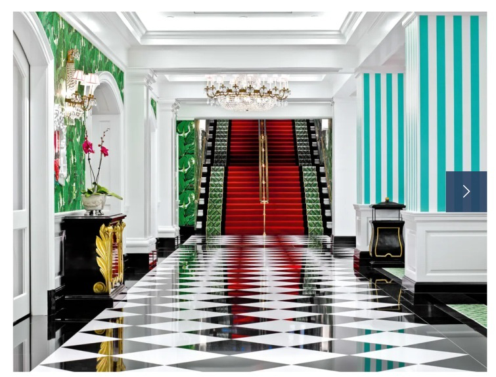
Similarly, Dorothy Draper (1889–1969) used Hollywood Regency’s glamour to create dramatic interiors. In 1923, Draper founded Dorothy Draper & Company, the first specialized interior design firm in America. She revolutionized hotel interiors in the early 1930s, playing a crucial role in Hollywood Regency’s evolution. Draper emphasized the importance of coordination in design, stating, “But color and design coordination does not stop with paint, paper, fabrics, and carpet. It extends into china, glass, table linen, silver...” (Draper 1948, 13). Her mention of china highlights the significance of Chinese design elements in American design.
Driven by designers like Haines and Draper, Hollywood Regency style became widespread in upper and middle-class American architecture and interiors of the 20th century.
Hollywood Regency: American Design Under the Influence of Chinoiserie 385
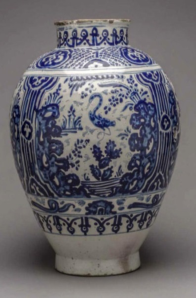
Common Chinoiserie Design Elements in the Hollywood Regency Style Porcelain The arrival of Chinoiserie porcelain in North America was significant. An example of its influence is the pottery tradition of Puebla in Southeastern Mexico, which thrived on the import of Chinese blue and white porcelain. Local artisans, unable to access fine porcelain materials, used a white tin glaze and expensive cobalt blue paint to create talavera poblana ceramics. These adopted the shapes of Chinese porcelain but featured local elements, such as a crane standing on a cactus, symbolizing both the Aztec Empire and emerging Asian trade routes (McQuade 1999).
Figure 1: Crane standing on a cactus, Ming-style blue and white pot, produced in Mexico, 18th century. (Photo: Hispanic Society of America, Museum Acquisition Fund, 2008).
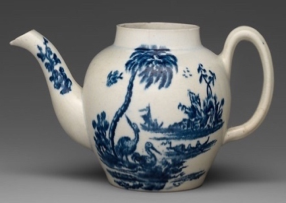
John Bartlam opened the first US porcelain factory in the 18th century, using local clay and palm trees for Chinoiserie porcelain with American characteristics. The American China Manufactory (1770–1772), founded by Gousse Bonnin and George Anthony Morris, also significantly impacted American design by using local motifs like shells and sea creatures in their Chinoiserie designs (South 1993).
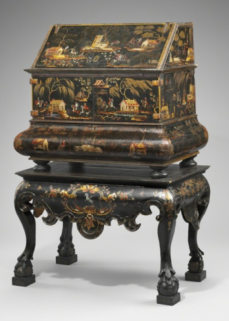
Lacquerware Chinese lacquerware, popular in Europe during the Ming and Qing Dynasties, was used on furniture with dark tones, primarily red and black, featuring painted or gold-thread decorations (Yan 2008). José Manuel de la Cerda’s North American studio produced lacquerware with a visible Eastern influence, such as pieces with painted Chinese-style buildings and golden weeping willows.
James Mont, a Hollywood Regency designer, embraced his “Oriental” heritage, incorporating Chinoiserie designs into his work. Mont’s designs were described as “a stylish uptown fusion of Eastern silhouettes and Western modernism” (New York Times, April 4, 1996). He used lacquer techniques to create exotic designs, often adopting the classic black, red, and gold colors of Chinese lacquerware, resulting in elegant and avant-garde pieces.
Willy Rizzo, involved in interior and furniture design since the 1960s, created a round brass storage object in a yin-yang shape, reflecting Chinoiserie lacquer elements with black and gold thread.
Figure 4: Brass lacquer cocktail table by Willy Rizzo, 1970. (Photo: Fears and Kahn).
Hollywood Regency: American Design Under the Influence of Chinoiserie 387
Wallpaper Chinoiserie wallpaper, developed to cater to European aristocrats, featured hand-painted, embroidered, and patterned designs with floral, bird, and landscape motifs. These wallpapers significantly impacted European design, embodying luxurious lifestyles (Needham and Tsuen-Hsuin 1985). Early North American wallpapers copied European fashions until 1739, when Plunket Fleeson began producing wallpaper in Philadelphia, reducing American reliance on imports (Waring 1968).
In 1935, Dorothy Draper designed the iconic Brazilliance wallpaper for the Arrowhead Springs Hotel, featuring Brazilian prints in the Hollywood Regency style. Seven years later, Lucile Chatain created the famous Martinique banana leaf print, used by Hollywood decorator Don Loper for the Beverly Hills Hotel’s renovation, becoming an iconic design element.
Hollywood Regency wallpapers often had nature-related themes, incorporating plants common in the US, such as banana leaves and palm trees, infusing local characteristics into Chinoiserie designs.
CONCLUSION
Hollywood, synonymous with glamor and luxury, reflects this sense of opulence in its designs. The Hollywood Regency style, influenced by various designers, embodied a sensual and fantastical aesthetic, integrating new ideas such as Chinoiserie. This style mirrors Hollywood’s golden age and the aesthetic sensibilities of modern society.
American Chinoiserie is a continuation of the 17th-century European Chinoiserie, rooted in European aesthetics. For most Europeans, the exotic and mysterious appeal of Chinese art overshadowed its cultural authenticity, leading to a “pseudo-Chinese” commodity that catered to European tastes.
388 Zhu
This adaptation often resulted in a loss of the original Chinese cultural identity in the context of long-distance trade and commercialization.
However, unlike its European counterpart, American Chinoiserie combined local raw materials with specifically American plants, flowers, birds, and more. The designs featured black lacquer and gold, hand-painted patterns, forms blending Chinese and Western motifs, and even Buddhist and Taoist elements. These poetic designs, rich in references to traditional Chinese culture, inspired Hollywood Regency designers and offered an escape from reality during and after the two world wars and the Great Depression. Design historian Donald Albrecht described Mont’s work as “a form of escapism,” capturing the zeitgeist of the time.
Thus, Hollywood Regency style can be seen as a perceptual, fantasy- oriented design. With the evolution of politics and trade, Americans gained a deeper understanding of Chinese culture, moving beyond superficial imitations. Chinoiserie in America became a more profound fusion, combining authentic Chinese influences with American characteristics.
REFERENCES
Chu, Petra Ten-Doesschate, and Jennifer Milam, eds. (2019). Beyond Chinoiserie: Artistic Exchange between China and the West during the Late Qing Dynasty (1796–1911). Boston: Brill. Dragonette Ltd. (2021a). “Armature Lamp with Asian Figures Designed by William
Haines.” Accessed 20 November 2021. https://www.incollect.com/listings/furnitu re/lighting/william-billy-haines-armature-lamp-with-asian-figures-designed-by- william-haines-159094 Dragonette Ltd. (2021b). “Custom Table Lamp by William Haines.” Accessed 20 November 2021. https://www.incollect.com/listings/furniture/lighting/william-bi lly-haines-custom-table-lamp-by-william-haines-159089 Draper, Dorothy. (1948). “Interior Design.” Travel USA Bulletin, 1. Frank, Caroline. (2012). Objectifying China, Imagining America: Chinese Commodities in Early America. Chicago: University of Chicago Press. Hayman, Richard. (2021). Chinoiserie. New York: Bloomsbury Publishing. Honour, Hugh. (1961). The Vision of Cathay. London: John Murray. Mann, William J. (1998). Wisecracker: The Life and Times of William Haines,
Hollywood’s First Openly Gay Star. New York: Viking Press. Mazumdar, Sucheta. (2010). “Slaves, Textiles, and Opium: The Other Half of the Triangular Trade.” Paper presented at the Asia-Pacific in the Making of the Americas symposium at the John Nicholas Brown Center, Providence, September 27–28. McQuade, Margaret Connors. (1999). Talavera Poblana: Four Centuries of a
Mexican Ceramic Tradition. New York: The Americas Society. Metropolitan Museum of Art. (2021a). “Pickle Stand.” Accessed 10 December 2021.
https://www.metmuseum.org/art/collection/search/13370 Metropolitan Museum of Art. (2021b). “Teapot.” Accessed 10 December 2021.
https://www.metmuseum.org/art/collection/search/777786 Needham, Joseph, and Tsien Tsuen-Hsuin. (1985). Science and Civilisation in China: Volume 5, Chemistry and Chemical Technology, Part 1, Paper and Printing. Cambridge: Cambridge University Press.
Hollywood Regency: American Design Under the Influence of Chinoiserie 389
Osbaldeston, Peter. (2009). The Palm Springs Diner’s Bible: A Restaurant Guide for Palm Springs, Cathedral City, Rancho Mirage, Palm Desert, Indian Wells, la Quinta, Bermuda Dunes, Indio, and Desert Hot Springs. New Orleans: Pelican Publishing. Schifando, Peter, and Jean H. Mathison. (2005). Class Act: William Haines,
Legendary Hollywood Decorator. New York: Pointed Leaf Press. South, Stanley. (1993). “The Search for John Bartlam at Cain Hoy: American’s First Creamware Potter.” South Carolina Institute of Archaeology and Anthropology Research Manuscript Series, 219. Columbia: University of South Carolina. Turkel, Stanley. (2020). Great American Hotel Architects Volume 2. Indiana:
AuthorHouse. Wallace, Lee. (2008). “Dorothy Arzner’s Wife: Heterosexual Sets, Homosexual Scenes.” Screen, 49 (4): 391–409. Waring, Janet. (1968). Early American Stencils on Walls and Furniture. New York:
Dover Publications. Yan, Yan. (2008). “On the Influence of Chinoiserie on The Rococo Era in Europe.”
Meiyuan, 6: 93–94.
LISTED IN THE AHFE DIGITAL BOOKSTORE CATALOGUE
Explore the complete digital volume
Human Factors in Design, Engineering, and Computing
Read this individual research paper free through the original publisher, or explore the full digital proceedings book.
ISBN 978-1-964867-35-9
Explore this ISBN in the AHFE Bookstore ↗Listed in the July 2026 bookstore catalogue; search by ISBN to confirm current availability · Digital book purchase optional