Alexander Kreis, Mario Hirz, Christoph Stocker (2024). Harmonizing User-Centered Design and Operational Efficiency in Battery Electric Vehicles: Navigating the Electric Dilemma for Sustainable Mobility. In: Human Factors in Design, Engineering, and Computing. AHFE Open Access, vol. 159, pp. 536–546. https://doi.org/10.54941/ahfe1005620
As battery electric vehicles (BEVs) become more prevalent in the automotive industry, the interplay between user-centered design and usability takes center stage. This study addresses the complex dynamics of this paradigm and sheds light on the intricate trade-offs between user satisfaction and functional effectiveness to determine the optimal balance for a satisfying and sustainable user experience (UX). Therefore, an innovative approach is presented that enables optimized energy management, thereby increasing comfort and improving the UX. As technological innovations drive the capabilities of BEVs, the confluence of user expectations and operational efficiency presents a fundamental challenge. The pursuit of greater range combined with seamless usability underscores the need for a holistic human-centered design approach. In addition, the growing number of user-centric features (e.g., comfort features) introduces a new dimension to the equation, reinforcing the importance of human-centered design principles. Against this backdrop, external factors such as environmental conditions and user behavior exert a profound influence on the performance and usability of BEVs. The intricate interplay of these variables requires a nuanced understanding of user preferences and technological advances to strike a delicate balance. In response to these challenges, this research proposes an innovative framework to improve the UX of BEVs while maximizing energy efficiency in different operating scenarios and optimizing comfort features. By leveraging insights from user-centered design principles and advanced energy management strategies, this framework aims to optimize the driving experience while minimizing energy consumption. The electric dilemma highlighted in this study - increasing energy efficiency and driving range on the one hand and increasing comfort, optimized UX and human-center design on the other - which is particularly relevant for BEVs, illustrates the complicated interplay between user satisfaction and efficiency. Achieving a harmonious balance requires a multi-faceted approach that integrates user insights, technological advances and environmental considerations. The results emerging from the research offer actionable insights to guide the development of BEVs and provide manufacturers with a roadmap to tackle the electric dilemma and deliver UX that seamlessly combine comfort and efficiency. By embracing a human-centered design ethos, vehicle manufacturers can cultivate a symbiotic relationship between user satisfaction and efficiency, promoting a sustainable future for BEVs.
Harmonizing User-Centered Design and Operational Efficiency 537
INTRODUCTION AND MOTIVATION Due to a variety of influencing factors, including environmental aspects, political regulations and strengthened emission limits for newly registered vehicles, original equipment manufacturers (OEMs) and automotive suppliers are not only shifting their focus to the further advance of combustion engines, but are also placing greater emphasis on the development of hybrid and battery electric vehicles (BEVs). Especially in defined target markets such as the European Union, China and selected states in the USA, BEVs are expected to account for the majority of new vehicle registrations (European Union, 2022; Scott et al., 2023). This development leads to a growing relevance of BEVs in the automotive product landscape. In comparison between traditional internal combustion engine-driven vehicles (ICEVs) and BEVs, the latter have a number of advantages, including lower local emissions, lower operating costs and higher energy efficiency (Lebeau et al., 2013; Ntombela et al., 2023). However, there are also some challenges to consider, such as the persistent problem of limited driving range per charging process because of limited energy storage capabilities of batteries, which affect the mobility of BEVs and thus the UX (Lebeau et al., 2013; Ntombela et al., 2023). In addition, higher energy consumption values of up to 40% (Donkers et al., 2020) must be taken into account with changing external influences such as low temperatures. The limited availability of charging infrastructure poses a further dilemma, particularly for longer journeys (Bardo-Bosch et al., 2021), which in turn has a negative impact on the UX. In recent decades, considerable development work has been carried out in the areas of powertrain efficiency, reduction of vehicle weight, optimization of aerodynamics and material development. As a result, traditional ICEVs have become more efficient and environmentally friendly, paving the way for the widespread adoption of BEVs. These advancements have not only enhanced the performance of ICEVs but have also contributed to a significant shift in the automotive industry towards sustainable and greener technologies. In addition, comfort features and convenience have become a relevant factor for achieving customer satisfaction, resulting in a wide range of comfort-related systems in modern cars. However, the situation is different for BEVs. Due to limited energy storage capability and increased vehicle weight because of relatively heavy battery systems, which increases driving resistances, the driving range of BEVs is considerably lower than that of ICEVs. In this context, both improving battery technology and energy efficiency plays an essential role in the optimization of BEVs. Optimization measures can take different forms, from improved energy storage densities of batteries and optimized lightweight vehicle structures to faster and more efficient charging cycles. However, there is also a need to improve the energy efficiency of comfort functions to ensure efficient energy management and optimize the driving experience and UX. In this context, the aim of this work is to introduce an innovative approach supporting BEV energy management, taking into account the parameters of energy efficiency and comfort.
STATE-OF-THE-ART In order to delineate an innovative approach supporting smart energy management focusing on comfort features and tailored for the needs of BEVs, it is imperative to conduct a comprehensive analysis of two crucial parameters: (1) The actual landscape of electric energy consumers, including auxiliary consumers, considering the share of energy consumption, which have an influence on the driving range and (2) the spectrum of comfort features available in modern BEVs.
Landscape of Energy Consumers in BEVs With regard to driving range calculations in vehicles, OEMs refer to different algorithms. Basically, there are two main approaches to predict the remaining range of electric vehicles: static and dynamic (Dedek et al., 2019; Bi et al., 2019; Grunditz and Thiringer, 2016). Static range calculation is a basic approach that relies on fixed parameters and assumptions, often considering the vehicle’s average energy consumption based on historical or standardized driving cycles. It considers factors such as the current energy content of the battery and the average energy consumption in order to estimate the remaining range. While static calculations are straightforward and less computationally intensive, they provide a baseline estimate of remaining range but may not incorporate dynamic changes of driving conditions and energy consumption. Dynamic range calculation is a more sophisticated approach that adapts to real-time driving conditions. It continuously updates its predictions based on current energy consumption, driving patterns, and environmental factors. Variables such as speed, acceleration, deceleration, temperature, and topography are considered to provide a more accurate and adaptive estimation of driving range. In this way, dynamic calculations deliver a more accurate and responsive prediction of remaining range, taking into account variations of driving behavior and external conditions. For example, Tesla used static calculation approaches in previous vehicle models (Grubwinkler et al., 2014), while new models use dynamic calculations considering many influencing parameters to estimate the remaining range. In the meantime, a number of factors such as wind, ambient temperature, heating, ventilation and air conditioning (HVAC), battery pre-conditioning and others are integrated into the prediction model. However, almost all algorithms have one thing in common: They neglect smaller influencing factors, such as auxiliary consumers, predicted temperature changes during the day (e.g., on long trips), as well as changing payload and cargo weight. The general energy consumption and driving range calculation of BEVs depends on (1) battery and powertrain and (2) auxiliary consumers and comfort features. The consideration of battery and powertrain mainly comprises parameters relevant to the driving process. These account for a large proportion - about 70–80% (Abdul-Hak et al., 2011; Schueppel et al., 2017) - of energy consumption. There are several external factors to be considered (e.g., route selection, topography, climbing resistance when driving uphill, road conditions, wind influences, temperature influences, weather conditions), human driving behavior (e.g., acceleration and braking behavior, anticipatory driving, the choice of vehicle speed, specific charging
Harmonizing User-Centered Design and Operational Efficiency 539
behavior), traffic volume (e.g., accidents, construction zones, traffic jams), etc. Each of these elements directly affects the energy consumption and overall efficiency of the vehicle and is critical in determining and optimizing the range of BEVs. Furthermore, other driver-specific factors that are not directly related to driving style also have an effect on energy consumption. In addition, various aspects such as battery ageing, thermal losses, inefficiencies during charging and discharging and power management can have a significant impact on the range of BEVs. On the other hand, auxiliary consumers play a crucial role in supporting various functions. In this way, auxiliary consumers are responsible for about 20–30% of energy consumption (Abdul-Hak et al., 2011; Schueppel et al., 2017). They can be broken down into the following factors: (1) Thermal management, (2) Safety systems, and (3) Comfort features.
Auxiliary consumers can affect the range of BEVs in different ways by their additional energy demand. Relevant share of energy is demanded by air conditioning and heating systems (thermal management). Comfort features such as but not limited to convenient functions and infotainment systems also play a decisive role. Furthermore, other driver-specific factors that are not directly related to driving style have an effect on energy consumption. These include for example adjustment of windows, sunroof, installation of additional rack systems and trailer operation. Table 1 provides an overview of thermal management-related and safety system-related auxiliary consumers in modern BEVs, including their impact on total energy consumption. In an averaged BEV, these auxiliary consumers can have a share of about 20–30% of the total energy consumption.
Comfort Features in BEVs The assessment of available comfort features in BEVs necessitates an in- depth investigation into the range and sophistication of features contributing to the occupants’ convenience and overall driving experience and UX (Kreis et al., 2023). This includes but is not limited to climate control systems, entertainment and connectivity features, adaptive cruise control, autonomous driving capabilities, and other amenities that enhance the comfort and convenience levels for the occupants.
Table 2 provides an overview of comfort-related features in modern BEVs, including their share of total energy consumption. The automotive industry has witnessed a remarkable evolution with a notable surge in the integration of advanced comfort features within vehicles. This trend is driven by a growing emphasis on enhancing the overall driving experience and meeting the evolving expectations of consumers. Modern vehicles now boast an increasing number of comfort features designed to cater to various aspects of the driver and passengers’ well-being. These features span a wide spectrum, ranging from traditional amenities to cutting-edge technologies. The rise of BEVs and the transition to autonomous driving have further fueled the incorporation of comfort features, as manufacturers seek to differentiate their offerings in a competitive market. As consumers increasingly prioritize comfort and convenience, the integration of these advanced features is
Table 1. Overview of thermal management- and safety system-related auxiliary consumers in modern BEVs, referred to (Tober, 2016).
Table available in the original PDF paper.
Auxiliary Consumers Thermal Management System Share of Total Energy Consumption
Cooling Passenger cabin air conditioning, blowers, battery cooling 11–14% Heating Passenger cabin heater, interior blower, battery heating 4–9% Safety Systems in total 4–5%
Light and vision systems
Night vision assistant, automotive night vision, daytime running light, parking light, beams, brake light, tail light and rear fog light, fog lights, indicators, interior lighting, door frame lighting, adaptive light assistants, etc. Brake assistance Automatic emergency braking systems, forward collision warning, emergency braking system, multi-collision brake, automatic emergency braking for pedestrians, front and rear pedestrian detection system Collision warning Forward collision warning and avoidance system, collision detection warning (pedestrian/bike) Driving dynamics ABS, ESP, hill start assist, acceleration assistant Parking systems Parking aids, reversing assistant Lane change assistance
Lane keep assist, lane departure warning, emergency lane keep assist Vehicle guidance support Cruise control Adaptive Cruise Control (ACC), intelligent speed adaptation, speed limiter, intelligent speed assistant Turning assistance Cross-traffic warning, junction warning (braking), turn assist, left turn assist, blind spot assist Driver monitoring Drowsy driver warning, driver fatigue warning, driver downness detection, driver monitoring system, emergency driver assistant, health monitoring system, etc. eCall Post-collision Information systems Optical surface contamination, tire pressure monitoring system, surround view camera, traffic light recognition, traffic sign recognition Traffic jam assistant Automatic support for lane keeping Evasion Evasion assistant Windscreen wiper Front and rear windscreen wiper, windscreen washer, washer nozzle heating, automatic windscreen wiper
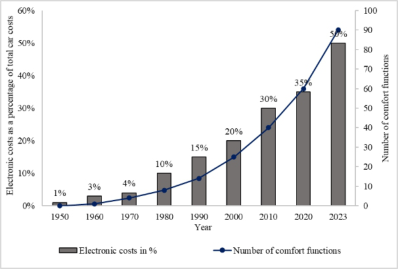
expected to continue, influencing the future landscape of automotive design and technology. Figure 1 shows the increase in costs of electronic components and electronic control units (ECUs) in relation to total vehicle costs from 1970 to 2030. It is clearly visible that the costs have increased significantly, especially since the last three decades. This rise of value creation of electronic components is due to an increase of automotive electronics systems functions, which includes a significant share of comfort-related features. In the period from 1970 to 2000, the number of comfort features in cars increased slowly, with mainly low-energy consumption functions being integrated, such as electronic stability program (ESP), anti-lock braking system (ABS), cruise control, etc. In the last three decades, however, there has been a dramatic increase in comfort features, leading to an increase of energy consumption.
Harmonizing User-Centered Design and Operational Efficiency 541
Table 2. Overview of comfort-related auxiliary consumers in modern BEVs (Tober, 2016).
Table available in the original PDF paper.
Auxiliary Consumers Share of Total Energy Consumption Comfort Features 1–2%
Convenient functions
Heated windscreens and rear windows, seat heating, massage seats, seat cooling, exterior mirror heating, sunroof motor, electric windows and central locking, seat and steering wheel adjustment, tailgate opening, folding exterior mirrors, adjustable exterior mirrors, heated steering wheel, steering wheel cooling, multifunction steering wheel, door handle flaps, electric fuel filler cap, automatic dimming interior mirror, automatic darkening interior mirror, electric power steering motor, etc. Infotainment Display (depending on size and resolution), head-up display, radio, navigation, USB connection Extra features
Electric power supply for trailer, fold-out trailer coupling, active chassis, steering, coolant pump, DC/DC converter
This trend is resulting in a transformation of the vehicle interior from traditional functions such as safety systems to a comprehensive range of amenities. These include infotainment, complex climate control, adaptive driver assistance systems, intelligent lighting and other advanced features. While previous decades were characterized by the integration of basic safety features, recent developments have led to vehicles becoming increasingly high-tech, comfortable and connected.
Figure 1: Automotive electronics cost as a percentage of total car costs and number of comfort features in cars from 1970 to 2030, referred to (Placek, 2019).
However, this paradigm shift in vehicle development has also brought with it a challenge in the form of increased energy demand, which requires a balanced optimization between comfort and energy efficiency. In a nutshell, it can be stated that due to the accelerated integration of new comfort features, the proportion of energy consumption, caused by comfort functions, in
relation to the total energy consumption of the vehicle, will increase. To counteract these effects, it is necessary to implement a suitable smart energy management for BEVs.
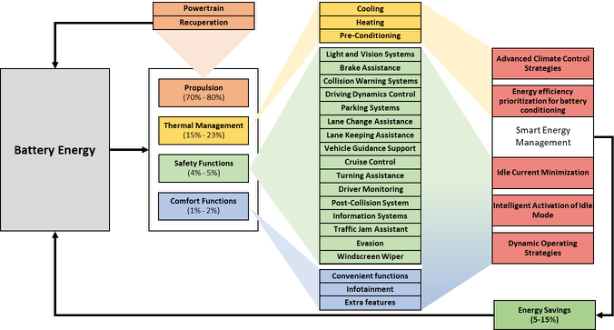
INNOVATIVE APPROACH OF A USER-CENTERED ENERGY MANAGEMENT FOR BEVS The core objective of this paper is to detail the critical supporting factors necessary for user-centered energy management, specifically tailored to BEVs. These factors are essential to evaluate how various elements influence UX, particularly given the continuously increasing number of comfort features. The overarching goal is to meet the evolving requirements for energy-efficient driving from the user’s perspective. It is crucial to consider the specific needs of BEV users to develop customized solutions that enhance their driving experience. Identifying and analyzing these supporting factors will help design an optimal smart energy management that not only satisfies the increasing comfort demands but also maximizes energy efficiency in a way that aligns with user expectations. The main components of this user-centered energy management approach are described in the following sections. Figure 2 illustrates the overall concept, showing main energy consumers (e.g., propulsion system, thermal management, safety systems, comfort systems) and how these systems impact UX.
Figure 2: Smart energy management displays auxiliary energy consumers, categorizing influencing components by system, and illustrates potential savings.
Advanced Climate Control Strategies Since the HVAC system is one of the largest auxiliary energy consumers in BEVs, up to 30% (Broglia et al., 2012; Ganesan et al., 2018), the introduction of intelligent climate system control strategies is crucial for user- centered innovative energy management. By focusing on user comfort and convenience, strategies such as targeted shutdown of unoccupied zones in the vehicle, proactive HVAC control with pre-heating sequences, and defined
Harmonizing User-Centered Design and Operational Efficiency 543
shutdown before reaching the driving destination can achieve significant energy savings of approximately 5% to 10%, depending on ambient temperature, humidity, cabin occupation, etc., without compromising user comfort. Additionally, the air conditioning system can be automatically turned off a certain time before reaching the destination while keeping the air fan active. This not only contributes directly to energy savings but also addresses user concerns such as drying out condensation on the evaporator, reducing the potential for bacteria and unpleasant smells, and promoting a healthier and more comfortable vehicle environment for the user.
Dynamic Operating Strategies This feature focuses on the dynamic management of ECUs, sensors, and auxiliaries with the primary goal of minimizing energy consumption under different driving conditions, all while prioritizing UX. Using adaptive algorithms, the system ensures maximum efficiency by selectively activating or deactivating energy consumers in the electronic network in real time, promptly responding to the immediate needs of the user. This is realized by tracking the activity of specific comfort systems. For example, when ECUs, sensors, and auxiliary components are not actively engaged (e.g., ACC off), the corresponding sensors and subsystems are strategically disabled to help reduce energy consumption. Activation of these components is triggered by the specific driving situation or user demand, such as when the driver requests infotainment displays, the navigation system, or adaptive cruise control. This smart control strategy not only optimizes energy use but also enhances the overall UX, aligning with the paradigm of smart and user-centric, energy-conscious vehicle operation.
Idle Current Minimization Effective management of idle power losses is a key component of user- centered energy management in BEVs. Implementing advanced idle current minimization techniques is essential to mitigate unnecessary energy drain during periods of inactivity, enhancing the UX by ensuring the vehicle remains energy-efficient even when stationary. This strategic approach optimizes energy efficiency and contributes to extended battery life, directly benefiting the user. Monitoring of user input and vehicle activity by measuring the control inputs, current and voltage of relevant systems enables proactive management of idle power losses. By addressing idle power losses, the system demonstrates a commitment to sustainable energy management, aligning with the broader goals of improving overall vehicle efficiency and promoting environmentally responsible driving practices. Energy-efficient system operation includes various user-focused measures, for example: (1) sleep mode temporarily reduces the power consumption of non-essential control systems to conserve energy during idle periods, benefiting users by extending battery life, (2) utilizing a selective wake-up mode to activate specific systems only when necessary, ensuring systems critical to immediate vehicle operation remain in a low-power state and quickly wake up when needed, reducing overall idle current and improving user convenience, (3) the
battery management system (BMS) can intelligently disconnect non-essential circuits, reducing standby power consumption and extending overall battery life, enhancing user satisfaction, (4) intelligent power control to peripherals and auxiliary systems manages non-essential devices, such as entertainment systems or interior lighting, which can be intelligently shut down or placed in a low-power state to reduce idle power without compromising essential functions, thus maintaining user comfort.
Intelligent Activation of Idle Mode and Dynamic Operation An innovative feature of the conceptual framework includes the intelligent activation of idle mode for auxiliary consumers during periods of inactivity, enhancing the UX by optimizing energy use. By detecting idle states in auxiliary consumers, the system intelligently transitions them to an energy- efficient sleep mode. This is done by measuring power consumption of relevant auxiliary systems and monitoring user interactions. The individual subsystems (Idle Mode and Dynamic Operation) are controlled by context- based prioritization and depend on vehicle states as well as driving and operation situations. Dynamic operating strategies are activated when the vehicle is in motion. Idle current minimization techniques are used during periods of inactivity. This proactive approach is designed to minimize energy consumption when these auxiliary components are not actively participating in vehicle functions, directly benefiting users by conserving battery life. The impact of this feature is profound, contributing significantly to the overall energy savings of BEVs. Additionally, by reducing unnecessary heat and wear during inactive periods, the implementation of this intelligent idle mode has the potential to significantly extend the operational life of auxiliary components, which improves the overall sustainability and efficiency of BEVs in the long term, providing users with a more reliable driving experience.
Energy Efficiency Prioritization for Battery Conditioning Battery conditioning, typically used to keep batteries in an optimal temperature range and to optimize charge and discharge performance, can be adjusted based on user preferences in energy conservation situations. If the focus is on energy efficiency and users can accommodate longer charge times, it is a reasonable strategy to dispense with battery conditioning. This user-centered decision not only underscores the quest for energy efficiency but also has the potential to reduce battery stress and extend battery life. This nuanced approach offers a customized compromise that balances the benefits of energy savings with an acceptable extension of charging times, enhancing the overall UX by providing flexibility and promoting battery longevity.
CONCLUSION
The integration of advanced comfort functions in BEVs increases energy consumption. To address this and promote energy-efficient driving, a user-centered smart energy management is essential. This paper presents an innovative approach focusing on key factors to meet evolving user requirements for energy efficiency amid the proliferation of comfort features.
Harmonizing User-Centered Design and Operational Efficiency 545
Key components include advanced climate control, dynamic operating strategies, idle power minimization, intelligent idle mode activation, and prioritization of battery conditioning, aiming for energy savings of 5% to 15%. User-focused measures like targeted shutdown of unoccupied areas, proactive HVAC control, dynamic management of control units and sensors, and intelligent idle mode activation achieve significant energy savings without sacrificing comfort. Techniques like sleep mode, selective wake-up mechanisms, and intelligent power control underline the commitment to sustainability and energy-efficient operation. This smart energy management approach provides a comprehensive solution to the challenges of increasing comfort features in BEVs. By incorporating these strategies, energy consumption is minimized, the lifespan of auxiliary components extended, and battery efficiency improved, contributing to a more sustainable and user- friendly driving experience. Ongoing development and integration of comfort features require continued refinement of smart energy management to keep pace with technological advances, shaping the future of BEV sustainability and user experience.
REFERENCES
Abdul-Hak, M. Al-Holou, N. and Mohammad, U. (2011) ‘Predictive Intelligent Battery Management System to Enhance the Performance of Electric Vehicle’ in Electric Vehicle – Modelling and Simulations. https://doi.org/10.5772/17099 Bardo-Bosch, F. Pujadas, P. Morton, C. and Cervera, C. (2021) ‘Sustainable
deployment of an electric vehicle public charging infrastructure network from a city business model perspective’ in Sustainable Cities and Society Volume 81. https://doi.org/10.1016/j.scs.2021.102957 Bi, J. Wang, Y. Sai, Q. and Ding, C. (2019) ‘Estimating remaining driving range of battery electric vehicles based on real-world data: A case study of Beijing, China’ in Elsevier Energy Volume 169. https://doi.org/10.1016/j.energy.2018.12.061 Broglia, L. Autefage, G. and Ponchant, M. (2012) ‘Impact of passenger thermal
comfort and electric devices temperature on range: a system simulation approach’ in World Electric Vehicle Journal Volume 5, NO. 4. https://doi.org/10.3390/wevj 5041082 Dedek, J. Docekal, T. Ozana, S. and Sikora, T. (2019) ‘BEV Remaining Range Estimation Based on Modern Control Theory - Initial Study’ in IFAC- PapersOnLine Volume 52. https://doi.org/10.1016/j.ifacol.2019.12.738 Donkers, A. Yang, D. and Viktorovic, M. (2020) ‘Influence of driving style, infrastructure, weather and traffic on electric vehicle performance’ in Transportation Research Part D: Transport and Environment Volume 88. https: //doi.org/10.1016/j.trd.2020.102569 European Union (2022) Zero emission vehicles: first ‘Fit for 55’ deal will end the sale of new CO2 emitting cars in Europe by 2035, The European Commission Website: https://ec.europa.eu/commission/presscorner/detail/en/ip_22_6462 Ganesan, A. Jaiswal, R. and Pitchaikani, A. (2018) ‘A Study of an Integrated HVAC-
Vehicle Model for Automotive Vehicles’ in SAE International Journal of Passenger Cars - Mechanical Systems Volume 11, NO. 2. https://doi.org/10.4271/06-11-02- 0013
Grubwinkler, S. Hirschvogel, M. and Lienkamp, M. (2014) ‘Driver- and Situation- Specific Impact Factors for the Energy Prediction of EVs Based on Crowd- Sourced Speed Profiles’ in IEEE Xplore, 2014 IEEE Intelligent Vehicles Symposium Proceedings. https://doi.org/10.1109/IVS.2014.6856501 Grunditz, E. A. and Thiringer, T. (2016) ‘Characterizing BEV Powertrain Energy
Consumption, Efficiency, and Range During Official and Drive Cycles from Gothenburg, Sweden’ in IEEE Transactions on Vehicular Technology Volume 65, NO. 6. https://doi.org/10.1109/TVT.2015.2492239 Kreis, A. Fragner, D. and Hirz, M. (2023) ‘User Experience in Modern Cars – Definition, Relevance and Challenges of Digital Automotive Applications’ in Usability and User Experience, Proceedings of the AHFE International Conference 2023 Volume 110. https://doi.org/10.54941/ahfe1003172 Lebeau, K. Mierlo, J. V. Lebbau, P. Mairesse, O. and Macharis, C. (2013) ‘Consumer
attitudes towards battery electric vehicles: a large-scale survey’ in International Journal of Electric and Hybrid Vehicles Volume 5, NO. 1. https://doi.org/10.1504/ IJEHV.2013.053466 Ntombela, M. Musasa, K. and Moloi, K. (2023) ‘A Comprehensive Review for Battery Electric Vehicles Drive Circuits Technology, Operations, and Challenges’ in World Electric Vehicle Journal, Volume 14, NO. 7. https://doi.org/10.3390/we vj14070195 Placek, M. (2019) ‘Automotive electronics cost as a percentage of total car
cost worldwide from 1970 to 2030’ The Statista Inc. Website: https://www.st atista.com/statistics /277931/automotive-electronics-cost-as-a-share-of-total-car- cost-worldwide/ Schueppel, F. Schlüter, M. and Gacnik, J. (2017) ‘Design of battery electric vehicles in accordance with legal standards and manufacturers’ and customers’ requirements’ in Der Antrieb von morgen 2017. https://doi.org/10.1007/978-3-658-19224-2_2 Scott, B. Troop, W. and Chang, A. (2023) ‘New cars in California must be zero-emissions by 2035. Can the power grid handle it?’ The NPR Website: https://www.npr.org/2023/01/30/1152627751/new-cars-in-california-m ust-be-zero-emissions-by-2035-can-the-power-grid-handle- Tober, W. (2016) ‘Practical report on electric mobility and the combustion engine:
analysis of electrified car drive concepts’ Springer Vieweg, Ed. Lenz, H. P. https: //doi.org/10.1007/978-3-658-13602-4
LISTED IN THE AHFE DIGITAL BOOKSTORE CATALOGUE
Explore the complete digital volume
Human Factors in Design, Engineering, and Computing
Read this individual research paper free through the original publisher, or explore the full digital proceedings book.
ISBN 978-1-964867-35-9
Explore this ISBN in the AHFE Bookstore ↗Listed in the July 2026 bookstore catalogue; search by ISBN to confirm current availability · Digital book purchase optional