Christoph Stocker, Alexander Kreis, Mario Hirz (2024). Advanced Sustainable Mobility: A Novel Human-Machine Interaction Approach Supporting Energy-Efficient Driving. In: Human Factors in Design, Engineering, and Computing. AHFE Open Access, vol. 159, pp. 2174–2184. https://doi.org/10.54941/ahfe1005785
Growing awareness of environmental issues and the constant pressure to reduce greenhouse gas emissions have prompted the automotive industry to research and develop sustainable solutions. Battery electric vehicles (BEVs) are considered as a key element in reducing dependence on fossil fuels and minimizing driving-related emissions from road transport. While technological innovation is driving the adoption of BEVs, range in relation to driving and operating strategies remain a fundamental challenge. One solution to this challenge is the application of so-called “eco-tips” in vehicles, which enable and support optimal human-vehicle interaction and thus guide the driver towards more environmentally friendly driving and operating behavior. Therefore, modern eco-tips approaches focus on increasing energy efficiency and maximizing range by striving for an innovative, human-centered design. Moreover, contemporary vehicles feature advanced recuperation systems capable of converting kinetic energy into electrical energy, further enhancing their eco-friendly credentials. Eco-tips encompass a spectrum of recommendations, ranging from fundamental behavioral adjustments like anticipating traffic flow to sophisticated real-time suggestions leveraging technological innovations. Drivers are encouraged to refine their driving styles by adopting smoother acceleration, maintaining consistent speeds, and maximizing the use of regenerative braking mechanisms. Despite the strides made in integrating eco-friendly features into modern vehicles, there remains untapped potential for enhancing the effectiveness of eco-tips and ensuring their seamless adoption by drivers without causing distractions or compromising safety. This necessitates the exploration of innovative approaches, such as user-friendly human-computer interfaces and gamification strategies, to incentivize eco-friendly driving practices and extend the range of electric vehicles. In this context, this study undertakes a comprehensive analysis of the underlying objectives of eco-tips, delves into the rationale behind specific recommendations, evaluates the current state of their implementation across vehicle platforms, and proposes a novel approach for developing an advanced, holistic, and adaptive eco-tips system tailored to individual drivers’ preferences and driving habits. By leveraging insights from human-computer interaction research, the proposed eco-tips system aims to enhance user engagement, facilitate seamless interaction between drivers and vehicles, and contribute to the broader goal of fostering environmentally sustainable mobility solutions.
Advanced Sustainable Mobility: A Novel Human-Machine Interaction Approach 2175
INTRODUCTION
Faced with growing environmental challenges and the need to mitigate anthropogenic impacts, the automotive industry continues their transformative innovation. Battery electric vehicles (BEVs) have emerged as a central part of this paradigm shift. As the global community intensifies its commitment to sustainable practices, the need for eco- friendly solutions in transportation becomes increasingly relevant. Several studies have shown that even a change of driving style alone can contribute to significant reductions in energy consumption, without the need for changes in infrastructure or vehicle technology (Miotti et al., 2021). This paper explores a key aspect of this paradigm shift - the integration and effectiveness of eco-tips and their effects on energy efficient operations. Eco-tips, which encompass a range of human-machine interaction (HMI) strategies including technologies and behavioral adjustments, have emerged as a critical element in the journey toward sustainable driving habits. Studies show that individuals exposed to framed eco-driving information, regardless of the framing content, reported an improvement in eco-driving behavior compared to the control group (Kramer and Petzoldt, 2023; Thibault et al., 2018). Evaluating real-time parameters such as wheel speed and battery state of charge (SOC) across a series of driving tests revealed that driving style has a significant impact on energy consumption of up to 30% reduction potential (Bingham et al., 2012; Miotti et al., 2021). Basic statistical analysis of acceleration profiles, for example, can serve as a reference point for assessing “good driving practice” metrics (Bingham et al., 2012). From early fuel efficiency recommendations to cutting-edge coaching systems, the spectrum of eco-tips has evolved in parallel with advances in automotive technologies. Based on a comprehensive review of literature, empirical studies, technological innovations, as well as benchmarking of various vehicles, this paper attempts to unravel the multifaceted dimensions of HMI in terms of eco-tips, behavioral impacts and intricate relationships between eco-tips and the quest for sustainable transportation. In addition, a novel human centered and holistic approach for improving eco-drive support systems is presented.
STATE-OF-THE-ART HMI IN TERMS OF ECO-TIPS Since the development of the first eco-tips interfaces for internal combustion engine vehicles (e.g., display of current and average fuel consumption and gear shift recommendations) (Staubach et al., 2014), the systems have evolved with the introduction of hybrid vehicles and BEVs. Today, there are several types of eco-tips systems in use. They include driver rating, driver coaching, general tips, navigation recommendations as well as visualized statistics and progress data (Neumann et al., 2015). Today’s energy-saving systems provide eco-tips for vehicles and feature advances such as eco-mode optimization, real-time range estimation, intelligent energy distribution, interactive driver hints, gamification approaches, driver rating systems, and navigation-based recommendations. However, these systems are usually installed only in exceptional cases, are partly not sufficiently substantial or are sometimes
incomprehensible. Furthermore, providing feedback uniformly to drivers with different motivations and driving styles may not result in optimal effectiveness.
BENCHMARKING To determine the current state of the art in HMI in the context of eco- tips, a comprehensive benchmarking was conducted. This included both a thorough review of existing research and real-world driving tests using a fleet of 10 different vehicles. The selection process of the tested vehicles deliberately narrowed the options to different BEV manufacturers, vehicle classes, and models. To maximize diversity within the sample, vehicles were selected based on a set of characteristics and parameters. First, test vehicles equipped with a wide range of eco-tips systems to ensure a comprehensive assessment have been filtered from the fleet of available mass production cars. Second, the selection process was designed to include different BEV manufacturers to qualitatively examine a wide range of HMI solutions and their respective interfaces. The aim was to create a representative and diverse sample to support a nuanced understanding of the current HMI landscape for driving improvement in the BEV sector. Depending on the specific original equipment manufacturer (OEM), configuration, and year of production, the following eco-tips systems have been identified: driver rating, driver coaching, general tips and warnings, navigation recommendations, as well as visualized statistics. To ensure a comprehensive benchmarking analysis, a diverse set of BEV models (vehicle classes) by different manufacturers and market segments was selected. Out of a primary selection group, vehicles with the most advanced eco-tips systems (e.g., real-time feedback, coaching systems, and eco-route navigation systems) were subsequently chosen for real-life driving tests. This includes models from several OEMs, including Audi, BMW, BYD, Ford, Honda, Kia, Mercedes, NIO, Tesla, and VW.
Driving Tests Procedure Conducting driving tests to evaluate eco-tips involves a systematic approach to measure and analyze HMI in terms of efficiency, safety, and environmental impact of state-of-the-art systems. First, the objectives of evaluation have been defined based on a systematic categorization of the installed eco- tips systems and the corresponding human machine interfaces. To evaluate different OEM eco-tips systems under different conditions and to ensure the reliability and applicability of the benchmarking results, a standardized and representative test track was selected covering urban (low speed: 30%), rural (medium and high speed: 50%) and highway (extra high speed: 20%) driving scenarios. On average, this is comparable to the standardized Worldwide Harmonized Light-Duty Vehicles Test Procedure (WLTP) (Micari et al., 2022), but with a higher relation to real driving conditions in central Europe. The tests were conducted on public roads and live traffic situations several times with and without the use of eco-tips. To validate the results, the energy consumption of each driving test and driver behavior were measured using CAN-Bus data and on-board sensors. Subsequently, the energy efficiencies
Advanced Sustainable Mobility: A Novel Human-Machine Interaction Approach 2177
and the driver behavior of individual driving tests were compared to each other and to results from measurements according to the WLTP.
Evaluation Categories and Performance Indicators Since driving a car is a highly dynamic activity, HMI systems must meet certain criteria to be perceived as convenient and intuitive by drivers. For example, the suggestions provided by in-vehicle eco-driving support systems must be relevant, comprehensible, intuitive, and precisely timed. In addition, the impact or benefit of complying with eco-tips must be clearly communicated to the driver. To classify the benchmarking results, evaluation categories and performance indicators have been defined. They include parameters for clarity of guidance, real-time adaptability to driving conditions and driving styles, helpfulness, distraction, timing, intuitiveness, comprehensibility, impact on energy efficiency and driving style, user engagement, and integration with other vehicle functionalities, like regenerative braking, safety functions, and infotainment system.
Results of Literature Study and Real-Life Test Series Data analysis of the driving tests show that, depending on vehicle configuration and equipment, an average of 70% to 80% of battery energy is used for propulsion. Driving style therefore plays a crucial role in energy-efficient transportation. Various state-of-the-art eco-support systems (c.f. Table 1) from the selected OEMs have been benchmarked and tested according to the test procedure mentioned. Each system underwent 20 test drives, with 10 conducted strictly in accordance with the recommendations and information provided by the respective eco-support system, and 10 conducted while completely disregarding the system. By measuring energy consumption, it was possible to determine the amount of energy saved by adhering to the individual eco-tips. The systems were considered individually, resulting in the percentage savings shown (c.f. Table 1). Since the systems are partly interdependent or included in others (e.g., auxiliary consumers included in eco-mode, gamification partially included in eco-coaching), the values cannot simply be aggregated. However, these results show that in many modes of vehicle operation, significant energy savings can be achieved through the application of eco-support systems and driver-centered feedback.
Table 1. Results of the assessment of state-of-the-art eco-support-systems.
Table available in the original PDF paper.
Eco-Support System Average Energy Savings1 Eco-Mode 7% Eco-Coaching 5% Driver Rating 6% Driver Hints (anticipation) 11% Auxiliary Consumers (limitation hints) 15% Gamification 4% Intelligent Route Optimization 3%
1Energy saved during test drives with individual eco-tips obeyed compared to eco-tips ignored.
Derivation of Gaps Literature review and test driving revealed significant gaps that existing eco-tips HMI systems do not address. Potential gaps include low user engagement, limited personalization of tips, insufficient integration with vehicle systems, non-intuitive usage, ineffective communication of environmental impact, static content without real-time updates, limited accessibility and comprehensibility, inadequate incentive structures, lack of gamification elements, limited community engagement, and insufficient response to user feedback. Studies examining various energy feedback technologies (Brouwer et al., 2015; He et al., 2010) suggest that an improvement could be made by considering the unique values and goals of each individual when providing feedback to drivers. The objective was to create a generic and holistic system that can be easily adapted to various vehicle types, minimizing dependence on equipment variations, and allowing customization by OEMs. In addition, user-specific configurations should also be guaranteed. To illustrate, the visualization shall provide tailored and highly adaptive real-time feedback to the driver and highlight positive outcomes of eco-driving, emphasizing also health and financial benefits to individuals. Furthermore, it improves user experience (Kreis et al., 2023) and addresses key aspects of range anxiety (Nilsson, 2011; Rauh et al., 2015), promoting the acceptance and uptake of electric vehicles. Personalized and adaptive feedback shall be applied to all aspects of the above-mentioned state- of-the-art eco-tips systems where appropriate. The lack of communicating holistic, driver-specific, and adaptive eco-tips for extending the range of BEVs represents a significant gap in optimizing HMI for efficient driving.
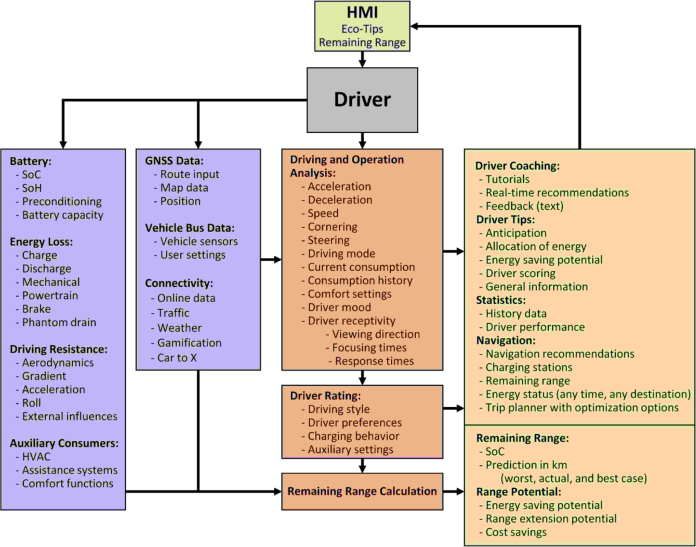
HOLISTIC HUMAN CENTERED ECO-TIPS APPROACH Based on the results of benchmarking and gap analysis, an adaptive, human- centered, and holistic eco-tips approach has been developed, suitable for implementation in almost all modern BEVs. The system processes a wide range of data from multiple sources, utilizing vehicle’s existing equipment (e.g., connectivity, GNSS) and available vehicle sensors (e.g., speed, steering angle, pedal position, acceleration, deceleration). The challenge of different vehicle types with equipment variants providing different sensors or data inputs is solved by using redundant signal sources. If one or more signals (e.g., internet, sensors) are missing in a vehicle configuration, substitute signals are applied to specific functions to ensure smooth operation. For example, if there is no eye tracking camera available to determine driver attention, alternative indicators such as steering behavior or pedal patterns are used to determine the desired output. Missing parameters may affect the accuracy, but not the overall function. The system processes all available data and generates a conglomerate of feedback to the driver. This allows users to adjust the driving and operation style in real time to optimize energy consumption immediately. The main components of the Holistic Approach to Efficient Driving (HAED) system (c.f. Figure 1) are described in the following subsections.
Advanced Sustainable Mobility: A Novel Human-Machine Interaction Approach 2179
Figure 1: Block diagram of the novel HAED system to support energy-efficient driving based on real-time feedback provided to the driver.
Increase Acceptance To promote acceptance of eco-tips by drivers, several approaches have already been formulated in literature. The most promising concepts for improving acceptance of eco-tips are summarized in this section and incorporated into the HAED approach. One key improvement includes the personalization of eco-tips (Brouwer et al., 2015). Adapting to individual driving and operating styles and preferences increases relevance for each driver. At the same time, only relevant information is displayed in an intuitive manner while driving. Information that is not directly relevant during the driving task is collected, evaluated, and can be reviewed before or after the trip, providing valuable tips for further improving individual driving and operation behavior. Integration of real-time feedback provides drivers with immediate feedback (e.g., accelerate, decelerate, corner ahead, suggested speed) to adjust driving behavior and creates direct understanding of the impact of driver decisions on energy efficiency (Avolicino et al., 2022). In addition, gamification aspects keep drivers entertained and motivated by allowing them to collect points or earn rewards (Magaña and Organero, 2014). An intuitive user interface ensures that eco-tips are communicated clearly and simply (Ahlstrom and Kircher, 2017; Jamson et al., 2015). Clear graphics and easy-to-understand instructions help to prevent driver distraction (Dahlinger et al., 2018; Rouzikhah et al., 2013). Integrating eco-tips with navigation systems also enables seamless energy-efficient
route recommendations, further increasing acceptance (Das and Sharma, 2022). Creating a community where drivers can share their experiences encourages social interaction and fosters community cohesion. Incentives and rewards motivate drivers to follow eco-tips, and frequent updates keep the information relevant. Transparent communication about the environmental impact of individual driving behavior encourages environmentally conscious thinking, and consideration of vehicle specifications improves the relevance of eco-tips for individual usage.
Real-Time Feedback Incorporating real-time data analytics to provide drivers with immediate feedback on their driving habits is a key element in establishing a dynamic and adaptive approach for improving energy efficiency. This feedback feature uses a continuous stream of data from vehicle sensors, allowing the eco- tips system to provide nuanced and contextual recommendations. A driving style and operation analysis component evaluates historical and real time data to identify driving and operation patterns and energy requirements. To analyze driving and operation behavior, pattern recognition has been implemented (Si et al., 2018) and enhanced with the ability to detect driver mood and receptivity. This was achieved using machine learning models based on CAN and additional data where available, depending on the vehicle’s equipment. Using additional sensors (e.g., interior camera) and internet connection, the system also considers factors such as direction of view, facial expressions, traffic, terrain, and weather conditions. Using this wealth of information, the eco-tips system offers tailored suggestions at the right time (high receptivity) for optimal acceleration, deceleration, speed patterns, and operation of auxiliary consumers. The adaptive algorithm can dynamically adjust recommendations, ensuring that drivers receive guidance, which is appropriate to the immediate context, promoting a responsive and effective eco-driving experience. The system uses predictive analysis to anticipate upcoming driving scenarios based on historical data, driving behavior, map data, and additional sources (e.g., camera, online connection), if available. This proactive approach allows the eco-tips system to offer preemptive suggestions, preparing the driver for energy-efficient maneuvers in advance.
Personalized Eco-Recommendations Through continuous learning, the system becomes familiar with the nuances of how a specific driver navigates different routes, handles acceleration and deceleration, responds to different driving conditions, and the individual operation of auxiliaries. This comprehensive understanding allows the system to accurately predict driver’s behavior and to offer recommendations tailored to their unique style (e.g., driver style dependent communication). Integration with external data sources enables broader contextual factors such as real-time traffic updates, road conditions as well as weather and temperature forecasts. By synthesizing all available information, the system generates personalized eco-recommendations that match the driver’s style
Advanced Sustainable Mobility: A Novel Human-Machine Interaction Approach 2181
while considering current external environmental influences. To increase awareness of energy consumption and associated costs, the system provides real-time information on additional energy consumption or savings due to driving style and auxiliary operation.
Navigation and Charging Experience Target is an expansion of capabilities of existing systems to include integration with navigation features, providing drivers with more than just directions, but a holistic approach to energy-efficient operation. When integrated with navigation features, the system considers detailed information about the changes in altitude along the selected route and strategically suggests routes that minimize elevation changes and improving overall efficiency and remaining range. By using real-time traffic data, the system identifies congested areas and suggests alternative routes that avoid traffic hotspots. Understanding that effective trip planning includes consideration of charging stops, the system identifies and recommends optimal charging stations along the route.
Human-Machine Interface The commitment to intuitive interaction is further exemplified by an easy-to- use interface that ensures that eco-tips are presented to drivers in a clear and intuitive manner. Recognizing the importance of simplicity in increasing user engagement, the interface is designed with a focus on clarity and accessibility. As mentioned, only information relevant to the current situation is displayed. Using visual cues that are easy to understand facilitate seamless integration into driving experience. In conjunction with the visual interface, the system includes the ability to provide acoustic and haptic (e.g., steering wheel and accelerator pedal) feedback for convenient interaction and minimal distraction.
Community, Connectivity and Education The integration of mobile and online interfaces into the eco-driving system combines calendars, user data, and community engagement. This enables collaborative eco-challenges and advanced feedback. By merging calendars with the eco-driving interface, the system can proactively suggest smart travel combinations, identify optimal commuting times, and offer efficient task combination suggestions, such as coordinating work- and shopping trips. This feature not only streamlines daily routines, but also helps to reduce traffic congestion and energy consumption during rush hours. In addition, required energy demand for future trips can be estimated, supporting optimized battery energy management. Introducing a social aspect to eco- driving adds a community dimension by allowing drivers to share their environmental achievements and driving data with other BEV users. This fosters a vibrant community, enhances feedback, and improves the driver experience and the learning algorithms used. The feature educates users about the environmental and cost impacts of their driving behavior, providing detailed performance statistics and recommendations for improvement. In
addition, an eco-scoring system is introduced. This highlights the driver’s performance in acceleration, braking, anticipation, and speed and provides tips for improvement. The scoring system considers not only direct energy consumption, but also factors such as energy efficiency, route optimization, and adherence to eco-driving principles. For traceability purposes, there is also an explanation of the scoring process and how it can be improved for full ranking.
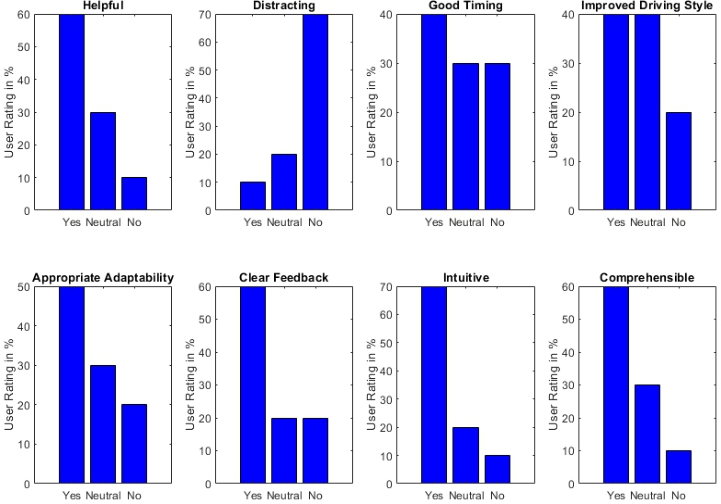
SIMULATOR STUDY RESULTS After design phase, initial vehicle simulator tests were conducted to assess user satisfaction. In the simulated scenario, 10 participants completed an identical test course with urban and highway scenes. After each session, participants answered a post-session questionnaire to express their subjective HMI experience. Users are asked to rate the system based on the previously mentioned performance indicators, choosing from “yes”, “neutral”, or “no”. The aggregated results of these responses are summarized in Figure 2. In addition, the energy consumption of each cycle of the simulation was measured. When actively using the HAED system, users achieved an average energy saving of 6% compared to the benchmarking results shown in Table 1.
Figure 2: User evaluation of the developed HMI approach (HAED) based on driving tests conducted with a vehicle simulator.
Advanced Sustainable Mobility: A Novel Human-Machine Interaction Approach 2183
CONCLUSION
A generic and holistic eco-tips approach for driving behavior and operation optimization of BEVs was presented. The system provides user-specific, straightforward real-time feedback designed to minimize distractions and optimize HMI, providing an efficient path to range extension. Intelligent HMI includes several key components designed to reduce energy consumption by optimizing driving and operating habits. Improving eco- driving through feedback systems is a cost-effective measure that can achieve a 5% to 15% reduction in energy consumption for road transport when fully implemented. It can deliver immediate results without the need to change complex systems such as the power train. The results of initial tests are promising, and future works will focus on the optimization of the algorithm, considering feedback of testing on a driving simulator. In addition, further features will be implemented to enhance the capability of the presented approach. Finally, the virtually developed system will be implemented into real cars to optimize the system under real driving conditions. Feature enhancements and real-world driving tests involving the entire system with all features will be presented in future publications.
REFERENCES
Ahlstrom, C., Kircher, K., 2017. Changes in glance behaviour when using a visual eco-driving system – A field study. Appl. Ergon. 58, 414–423. https://doi.org/10.1016/j.apergo.2016.08.001 Avolicino, S., Di Gregorio, M., Romano, M., Sebillo, M., Tortora, G., Vitiello,
G., 2022. EcoGO: Combining eco-feedback and gamification to improve the sustainability of driving style, in: Proceedings of the 2022 International Conference on Advanced Visual Interfaces. Presented at the AVI 2022: International Conference on Advanced Visual Interfaces, ACM, Frascati, Rome Italy, pp. 1–5. https://doi.org/10.1145/3531073.3531127 Bingham, C., Walsh, C., Carroll, S., 2012. Impact of driving characteristics on electric vehicle energy consumption and range. IET Intell. Transp. Syst. 6, 29. https://doi.org/10.1049/iet-its.2010.0137 Brouwer, R. F. T., Stuiver, A., Hof, T., Kroon, L., Pauwelussen, J., Holleman, B., 2015.
Personalised feedback and eco-driving: An explorative study. Transp. Res. Part C Emerg. Technol. 58, 760–771. https://doi.org/10.1016/j.trc.2015.04.027 Dahlinger, A., Tiefenbeck, V., Ryder, B., Gahr, B., Fleisch, E., Wortmann, F., 2018.
The impact of numerical vs. symbolic eco-driving feedback on fuel consumption – A randomized control field trial. Transp. Res. Part Transp. Environ. 65, 375–386. https://doi.org/10.1016/j.trd.2018.09.013 Das, K., Sharma, S., 2022. Eco-routing navigation systems in electric vehicles: A comprehensive survey, in: Autonomous and Connected Heavy Vehicle Technology. Elsevier, pp. 95–122. https://doi.org/10.1016/B978-0-323-90592-3.00006–9 He, H. A., Greenberg, S., Huang, E. M., 2010. One size does not fit all: applying the
transtheoretical model to energy feedback technology design, in: Proceedings of the SIGCHI Conference on Human Factors in Computing Systems. Presented at the CHI ‘10: CHI Conference on Human Factors in Computing Systems, ACM, Atlanta Georgia USA, pp. 927–936. https://doi.org/10.1145/1753326.1753464
Jamson, A. H., Hibberd, D. L., Merat, N., 2015. Interface design considerations for an in-vehicle eco-driving assistance system. Transp. Res. Part C Emerg. Technol. 58, 642–656. https://doi.org/10.1016/j.trc.2014.12.008 Kramer, J., Petzoldt, T., 2023. Environmental, altruistic, or monetary benefits? A
longitudinal online experiment on how framed behavioral consequences affect self-reported eco-driving of German vehicle owners. Transp. Res. Part F Traffic Psychol. Behav. 93, 204–221. https://doi.org/10.1016/j.trf.2023.01.006 Kreis, A., Fragner, D., Hirz, M., 2023. User Experience in Modern Cars – Definition, Relevance and Challenges of Digital Automotive Applications. Presented at the 14th International Conference on Applied Human Factors and Ergonomics (AHFE 2023). https://doi.org/10.54941/ahfe1003172 Magaña, V. C., Organero, M. M., 2014. The Impact of Using Gamification
on the Eco-driving Learning, in: Ramos, C., Novais, P., Nihan, C. E., Corchado Rodríguez, J. M. (Eds.), Ambient Intelligence - Software and Applications, Advances in Intelligent Systems and Computing. Springer International Publishing, Cham, pp. 45–52. https://doi.org/10.1007/978-3-319- 07596-9_5 Micari, S., Foti, S., Testa, A., De Caro, S., Sergi, F., Andaloro, L., Aloisio, D., Leonardi, S. G., Napoli, G., 2022. Effect of WLTP CLASS 3B Driving Cycle on Lithium-Ion Battery for Electric Vehicles. Energies 15, 6703. https://doi.org/10.3390/en15186703 Miotti, M., Needell, Z. A., Ramakrishnan, S., Heywood, J., Trancik, J. E., 2021. Quantifying the impact of driving style changes on light-duty vehicle fuel consumption. Transp. Res. Part Transp. Environ. 98, 102918. https://doi.org/10.1016/j.trd.2021.102918 Neumann, I., Franke, T., Cocron, P., Bühler, F., Krems, J. F., 2015. Eco-driving strategies in battery electric vehicle use – how do drivers adapt over time? IET Intell. Transp. Syst. 9, 746–753. https://doi.org/10.1049/iet-its.2014.0221 Nilsson, M., 2011. Electric vehicles: An interview study investigating the phenomenon of range anxiety. Lindholmen Sci. Park Swed. Task 5000 Elvire. Rauh, N., Franke, T., Krems, J. F., 2015. Understanding the Impact of Electric Vehicle
Driving Experience on Range Anxiety. Hum. Factors J. Hum. Factors Ergon. Soc. 57, 177–187. https://doi.org/10.1177/0018720814546372 Rouzikhah, H., King, M., Rakotonirainy, A., 2013. Examining the effects of an eco-driving message on driver distraction. Accid. Anal. Prev. 50, 975–983. https: //doi.org/10.1016/j.aap.2012.07.024 Si, L., Hirz, M., Brunner, H., 2018. Big Data-Based Driving Pattern Clustering and
Evaluation in Combination with Driving Circumstances. Presented at the WCX World Congress Experience, pp. 2018–01–1087. https://doi.org/10.4271/2018- 01-1087 Staubach, M., Schebitz, N., Köster, F., Kuck, D., 2014. Evaluation of an ecodriving support system. Transp. Res. Part F Traffic Psychol. Behav. 27, 11–21. https://doi.org/10.1016/j.trf.2014.09.006 Thibault, L., De Nunzio, G., Sciarretta, A., 2018. A Unified Approach for
Electric Vehicles Range Maximization via Eco-Routing, Eco-Driving, and Energy Consumption Prediction. IEEE Trans. Intell. Veh. 3, 463–475. https://doi.org/10.1109/TIV.2018.2873922
LISTED IN THE AHFE DIGITAL BOOKSTORE CATALOGUE
Explore the complete digital volume
Human Factors in Design, Engineering, and Computing
Read this individual research paper free through the original publisher, or explore the full digital proceedings book.
ISBN 978-1-964867-35-9
Explore this ISBN in the AHFE Bookstore ↗Listed in the July 2026 bookstore catalogue; search by ISBN to confirm current availability · Digital book purchase optional