Katlane Seema, Clinton Aigbavboa, Ogunbayo Babatunde (2024). An assessment of the maintenance of heritage buildings using AI and IoT: a South African perspective. In: Human Factors in Design, Engineering, and Computing. AHFE Open Access, vol. 159, pp. 60–71. https://doi.org/10.54941/ahfe1005568
cidb Centre of Excellence & Sustainable Human Settlement and Construction Research, Centre, Department of Construction Management & Quantity Surveying, University of Johannesburg, South Africa ↗
The paper assesses the possibilities of maintaining South African heritage buildings using Artificial Intelligence and the Internet of Things. Over the years, the construction industry has evolved with AI, creating software to make maintenance of buildings easier for the end-user by collecting data from different systems within the building to be centralised for data storage and future analysis and maintenance planning. The study aims to assess the merits and benefits, and the pitfalls, if any, in the adoption of AI and IoT in the maintenance management of heritage buildings in South Africa. The standardisation of IoT for the maintenance of heritage buildings and the challenges that the industry faces for not adopting AI are likewise discussed in the paper. The paper is based on the assessment of peer-reviewed literature and policies on the current systems used to track the maintenance of heritage buildings in South Africa. The findings concluded the benefits of cost, quality, and time for the end-user and stakeholders while it noted challenges that mainly involved the security of data collected and the standardisation of IoT in the architectural, engineering, and construction industries.
Over the years, the construction industry has evolved with the introduction of the 4IR with the drive to create smart machinery and automotive for a smart way of working (Siphosenkosi et al., 2021) and merging it with AI- creating software to make the maintenance of building easier for the end-user by collecting data from different systems within the building to be centralised for data storage and future analysis and maintenance planning. The concept of maintenance and conservation of heritage buildings has evolved over the years, with architects and engineers always finding new ways to preserve the existing buildings while maintaining the original design and materials used (Prieto et al., 2020). However, Motheo et al. (2022) argued that the development of 4IR introduced a part solution to the construction industry, while the introduction of AI will be able to assist the engineers and architects
An Assessment of the Maintenance of Heritage Buildings Using AI and IoT 61
in being able to have a design and analysis of the project’s life cycle while monitoring and sharing information to make sure that everyone is on the same page (Motheo et al., 2022).
Based on the review of relevant literature and policies, the study assesses the benefits and pitfalls, if any, in the adoption of AI and IoT in the maintenance management of heritage buildings in South Africa. The standardisation of IoT to the maintenance of heritage buildings and the challenges that the industry faces for not adopting AI were also established in the study.
BACKGROUND
Preservation has the good sense of holding on to well-designed things that link us to our past meaningfully and have plenty of good use for them (Richard, 1993). Heritage is the past, present and future. Maintaining and conserving a heritage building for future generations is a symbol of cultural identity and heritage and a legacy left behind by the ancestors and can be studied by the current and future generations (Ziyo et al., 2024). Maintenance of heritage buildings differs from modern buildings as it carries a spiritual connection, a place’s history, politics, and architecture (Yuan et al., 2021). Due to changes in climate and human utilisation over time, studies of past designs and the preservation and conservation of heritage buildings have contributed to research understanding of heritage building culture, architectural method of construction, and decay of the material used for its construction. (Lukman & Patel, 2022).
Similarly, the United Nations Educational, Scientific and Cultural Organization identifies heritage buildings as part of cultural heritage (UNESCO, 2021). Glossary (2024) states that ‘Cultural Heritage include artefacts, monuments, a group of buildings and sites, museums that have a diversity of value including symbolic, historical, artistic, ethnological, anthropological, scientific, and social significance. It includes tangible heritage (movable, immovable and underwater), intangible cultural heritage embedded into culture, and heritage artefacts, sites, or monuments. The definition excludes intangible cultural heritage related to other cultural domains, such as festivals or celebrations. It covers industrial heritage and cave paintings.’ (UNESCO Institute for Statistics, 2024).
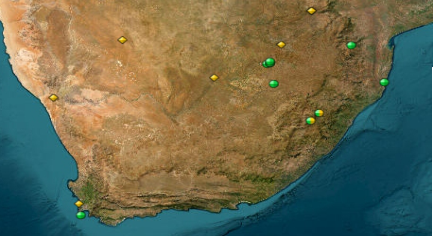
However, each country has its ways of identifying heritage (Xinyue et al., 2024). In South Africa, heritage sites (See Figure 1) are governed by the National Heritage Act, which will need to be graded into different categories by local authorities and the South African Heritage Resource Agency (SAHRA). SAHRA is responsible for identifying, conserving and managing heritage resources, developing national standards for conserving heritage sites to meet international standards, and contributing skills and knowledge to heritage resource management in South Africa.
Figure 1: Heritage/site buildings in South Africa (UNESCO, 2024).
According to UNESCO (2018), there are five cultural heritage places in South Africa -Fossil Hominid of South Africa, Mapungubwe Cultural Escape, Richtersveld Cultural and Botanical Landscape, Robben Island and Khomani Cultural Landscape, with four Natural heritage sites, Barterton Makhonjwa Mountains, Cape Floral Region Protected Areas, ISimangaliso Wetland Park and Vredefort Dome with one Mixed Heritage site being Maloti-Drakensberg.
However, due to the grading used in South Africa to determine the Heritage buildings, many Heritage buildings are part of the Heritage Act in South Africa but not included in UNESCO (HWC Council, 2016). There are currently 13 heritage buildings in Cape Town that the Western Heritage Act protects. Due to the many heritage buildings in South Africa, the study focuses on maintaining the Castle of Good Hope and Robben Island.
LITERATURE REVIEW
Artificial Intelligence in the Maintenance of Heritage Buildings The older the building, the more difficult it is to maintain. Artificial intelligence (AI) can improve how the construction industry is handled with minimal errors, decrease waste, increase stakeholder coordination, analyse data from different sources, and make forecasting and scheduling work easy (Avannesh et al., 2023). Furthermore, introducing AI to the maintenance of heritage buildings can assist with analysing and sourcing construction materials while creating policies and procedures for handling the building (Siphosenkosi et al., 2021).
Siphosenkosi et al. (2021) noted that one thing that causes more risk to the maintenance of Heritage buildings is the severe changes in weather and environmental parameters. This, as noted by Sesana et al. (2021), can decrease the life span of a building and cause it to decay quickly, as it also affects rising sea levels. In the studies of Sesana et al. (2021) and Siphosenkosi et al. (2021), climate change and pollution were noted as the most significant risks to heritage. Moreover, the study of Lukman and Patel (2022) emphasised that structural defects caused by human use, pollution and weather changes need to be understood as that can instigate a challenge when finding the suitable materials and approaches
An Assessment of the Maintenance of Heritage Buildings Using AI and IoT 63
to conserving the heritage buildings toward maintaining their original authenticity. Additionally, Lukman and Patel (2022) further explained how conserving and maintaining heritage buildings is part of sustaining the built environment as it plays a role in economic development. Motheo et al. (2022) supported the idea that more ways must be developed to effectively manage infrastructure development and decrease the cost of managing maintenance and data analysing duration.
However, Hadi et al. (2021) have argued that the increase in the maintenance of heritage buildings has created a need for new methods of managing the maintenance of historic buildings, which will need to be cost-effective and assist with project management of the buildings. While initially, the data collection for the building information and analysis included the highly skilled and trained professionals manually assessing the material and taking time to analyse the findings, it was becoming costly and time- consuming for the stakeholders, and some information was missed due to the lack of documentation as stated by Anon (2018) hence the need of developing new ways to manage the data handling, management and maintenance of heritage buildings (Lukman & Patel, 2022).
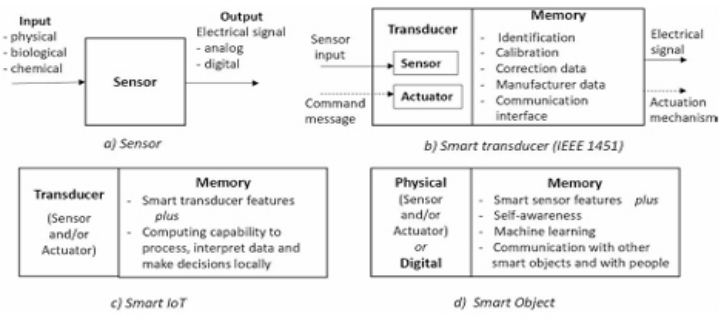
The study of Avannesh et al. (2023) explained the impact that AI has on the construction industry. Table 1 below summarises what previous authors have discussed and establishes the impact of AI in the construction industry while identifying the study’s gaps. As detailed in Figure 2, the integration of AI and IoT can be able to singingly sense, actuate, log, and interpret the information that is collected in the building, making it easy for the data to be analysed and communicated to the end-user by the use of a small sensor, illustrating how the sensor works (Giancarlo & Gennaro, 2024).
Table 1. Previous studies of AI in construction and gaps identified.
Table available in the original PDF paper.
Title of Study Author and Year Research Gain Gaps in Study Brown (2017) Avannesh et al. (2023) Explained how AI improves the quality of products in the manufacturing industry.
It does not explain how AI improves safety in the manufacturing industry.
The role of AI in improving quality control in manufacturing AI and security in buildings Doe (2016) Explains how AI provides security, which helps the maintenance of buildings.
It does not explain how the workload of other people is significantly decreased.
It does not explain how AAI improves the quality of buildings. The impact of AI on the efficiency of mechanical engineering projects
Smith (2020) Explains how AI makes projects in Mechanical Engineering and Construction more efficient.
William (2018) Explains how AI helps in the maintenance of buildings.
AI and predictive maintenance in buildings
It does not explain how AI provides security in buildings. AI and energy management in buildings
Jones (2019) Explains the role of AI as it correlates to energy management and maintenance in buildings.
It does not explain how energy management contributes to the mechanical engineering field.
Figure 2: Adding memory, processing, and communication capabilities (Giancarlo & Gennaro, 2024).
Historic Building Information Model Construction has always been a paper-based industry- from the design and the expectation taking the design to formulate construction drawings, which is how a building was constructed. However, the innovation of the Building Information Model (BIM) meant that the process of collaboration between the professional teams to produce a concept and design could be centralised and digitalised to make it easy for information sharing and analysis of how the end product will look before it is constructed and that meant, less clashes between the designers. They can make informed decisions with fewer scope creeps during the construction stage- it means moving from physical format to digital format (Viktoria et al., 2020). BIM is mostly used to turn a 2D drawing into a 3D design. The software can assist the architecture, engineering, and construction (AEC) with performance through design, procurement, costing and even fabrication (Christoph & Erik, 2014). However, for the implementation of BIM software to work, the team must have sufficient knowledge and experience to enable the team to use the software positively. Furthermore, a professional with motivation for collaboration and willingness to take training to learn more about the software can positively influence the outcome of the collaboration between the professional team (Kaiyang et al., 2022). The use of the software on heritage buildings is called the Historic Building Information Modelling (H-BIM) by Murphy et al. (2009).
According to Murphy, McGovern, and Pavin (2013), H-BIM is a model of architectural elements and data scanned and constructed for historical data. They accurately develop a 3-D image stored in a cloud-based image, which has been studied and discussed in previous studies (Murphy et al., 2009). It concentrated on how data can be collected and analysed for the building using a laser. A combination of the modelling system with existing Building Automation and Management systems (BAMSs) can be able to assist in the maintenance of existing buildings as the systems can assist with keeping data and analysis patterns to be able to come up with the best
An Assessment of the Maintenance of Heritage Buildings Using AI and IoT 65
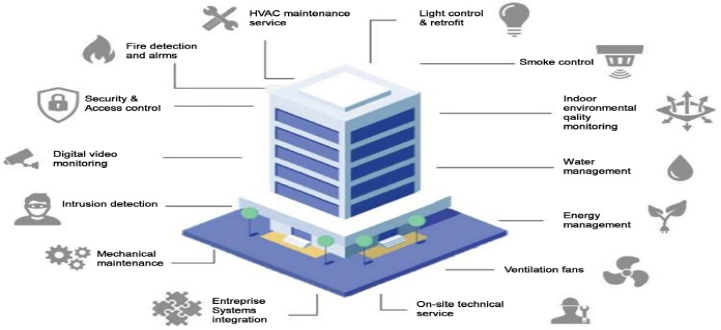
way to produce maintenance criteria suitable for that specific building and region. (Himeur et al., 2022). BAMS uses automation and control systems to monitor and control building-wide systems, such as HVA, lighting, alarms, and security.
Figure 3: Principal services of BAMS systems (Hemeur, 2022).
In Figure 3, Hemeur (2022) indicates the different components/ data needed to go into BAMSs to ensure that a single network is created to assist the user in tracking the energy consumption and cost to the building. Some of the protocols available with the running of the BAMSs are but are not limited to (i) BACnet- Building Automation and Control Network that focuses on automation of the building, (ii) LonWorks- Local Operating Network (LON) a control network system, (iii) DALI-Digital Addressable Lighting Interface for the lighting control, (iv)EnOcean- energy-efficient wireless communication and (v) Zigbee- wireless standard for home and building automation (Lohia, 2019). According to Newman (2015), BACnet was explicitly designed for buildings. It was designed to be extensible, can never depend on hardware or network technology, and can be utilised in any building size. However, the H-BIM methodology will need all the data and information for the building to be available to ensure that documentation is done correctly (Arturo et al., 2022).
Structural Health Monitoring The edge to find ways to measure and conserve heritage buildings has made several techniques and solutions being attempted- Structural Health monitoring (SHM) is the application on the table for the conservation of Heritage Buildings, and the application can be used to monitor the performance of the structure and evaluate its health status. (Arturo et al., 2022). SHM and H-BIM are tools available to the construction industry but still have yet to be applied to the conservation of heritage buildings with the hopes of creating easier and economically easier methods.
SOUTH AFRICAN HERITAGE BUILDINGS The maintenance practices in South Africa are not standardised. The majority of the reason, according to Ogunbayo, Aigbavboa, and Thwala (2023), is due to the gaps in the understanding of the maintenance culture as most of the literature for maintenance is based in developed countries and understanding communication amongst stakeholders between the maintenance management and the end-users. The monitoring and evaluation of heritage buildings in South Africa is based on the grading system where the criteria used were based on the uniqueness of the site, the integrity of the cultural deposits, broader historical context, location and preservation considerations of the site (Jaco vab der, 2023).
Table 2. Heritage significance and field grading.
Table available in the original PDF paper.
Field Rating Grading Significance Recommended Mitigation National significance (NS) Grade 1 - Conservation; national site nomination Provincial significance (PS) Grade 2 - Conservation; provincial site nomination Local significance (LS) Grade 3A High significance Conservation; mitigation not advised Local significance (LS) Grade 3B High significance Mitigation (part of the site should be retained) Generally protected A (GP. A) - High/medium significance
Mitigation before destruction Generally protected B (GP. B) - Medium significance Recording before destruction Generally protected C (GP.C) - Low significance Destruction
According to Maphole et al. (2020), in South Africa, for the conservation and maintenance of heritage buildings, a license is to be obtained from the municipality and advice from a professional building and restoration advisor- there is no need for the materials to be analysed and that has resulted in ineffective ways of conserving heritage building as compared to the set standards and guidelines for conservation and maintenance of heritage buildings set by the Department of Archaeology and Historic Preservation of the United States, through the Secretary of the Interior’s Standards and Guidelines for analysing of the historic characteristics of the property, distinctive materials in a way that it is not taken away from the original material and intensive studies need to be carried out towards the material. Introducing the technologies to the maintenance practices has the potential to assist with planning, monitoring and controlling (Keogh & Smallwood, 2021), which is an aspect of the conservation and maintenance of Heritage Buildings; however, the major challenge has always been the choice of material due to no records of the original material used to assist with the reconstruction of the existing building (Harun, 2011).
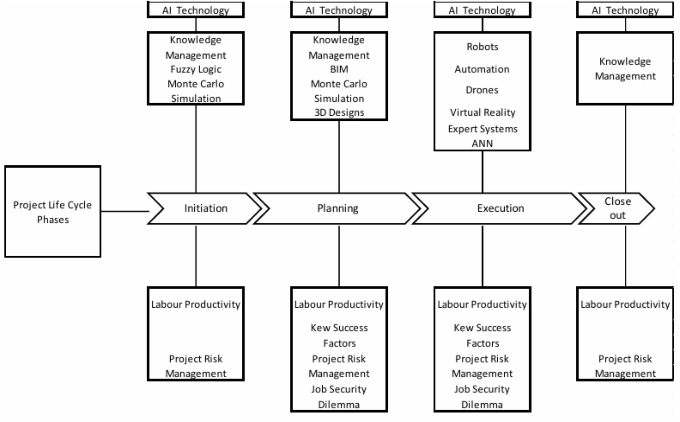
Makaula, Munsamy, and Telukdaria (2021) developed a theoretical framework for using artificial intelligence in the lifecycle of a project, as shown in Figure 4, where the authors further stated how AI can increase
An Assessment of the Maintenance of Heritage Buildings Using AI and IoT 67
labour productivity. The stakeholders have well-informed decision-making, project risk management, and conflict in policymaking and preservation.
Figure 4: AI Approach to project lifecycle (Siphosenkosi et al., 2021).
Using digital technologies to improve processes in the South African construction industry is advantageous as the infrastructure drives economic growth (Motheo et al., 2022). To implement AI technologies, Motheo et al. (2022) further recommended the introduction of AI to the traditional way of implementing maintenance.
BENEFITS AND CHALLENGES OF AI AND IoT IN HERITAGE BUILDINGS According to Maramura and Thakhathi (2019), the challenges faced in South Africa for the adoption of the use of AI and IoT are due to the lack of electronic readiness as the majority of the stakeholders are not receptive to the change, lack of electricity as majority of the software need electricity and the country has a shortage of electricity and many building will then require a back-up power system, infrastructure capacity due to the support strategy policy and decision making and additionally, lack of skilled people to make the use of AI possible for Heritage Buildings (Tafadzwa & Thakhathi, 2016). With the South African draft for the e-Government Strategy released in 2017, the use and implementation of technological innovations imply tax jurisdiction and socio-political ramifications, and the AEC sector will need to know which innovation will be implemented first (PSA, 2019).
The use of H-BIM can enhance the capturing and modelling of the uniqueness of heritage buildings, making it easy for professionals to plan and know which conservation and restoration measures and materials to implement, and that can be able to reduce the energy efficiency of the
buildings and any environmental impacts (Aawag et al., 2023). In addition, the application of H-BIM to heritage buildings has been studied previously in China (Zhou et al., 2022), Liao et al. (2023), Mahnoudi et al., with the results showing how the use of the model can reduce errors, enhance collaboration between the team, identifying the structural problem, showing how it can assist with identifying the most suitable strategies that the professional team can apply to the maintenance of Heritage Building.
However, even with the use of the H-BIM on Heritage Buildings making it easy for the professional to reduce the time it takes to analyse the data collected to determine the suitable strategy and material as discussed above, some challenges come with the implementation; the lack of existing documentation for heritage building because of them being lost or because they were hand drawn, makes it hard for the professional team to change them to a soft copy and the documentations may include existing maintenance data that was done previously making it hard for the professional team to create an asset register to track the material used over time and still be able to maintenance the original build specifications hence the concept to integrate the use of AI and H-BIM to maintenance management. The following practice will assist the professional team with data storage, planning, and better agility in the processing of maintenance (Inojosa & Vilanova, 2023).
CONCLUSION
The need for building maintenance is not just to prolong the life span of the building but for the investors to still earn the best value for the investment. This can be done through proper maintenance planning and ensuring proper documentation for the heritage buildings’ assets management. Furthermore, it adds value to the maintenance practices. Therefore, as discussed, maintaining heritage buildings is a challenge that will require ‘both theoretical knowledge and practical implementation to protect this valuable asset effectively’ (Giancarlo & Gennaro, 2024). There is enough research on using AI and AoI to maintain and conserve Heritage Buildings, but not enough application has been done in developing countries. Maintenance cannot be avoided, but it can be planned and monitored, especially during the maintenance of Heritage Buildings, as the buildings are a cornerstone of every community and play a role in the cultural and heritage significance.
The study recommends that policymakers involved in the maintenance of national buildings and other heritage sites should develop supportive frameworks and provide funding to facilitate the integration of AI and IoT in heritage conservation efforts. Government and professional institutions involved in heritage building maintenance should invest in training programs for conservation professionals and technicians to develop expertise in AI and IoT applications. Further, the study established that there should be collaboration between government agencies, private sector stakeholders, and technology providers, leading to developing tailored solutions for heritage building maintenance.
An Assessment of the Maintenance of Heritage Buildings Using AI and IoT 69
Conclusively, the study underscores the transformative potential of AI and IoT in revolutionising the maintenance of heritage buildings in South Africa. Embracing these technologies will ensure the preservation of the nation’s cultural legacy and set a precedent for innovative and sustainable heritage conservation practices globally. Hence, integrating AI and IoT in heritage building maintenance represents a significant step towards safeguarding its historical treasures for future generations.
REFERENCES
Aawag, M. A. et al., 2023. Incorporating the Applications of Building Information Modeling (BIM) Technology in the Sustainable Retrofitting of Heritage Buildings: A Systematic Review. International Conference on Sustaining Heritage: Innovative and Digital Approaches (ICSH), Volume 23, pp. 125–130. Ali, H., Junaidah, J., Ismail, A. R. & Najib, A.-f., 2020. Building maintenance
practices in Malaysia: a systematic review of issues, effects and the way forward. International Journal of Building Pathology and Adaptation, 38(5), pp. 653–672. Al-Sakkaf, A., Zayed, T. & Bagchi, A., 2020. A sustainability based framework for evaluating the heritage buildings. International Journal of Energy Optimization and Engineering (IJEOE), 9(2), pp. 49-73. Anon., 2018. A Review of Heritage Building Information Modeling (H-BIM).
Multimodal Technologies and Interaction (MDPI), 2(21), pp. 1–29. Arturo, C., Vaughan, C., Tommy, C. & Miljenka, P., 2022. Engineering in Heritage conservation. Journal of Cultural Heritage Management and Sustainable Development, 12(4), pp. 426--443. Avannesh, M., Abdul, M. & Smrutirekha, P., 2023. Role of Artificial Intelligence
in the Construction Industry. International Journal of Advanced Research in Computer and Communication Engineering, 12(2), pp. 2–7. Ayman, A., Ibrahim, M. & Stephen, O., 2015. The Common Problems Facing the Building Maintenancne Departments. International Journal of Innovation, Management adn Technology, 6(3), pp. 234–237. Babatund, O., Aigbavboa, C. & Thwala, W., 2023. Gaps in Maintenance
Management Research. In: A Maintenance Management Framework for Municipal Buildings in Developing Economies. Abingdon: Routledge, pp. 156- 175. Bonoiface, O., Abiodun, O. & Kelechi, E., 2021. Improving Maintenance Consitions of Residential Building and Infrastructure Through Comparative Analysis: A Stucy of Housing Development Corporation Estate in Enugu. OOU African Journal of Environmental Research, 3(1), pp. 53–66. Cary, Z., 2019. Earth&World.[Online] Available at: https://earthnworld.com/oldest
-buildings-in-the-world/[Accessed 24 March 2024]. Christoph, M. & Erik, M., 2014. How is Building Information Modeling Influenced by Project Complexity?: A cross-case analysis of e-collaboration Performance in Building Construction. Internation Journal of e-Collaboration (IJeC), 10(2), pp. 20–39. CISCO, 2021. What is building Automation. [Online] Available at: https://www.cisc
o.com/c/en/us/solutions/enterprise-networks/what-is-building-automation.html [Accessed 03 April 2024]. Giancarlo, N. & Gennaro, P., 2024. Heritage buildings management: the role of situational awareness and cyber0physocal systems. Journal of Ambient Intelligence and Humanized Computing, Volume 15, pp. 2227-2239.
Harun, S., 2011. Heritage Building Conservation in Malaysia: Experience and Challenges. Procedia Engineering, Volume 20, pp. 41–53. Himeur, Y. et al., 2022. AI-big data analytics for building automation and
management systems: a survey, actual challenges and future perspectives. Artificial Intelligence Review, Volume 56, pp. 4929-5021. HWC Council, 2016. Grading: Purpose and Management Implication. [Online] Available at: https://www.hwc.org.za/sites/default/files/2_3_6%20Grading_Impli cations%20and%20Management_Approved.pdf [Accessed 6 June 2024]. Inojosa, L. d. S. P. & Vilanova, K. d. A., 2023. BIM interoperability in the maintenance planning process for existing buildings. Journal of Building Patahology and Rehabilitation, 8(45), pp. 1-13. Jaco vab der, W., 2023. Heritage Impact Assessment for the Prospecting Application
On Portion 6 & 7 Of The Farm Gams No 367, Northern Cape Province., Upington: Beyond Heritage. Jolanta, T., Hadi, S., Matteo, C. & Daniel, C., 2021. Identification and Prioritizing the selection criteria of appropriate repair and maintenance methods for Commercial Buildings. International Journal of Strategic Proporty Management, 25(2), pp. 413–431. Jolanta, T., Hadi, S., Matteo, C. & Daniel, C., 2021. Identifiying and prioritizing the
selection criteria of appropriate repair and maintenance methods for commercial buildings. International Journal of Strategic Property Management, 25(5), pp. 413–431. Kaiyang, W., Cheng, Z., Fangyu, G. & Shuting, G., 2022. Toward an Efficient Construction Process: What Drives BIM Professionals to Collaborate in BIM-Enabled Projects. Jourmanl of Management in Engineering, 38(4), pp. 04022033–1-13. Keogh, M. & Smallwood, J., 2021. The role of the 4th Industrial revolution in enhancingn performance within the construction industry. IOP Conference Series: Earth and Environmental Science, Volume 654, p. 012021. Lohia, K. J. Y. P. C. a. D. N., 2019. Open communication protocols for building
automation systems. Procedia Computer Science„ Volume 160, pp. 723–727. Lukman, M. & Patel, A., 2022. Artificial Intelligence-base automatic visual inspection system for Built Heritage. Smart and Sustainable Built Environment, 11(3), pp. 622–646. Maphole, L., Kumar, P. & Rainer, H., 2020. Characterisation of Heritage cementing
materials for restoration purposes: A review. Journal of the South African Institutionn of Civil Engineering, 62(1), pp. 10–21. Maurice, M., Eugene, M. & Sara, P., 2013. Historic Building Information Modelling– Adding intelligence to laser and image based surveys of European classical architecture. ISPRS Journal of Photogrammetry and Remote Sensing, pp. 1–14. Mayowa, A. et al., 2023. Understanding the influencing factors of heritage building
maintenance management: findings from developed and developing region. Building Research & Information, 51(5), pp. 605-624. Motheo, T., Innocent, M. & Chioma, O., 2022. Organisational Factors of Artificial Intelligence Adoption in South African Construction Industry. Frontiers in Built Environment, 8(823998). Parker, J., 2023. Architecture Maker. [Online] Available at: https://www.architecture
maker.com/what-is-heritage-architecture/ [Accessed 24 March 2024]. Platform, W. H. O. M., 2024. World Heritage List. [Online] Available at: https: //whc.unesco.org/en/list/ [Accessed 28 March 2024].
An Assessment of the Maintenance of Heritage Buildings Using AI and IoT 71
Press, C. U., 2024. Cambridge Advanced Learner’s Dictionary & Thesaurus.
[Online] Available at: https://dictionary.cambridge.org/dictionary/english/unesco [Accessed 24 March 2024]. Prieto, A. et al., 2020. Artificial Intelligence applied to the preventive conservation of Heritage Buildings. London, Science and Digital Technology for Cultural Heritage, pp. 245–249. PSA, 2019. The Era of Fourth Industrial Revolution: Challenges and Opportunities
for the Public Service, s.l.: Public Servants Association of South Africa. Rachel, K., 2023. The Future of Heritage Management and Development In Africa.
African Archaelogical Review, Volume 48, pp. 781–183. Sesana, E. et al., 2021. Climate change impacts on Cultural heritage: A literature Review. Wiley Interdisciplinary Reviews: Climate Change, 12(4), p. 710. Siphosenkosi, M., Megashnee, M. & Arnech, T., 2021. Impact of Artificial
Intelligence in South African Construction Project Management Industry. Brazil, IEOM Society International. Tafadzwa, C. M. & Thakhathi, D., 2016. Challenges of ICT and Electronic- Governance for Service Delivery on the Public Service. Journal of communication, 7(2), pp. 252–256. UNESCO Institute for Statistics, 2024. Glossary-Cultural Heritage. [Online] Available at: https://uis.unesco.org/en/glossary-term/cultural-heritage [Accessed 29 March 2024]. UNESCO, 2024. Convention Concerning the Protection of the World Cultural and
Natural Heritage. [Online] Available at: https://whc.unesco.org/en/conventiontext [Accessed 24 March 2024]. Viktoria, S. et al., 2020. BIM in Construction Production: Gains and Hinders for Firms, Projects and Industry. UK, ARCOM 2020-Association of Researchers in Construction Management, 36th Annual Conference 2020-Proceedings, pp. 505–514. Xinyue, L., Zhenjiang, S., Xiao, T. & Qizhi, M., 2024. Cultural Routes as Cultural
Tourism Products for Heritage Conservation and Regional Development: A Systematic Review. Heritage, 7(5), pp. 2399–2425. Yuan, L., Long, Z., Jingxiong, H. & Andrew, L., 2021. Research frameworks, methodologies, and assessment methods concerning the adaptive reuse of architectural heritage: a review. Building Heritage, 5(6), pp. 1–19. Ziyo, C., Suk Ha Grace, C., Wing Han Helen, L. & Binglin Martin, T., 2024. Legacy
of cultural heritage building revitalization: place attachment and culture identity. Frontiers in Psychology, pp. 1-20.
LISTED IN THE AHFE DIGITAL BOOKSTORE CATALOGUE
Explore the complete digital volume
Human Factors in Design, Engineering, and Computing
Read this individual research paper free through the original publisher, or explore the full digital proceedings book.
ISBN 978-1-964867-35-9
Explore this ISBN in the AHFE Bookstore ↗Listed in the July 2026 bookstore catalogue; search by ISBN to confirm current availability · Digital book purchase optional