Wojciech Korek, James Blundell, Wen-chin Li, Linghai Lu, James Whidborne, Thomas Clare, Peter Beecroft (2025). Developing a Liquid Hydrogen (LH2) System Layout for an Aircraft: A Programmer's Perspective. In: Intelligent Human Systems Integration (IHSI 2025): Integrating People and Intelligent Systems. AHFE Open Access, vol. 160, pp. 585–595. https://doi.org/10.54941/ahfe1005864
The future of aviation lies in the adoption of sustainable technologies such as liquid hydrogen (LH2) fuel systems. The integration of these systems requires sophisticated management of the fuel flow, control mechanisms, and pilot interaction. This paper discusses the development of an LH2 system layout for a next-generation aircraft, with a focus on the simulation and interface design process from a programmer’s perspective. Utilising Cranfield University’s Future Systems Simulator (FSS), an iterative design and implementation process involved collaboration between pilots, engineers, and human factors specialists. Design and implementation: Initial conceptual designs were created in Miro during a series of workshops with subject-matter experts and pilots that refined key control elements and safety-critical aspects of the LH2 system. These prototypes were implemented in the FSS using Unity and linked with the aircraft and engine models, providing a platform for instant changes based on the pilot's feedback. Key technical challenges included developing control-loop algorithms for HMI that allowed autonomous engine management with pilot override capabilities. Data transmission between the FSS and LH extsubscript{2} model was optimised using half-byte encoding to handle real-time system data efficiently despite the large volume of information. Scenario: A series of test flights were performed in the FSS using the newly developed LH2 engine model and HMI layout. The first test was a "clean" flight, with no system faults, where pilots started the LH2 engines using electronic checklists, completed a circuit flight, and landed. Subsequent flights involved triggering system faults to assess pilot responses. Two sessions were conducted: the first with project-involved pilots aware of the potential faults, and a second "blind" trial with external pilots. Pilots wore eye-tracking devices, and post-flight interviews were conducted to gather qualitative feedback. System Usability Scale (SUS) scores were also recorded to evaluate interface usability.The pilot interface provided intuitive synoptic pages for system monitoring and control to enhance situational awareness and response times. Feedback from the trials will guide future refinements to the HMI layout, focusing on safety and usability optimisation.Conclusions: This paper demonstrates the integration of advanced programming techniques and human-centred HMI design, which is critical to the successful implementation of sustainable fuel technologies in aviation. It also highlights the importance of flight simulation platforms like the FSS in enabling safe and cost-effective development and testing of these systems. Future research will focus on optimising the procedures, layout design, and control algorithms, which will lead to conducting real-world validation tests for certification.
The aviation industry is undergoing a significant transformation to address the environmental impacts associated with traditional fossil fuel-based propulsion (Afonso et al., 2023). Over the last few years, the search for sustainable alternatives has gained momentum with increasing regulatory and societal pressure to reduce carbon emissions. These efforts include exploring alternative fuels, developing more environmentally friendly propulsion systems, better air traffic control, and implementing policy mechanisms, for example, emissions trading and carbon offsets (Capoccitti
et al., 2010). Sustainable aviation fuels (SAFs) are seen as a good long-term solution for commercial aviation, while battery-powered electric aircraft show potential for short-range flights but require further technological advancements (Yilmaz, 2022). Hybrid propulsion systems, encompassing full-electric, hybrid-electric, and turbo-electric architectures, are also being researched to significantly reduce fuel consumption and emissions (Cardone et al., 2024). Additionally, the industry is investigating improvements in aerodynamics, structures, materials, and manufacturing processes to enhance overall efficiency (Afonso et al., 2023). Despite this progress, challenges remain, including the need for increased SAF production capacity and improved battery technologies. Collaboration between governments, universities and companies is crucial to establish effective policies and driving innovation towards a more sustainable aviation sector (Arnaldo Valdés et al., 2019). Liquid hydrogen (LH2), one of the conventional fuel alternatives, plays a crucial role in decarbonising aviation. Hydrogen offers a high energy density per unit mass and, when used as a fuel, produces zero carbon dioxide emissions at the point of use, emitting only water vapour as a by-product. This makes it an attractive option for achieving net-zero emissions in the aviation sector by 2050 (Sethi et al., 2022; Yusaf et al., 2022).
The adoption of LH2 as an aviation fuel, however, introduces a host of new technical challenges. Unlike conventional jet fuels, liquid hydrogen must be stored at cryogenic temperatures (around –253
C) and at high pressures to remain in liquid form. This presents significant demands on fuel storage, handling, and distribution systems within an aircraft. Furthermore, the integration of LH2 propulsion requires new approaches to fuel flow management and safety protocols to ensure that pilots can effectively monitor and control the system in real-time. These challenges necessitate the development of novel technologies and design approaches that incorporate human factors considerations from the outset (Sarkar et al., 2023; Schutte et al., 2015; Treleaven et al., 2023).
One of the most critical aspects of integrating LH2 technology into aviation is designing an effective human-machine interface (HMI) that allows for seamless interaction between pilots and the fuel system. The complexity of an LH2 fuel system, which includes multiple pumps, valves, and cryogenic components, demands an interface that can provide clear, actionable information while minimising the cognitive load on the pilot. This is particularly important in scenarios where faults occur, as pilots must be able to quickly understand the problem and take corrective action. Decision- making is often compromised by a startle reaction to becoming aware of the system failure state (Landman et al., 2017). Thus, the design of the HMI is not only a matter of engineering but also of human factors, where usability and situational awareness play crucial roles in system safety and efficiency. To the authors’ best knowledge, there are no frameworks that discuss the human-machine interaction aspect of LH2 systems.
To address these challenges, simulation platforms such as Cranfield University’s Future Systems Simulator (FSS) (Korek et al., 2024) provide a valuable environment for testing and refining LH2 system layouts before
Developing a Liquid Hydrogen (LH2) System Layout for an Aircraft 587
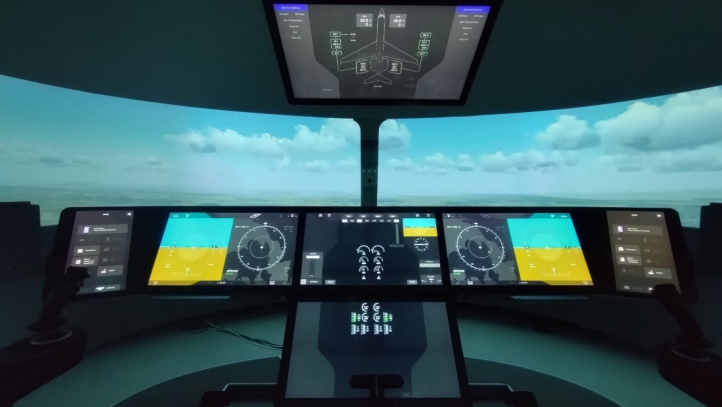
real-world implementation. The FSS is a fixed-base flight simulator capable of replicating the flight dynamics model and cockpit environment of any aircraft (Fig. 1). The HMI is composed of seven screens representing various control panels and synoptic displays. In addition to touchscreen displays, the simulator includes physical sidesticks and a motorised dual-engine throttle. The FSS has a modular architecture: HMI, aircraft dynamics and engine models, and the instructor operating station communicate by sending data packets via the user datagram protocol (UDP) over a local network. By incorporating pilot-in-the-loop testing, the simulator can evaluate the human factors aspects of the HMI under various flight conditions, including both nominal operations and fault scenarios (Korek et al., 2022; Wang et al., 2024).
Figure 1: Future systems simulator (FSS) cockpit environment.
The work presented in this paper aims to demonstrate the process of developing a prototype LH2 system layout for a next-generation aircraft, focusing on the integration of advanced programming techniques and human-centred HMI design. Through a series of simulated flight trials using the FSS, the authors, in collaboration with stakeholders, were able to see how pilots interact with the LH2 system and identify areas for further optimisation. The results contribute to the broader goal of advancing sustainable aviation technologies and supporting the industry’s transition to a low-carbon future.
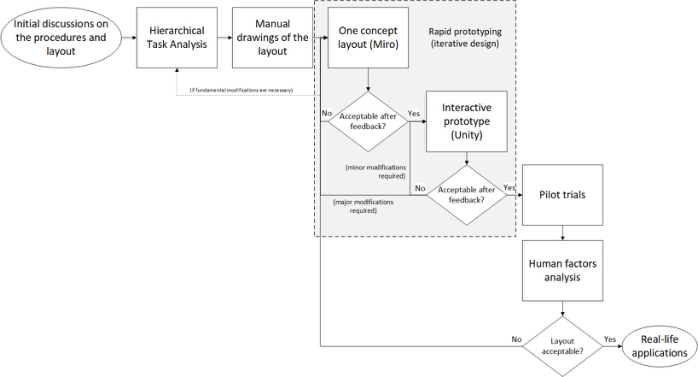
DESIGN PROCESS The design of the LH2 system layout followed the human-centred and iterative approach, shown in Fig. 2. The flow chart illustrates the steps taken from the early design stages to pilot trials and human factors analysis. The process was divided into multiple stages, including initial discussions, task analysis, manual sketching, and digital prototyping, to progressively refine
the layout. The following sections detail each stage of the initial design process.
Initial Discussions The design process began with a series of initial meetings involving stakeholders, pilots, engineers, and human factors specialists. The main objective of these meetings was to gather initial requirements and establish a foundation for the LH2 systems procedures. Engineers presented the systems architectures, and then all participants discussed essential functions, safety considerations, and the interactions needed between the pilot and the system. It is worth noting that LH2 systems are already operational in other areas, such as the automotive and manufacturing industries (Arnold and Wolf, 2005; Hirabayashi et al., 2008). Those applications, procedures, and reports were considered. During these discussions, key tasks for managing the LH2 system in commercial aviation were outlined, which served as a basis for further analysis and development.
Figure 2: Flow chart of the LH2 layout design process.
Hierarchical Task Analysis (HTA) Following the initial discussions, human factors specialists conducted a Hierarchical Task Analysis (HTA) based on the meeting notes. HTA is a technique used to decompose complex tasks into a hierarchy of goals, sub- goals, and actions, showing the relationships between different activities required to accomplish the system’s objectives (Stanton, 2006; Stanton et al., 2013). This method provided a structured approach to understanding the tasks involved in operating the LH2 system, identifying potential points of failure, and determining the required interface elements to support the pilot’s tasks effectively. The HTA enabled a more detailed understanding of task sequences and operator requirements, which informed the subsequent development of initial layout concepts.
Developing a Liquid Hydrogen (LH2) System Layout for an Aircraft 589
Manual Drawings With the insights gained from the HTA, a series of workshops were conducted where pilots and engineers collaborated to sketch initial concepts for the fuel system interfaces. These manual drawings explored various configurations for interface elements, control layouts, and information display. The workshops allowed participants to experiment with different arrangements and identify essential features as well as areas for potential improvement. The manual sketches served as preliminary designs, offering a representation of the concepts and facilitating discussions on how to best integrate safety and usability considerations into the final layout.
One Concept Layout The manually sketched concepts were then transferred to a digital format using Miro, an online collaborative whiteboard tool. Miro (miro.com) enables team members to upload, share, and modify designs in real time, making it a suitable platform for refining interface layouts through feedback and collaborative input. The sketches were digitised and organised in Miro, where the team could evaluate multiple designs, add notes, and combine them into one concept design for each display – in this case, the overhead panel and fuel synoptics page. This early digital prototype allowed for iterative modifications, ensuring that the design addressed the initial requirements while also incorporating feedback from pilots and engineers, encapsulating the human-centred approach. Once the prototype was deemed satisfactory, it served as the basis for the development of an interactive prototype in Unity, which will be detailed next.
INTERACTIVE PROTOTYPE DEVELOPMENT IN UNITY The development of the interactive prototype for the LH2 system layout was a critical stage in the design process, focusing on translating the refined digital layout into a functional simulation environment. Unity (unity.com), a versatile game engine and application development environment, was chosen as the development platform for the LH2 system’s HMI because of its ability to program complex interactive interfaces. The platform’s multi-touch and multi-window support made it ideal for simulating the digitised control elements and touchscreen interfaces found in modern aircraft cockpits, facilitating realistic pilot interactions. Additionally, the Unity Editor enables rapid iteration and testing, allowing for quick implementation of design changes based on pilot feedback. The aircraft’s flight dynamic model and engine systems (including the entire LH2 fuel system) were developed using MATLAB Simulink, which enabled realistic behaviour of the aircraft during pilot-in-the-loop simulations, including emergency scenarios.
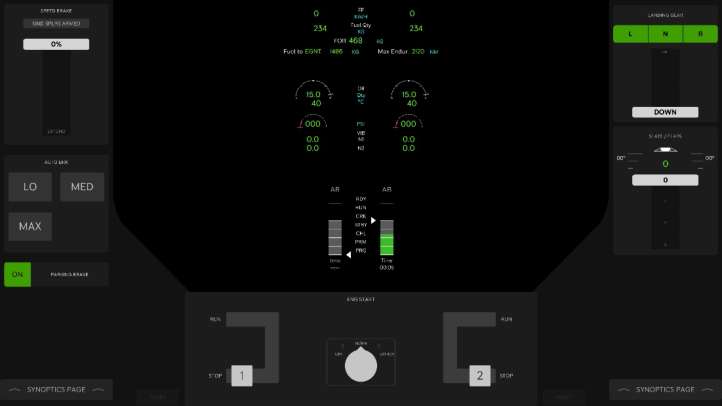
Those scenarios were implemented in the Future Systems Simulator (FSS). The LH2 interface implementation was based on an existing generic business jet cockpit layout used regularly in the FSS. The design focused on two monitors: the central lower display (CLD) and the central overhead display (COD). The CLD featured an engine startup panel, which included master levers and a crank/ignition knob, as well as synoptics pages displaying
fuel and engine parameters along with control options. This page allowed pilots to monitor critical data during various phases of flight and manage the LH2 engine startup process. Fig. 3 presents the example engine synoptics page of the CLD. The COD provided an overview and control interface for multiple aircraft systems, such as the fire isolation panel, fuel, hydraulic, electric, and air systems. The simplified fuel panel on the COD was synchronised with the CLD fuel synoptics page. Additionally, a “range rings” feature was developed for the navigation display, providing each pilot with enhanced situational awareness of the range capabilities based on the fuel and flight conditions.
One of the challenges in developing the LH2 interface was the integration of automatic system control from the engine model and pilot overrides, i.e. the interface needed to accommodate scenarios where the engine model could autonomously control components such as valves and pumps while still allowing the pilot to override these controls if necessary. The “control- loop” algorithm managed the state of each toggle, lever, or knob by setting their positions based on incoming data from the model and then sending the updated state back to the model to ensure synchronisation. When the pilot made a manual adjustment, a 0.1-second “lock” flag was set in the element’s structure to prevent it from reverting to the previous state. This lock was necessary because it took two “frames” of operation for the system to register the new value: sending the manually changed state to the model first and then receiving an updated value back from the model. The brief lock ensured that the element did not revert to its old position due to the model sending back the prior state one frame after the manual change. This approach prevented unintended changes caused by synchronisation delays.
Figure 3: An example of FSS engine synoptics page on the central lower display.
Developing a Liquid Hydrogen (LH2) System Layout for an Aircraft 591
Another challenging novelty of the new interface was that significantly more variables had to go through the network than the existing FSS architecture. The new values included the state of each system’s element, from wires, pipes, tanks, valves, and pumps in the synoptic pages to the engine levers and startup progress bars. To optimise this data flow, a custom data compression method was developed using “half-byte” encoding. By sending multiple states within a single byte using 4 bits for each single digit (0–9) value, and 1 bit for each boolean value, the data for multiple system elements could be packed into a smaller number of UDP packets. This approach significantly reduced the bandwidth requirements and ensured that the HMI could maintain real-time responsiveness even when managing large amounts of data.
PILOT TRIALS
Methodology
Five crews (10 pilots) participated in the research. Participants’ total flight experience ranged from 2000 to 15000 hours (M = 6796, SD = 4063). The research proposal was approved by the Cranfield research ethics committee before the experiments were conducted.
Following a 20-minute briefing session explaining the purpose of the trial and the functionality of the LH2 interface, the crews undertook a training flight in the FSS to familiarise themselves with the simulator capabilities. The training flight involved a 10-minute circuit of Bristol Airport (ICAO: EGGD), taking off from and landing at runway 09. Subsequently, the crews conducted a short-haul flight between Bristol Airport (ICAO: EGGD) and Newcastle International Airport (ICAO: EGNT). During the flight, they encountered four scenarios that provided the opportunity to interact with and provide feedback on the full range of the HMI’s functionality. The four scenarios included 1) an on-ground engine start failure at EGGD, 2) an inflight engine failure, 3) an inflight fuel leak, and 4) an on-ground engine shutdown at EGNT.
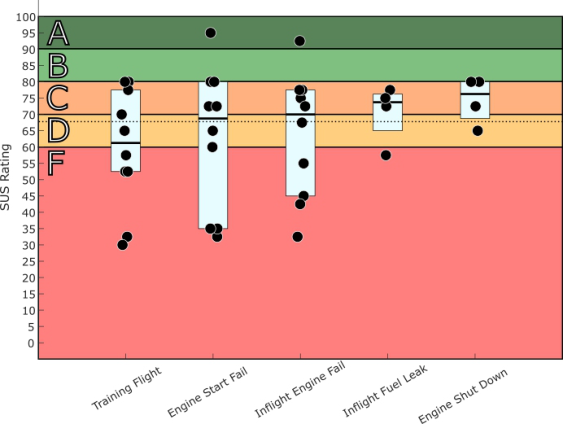
Between scenarios, each crew member completed the System Usability Scale (Bangor et al., 2008). The SUS measures system usability on ten positively and negatively worded items using a five-point Likert scale response (strongly disagree (1) to strongly agree (5)). To aid interpretation, SUS dimension scores were transformed into percentile scores and allocated usability gradings (A: > 89; B: 80–89; C: 70–79; D: 60–69; and F: < 60) based on published normative datasets. Percentile scores above 68% would be deemed above average (Bangor et al., 2008; Sauro and Lewis, 2016). After all scenarios were completed, the crews took part in a post-trial debriefing interview to provide qualitative feedback.
Results
Fig. 4 presents boxplots depicting the difference in HMI usability scores between the training flight and four scenarios according to participants’ SUS ratings. Six participants were unable to contribute usability data to two
scenarios, inflight fuel leak and engine shutdown, due to technical issues initiating the scenarios. Importantly, the HMI reached the 68% “acceptable” usability criterion on all four LH2 scenarios. Usability was rated below that criterion for the training flight only. Despite this, analysis of differences in usability between scenarios (including the training flight), using linear mixed effects analysis, revealed no significant difference (F (4.33) = 1.882, p = .137). The median usability of the HMI across scenarios was 71.25.
Corresponding positive useability feedback from pilots during the post- trial debriefing interviews was recorded. For example, pilots commented that “It was actually really intuitive” and “we’ve never seen that before. We came in, and we started an engine, and we even had a start failure, and it didn’t really phase us.” Constructive design feedback was offered in the form of improvements to the readability and salience of task critical information (“I would maybe like to see the text just a little bit bigger”), the provision of more explicit decision-making prompts (“just like a quick sort of green brilliant, the engine was relighted.”), and increasing the level of automation involved in the system interaction (“that’s clever engineering stuff in the background, but from a pilot point of view - it’s crossfeed, open or not”).
Figure 4: Boxplots for SUS ratings grouped by scenario. SUS normative grading bands from Bangor et al. (2008) are included. The dashed horizontal line represents the average SUS score - 68% - from the same normative datasets.
CONCLUSION
The development of the LH2 system layout presented in this paper demonstrates the critical role of advanced programming techniques in creating an effective HMI for future hydrogen-powered aircraft. Using a structured, human-centred design approach, the interface encapsulated the complexities of managing an LH2 fuel system during both normal and fault conditions.
Developing a Liquid Hydrogen (LH2) System Layout for an Aircraft 593
The implementation of the HMI in Unity, with its multi-touch support and rapid prototyping capabilities, enabled the development team to visualise and test interface elements in a realistic simulation environment. This choice proved essential for iteratively optimising the interface based on pilot feedback. The interactive prototype seamlessly interacted with the FSS HMI and aircraft model. The developed algorithms ensured smooth control exchange between the automated engine systems and manual pilot inputs, preventing unintended state changes.
A significant challenge was the need to compress large amounts of real- time data to optimise communication between the engine fuel model and the HMI. By implementing custom encoding, it was possible to efficiently transmit system state information without compromising performance. This technique played a vital role in maintaining the HMI responsiveness, even under heavy data loads.
Pilot-in-the-loop evaluation of an LH2 flight deck interface demonstrated how following a user-centred design approach can deliver an interface with “acceptable” usability within the first iteration of the design process. While no significant usability differences were found between different test scenarios, feedback from pilots highlighted areas for further refinement, particularly regarding the readability of information and the automation of certain system elements.
The trials have shown that the next research should focus on refining the time-critical aspects of emergency scenarios to better support pilot decision- making, especially under conditions where the startle effect compromises situational awareness. Additionally, exploring different levels of automation in the HMI design will help determine the balance between manual control and system autonomy, ensuring that the interface remains intuitive and safe in real-world operations. Further testing with alternative prototypes will help to identify the optimal configuration for future hydrogen-powered aircraft cockpits.
ACKNOWLEDGMENT
The authors would like to thank Rolls-Royce, easyJet and Cranfield University FSS Team for their engagement in this project. Co-financed by “Development of Human-Machine Interface for Hydrogen-powered Aircraft” (LH2) and “Powerplant Integration of Novel Engine System” (PINES) projects, Rolls-Royce Plc.
REFERENCES
Afonso, F., Sohst, M., Diogo, C. M. A., Rodrigues, S. S., Ferreira, A., Ribeiro, I., Marques, R., Rego, F. F. C., Sohouli, A., Portugal-Pereira, J., Policarpo, H., Soares, B., Ferreira, B., Fernandes, E. C., Lau, F., Suleman, A., 2023. Strategies towards a more sustainable aviation: A systematic review. Progress in Aerospace Sciences 137, 100878. https://doi.org/10.1016/j.paerosci.2022.100878
Arnaldo Valdés, R. M., Burmaoglu, S., Tucci, V., Braga da Costa Campos, L. M., Mattera, L., Gomez Comendador, V. F., 2019. Flight Path 2050 and ACARE Goals for Maintaining and Extending Industrial Leadership in Aviation: A Map of the Aviation Technology Space. Sustainability 11, 2065. https://doi.org/10.3390/su 11072065 Arnold, G., Wolf, J., 2005. Liquid Hydrogen for Automotive Application Next
Generation Fuel for FC and ICE Vehicles. TEION KOGAKU (Journal of Cryogenics and Superconductivity Society of Japan) 40, 221–230. https://doi.org/ 10.2221/jcsj.40.221 Bangor, A., Kortum, P. T., Miller, J. T., 2008. An Empirical Evaluation of the System Usability Scale. International Journal of Human–Computer Interaction 24, 574–594. https://doi.org/10.1080/10447310802205776 Capoccitti, S., Khare, A., Mildenberger, U., 2010. Aviation Industry - Mitigating Climate Change Impacts through Technology and Policy. Journal of technology management & innovation 5, 66–75. https://doi.org/10.4067/S0718- 27242010000200006 Cardone, L. M., Petrone, G., De Rosa, S., Franco, F., Greco, C. S., 2024. Review of
the Recent Developments About the Hybrid Propelled Aircraft. Aerotec. Missili Spaz. 103, 17–37. https://doi.org/10.1007/s42496-023-00173-6 Hirabayashi, H., Makida, Y., Nomura, S., Shintomi, T., 2008. Liquid Hydrogen Cooled Superconducting Magnet and Energy Storage. IEEE Transactions on Applied Superconductivity 18, 766–769. https://doi.org/10.1109/TASC.2008. 920541 Korek, W. T., Beecroft, P., Lone, M., Bragado Aldana, E., Mendez, A., Enconniere, J.,
Asad, H., Grzedzinski, K., Milidere, M., Whidborne, J., Li, W.-C., Lu, L., Alam, M., Asmayawati, S., Del Barrio Conde, L., Hargreaves, D., Jenkins, D., 2024. Simulation framework and development of the Future Systems Simulator. The Aeronautical Journal, 128(1330), 2754–2780. https://doi:10.1017/aer.2024.91 Korek, W. T., Li, W.-C., Lu, L., Lone, M., 2022. Investigating Pilots’ Operational Behaviours While Interacting with Different Types of Inceptors, in: Harris, D., Li, W.-C. (Eds.), Engineering Psychology and Cognitive Ergonomics. Springer International Publishing, Cham, pp. 314–325. https://doi.org/10.1007/978-3- 031-06086-1_24 Landman, A., Groen, E. L., van Paassen, M. M. (René), Bronkhorst, A. W.,
Mulder, M., 2017. Dealing With Unexpected Events on the Flight Deck: A Conceptual Model of Startle and Surprise. Hum Factors 59, 1161–1172. https: //doi.org/10.1177/0018720817723428 Sarkar, S., Grandi, G., Patel, S., Sarkar, S., Grandi, G., Patel, S., 2023. Hydrogen Fuel System for Aircraft. SAE International Journal of Advances and Current Practices in Mobility 5, 1793–1804. https://doi.org/10.4271/2023-01-0976 Sauro, J., Lewis, J. R., 2016. Quantifying the User Experience: Practical Statistics for
User Research. Morgan Kaufmann. Schutte, J. S., Payan, A. P., Briceno, S. I., Mavris, D. N., 2015. Hydrogen-Powered Aircraft, in: Encyclopedia of Aerospace Engineering. John Wiley & Sons, Ltd, pp. 1–13. https://doi.org/10.1002/9780470686652.eae1024 Sethi, V., Sun, X., Nalianda, D., Rolt, A., Holborn, P., Wijesinghe, C., Xisto, C.,
Jonsson, I., Grönstedt, T., Ingram, J., Lundbladh, A., Isikveren, A., Williamson, I., Harrison, T., Yenokyan, A., 2022. Enabling Cryogenic Hydrogen-Based CO2-Free Air Transport: Meeting the demands of zero carbon aviation. IEEE Electrification Magazine 10, 69–81. https://doi.org/10.1109/MELE.2022.3165955
Developing a Liquid Hydrogen (LH2) System Layout for an Aircraft 595
Stanton, N. A., 2006. Hierarchical task analysis: Developments, applications, and extensions. Applied Ergonomics, Special Issue: Fundamental Reviews 37, 55–79. https://doi.org/10.1016/j.apergo.2005.06.003 Stanton, N. A., Salmon, P. M., Rafferty, L. A., Walker, G. H., Baber, C., Jenkins, D. P.,
2013. Human Factors Methods: A Practical Guide for Engineering and Design. Taylor & Francis Group, Milton, United Kingdom. Treleaven, N. C. W., Puggelli, S., Mercier, R., Leparoux, J., Sun, X., Sethi, B., 2023.
High Altitude Relight Performance of Hydrogen-Air Micromix Combustion Systems. Presented at the ASME Turbo Expo 2023: Turbomachinery Technical Conference and Exposition, American Society of Mechanical Engineers Digital Collection. https://doi.org/10.1115/GT2023-103970 Wang, Y., Li, W.-C., Korek, W. T., Braithwaite, G., 2024. Future flight deck design: Developing an innovative touchscreen inceptor combined with the primary flight display. International Journal of Industrial Ergonomics 101, 103588. https://doi. org/10.1016/j.ergon.2024.103588 Yilmaz, N., 2022. Comparative energy and environmental assessment of battery
technologies and alternative fuels in sustainable aviation. International Journal of Green Energy 0, 1–10. https://doi.org/10.1080/15435075.2022.2075226 Yusaf, T., Fernandes, L., Abu Talib, A. R., Altarazi, Y. S. M., Alrefae, W., Kadirgama, K., Ramasamy, D., Jayasuriya, A., Brown, G., Mamat, R., Dhahad, H. A., Benedict, F., Laimon, M., 2022. Sustainable Aviation—Hydrogen Is the Future. Sustainability 14, 548. https://doi.org/10.3390/su14010548
LISTED IN THE AHFE DIGITAL BOOKSTORE CATALOGUE
Explore the complete digital volume
Intelligent Human Systems Integration (IHSI 2025): Integrating People and Intelligent Systems
Read this individual research paper free through the original publisher, or explore the full digital proceedings book.
ISBN 978-1-964867-36-6
Explore this ISBN in the AHFE Bookstore ↗Listed in the July 2026 bookstore catalogue; search by ISBN to confirm current availability · Digital book purchase optional