Katriina Heljakka, Pirita Ihamäki (2025). AIToys: A conceptual definition and future research agenda. In: Artificial Intelligence and Social Computing. AHFE Open Access, vol. 163, pp. 67–78. https://doi.org/10.54941/ahfe1006037
This paper introduces the conceptual definition of AIToys, which expands on IoToys to incorporate AI capabilities. AIToys are envisioned as life-long play partners with life-wide implications in play across leisure, learning, and work life. They range from educational robots to anthropomorphized or zoomorphized social and conversational companions, exemplifying the growing robotification of toy play across generations. We explore the concept of AIToys through fictional stories, theoretical perspectives, and toy industry offerings, representing the recent evolution of IoToys, namely AIToys. These toys can learn from our behavior and adapt to how we interact, and each has a persuasion strategy to provoke emotional responses. Our research aims to define the characteristics of AIToys, identify current challenges demanding more research, and propose development directions for sustainable and ethically responsible AIToy design.
The rise of digital technology has fundamentally changed the nature of play, making smart and connected devices an essential part of children’s daily lives. Toys integrated with technologies are, for example, called smart and robotic. The evolution of digital technologies has made it possible to see these digital toys as ‘play machines’ that often involve screen-based, digital play (Heljakka, 2024a). As digitalization continues to shape childhood experiences, the boundaries between traditional toys (physical and three- dimensional), technological playthings as well as the intermix of digital media with robotics will become increasingly blurred as regularly updated content for play is channeled through screens and sensor technology (Heljakka, 2024b). The evolution of conversational AI applications, such as ChatGPT, a popular “AI toy,” enabling AIPlay (Heljakka, 2024a; Kangas & Heljakka, 2024), has given rise to AI-enabled toys. AIToys represent the evolution of digital play, integrating artificial intelligence to create adaptive, interactive, and personalized experiences with a life-like presence. Unlike pre- programmed or remotely controlled IoToys, AIToys utilize machine learning, computer vision, and real-time data processing to engage with users more
sophisticatedly. These toys are designed to recognize patterns, interpret emotions, and respond accordingly, offering new possibilities in life-long and life-wide play within education, entertainment, and even work life. AIToys range from educational robots to anthropomorphized or zoomorphized social and conversational companions and ‘pets’, exemplifying the growing robotification of toy play across generations. As AI-driven play with these new, interactive, expressive, responsive, and persuasive ‘toy friends’ (Heljakka & Ihamäki, 2019) becomes more prevalent, it is essential to understand its implications for the learning, cognitive development as well as physical and emotional well-being of players of all ages.
AIToys are already available on platforms such as Amazon. They are anticipated to experience remarkable growth by soaring from their present value of USD 2,248.70 million in 2024 to USD 8,461.20 million by 2034 (Future Market Insights, n.d.) but lack a coherent, conceptual approach. This paper introduces the conceptual definition of AIToys, which expands on a previous category of ‘smart’ and internet-connected toys—IoToys—to incorporate AI capabilities. Our research addresses a gap in previous studies by providing a unified definition and presenting sustainable development directions for ethically responsible AIToys innovation and designs as researchers of technological toys, including smart and connected toys, their applications, and the play cultures and societal impacts surrounding them.
Our multi-partite study examines the speculative beginnings of AI-enabled toys by turning to research on speculative toy fiction, explores the transition from IoToys to AIToys through earlier investigations in the field, and proposes a future research agenda. Our research draws from a synthesis of insights from previous studies on speculative toy fiction, research on IoToys, and an analysis of media and industry articles related to current AIToys. Through these interdisciplinary perspectives, we seek to contribute to the ongoing discourse on the role of artificial intelligence in toy design and post-digital play culture.
METHODS
Our research is based on a multidisciplinary review covering research on smart and connected toys, or IoToys, (Wang et al., 2010; Peter et al., 2019, Hall et al., 2022; Heljakka 2024a). We also utilize speculative toy fiction (Heljakka, 2022) as a future-oriented research tool to explore potential applications and challenges associated with AIToys. Finally, we examine AI- enabled toy descriptions originating in company websites, media, and toy industry articles reporting extant AIToys to understand their dimensions. These materials are analyzed by themes and employed to answer the following research questions: What makes a toy an “AIToy”? This leads to the question: How can AIToys be defined? What challenges do they present for society that could be researched? And finally, which guidelines for AIToys design can we suggest?
AIToys: A Conceptual Definition and Future Research Agenda 69
BACKGROUND
The history of toy development intermingles with technological innovations. With the multitude of emerging AI applications, a new category of toys is entering the marketplace, namely AIToys. This category has evolved with IoToys, or Internet-connected toys, which in the decade 2010–2020 introduced new dimensions of interactivity, enabling players to engage with digital content through smart functionalities (Kafai, 2021).
IoToys, such as coding robots like Dash (2014), have a three-dimensional presence and persuade players to interact through various affordances related to receptive, manipulative, embodied, and contingent interaction. “Like toys in general, IoToys may provide physical, functional, fictional, and affective play experiences (Paavilainen & Heljakka, 2018). Physical experiences are delivered through their materiality (appearance, weight, and durability), functional experiences through mechanics (touch-sensitive surfaces), fictional experiences through storytelling capacities (producing content that augments its apparent personality), and affective experiences through emotional connection potentials (rounded shapes, plump bodies, welcoming posture, pleasant surface textures)” (Heljakka, 2024b).
Palaiologou et al., (2021) note the communicative ability of IoToys, which differentiates them from traditional toys. The IoToys can be updated with play-related content through online connectivity, such as storytelling, coding exercises, and various mini-games (Heljakka & Ihamäki, 2019). Wang et al., (2010) provide an early overview of smart social toys and their ability to interact with users through networked platforms, emphasizing their connectivity rather than intelligence. This distinction is crucial, as the AIToys defined in this paper incorporate machine learning, computer vision, and adaptive AI responses, setting them apart from pre-programmed or remotely controlled IoToys. Beyond their interactive features, AIToys raise important ethical, social, and technological questions. How do these toys influence human relationships with technology? What are the long-term effects of AI-enabled companionship in play? How can designers ensure AIToys promote safe, inclusive, and meaningful interactions? Additionally, data privacy, security, and sustainability issues must be addressed as digital toys become more intelligent. This paper offers some ideas of how this can be achieved. Let us begin with insights gained in research on speculative toy fiction, where we think that the conceptual evolution of AIToys began.
FINDINGS Speculative Perspectives on AIToys
Science fiction has long been a playground for imagining future toys, often presenting them as companions, educators, or alternatively, threats. These narratives provoke confusion and fear and serve as cautionary tales or blueprints for real-world toy developers. We believe AIToys evolved by envisioning them first as Artificial Toy Friends in science fiction literature. While science fiction “is the art of the plausible” (Aldiss, 1969), it is also possible to see how more recent popular storytelling gives us a glimpse of
70 Heljakka and Ihamäki
both utopian, possible, and dystopian views of toys to come. Heljakka (2022) introduced the concept of speculative toy fiction, which examines how fiction explores the evolving relationship between toys, play, and technology. She argues that sci-fi stories predict future toys and actively shape consumer expectations, ethical discussions, and design choices.
Renowned play scholar Sutton-Smith (1986) describes toys as baubles and intellectual machines. In Brian Aldiss’s novel Supertoys Last All Summer Long (1969), Teddy, a lifelike plush play companion and ‘intellectual machine’, serves as a companion and protector for the protagonist, David, an android. Unlike traditional toys, Teddy learns, remembers, and engages in meaningful conversations, showcasing an early vision of emotionally responsive AIToys. In fact, “Teddy” might be the first AIToy envisioned in popular fiction. More examples of toy stories envisioning AI-enabled toy friends in speculative narratives exist. Recent popular movies such as M3gan (2023) and the “Rachel, Jack and Ashley Too,” episode of Netflix’ Black Mirror series (2019), as well as the novel from Nobel-winning Kazuo Ishiguro, Klara and the Sun (2021), all represent tales of possible toys to come as part of plausible futures. These toys, or rather, Artificial Friends (AFs), represent synthetic life forms steered by controlled amounts of intelligence and who, as envisioned by Brian Aldiss in his novel, “will always answer, and the most vapid conversation cannot bore him” (Aldiss 1969/2001, p. 7). While these dystopian tales provoke tension, skepticism, and mistrust in new technologies by directing us to think about what we do not want from augmented technologies, there are some instances of more positive developments of Human-Robot-Interaction (HRI). For example, in the animated family movie Ron’s Gone Wrong (2021), Ron is an AIToy designed to be a social companion for children. Ron is a highly personalized and adaptable AI friend, capable of learning and evolving based on its owner’s personality. Unlike mass-produced AIToys in fiction that follow corporate-controlled AI behavior, Ron’s malfunction allows it to develop emotional intelligence, autonomy, and ethical reasoning—making it a more authentic and meaningful companion. All of the narratives above provoke questions about the toys’ liveness, but also the possibility of companionship, even friendship, enabling engaging playful interaction with the intelligent machines. Based on the learnings from the speculative toy fiction described and to avoid the pitfalls the stories suggest, the key aspects of AIToys as possible AFs summarized would be to emphasize reciprocal and meaningful interaction, empathy, and trust as cornerstones of true companionship.
Theoretical Perspectives on the Evolution of IoToys to AIToys Already in 1998, Resnick and colleagues predicted the emergence of smart and Internet-connected toys by claiming: “Old toys will become smarter. New toys will become possible. All toys will be connected.” IoToys leverage internet connectivity and cloud computing to provide interactive experiences. They collect data, transmit it to external servers, and often rely on predefined responses or remote updates. This challenges social and ethical concerns (e.g., privacy, security risks, and impact on play behavior). IoToys proliferated in
AIToys: A Conceptual Definition and Future Research Agenda 71
the 2010s (Wang, 2010). This category includes toy robots and educational smart plush toys, such as the Dash coding robot and Junior Smart Bear (Heljakka & Ihamäki, 2019). As defined by Peter et al., (2019, p. 29), these toys: “are devices that need energy, rely on one or more types of sensors (e.g., visual, audio, haptic), are software-controlled smart and connected toys, are both smart and connected toys that interact with children, may be able to move in the physical world.” While both IoToys and AIToys enhance play experiences with digital intelligence, IoToys, like IoT, prioritize connectivity and data exchange. In contrast, AIToys focus on AI-driven learning and autonomy (Velit, 2023), operating offline as well. Some toys may integrate both technologies, but the key distinction lies in whether the toy merely connects and retrieves data (IoToys), is context-aware, or actively learns and adapts (AIToys). While the learning capability of IoToys is limited, AIToys evolve with the player. The key properties of each category of technologies used in the toys are summarized in Table 1.
Table 1: IoToys and AiToys, key differences summarized.
Table available in the original PDF paper.
Feature IoToys AIToys May function offline with Primary technology Internet of Things Artificial Intelligence (AI) Connectivity Dependency Requires constant or
periodic internet access
Context-aware, adaptive
AI models embedded Interactivity Type Predefined responses
triggered by input
Learns and evolves with
responses Learning Capability Limited; mostly
pre-programmed
Higher; can operate
user interactions Autonomy Minimal; cloud-based
processing
AI-driven toys as
independently Examples Smart toys (e.g., Dash,
Junior Smart Bear)
presented in Table 2
Toy Industry Perspectives on AIToys So far, it has been presented that AIToys strive to function as companions and differ from other smart and connected toys due to their learning ability. To further our understanding of AIToys, we selected extant examples from the toy market and explored their physical, functional, and affective dimensions. We intentionally omitted the fictional dimension from our analysis, as it merges with the toy type and aesthetics (physical dimension). According to our study, to their physical dimension, AIToys represent fantastic creatures of robots with either zoomporphisable or anthropormorphisable features, referring to their liveness that mimics animal or human forms. How these new ‘toy friends’ are categorized by the industry demonstrates their functional dimensions—mechanical abilities and digital affordances (sound, light, movement, sensor technology) to serve the player’s needs. Essentially, all AIToys interact and thanks to their learning ability, the toys offer personalized interactions as they learn from their users.
72 Heljakka and Ihamäki
An analysis of industry and media articles illustrates that many extant AI-enabled toy characters are referred to as robots, robotic pets, assistants, or AI tutoring companions. Yet, despite their functional uses as educational devices that provide assistance and companionship, their aesthetics are very toy-like, often leaning on cuteness. The aspect of toy-ness alongside the toys’ affective dimension—their persuasion strategies to provoke emotional responses and to elicit amusement and affection is key to building trust and true companionship. Curiously, based on our readings of the toy industry and media materials (see Table 2), their possibility to function as play partners does not come across as strongly as the tendency to assist in learning or in the request to be treated as pets.
Table 2: Dimensions of AIToys according to industry and media materials.
Table available in the original PDF paper.
AIToy (Examples) Physical Dimension
Affective
(Toy Type)
Functional Dimension a) Interaction Type b) Learning Ability
Dimension (Persuasion Strategy to Provoke Emotional Responses Builds an a) Conversational,
Small and cute
ROPET (2025) robotic pet
Sensor-Based b) High (Learns user habits)
emotional bond with users through personalized interactions and adaptive responses
robotic pet with plush body (emotional and social companion), expressive movements and LED-lit facial expressions
Engages children
a) Conversational,
Small, rounded
MIKO 3 (2025) robot
Educational b) High (Adaptive responses)
robot out of plastic with a screen interface (educational and entertainment assistant) Robot with
a) Motion-Based,
Encourages
through voice and facial recognition, adapting to their emotions and interests AIRO (2025) robot
Educational b) Medium (Tracks & mimics movement)
emotional connection by reacting positively to user movements and learning patterns
articulated limbs and a screen display for animated facial expressions (learning and movement tracking robot)
Continued
AIToys: A Conceptual Definition and Future Research Agenda 73
Table 2: Continued AIToy (Examples) Physical Dimension
Table available in the original PDF paper.
Affective
(Toy Type)
Functional Dimension a) Interaction Type b) Learning Ability
Dimension (Persuasion Strategy to Provoke Emotional Responses)
Small interactive
Builds emotional
FOLOTOY (2024)
a) Interactive, Conversational
AI assistant toy
b) Medium (Adjusts engagement)
engagement through conversation, game-like interactions, and learning adaptability
toy with an LED screen for expressive visuals (engagement tool designed for interactive learning and companionship)
Strengthens the
a) Storytelling,
Soft plush bear
PLAYI POE BEAR (2024) plush toy
Interactive (AI-generated content) b) Medium (Adapts stories)
embedded with AI-driven storytelling features (storytelling companion)
Engages children
a) Conversational
Plush toy with
child-toy bond through immersive and personalized storytelling experiences GROK (2023) plush toy
AI b) Medium (Improves with updates)
emotionally by creating personalized narratives and responding to their creativity
integrated AI capabilities, designed with a minimalistic but interactive appearance, cute aesthetics (conversational assistant) Humanoid-like
Encourages deep
MOXIE (2020)
a) Emotional, Conversational
humanoid robot companion
b) High (Personalized interactions)
emotional connections by recognizing emotions and responding empathetically
design with soft, approachable features, expressive eyes, and animated gestures (designed for socio-emotional learning)
Continued
74 Heljakka and Ihamäki
Table 2: Continued AIToy (Examples) Physical Dimension
Table available in the original PDF paper.
Affective
(Toy Type)
Functional Dimension a) Interaction Type b) Learning Ability
Dimension (Persuasion Strategy to Provoke Emotional Responses)
Small, colorful,
Uses friendly voice
ROYBI (2020)
a) Educational, Language Learning
robot
b) High (Adaptive learning)
cylindrical robot (educational tutor) with a speaker and animated LED face
interactions and animated expressions to create a supportive learning environment
AIToys, A Definition What makes a toy an “AIToy”? First, as described, the toy needs AI integration, enabling machine learning, interactivity, adaptability, and autonomy, which differentiates AIToys from other smart and connected toy technologies and traditional toys in general. Second, key capabilities of AIToys include variations in interactivity leveraged, e.g., through meaningful conversations, physical motion, and emotional cues. Further, based on our findings from speculative toy fiction, we emphasize reciprocal and meaningful interaction, empathy, and trust as cornerstones of true companionship between the human and AIToy.
To involve generative AI in the co-creative process of this paper, we asked ChatGPT (11.2.2025) for a definition of AIToys and were suggested the following definition: AIToys are interactive play objects embedded with artificial intelligence (AI) that enable adaptive, autonomous, and personalized experiences through learning, perception, and decision-making. These toys leverage AI techniques such as machine learning, natural language processing, computer vision, and robotics to engage users dynamically, responding to stimuli in real-time and evolving based on interactions.
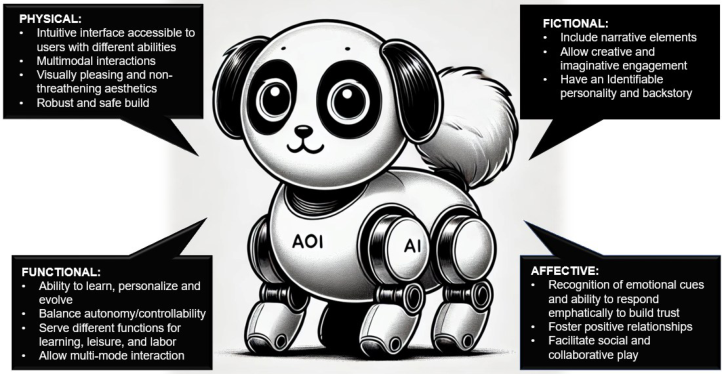
While this working AI-generated definition of AIToys is satisfactory, we would like to add the importance of AIToys to foster play multidimensionally, a facet of interaction that is less accentuated in current conversations on AIToys, rather focusing on their technological affordances. To provide help in future work in this field, we propose the Framework of the dimensions of the AIToys experience, which encompasses the dimensions of physical, functional, fictional, and affective with explained facets important to playful toy-human interaction (see Figure 1).
AIToys: A Conceptual Definition and Future Research Agenda 75
Figure 1: Framework of the dimensions of the AIToys experience including an AI-generated image of an AIToy with the physical, functional, fictional, and affective dimensions considered. Image generated with ChatGTP (11.2.2025).
Establishing a Future Research Agenda Beyond their interactive features, AIToys raise essential educational, social, and ethical questions. The existing but limited literature underscores the need for a more structured, interdisciplinary approach to AIToys research, which includes design, human psychology, and regulatory and ethical frameworks. An additional issue yet essential question that needs to be addressed is how these toys promoting liveness change play dynamics. A key question is then how human players engage, perceive, and form relationships with AI-driven entities. What are the long-term effects of AI-enabled companionship in play? More user experience studies with players of different backgrounds and contexts are needed to answer these questions. While Wang et al., (2010) provide an early glimpse into AI-enhanced toy ecosystems, recent studies like Anwar (2024) demonstrate that the field has evolved rapidly, requiring new frameworks to evaluate AI’s role in play-based learning, social development, and ethical AI governance. Future research could explore: How AIToys influence experiences of meaningfulness, enjoyment, and cognitive and emotional growth over extended periods and investigate the role of AI companionship in childhood development, adulthood, and human-AI socialization. Regulatory frameworks for ensuring transparency, security, and ethical AI use in toys are also needed.
AIToys Design Guidelines: Ensuring Sustainable Play Engagement Sci-fi imagines what AI toys could become, but real-world developers must decide what they should be. How can designers ensure that AI toys promote safe, inclusive, and meaningful interactions? Promoting meaningful connections with AI-enabled toys includes responsible and user-centered design ideas, some of which are synthesized next.
76 Heljakka and Ihamäki
Hassinger-Das and colleagues (2017) state that extra effort will be required to ensure that developed toys provide the same enriching experience as their traditional counterparts. If a toy is augmented with technology, all traditional toy qualities should be present, and the technology enhancements should provide added value. State-of-the-art toys no longer invite play; they actively persuade, instruct, and demand attention in paralleling their assistance, tutoring, and companionship. But the relationship should be balanced: Players must care for and nurture these AFs and synthetic life forms, shifting the traditional role of toys from passive objects to interactive and emotional companions with their own needs.
Designing AIToys that meet the needs of children, adults, and society involves a delicate balance between technological innovation, emotional intelligence, ethical responsibility, and practical functionality. Based on the insights derived from science fiction, current industry innovations, and research into contemporary play, the following design guidelines aim to create safe, inclusive, and meaningful AIToys that encourage positive (and playful) human interaction and engagement throughout the lifespan.
AIToys presents a promising avenue for addressing many challenges associated with contemporary play, such as (passive) screen time, addictive content, indoor encapsulation, and isolation from other players. Beyond the ideas suggested above, our final insights for ensuring sustainable engagement with AIToys include: How they can be played with and paying attention to how long intervals the AIToy can be played with, when they can be played with, and where they can be played with. Moreover, designers could consider how to address the following: 1) Accessibility through multimodality (interaction beyond screens) liberates humans from customary device use. It allows a richer variety of interactions that involve human bodies and senses. 2) Content for play addressing the needs of life-long as well as life-wide implications, including leisure, learning, and work life that can regulated to promote healthy lifestyles (e.g., steer attention towards the world and real-world phenomena) and that is age-appropriate catering to stimulation of creativity, relaxation, and comfort depending on player needs. 3) Mobilization of players through portability and movements in the toy that inspires movement in players both indoors and outdoors, solitarily and socially. 4) Meaningful communication through customization to support both intrapersonal and interpersonal communication, offering comfort, support, or playful engagement. 5) Empathy helping users navigate feelings of stress, loneliness, or excitement through gentle interactions.
CONCLUSION
AIToys represent a significant shift in play, education, and social interaction evolution. Yet, so far, they have lacked a common definition, which we propose in this paper. Our study contributes to the ongoing discourse on AI’s role in shaping play and provides a foundation for future research on AIToys as tools for lifelong learning, labor, and leisure. We predict that AIToys will become a more normalized part of media-rich homes (Livingstone, 2007), and their popularity will expand to include adult users and players due to
AIToys: A Conceptual Definition and Future Research Agenda 77
the kidult phenomenon (Heljakka, 2024a), as adults will be purchasing more toys to themselves for the interests of leisure, learning, and work life. Sutton- Smith (1986) reassures that toys are in our control rather than vice versa. In an AI era, the AIToys agency raises many questions and concerns. They require sustainable, ethically aligned design principles to address pressing challenges such as privacy, inclusivity, and social sustainability. Alongside researching accessibility, cost, and cultural responses to AIToys, which are not discussed in our paper, future research should explore further guidelines for responsible AIToy development. Positive instances of speculative toy fiction, such as Ron’s tale in the movie Ron’s Gone Wrong, offer a novel approach for envisioning preferable and friendlier AIToy futures, ensuring their integration aligns with societal values. This study contributes to the ongoing discourse on AI’s role in shaping play and provides a foundation for future research on AIToys as tools for lifelong learning, leisure and work.
REFERENCES
Aldiss, Brian (1969/2001). Supertoys last all summer long. And other stories of futuretime. A novel. Saint Martin⣙s Press Anwar, Ahmad Choiru (2024). The Integration of Internet of Toys in early childhood
education. Research from Australia, England, and Norway. Asia Pacific Journal of Educ., 1–4. Aldiss, Brian (1969/2001). Supertoys last all summer long. And other stories of future time. A novel. Saint Martin’s Press. Future Market Insights (n.d.) Smart AI Toys – Transforming Learning & Interactive
Play https://www.futuremarketinsights.com/reports/smart-ai-toys-market. Hall, Lynne, Paracha, Samiullah, Flint, Tom, MacFarlane, Kate, Stewart, Fiona, Hagan-Green, Gillian, Watson, Derek (2022). Still looking for new ways to play and learn… Expert perspectives and expectations for interactive toys. International Journal of ChildComputer Interaction, 31. Hassinger-Das, Brenna, Zosh, Jennifer M., Hirsh-Pasek, Kathy, Michnick Golinkoff,
Roberta (2017). Toys. In Peppler, Kylie (Ed.) The SAGE Encyclopedia of Out-of School Learning. Thousand Oaks: SAGE Publications, pp. 781–783. Heljakka, Katriina I. (2022). Reading Ron Right: Speculative Toy Fiction, Friendship and Design of Future IoToys. Proceedings of the 25th Mindtrek Conference, pp. 334–338. Heljakka, Katriina (2024a). How Play Moves Us: Toys, Technologies, and Mobility
in a Digital World. Doctoral dissertation. Annales B 658, University of Turku. Heljakka, Katriina (2024b). Screens & Links: Playful Affordances of Future Friends.
In J. Banks (Ed.) Agent, Assembled: The Relational and Technical Anatomy of Social Robots. Peter Lang Publishing.
78 Heljakka and Ihamäki
Heljakka, Katriina, Ihamäki, Pirita (2019). Persuasive toy friends and preschoolers: Playtesting IoToys. In Mascheroni, Giovanna, & Holloway, Donell (Eds.) The Internet of toys: Practices, affordances and the political economy of children’s smart play, Palgrave Macmillan, 159–178. Ishiguro, Kazuo (2021). Klara and the Sun, A novel. Faber & Faber. Johnstone, Gerard (2022). M3gan. Movie. Universal Pictures/Blumhouse Productions. Kafai, Yasmin B. (2021). Play and technology: Revised realities and potential
perspectives. In Play from birth to twelve and beyond. Routledge, pp. 93–99. Kangas, Marjaana, Heljakka, Katriina (2024). AI Play in Higher Education: Students’ perceptions of play and co-creation of knowledge with generative AI. In AHFE International Conference on Human Factors in Design, Engineering, and Computing AHFE International, pp. 92–101. Livingstone, Sonia (2007). Strategies of parental regulation in the media-rich home.
Computers in Human Behavior, 23(3), 920–941. Netflix (2016–2023). Black Mirror. Anthology television series. Paavilainen, Janne, Heljakka, Katriina, Arjoranta, Jonne, Kankainen, Ville, Lahdenperä, Linda, Koskinen, Elina, Kinnunen, Jani, Sihvonen, Lilli, Nummenmaa, Timo, Mäyrä, Frans, Koskimaa, Raine (2018). Hybrid Social Play Final Report. Trim research reports, (26). Palaiologou, Ioanna, Kewalramani, Sarika, Dardanou, Maria (2021). Make-believe
play with the Internet of Toys: a case for multimodal playscapes. British Journal of Educational Technology, 52(6), 2100–2117. Peter, Jochen, Kühne, Rinaldo, Barco, Alex, de Jong, Chiara, van Straten, Caroline L.
(2019). Asking Today the Crucial Questions of Tomorrow: Social Robots and the Internet of Toys. In Giovanna Mascheroni & Donell Holloway (Eds.) The Internet of Toys. Practices, affordances and the political economy of children’s smart play. Cham: Palgrave Macmillan, pp 25–46. Resnick, Mitchel, Martin, Fred, Berg, Robert, Borovoy, Rick, Colella, Vanessa, Kramer, Kwin, Silverman, Brian (1998). Digital manipulatives: new toys to think with. Proceedings of the SIGCHI conference on Human factors in computing systems, 281–287. Smith, Sarah, Vine, Jean-Philippe, Rodriguez, Octavio E. (2021). Ron’s Gone Wrong.
Animated movie. 20th Century Animation, TSG Entertainment, and Locksmith Animation. Sutton-Smith, Brian (1986). Toys as Culture. Gardener Press. Velit, Nadia (2023). AI Rising. Toybook, Dec 7, 2023 https://toybook.com/ai-risingdecember-2023-feature/?utm_source=chatgpt.com Wang, W.-N., Kuo, V., King, C.-T., Chang, C.-P. (2010). Internet of toys: an e-pet
overview and proposed innovative social toy service platform. 2010 International Computer Symposium (ICS2010), 264–269.
LISTED IN THE AHFE DIGITAL BOOKSTORE CATALOGUE
Explore the complete digital volume
Artificial Intelligence and Social Computing
Read this individual research paper free through the original publisher, or explore the full digital proceedings book.
ISBN 978-1-964867-39-7
Explore this ISBN in the AHFE Bookstore ↗Listed in the July 2026 bookstore catalogue; search by ISBN to confirm current availability · Digital book purchase optional