Xiaobu Zhou (2025). Construction and Empirical Research for User Demand-Oriented Food Product Design Pathway. In: Affective and Pleasurable Design. AHFE Open Access, vol. 164, pp. 232–241. https://doi.org/10.54941/ahfe1006079
With the globalization accelerates rapidly and consumer cultures become increasingly diverse, food design has shifted from a focus on functionality to prioritizing cultural value, emotional connection, and personalized experiences. In particular, within the realm of cultural and creative foods, the central challenge lies in integrating local culture with contemporary craftsmanship to meet the varied demands of consumers. Dali, a city rich in historical and cultural heritage, provides abundant inspiration for designing cultural and creative ice creams. However, existing designs largely rely on surface-level cultural symbols, failing to meet consumer expectations for interactivity, emotional engagement, and innovation, and neglecting the exploration of deeper cultural meanings. This shortcoming limits both the market appeal and the cultural dissemination potential of Dali's cultural ice cream.This study employs a mixed-methods approach, integrating both qualitative and quantitative techniques, and proposes a food design framework based on the F-KANO-AD-TOPSIS integrated model. The research first collects and analyzes the preferences of 26 tourists through surveys and in-depth interviews. Using the KJ method, the study identifies four major preference categories for Dali's cultural ice cream design: functionality, enjoyment, ease of use, and emotional connection. From these, 20 key user needs were distilled. The F-Kano model questionnaire was then employed to classify the demand attributes, distributing 387 questionnaires and receiving 371 valid responses. A Cronbach's alpha coefficient of 0.781 indicated the reliability of the data. Based on the prioritization of these demand attributes, 10 significant user needs were identified: a refreshing and pleasant experience, comfortable taste, color harmony, a sense of ritual and participation, brand identity, convenient and safe consumption, diverse flavors, aesthetic appeal, social engagement, and entertainment value.The study then applies AD theory to translate these user needs into functional requirements, mapping them onto 10 design parameters: improved craftsmanship, optimized formulations, color coordination, creation of immersive consumption experiences, establishment of a distinctive brand image, use of healthy ingredients, flavor enhancement, aesthetic design improvements, integration of local cultural elements, and increased enjoyment. These parameters provide a structured approach to designing cultural ice cream. Finally, the TOPSIS method was used for a multi-criteria evaluation of three design proposals. Proposal 1 emphasizes brand identity; Proposal 2 integrates brand identity with diversified aesthetics; and Proposal 3 focuses on experiential consumption methods to increase enjoyment. The results show that Proposal 2 (a diversified design centered on the cultural IP of local attractions) performs best in terms of functionality, emotional appeal, and enjoyment, with a relative closeness score of 0.931, significantly outperforming the other proposals and existing market products.The findings demonstrate that the food design framework presented in this study is both scientifically sound and practical. It not only enhances consumer satisfaction with cultural ice creams but also boosts cultural transmission and market competitiveness. This research extends the theoretical framework of cultural and creative food design and provides valuable guidance for companies in the development of cultural food products, offering a significant reference for future research and applications in this field.
Construction and Empirical Research on User Demand-Oriented Food Product 233
INTRODUCTION
Food product design integrates art, science, culture, and commerce, encompassing food shape, color, materials, and taste alongside dining environments, tableware, and presentation. Recent studies highlight the importance of user preferences in food product design. For instance, Ge and Liu (2024) explored bakery food design through experiential approaches, while Liu and He (2023) examined cultural genes in food design. Despite these advances, most research remains a lack of systematic exploration into integrating cultural elements with user-centered innovation. Thus, constructing a user demand-oriented food design path is crucial for enhancing user satisfaction, innovation, and market competitiveness.
USER DEMAND-ORIENTED FOOD PRODUCT DESIGN PATH CONSTRUCTION Currently, user demand is one of the primary driving forces behind innovative food design. In the design and development, it focuses on taking user demand as the primary driving force in the process of food product design, and is the source of food innovative design. Food innovative design not only considers the physical needs such as function and consumption, but also takes “people” as the center and pays attention to other needs such as user emotion, giving full consideration to practicability and science. In food product design, the designer’s primary consideration should be user needs. It can be seen that the user-demand-oriented design method has become the key to research and development (Zhao et al., 2022). Therefore, the food product design research method based on user needs plays a key guiding role in optimizing and innovating food product design.
Recent studies utilize methods such as F-Kano, AD, AHP, SEM, and TOPSIS for analyzing user demands in food design. F-Kano, AD, and TOPSIS provide effective tools for classifying user needs and evaluating solutions.
DESIGN AN EMPIRICAL STUDY With the improvement of living standards and the upgrading of consumption, cultural and creative ice cream as a common food continues to flood the market. Cultural and creative ice cream is a kind of food that combines cultural IP with modern product design, which has the dual attributes of culture and consumption. On the one hand, it can promote cultural transmission and inheritance, increase the emotional interaction with users, and establish a good cultural image; On the other hand, it can stimulate consumption and promote the optimization and development of the food industry, thereby enhancing economic benefits (Chen and Xie, 2022). Existing designs often fail to deeply explore user satisfaction and cultural engagement due to limited demand mining and insufficient design evaluation. Therefore, this study conducted an in-depth study on the design of cultural and creative ice cream.
Dali, a famous tourist resort, offers cultural ice cream designs but faces challenges in addressing user satisfaction, cultural engagement, and
234 Zhou
innovation. This study integrated F-Kano-AD-TOPSIS to demonstrate design improvements based on user needs.
Dali Ancient City Cultural and Creative Ice Cream Demand Mining in Yunnan In view of the existing problems in the design of cultural and creative ice cream in Dali Ancient City Scenic spot, the needs of tourists in the process of eating cultural and creative ice cream are clarified. This study analyzes the factors of user preference in food product design of cultural and creative ice cream in Dali Ancient City by means of questionnaire survey, interview and observation. A sample of 26 tourists was interviewed to understand user preferences and challenges.
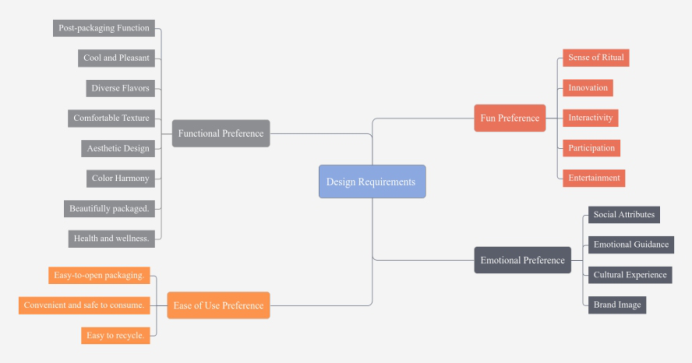
Based on interviews and analysis, the following issues were identified in the design of Dali Ancient City cultural and creative ice cream: the designs are simple, with limited taste variations, primarily cream, resulting in low re-purchase rates. The cultural elements are superficial, failing to convey the deeper cultural connotations of Dali Ancient City. Additionally, high prices and a lack of engaging or memorable experiences reduce broader appeal and economic benefits. Existing designs lack emotional expression, providing little emotional value or connection for tourists. Using the KJ method, this study categorized the design requirements of Dali Ancient City cultural and creative ice cream into four preference types: function, fun, ease of use, and emotion. These were expanded into 20 detailed user requirements (Li and Zhang, 2024, Yu et al., 2022), as shown in Figure 2.
Figure 1: User design requirements for cultural and creative ice cream in Dali (created by the author, 2024).
Construction and Empirical Research on User Demand-Oriented Food Product 235
Preference Analysis of Functional Requirements for Dali Cultural and Creative Ice Cream Design The functional preference elements are the basic elements of the design of Dali Ancient City cultural and creative ice cream. In the functional requirements, exquisite packaging, beautiful appearance, color coordination, diversified tastes, comfortable taste, cool and pleasant taste meet the basic functional needs of most tourists to pursue appearance, taste and heat relief; The post packaging function enables tourists to make secondary use of the cultural and creative ice cream after eating it, which can increase the interactive interest of the cultural and creative ice cream; The demand for health preservation not only conforms to the pursuit of healthy life by users in the era of great health, but also appeals to tourists who pay attention to quality and composition.
Analysis of Taste Demand Preference of Dali Ancient City Cultural and Creative Ice Cream Design In the design of Dali Ancient City cultural and creative ice cream, the fun can promote it to stand out from the public ice cream and attract a large number of potential users; The design of ritual, participation and interaction can not only enhance the interaction between users and products, but also increase the re-purchase rate and user stickiness; The innovation makes the ice cream more novel and unique, and improves the user experience; Entertainment users in the process of eating Cultural and creative ice cream can not only punch the card and label, but also enhance the fun of the user eating process.
Analysis of Demand Preference for Ease of Use in the Design of Cultural and Creative Ice Cream in Dali Ancient City As an edible product, ease of use is one of the important factors of cultural and creative ice cream. Easy packaging is a key demand factor for consumers to eat cultural and creative ice cream, and its convenient and safe consumption can provide users with health quality assurance; In addition, easy to clean recycling will reduce the user’s cleaning burden, improve the convenience of eating, but also reflects the design of environmental responsibility. Therefore, the convenient and easy-to-use design of cultural and creative ice cream is easier to win user recognition and love.
The Analysis of Emotional Demand Preference in the Design of Cultural and Creative Ice Cream in Dali Ancient City Emotional needs play an important role in the design of cultural and creative ice cream, which affects the user’s emotional connection and eating feelings of cultural and creative ice cream. Through emotional guidance and situational experience, it can effectively stimulate tourists’ eating interest and exploration desire, and establish a certain emotional connection for users; At the same time, sweet food can relieve the mood, meet the needs of the brain for energy, and eliminate the role of brain fatigue and discomfort. Combined with the diversified flavors of cultural and creative ice cream, it provides users with emotional value, evokes long-term memory, promotes users to find a sense of belonging, further satisfies the emotional needs of users, and
236 Zhou
deepens the emotional bond with cultural and creative ice cream (Mielmann et al., 2022); The positive brand image of cultural and creative ice cream can effectively improve user satisfaction and product reputation.
Demand Attribute Division of Cultural and Creative Ice Cream in the Dali Scenic Area This study identified 20 user needs and applied the F-Kano model to classify these needs, aligning design attributes with user preferences. A total of 371 valid F-Kano questionnaires were collected, with a reliability coefficient of 0.781, confirming the reliability of the data (Barutçu et al., 2015). Therefore, the above valid F-Kano questionnaire can be combined with the following steps to divide the demand attributes. The user demand attributes were classified using the F-Kano model, as shown in Table 1.
Table 1: F-Kano user requirements attribute segmentation (compiled by the author, 2024).
Table available in the original PDF paper.
User Needs I Q A M R O Attributes
38 13 82 158 12 68 M
Health regimen 184 12 45 65 8 57 I Cool and pleasant
24 11 68 169 14 85
Pleasant taste 38 15 71 155 16 76 Color coordination
29 15 74 138 25 90
Brand image 39 14 77 172 16 53 Easy and safe to eat
33 11 69 60 14 184 O
Multiple flavors
36 16 77 74 12 156
Beautiful in shape
42 10 82 74 16 147
Beautifully packaged
28 13 59 83 19 169
Easy packaging to remove
46 11 66 60 14 174
Innovativeness 32 14 72 53 12 188 A sense of ritual
53 17 70 52 11 168
Participation 34 13 58 79 16 171 Cultural experience
30 18 73 54 16 180
Easy to clean and recycle
37 14 177 30 21 92
entertainment 32 12 174 51 15 87 A Social attributes
42 17 182 28 13 89
Packaging post features
38 12 172 45 14 90
Interactivity 40 11 187 36 19 78 A sense of belonging
Construction and Empirical Research on User Demand-Oriented Food Product 237
Based on Table 1, the study identified emotional preferences as key attributes. Prioritized user needs include cool and pleasant experiences, aesthetic appeal, cultural elements, and safe consumption. The Better- Worse coefficient was used to refine attributes, resulting in 10 top user needs indicators. These indicators guided the subsequent design parameter development.
Analysis of Design Parameters of Cultural and Creative Ice Cream in Dali Scenic Area AD theory is a design parameter mapping method driven by user demand. This method mainly expresses the design parameters through the judgment matrix, and solves the optimal solution based on independence and information axioms to judge the rationality of the design, so as to obtain the design parameters [20] corresponding to user needs. In the process of food product design of Dali Ancient City cultural and creative ice cream, it is necessary to match user needs with food product design, food technology, human factor engineering, etc., and map technical parameters of Dali cultural and creative ice cream according to AD theory (Li et al., 2022). Based on the key needs analyzed by F-Kano, the functional requirements of the cultural and creative ice cream were reasonably expressed according to the theoretical principles of AD and the food product design characteristics of the cultural and creative ice cream (Cheng et al., 2016), and the user’s needs were transformed into functional requirements, as shown in Table 2.
Table 2: Cultural and creative ice cream user needs and function, design requirements comparison table (compiled by the author, 2024).
Table available in the original PDF paper.
User Requirements CAs Functional Requirements
Design Requirements DPs
FRs
DP1 improves the process
CA1 Cool and pleasant FR1 meets the needs of users to quench thirst and relieve heat and optimizes the product CA2 Comfortable taste FR2 provides comfort
DP2 improves
taste function
formulation and taste CA3 Color Coordination FR3 Cultural and creative
DP3 color coordination, outstanding beauty
ice cream is rich in color, harmonious and beautiful
CA4 ritual sense and
FR4 gives Cultural and
DP4 Experiential eating
participation
way
creative ice cream more formal meaning
CA5 Brand Image FR5 meets branding needs DP5 cultural and creative joint name, create IP image CA6 food is convenient
FR6 provides users with
DP6 ingredients are
and safe
food security
healthy, fresh and safe Continued
238 Zhou
Table 2: Continued User Requirements CAs Functional Requirements
Table available in the original PDF paper.
Design Requirements DPs
FRs CA7 Multiple Flavors FR7 to meet the needs of
DP7 improve the
different user tastes
production techniques, improve the quality of ice cream, delicious upgrade CA8 Beautiful shape FR8 High Appearance
DP8 is aesthetically pleasing and visually appealing
Level ice cream enhances the user’s visual experience CA9 Social Attributes FR9 Establish bonding
DP9 incorporates local
attributes
cultural elements and provides social attributes CA10 Entertainment FR10 gives ice cream fun DP10 sound ice cream to add interest
Combined with the requirements of taste, shape, color, function, culture and other characteristics in the food product design process of cultural and creative ice cream and combined with the design process of cultural and creative ice cream, AD axiom design method was adopted to conduct in-depth analysis of its functional requirements, and corresponding design parameters were proposed to meet these requirements, as shown in Table 2.
According to the independence axiom in AD theory, the above functional requirements and design parameters of the cultural and creative ice cream are substituted into formula (4) for calculation, and the following matrix can be obtained (Cochran and Reynal, 1996):
Equations and mathematical formulas are available in the original paper PDF.
X O O O O O O O O O O X O O O O O O O O O O X O O O O O O O O O O X O O O O O O O O O O X O O O O O O O O O O X O O O O O O O O O O X O O O O O O O O O O X O O O O O O O O O O X O O O O O O O O O O X
FR1 FR2 FR3 FR4 FR5 FR6 FR7 FR8 FR9 FR10
DP1 DP2 DP3 DP4 DP5 DP6 DP7 DP8 DP9 DP10
In the matrix, “X” indicates strong correlation, and a diagonal matrix confirms that the design parameters are reasonable and follow the AD theory independence axiom, indicating a non-coupling design. Conversely, “O” denotes weak correlation or irrelevance, suggesting a coupling design. The Dali cultural and creative ice cream design results in a diagonal matrix, demonstrating its compliance with AD principles, ensuring scientific and reliable design parameters for enterprise application.
Construction and Empirical Research on User Demand-Oriented Food Product 239
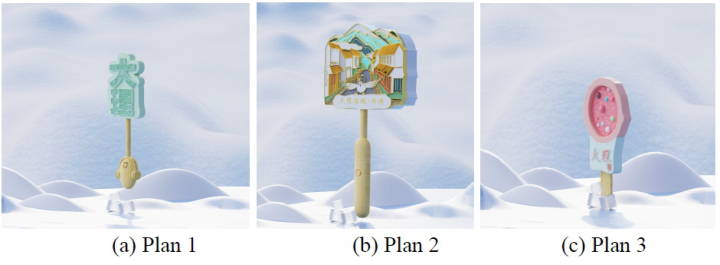
Dali Scenic Area Cultural and Creative Ice Cream Design Evaluation Design of Cultural and Creative Ice Cream in Dali Scenic Spot Based on the analysis, the design of cultural and creative ice cream in Dali Scenic spot addresses 10 user needs, including function, interest, emotion, ease of use, and aesthetics. Three design schemes were developed (Figure 2): Plan 1 (a) emphasizes brand identity by integrating cultural symbols, such as the Three Pagodas and Erhai Lake, into the ice cream shape. It also incorporates sound technology for an enhanced cultural experience; Plan 2 (b) prioritizes the integration of brand identity with refined aesthetics. Inspired by the Erhai Lake landscape, the design combines the relationships of point, line, and surface to create a visually engaging ice cream shape. This design fosters social and emotional resonance, invoking a sense of “people in the middle of the scene and the scene in the mouth.” The use of distinct colors not only enhances visual appeal but also differentiates flavors, catering to the diverse tastes of tourists; Plan 3 (c) focuses on experiential eating. By incorporating jumping jellybeans, this design evokes childhood nostalgia while delivering a playful and memorable eating experience. Its geometric shape and harmonious color palette create a fun yet visually.
Figure 2: Dali scenic area cultural and creative ice cream design scheme (designed by the author, 2024).
Dali Scenic Area Cultural and Creative Ice Cream Design Scheme Evaluation This study validated the design scheme for cultural and creative ice cream in Dali Ancient City using four key user preference categories—functionality, ease of use, enjoyment, and emotional connection—under the TOPSIS framework. A seven-point Likert scale survey of 216 tourists achieved a high reliability score (Cronbach’s alpha = 0.906), confirming data robustness (Shafia and Abdollahzadeh, 2014).
Results (Table 3) show Scheme 2 as the most favorable, significantly improving user satisfaction. The F-Kano-AD-TOPSIS approach confirmed all proposed schemes outperform market designs, highlighting the scientific and practical value of this methodology for user-centered food product development.
240 Zhou
Table 3: Dali cultural and creative ice cream evaluation value (compiled by the author).
Food product design, exemplified by Chinese ice cream, integrates creativity and cultural heritage to engage consumers emotionally and culturally. However, current designs lack depth and practical balance. This study proposes a design framework combining the F-Kano model, AD theory, and TOPSIS analysis to prioritize user preferences, map needs to technical parameters, and evaluate solutions (Kuo et al., 2014). Empirical validation in Dali Scenic Spot demonstrated improved user satisfaction, cultural engagement, and innovation. Future research should refine demand analysis with AI and explore broader applications of this framework to diverse cultural products.
ACKNOWLEDGMENT
We sincerely thank the participants for their valuable time and insights, as well as our collaborators for their feedback and support throughout this research. Their contributions were essential to the successful completion of this work.
REFERENCES
Barutçu, S., Akgün, A. A. & Aydin, D. An analysis of m-customer satisfaction drivers with kano’s model. 5th European Business Research Conference, Roma, 2015. Chen, Y. L. & Xie, M. 2022. Cultural and creative ice cream: How to go from Internet
red to long red? Global Brand Insight, 60–62. Cheng, X. F. Yang, Y. F. & Xu, X. H. 2016. An Evaluation Method of Product Platform Adaptability Based on Information Axiom. Journal of Machine Design, 32, 68–71+79. Cochran, D. & Reynal, V. 1996. Axiomatic Design of Manufacturing Systems. Ge, Y. S. & Liu, Y. K. 2024. A study on the experiential composition of baked goods
from the perspective of food design. Design, 37, 52–54. Kuo, C.-M., Yuo, S.-H. & Lu, C. Y. 2014. Integration of the Kano and QFD model in health food development: using black beans as examples. Quality & Quantity, 48, 225–242. Li, W., Song, Z. & Suh, C. S. 2022. Axiomatic Design: A Theory for Guiding
Design Process. Principles of Innovative Design Thinking: Synergy of Extenics with Axiomatic Design Theory. Springer. Li, Y. & Zhang, Q. 2024. The Analysis of Aesthetic Preferences for Cultural and Creative Design Trends under Artificial Intelligence. IEEE Access. Liu, Q. & He, S. F. 2023. A study on food design based on the influence of food-
saving culture. Design, 36, 84–87.
Construction and Empirical Research on User Demand-Oriented Food Product 241
Mielmann, A., Le Roux, N. & Taljaard, I. 2022. The Impact of Mood, Familiarity, Acceptability, Sensory Characteristics and Attitude on Consumers’ Emotional Responses to Chocolates. Foods, 11, 1621. Moskowitz, H. R., Beckley, J. H. & Resurreccion, A. V. 2012. Sensory and consumer
research in food product design and development, John Wiley & Sons. Shafia, M. & Abdollahzadeh, S. 2014. Integrating fuzzy kano and fuzzy TOPSIS for classification of functional requirements in national standardization system. Arabian Journal for Science and Engineering, 39, 6555–6565. Yu, L., Feng, X., Wang, J., Kong, W. & Chen, W. 2022. Research on the mechanism
of emotional design in Chinese cultural and creative products. Heritage Science, 10, 119. Zhao, X. Wei, F. & Miu, Y. 2022. Research on the Design and Development of the Food Cultural and Creative Products of. Journal of Forestry Engineering, 7, 194–200.
LISTED IN THE AHFE DIGITAL BOOKSTORE CATALOGUE
Explore the complete digital volume
Affective and Pleasurable Design
Read this individual research paper free through the original publisher, or explore the full digital proceedings book.
ISBN 978-1-964867-40-3
Explore this ISBN in the AHFE Bookstore ↗Listed in the July 2026 bookstore catalogue; search by ISBN to confirm current availability · Digital book purchase optional