Satoshi Kose (2025). Can the risk caused by design changes against population stereotypes be avoided: issue of direction-of-motion of cooking controls. In: Design for Inclusion. AHFE Open Access, vol. 169, pp. 84–90. https://doi.org/10.54941/ahfe1006157
Population stereotypes have long been studied and discussed for years. Most of the designs have abided by the long-established customs, thereby drastic changes were rarely made. When there exists a de-facto or de-jour standard, it will be accepted as such, and no serious problems occur because people are accustomed to the state-of-the-art. However, if someone attempts to change something, problems can arise. However, the author quite recently noticed a change that can cause accidents under serious situations: it is related with the control system of gas burners - change of direction of motion (both rotation and sliding designs). Worse, the portable cooking stove with cassette gas container still follows the traditional design, i.e., turn left to ignite and increase power. Coexistence of completely colliding concepts can lead to accidents when the instant action to shut off the power is necessary. This paper argues the potential danger as the users grow older since they will stick to the long-established behavior, which is contradictory to the modernized appliance design.
Population stereotypes have long been discussed for years, and direction of motion for controls was no exception (Bradley, 1959; Brebner & Sandow, 1976; Hotta et al., 1979; Hotta et al., 1981; Hotta & Yoshioka, 1992a, 1992b; Loveless, 1962; Ueno, 1990). Most of the designs have abided by the long-established customs, thereby drastic changes were rarely introduced: Changes could invite mistakes on intended actions, which could result in serious accidents. Further, if population stereotypes are different between different cultures, it could also lead to fatal outcomes – at one time, the author was reminded by an American researcher on the direction of switch movement, i.e., up or down to activate is completely opposite between the US and the UK, critical issue for the design of Space Stations. To avoid problems from occurring during emergencies needing instant response, switches are to be designed to operate horizontally or otherwise, but never to move vertically (I assume the solution would have been to push to activate).
Can the Risk Caused by Design Changes Against Population Stereotypes Be Avoided 85
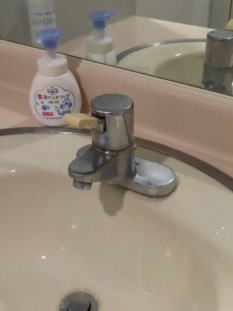
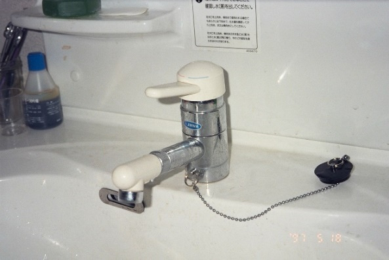
PREVIOUS EXPERIENCES One of the not so fatal mistakes on interface design was introduced when TOTO, a Japanese manufacturer, once decided to design their water faucets, to activate flow of water, by pushing down the lever. Figures 1 to 4 show the water flows out when the lever was pushed down.
Figure 1: & 2: Kitchen water faucet with push down to activate water flow (photos curtesy of Dr. Yoshiaki Goto).Figure 3: & 4: Water sink faucet with push down to activate water flow (photos by author).
It was completely opposite against the already marketed design by almost all manufacturers, globally (*note 1) and inland as well. TOTO, the largest in Japan, argued that the direction is better fit to people’s inherent tendency to activate water flowing. Several research papers argued the issue (Hotta & Yoshioka, 1992a; Ueno, 1990). The situation persisted until the Great Hanshin Earthquake occurred in January 1995. There came a report that the water in the reserve tank all flowed out in vain because something on the shelf above fell off to push down the lever of the faucet in the kitchen or in the bathroom. No quantitative evidence was collected based on surveys. Since the significance of the downward direction to activate the water flow was not so advantageous (if some ever existed – slight change in the angle of the lever affected the people’s response according to the experiments), Japanese manufacturers finally agreed that the upward direction to activate water flow
86 Kose
will become standard after a few years. See Figure 5 for a note to the users in Japanese telling that the direction to activate water flow is different here in contrast to other faucets in the same building.
Figure 5: Water sink faucet with push up to activate water flow. A warning sign is posted to remind the user of the differences from other water sinks (photo by author).
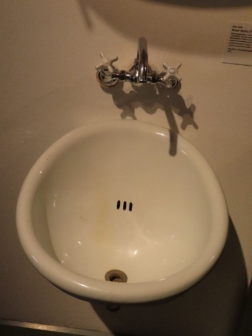
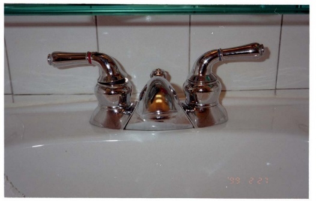
There are other kinds of population stereotypes, such as two-lever water sink, one for cold and the other for hot water. If the faucet interface was the same design (like the one in Sanatorium at Paimio designed by Alver Aalto, see Figure 6), both cold and hot water were necessary to turn left to activate the flow. However, when long-lever type was introduced, both had to be pulled onto the user’s side because one cannot operate otherwise – which means that the right one has to be rotated right while the left one is to be rotated left. If the faucet lever design was changed to a traditional interface, the user will try to turn both of them left to activate since it is the natural response (population stereotype). However, the right one will not work since it must be turned right. The author witnessed the problem years ago in a hotel where two guestrooms had different faucet lever designs, but the design was based on lever controls (see Figures 7 & 8).
Figure 6: Water sink faucet with two cross-type handles to activate hot- and cold-water flow, shown at the Helsinki Design Museum (photo by author).
Can the Risk Caused by Design Changes Against Population Stereotypes Be Avoided 87
Figure 7: & 8: Water sink faucet with two levers to activate hot- and cold-water flow, and cross-type handles to do the same. The right one is a replaced version of the left example. Therefore, one has to turn right to activate cold-water flow although the design suggests the opposite (photos by author).
THE CASE OF GAS COOKER DESIGN: INHERENT DANGER?
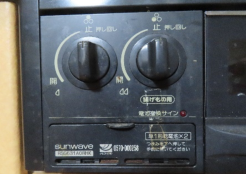
What has alarmed the author is the drastic change in recent years of the control design for gas cooking stoves. Traditionally, they were designed to push and turn left to click activate fires burning – then control the strength with the rotation of the control (turn left for stronger gas flow as shown in Figures 9 and 10).
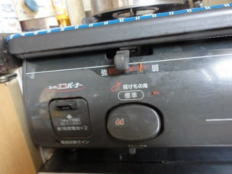
It is opposite of electricity control whose designs were traditionally to turn right to make the output stronger (in case of sliding lever, to move right to have larger output). Around the turn of the century, a new design of gas controls was introduced, with a large push button to activate the fire, while the strength level is controlled with horizontally sliding lever (move left to have stronger fire (See Figure 11).
Figure 9: & 10: A built-in gas cooker control (left) and a portable gas cooker found in a Japanese Izakaya restaurant (right). To activate the built-in cooker, one has to push and turn the dial to the left. The portable cooker does not need to push but just turn left (photos by author).Figure 11: A gas cooker marketed around the turn of the century. To activate, one has to press the large button. Fire strength control is done with the sliding lever (photo by author).
88 Kose
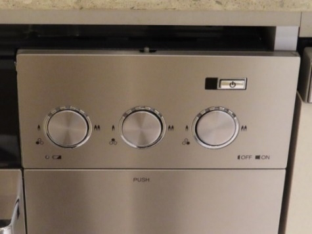
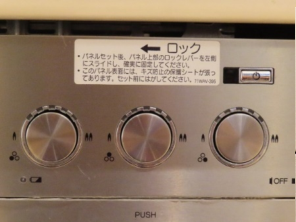
Quite recently, however, the author found that many higher-end gas cookers are designed differently from previous ones: the push button and rotating controls are put into one, to press to activate then turn the control for strength, but to turn right to get stronger output, which is completely opposite of the traditional gas appliance designs (Figure 12). In some models with sliders, the sliding controls (if ever existed) are designed to move right to have stronger output, which is also the opposite of the original design first introduced in the beginning of the 2000s (as in Figure 11). The strength indicator design is modest to be almost unidentifiable – assuming that the users are accustomed to its use (Figures 13 & 14).
Figure 12: A gas cooker of recent design. To activate, one has to press the button. The fire strength control is done with rotating the dial – turn right to obtain stronger output (photo by author).Figure 13: & 14: More examples of gas cooker design. Basically, the same interface as Figure 12 (photos by author).
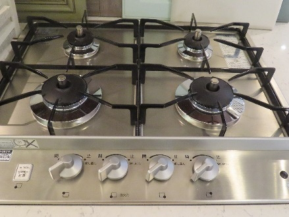
Checking the currently marketed products of the gas cooker manufacturers, one can find different types with different interface designs. For those who would like to utilize the maximum benefits of gas cooking, it seems that the turn-of-direction follows the traditional design, i.e., to turn left to make power stronger, prevails (Figures 15 & 16).
So, what is the problem? The author thought that the opposite turning direction can cause confusion on seniors when they were to instantly respond to serious situations such as flame getting too large or oil cooking pan catching a fire. If they can respond by pressing the button to stop the gas, the problem might not surface. However, we are not yet sure if this will be the case or not.
Can the Risk Caused by Design Changes Against Population Stereotypes Be Avoided 89
Figure 15: & 16: Other examples of gas cooker design. These follow the traditional turn left to activate, strongest to left (photos by author).
Another problem could be that the younger generation will not be familiar with the long-established turn-right-to-stop assumptions. This turn-right-to- stop controls is still prevailing with portable gas cookers everywhere – we encounter them at Japanese Izakaya restaurants where hot pot dishes are cooked at your table with the portable cooker (Figure 10). When they were to start the cooking by turning the control, the younger generation seem to have no problem turning it left without hesitation. However, when trouble happens, are they sure to turn right to control the situation as expected? There is no button to push to instantly stop the gas flow.
Seniors who have been accustomed to traditional designs definitely have problems of acquainting with the way of operation of newly designed equipment, and there is no knowing if they can properly handle the serious situations, such as cooking pan catching a fire (in some Chinese cooking, the flame is essential part of the cooking process and the cook is expected to handle the whole happenings at hand – the housewives may not be good at handling exceptional risky situations due to lack of experiences).
CONCLUSION
As I tried to look through the showrooms for cooking appliances, I have identified two extremes – on one side, push button type with turn right to make stronger, and on the other side, traditional turn left to click. The latter looks more fitted to professional cooks who are willing to utilize the maximum capacity of the cooking stove while the former looks more sophisticated, design-oriented, i.e., nice kitchen to look at, rather than a usable one. At least they look like induction cookers that have no trivet sticking out. In reality, induction cookers are popular in modern multifamily housing, such as in condos, who chose all electric with no piped gas supply.
Long ago, a book on senior housing design referred to gas cooking as a necessity for some ethnic cooking like Chinese, which use the fire flame as a process of cooking. One of the most serious accidents involving gas cooking was the sleeve catching fire, the author of the book added. It is true that most of Japanese cooking nowadays can be done with induction cookers, and gas cooking stove might become the way of the past – at least more
90 Kose
and more precooked foods are available that only need the microwave to serve.
ACKNOWLEDGMENT
The author would like to acknowledge Dr. Yoshiyuki Ueno for his kind response to my inquiry on water faucets population stereotypes. The author also expresses his thanks to Dr. Yoshiaki Goto for allowing me to use the photos.
NOTE 1 American Standard finally decided to make theirs to lift upwards to activate water in the 1980s, and Sweden seems to have proposed to do the same in the design standards around 1974 (private communication with Dr. Ueno).
REFERENCES
Bradley J. V. (1959) Direction-of-knob-turn stereotypes. Journal of Applied Psychology, vol. 43. Brebner and B. Sandow. (1976) Direction-of-turn stereotypes: Conflict and concord.
Applied Ergonomics, 7(1) pp. 34–36. Hotta, A., Takahashi T., Takahashi K. & Kogi, K. (1979) Relations Between Direction-of-Motion Stereotypes for Indicator Controls. Journal of Human Ergology, vol. 8, pp. 47–58. Hotta, A., Takahashi T., Takahashi, K. & Kogi, K. (1981) Relations Between
Direction-of-Motion Stereotypes for Controls in Living Space. Journal of Human Ergology, vol. 10, pp. 73–82. Hotta, A., & Yoshioka, M. (1992a) Experiment on direction-of-motion stereotypes for control function concepts of appliances and equipment in the living space. Journal of Architecture, Planning and Environmental Engineering, No. 441, pp. 61–70 (in Japanese). Hotta, A. & Yoshioka, M. (1992b) Experiment on direction-of-motion stereotypes
in rotary control. Japanese Journal of Ergonomics, 28(2) 61–68 (in Japanese). Loveless, N. E. (1962) Direction-of-motion stereotypes, A review. Ergonomics, 5(1–4) pp. 357–383. Ueno, Y. (1990) Experimental study on handling of single-lever cock. Summaries
of Technical Papers of Annual Meeting of AIJ 1990 -Architectural Design- pp. 675–676 (in Japanese).
LISTED IN THE AHFE DIGITAL BOOKSTORE CATALOGUE
Explore the complete digital volume
Design for Inclusion
Read this individual research paper free through the original publisher, or explore the full digital proceedings book.
ISBN 978-1-964867-45-8
Explore this ISBN in the AHFE Bookstore ↗Listed in the July 2026 bookstore catalogue; search by ISBN to confirm current availability · Digital book purchase optional