Skip to article
AHFE AHFE Discoveries AHFE International Open Access Journal
AHFE OPEN ACCESS OPEN ACCESS CONFERENCE PROCEEDINGS PAPER

Correlation between Headquarter Placement and Mirroring Collected Intel to Gain Knowledge on an Adversaries Headquarter Location based on Gender: An ISR Assessment

1 711 th Human Performance Wing, Airman Systems Directorate, WPAFB, OH 45433 USA ↗
2 Parallax Advanced Research, Beavercreek, OH 45431, USA ↗
Publication year
Digital Object Identifier10.54941/ahfe1006280

Abstract

Intelligence, Surveillance, and Reconnaissance (ISR) analysts are provided with a tremendous amounts of information that needs to be accurately processed, exploited, and disseminated (PED) in order to provide our warfighters an advantage on the battlefield. Analysts can obtain valuable information about the enemy territory by using ISR, such as, imagery intelligence (IMINT), signals intelligence (SIGINT), human intelligence (HUMINT) (Boury-Brisset, Kolodny, and Pham, 2016). ISR analysts can have varying strategies when capturing intelligence and often gain experience and expertise on the job rather than learning the necessary skills in a training environment. To address this problem, ISR subject matter experts (SMEs) developed Intrage: an ISR tabletop board game to provide training to Air Force intelligence personnel to gain skills relevant to ISR operations. By investigating different aspects of gameplay, we can better understand the complex decision-making process that warfighters face day-to-day and enhance future trainings and technology development. For an example, a previous study on Intrage investigated whether military experience influenced headquarter placement. Evidence was found that individuals with military experience centralized their headquarter location compared to individuals with no military experience (Nelson et al., 2024). With this knowledge, we can modify and improve training to include a less predictable outcome. In addition to this found significance, demographic characteristics such as gender is a variable that could further this discovery and increase its impact. Therefore, the purpose of this study was to determine if individuals mirrored headquarter placement with the adversary headquarter placement with respect to gender.Method: Before collecting data, the study protocol was approved by the U.S. Air Force Research Laboratory (AFRL) Institutional Review Board (IRB). The goal of this study was to determine if a relationship exists with regards to mirroring headquarter placement and adversary headquarter placement collections based on gender. Participants were recruited via email from WPAFB and completed the task online through Qualtrics. A sample of participants (N = 50) were selected from 25 military and 25 non-military participants completed the research study. The sample consisted of 11 female and 39 male participants. The participant was provided with the study objectives and were instructed to place their headquarters within a single quadrant in the northern region (i.e., Region A, B, or C) of the map. Additionally, participants were able to collect four times in the southern region of the map (i.e., Region E, F, and G) in an attempt to identify the adversary headquarters. The four collects contained a honeycomb pattern.Analysis: Statistical analyses were conducted in Rstudio using functions from various packages (R Core Team, 2022). An analysis of variance (ANOVA) was conducted to determine if there was a statistically significant difference between mirroring headquarters placement and adversary headquarter placement collections based on gender.Results: The ANOVA displayed a statistically significant difference detected with respect to mirroring headquarter placement and adversary headquarter placement collections based on gender (p = 0.04). Two of the eleven female participants (18%) conducted collections on the adversary in a mirroring manner with respect to identifying headquarter placement. Whereas twenty-one of the thirty-nine male participants (54%) conducted collections on the adversary in a mirroring manner with respect to identifying headquarter placement.Discussion: The findings of this study have provided underlying evidence that individuals headquarter placement often mirrors the adversary headquarter placement regarding gender. Additionally, more men mirrored headquarter placement than women; however, this should be investigated further with a greater sample size. As research continues, various findings will assist in the ongoing development and maturity of Intrage. In addition, future research should evaluate whether personality differences influence headquarter placement to mirror adversary headquarter placement.
© 2025. Published by AHFE Open Access. All rights reserved. 44

Correlation Between Headquarter Placement and Mirroring Collected Intel 45

INTRODUCTION

Intelligence, Surveillance, and Reconnaissance (ISR) analysts are provided with a tremendous amount of information that needs to be accurately processed, exploited, and disseminated (PED) in order to provide our warfighters an advantage on the battlefield (Nelson et al., 2023; Nelson et al., 2023). Analysts can obtain valuable information about the enemy territory by using ISR, such as imagery intelligence (IMINT), signals intelligence (SIGINT), and human intelligence (HUMINT) (Boury-Brisset et al., 2016). ISR analysts can have varying strategies when capturing intelligence and often gain experience and expertise on the job rather than learning the necessary skills in a training environment.

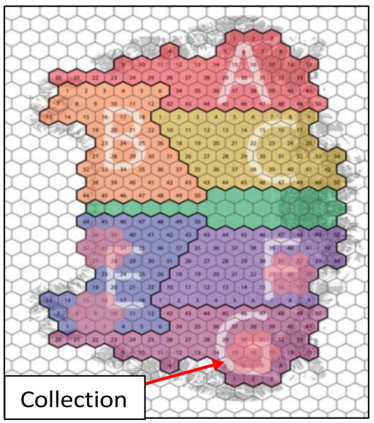
To address this area of interest, ISR subject matter experts (SMEs) developed Intrage. Intrage is an ISR tabletop board game to provide training to Air Force intelligence personnel to gain skills relevant to ISR operations (see Figure 1). By investigating different aspects of gameplay, we can better understand the complex decision-making process that warfighters face day-to-day and enhance future training and technology development. For an example, a previous study on Intrage investigated whether military experience influenced headquarter placement. Evidence was found that individuals with military experience centralized their headquarter location compared to individuals with no military experience (Nelson et al., 2025). With this knowledge, we can modify and improve training to include a less predictable outcome. In addition to this found significance, demographic characteristics such as gender is a variable that could further this discovery and increase its impact. Therefore, the purpose of this study was to determine if individuals mirrored headquarter placement with the adversary headquarter placement with respect to gender.

Figure 1: Geographical representation for intrage.
Original PDF Figure 1:

METHODS AND MATERIALS Study Participants

Before collecting data, the study was approved by the U.S. Air Force Research Laboratory (AFRL) Institutional Review Board (IRB). The goal of this research effort was to determine if a relationship exists with regards to mirroring headquarter placement and adversary headquarter placement collections based on gender. Participants were recruited via email from Wright-Patterson Air Force Base (WPAFB) and completed the task online through Qualtrics – a survey platform. A sample of participants (N = 50) were selected from 25 military participants and 25 non-military participants completed the research study. The sample consisted of 11 female and 39 male participants.

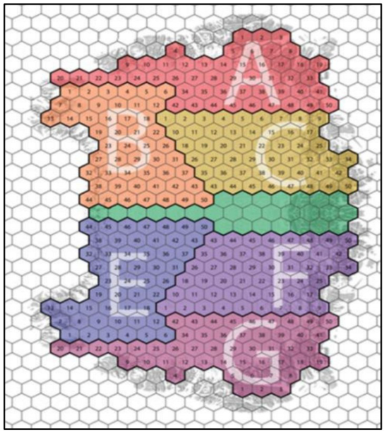
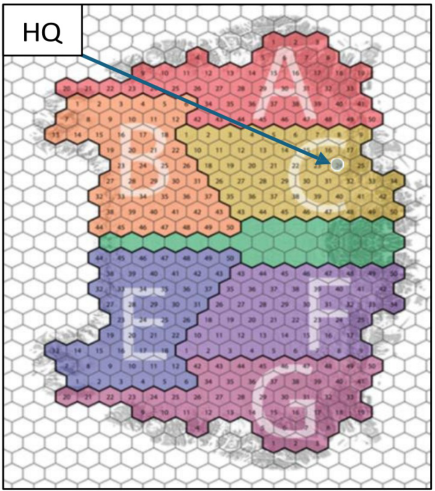
Procedures All participants were provided with an overview with the study objectives and were instructed to place their headquarters within a single quadrant in the norther region (i.e., Region A, B, or C) of the map (see Figure 2). Additionally, participants were able to collect four times in the southern region of the map (i.e., Region E, F, and G) in an attempt to identify the adversary headquarters. The four collects contained a honeycomb pattern (see Figure 3).

Figure 2: Headquarter placement in the northern region.
Original PDF Figure 2:

Correlation Between Headquarter Placement and Mirroring Collected Intel 47

Figure 3: Adversary headquarter intel collections in the southern region.
Original PDF Figure 3:

Data Analysis Data statistical analysis was conducted in Rstudio using functions from various packages (R version 4.1.2). R is an open-source programming language with downloadable packages from the Comprehensive R Archive Network (CRAN) repository. An analysis of variance (ANOVA) was conducted to determine if there was a statistical difference between mirroring headquarters placement and adversary headquarter placement based on gender.

Results

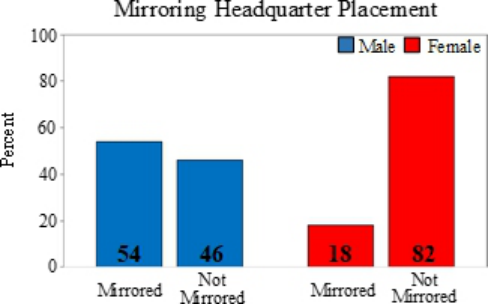
The analysis of variance (ANOVA) displayed a statistically significant difference was detected with respect to mirroring headquarter placement and adversary headquarter placement collections based on gender (p = 0.04) (see Table 1). Two of the eleven female participants (18%) conducted collections on the adversary in a mirroring manner with respect to identifying headquarter placement. Whereas, twenty-one of the thirty-nine male participants (54%) conducted collections on the adversary in a mirroring manner with respect to identifying headquarter placement (see Figure 4).

Table 1: Analysis of variance (ANOVA) comparing demographic characteristics and mirroring headquarter placement and adversary headquarter location based on gender.

Table available in the original PDF paper.

Source df SS MS F p Between-Conditions 1 1.09 1.09 4.54 0.04 Gender Within-Conditions 48 11.33 0.24 Total 49 12.42

Statistical Significance at alpha level of 0.05

Figure 4: Geographical representation depicting headquarter placement and mirroring collected intel to gain insight on the adversaries headquarter location based on gender.
Original PDF Figure 4:

CONCLUSION

The findings of this research effort has provided underlying evidence that individuals headquarter placement often mirrors the adversary headquarter placement regarding gender. Additionally, more male participants mirrored headquarter placement than female participants. However, this should be investigated further with a greater sample size. As research continues, various findings will assist in the ongoing development and maturity of Intrage. In addition, future research should evaluate whether personality differences influence headquarter placement to mirror headquarter placement.

ACKNOWLEDGMENT

The views, opinions, and/or findings contained in this paper are those of the author and should not be interpreted as representing the official views or policies, either expressed or implied, of the Air Force, Air Force Research Laboratory or the Department of Defense.

REFERENCES

Boury-Brisset, A., Kolodny, M., & Pham, T., 2016. ISR asset visibility and collection management optimization through knowledge models and automated reasoning. Knowledge Systems for Coalition Operations, Springer. Nelson, J., Heggedahl, T., Frame, M., Maresca, A., and Schlessman, B., 2023. Building the future of intelligence, surveillance, and reconnaissance (ISR) collections: The development and evaluation of a collaborative ISR tool to support intel analysts. Intelligence and Security Informatics: IEEE International Conference on Intelligence and Security Informatics, ISI 2023, Charlotte, NC, USA, Oct 2–3, 2023. Springer.

Correlation Between Headquarter Placement and Mirroring Collected Intel 49

Nelson, J., Maresca, A., Schlessman, B., Holt, J., Kegley, J., and Boydstrum, A.,

2023. Evaluating the efficacy of structured analytic techniques (SATs) as a support system to enhance decision-making within ISR mission environments. International Conference on Human Factors in Design, Engineering, and Computing, Honolulu, HI, USA, Dec 4–6, 2023. Springer. Nelson, J., Heggedahl, T., Morgan, J., Johnston, S., and Cotter, J., 2025.

Does military experience influence strategic decision-making with respect to geographical headquarter placement. IEEE Intelligent Human Systems Integration (IEEE IHSI), IHSI 2025, Rome, Italy, Feb 22–24, 2025. Springer.

Cover of the proceedings volume Human Error, Reliability, Resilience, and Performance

Explore the complete digital volume

Human Error, Reliability, Resilience, and Performance

Read this individual research paper free through the original publisher, or explore the full digital proceedings book.

ISBN 978-1-964867-49-6

Explore this ISBN in the AHFE Bookstore Listed in the July 2026 bookstore catalogue; search by ISBN to confirm current availability · Digital book purchase optional

Explore Related Research

Related research 8 matches

More papers from this volume

← Back to Research ExplorerBrowse the full library →