Qian Bao, Fangchao Yang, Pinzhe Zhao (2025). Exploring Generative AI Empowerment in City Brand Building from a Human-Factors Perspective: An Empirical Study Based on Wuhan City Emoji. In: Human Factors in Communication of Design. AHFE Open Access, vol. 177, pp. 99–109. https://doi.org/10.54941/ahfe1006335
The application of generative AI in enhancing the cultural identity of cities within the context of urban branding presents a novel perspective. Emojis, as vivid, engaging, and easily disseminated communication media, have become a crucial means of interaction in contemporary society. This study, based on a human factors engineering perspective, takes the design of Wuhan city-themed emojis as an empirical case study. Initially, a comprehensive literature review and semi-structured interviews were conducted to collect diverse data from Wuhan residents, tourists, frequent emoji users, and design experts, aiming to gain in-depth insights into the cultural essence and symbolic imagery of Wuhan. Subsequently, grounded theory was employed to perform a three-level coding process, leading to the development of an initial theoretical framework. The Kano model and the Analytical Hierarchy Process (AHP) were then integrated to classify and prioritize user needs through a systematic weighting analysis. Finally, based on the priority of element weights, Midjourney was utilized for design practice and iterative optimization. The results indicate that generative AI can stimulate creativity and foster emotional connections in city-themed emojis, meeting the diverse needs of various application scenarios and enhancing the digital dissemination of Wuhan's city image. This study provides a novel creative approach and theoretical model for city-themed emoji design, offering valuable insights for other cities in digital branding and cultural communication.
With the rapid advancement of generative AI technology, the field of art and design is experiencing a groundbreaking technological revolution. Generative AI, leveraging deep learning and convolutional neural networks (CNNs), enables the automatic generation and optimization of content through Generative Adversarial Networks (GANs) (Feuerriegel, 2024). In the realm of city brand communication, digitalization has become the prevailing trend, with traditional communication methods gradually being replaced by
more interactive digital media (Wang, 2024). Due to their vivid, engaging, and easily shareable nature, emojis have become a crucial medium for online communication, particularly favored by younger generations (Ju, & Zhao, 2024). At present, research on city branding rarely explores how to incorporate the cultural essence of a city and user needs into emoji design. Moreover, the application of generative AI in emoji creation remains in an exploratory stage, with most studies focusing on the technical implementation of generative AI, while lacking an in-depth integration with user demand analysis, design theories, and design process optimization. Consequently, in the context of digital branding, an important challenge has emerged—how to effectively utilize generative AI tools to balance cultural expression and user engagement in city-themed emoji design.
Although the potential of emojis in cultural communication has been widely recognized, existing research approaches struggle to effectively convey the unique cultural characteristics of cities and fail to gain a deep understanding of users’ emotional needs during their usage. This raises a critical question: how can generative AI technology be leveraged to develop city-themed emojis that not only reflect distinctive cultural features but also resonate emotionally with users? To address this issue, the study incorporates grounded theory and a Kano-AHP hybrid model to establish a systematic approach for user needs analysis and design prioritization. Grounded theory, through a three-level coding process, extracts core concepts and models from user interview data, making it well-suited for exploring latent user needs (Guo et al., 2024). The Kano model is employed to categorize user needs (Xu et al., 2009), while the Analytic Hierarchy Process (AHP) is utilized to quantify the weight of each design element, providing a prioritization framework for design factors (Lee, 2015). The integration of a hybrid research model can provide scientifically grounded user demand data to empower generative AI in city-themed emoji creation, while also offering a systematic design framework for city branding efforts. The significance of this study lies in establishing a comprehensive and scientifically rigorous pathway for generative AI-driven city emoji design, offering new perspectives for urban cultural dissemination and the digital transformation of city branding.
LITERATURE REVIEW
Generative AI Generative AI is a rapidly advancing field within artificial intelligence, focusing on the creation of novel and original content across various domains, including text, images, music, and video (Engy Yehia, 2024). It has the capability to simulate human creativity and imagination, offering new possibilities for the field of design (O’Toole et al., 2024). By being trained on large-scale datasets, generative AI can assimilate content with diverse styles and characteristics, enabling the generation of highly creative and unique design works (Singh et al., 2024). However, maintaining cultural authenticity and uniqueness while avoiding cultural appropriation in the AI-driven creative process remains a pressing challenge. Some researchers
Exploring Generative AI Empowerment in City Brand Building From a Human 101
have begun exploring the integration of traditional cultural elements into generative AI models. For instance, certain studies have proposed deep learning models that incorporate artistic knowledge to generate artworks with specific cultural styles (Zhang et al., 2024). Relevant studies have provided new insights into the application of generative AI in cultural creation.
Overview of City Emoticon Pack Design The widespread use of emojis has profoundly influenced the way people express emotions and ideas in the digital era (Danesi, 2017). As a specialized form of emojis, city-themed emojis encapsulate the essence of a city into compact yet expressive icons, representing landmarks, cultural symbols, and urban identity (Cohn et al., 2018). Exploring how emojis enhance digital communication by providing users with visual tools to express connections to specific locations (Rui Gong, 2024). The City Faces project visualizes urban emotions by analyzing facial expressions derived from social media data, demonstrating how emojis and similar graphical representations can encapsulate collective urban sentiments (MA Melo et al., 2016). Studies have shown that employing simple and engaging text and graphics, such as emojis, in urban interventions can evoke positive emotional responses and foster social interactions. Meanwhile, deep learning algorithms can analyze vast amounts of data, including images and social media content, to inform the design of emojis that effectively resonate with users (Kang & Wei, 2020).
Grounded Theory-Kano-AHP Hybrid Research Model In recent years, the application of grounded theory and the Kano-AHP hybrid model in user needs analysis and design optimization has been increasingly prevalent, providing a more comprehensive theoretical foundation and practical framework for design decision-making. Grounded theory, as a qualitative research method, aims to derive theories from data and is well- suited for exploratory studies, such as in-depth exploration of user needs and analysis of behavioral patterns (Glaser & Strauss, 1967). Through grounded theory, researchers can extract key needs and patterns from users’ authentic feedback without preconceived assumptions, ensuring a user-centered and practical design approach (Corbin & Strauss, 1990). The Kano model, by focusing on the classification of user needs, categorizes them into basic needs, performance needs, and excitement needs. This approach helps designers more clearly identify the priorities and impacts of different user requirements (Kano et al., 1984). The Analytical Hierarchy Process (AHP), as a multi- criteria decision-making method, can further quantify the weights of these needs, providing a more scientific basis for prioritization and optimizing design decisions (Saaty, 1980). The integration of the Kano model with the Analytical Hierarchy Process (AHP) enables a more precise quantification of need priorities, providing a theoretical foundation for enhancing user satisfaction.
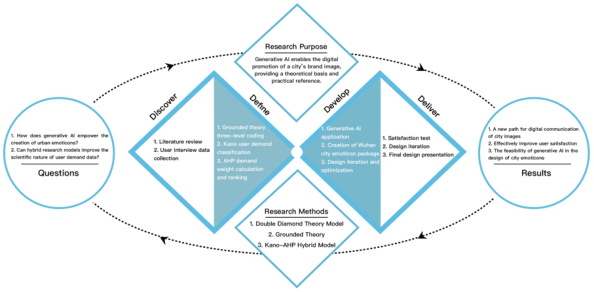
RESEARCH DESIGN AND PROCESS The Double Diamond Model is a widely used conceptual framework in the design process, comprising four stages: Discover, Define, Develop, and Deliver. The research methodology adopted in this study closely aligns with the Double Diamond Model, as illustrated in Figure 1.
Phase 1 Discover: In the initial phase, a comprehensive literature review is conducted to explore the potential applications of generative AI technology in city-themed emoji design. Additionally, semi-structured interviews are carried out to collect user needs from diverse groups, including Wuhan residents, tourists, emoji users, and design experts.
Figure 1: Basic research framework based on the double diamond model.
Phase 2 Define: Grounded theory is employed to perform a three-level coding analysis of the interview data. The Kano model is then utilized to classify user needs, and the Analytical Hierarchy Process (AHP) is applied to calculate the weight of these needs, ultimately establishing the priority of design elements.
Phase 3 Develop: The prioritized design elements are implemented using the Midjourney platform to generate Wuhan city-themed emoji designs. Multiple iterations and optimizations are conducted to ensure that the designs align with the city’s cultural identity while meeting user expectations.
Phase 4 Deliver: A user satisfaction survey is conducted to gather feedback on the designs. The city-themed emoji designs undergo continuous iterative testing and refinement based on user responses, leading to the final optimized design solution.
Construction of Wuhan City Emoticon Pack User Demand Based on Grounded Theory The study participants were selected from four distinct groups: Wuhan residents, out-of-town tourists, frequent emoji users, and graphic design experts. The selection of each group was based on their unique perspectives regarding the understanding of Wuhan’s urban culture, emoji usage
Exploring Generative AI Empowerment in City Brand Building From a Human 103
preferences, and design evaluation criteria. A total of 36 participants were recruited, and data were collected through semi-structured interviews.
Open Coding Phase: Following the analysis of data collected from 36 interview participants, a total of ten initial categories were identified. These categories were established through a collaborative effort between the research team and design experts, ensuring their representativeness and relevance. The identified categories include iconic city landmarks, local delicacies, historical narratives, regional dialects and slang, urban life scenes, traditional handicrafts, natural landscapes, climatic characteristics, representative plants, and the academic atmosphere. These elements collectively form the foundational basis for emoji design that embodies Wuhan’s unique characteristics while integrating emotional expression and cultural depth.
Axial Coding Phase: Through the integration of the ten initial categories, three thematic categories with inherent logical relationships were identified: the cultural elements layer, the natural landscape layer, and the urban lifestyle layer. These categories provide a structured framework for understanding the key aspects of Wuhan’s identity in emoji design. Details of the axial coding process are presented in Table 1.
Classification of User Needs for Wuhan City Emoticon Package Based on Kano The Kano model was employed to quantitatively analyze user needs and identify the key attributes of Wuhan city-themed emoji design. The study using the Kano model was conducted in three stages. First, a Kano dual-factor Likert questionnaire was developed based on the results of the three-level coding derived from grounded theory. Second, user needs were classified using the Kano model calculation method, and further quantified through the Better–Worse coefficient method and four-quadrant analysis. Finally, core user need categories were identified based on the data analysis results.
The survey was conducted using a combination of online and offline methods, with 100 questionnaires distributed online and 50 offline, totaling 150 Kano model questionnaires. A total of 137 valid responses were collected. The questionnaire consisted of two sections: the first section gathered basic demographic information from participants, while the second section conducted a bi-directional survey based on the ten user demand indicators identified in the preliminary study. The reliability and validity of the data were verified using SPSS software, with a Cronbach’s alpha coefficient of 0.719 and a KMO value of 0.831, indicating good reliability and validity. To achieve a more precise analysis of user satisfaction, the Better–Worse coefficient method was employed to quantify the weight of each user need. The coefficients were calculated using the following formulas: Satisfaction Index (SI): Better = (A + O) / (A + O + M + I), Dissatisfaction Index (DSI): Worse =−(O + M) / (A + O + M + I). Detailed analytical results are presented in Table 2.
Table 2: Classification of user needs of Wuhan city emoticon pack.
Table available in the original PDF paper.
No. M O A I R Better / Worse / Demand Division A1 32.75% 23.77% 22.61% 20.58% 0.29% 46.51% –56.69% M A2 34.49% 22.75% 20.15% 20.58% 2.03% 43.79% –57.10% M A3 33.91% 21.74% 20.87% 22.90% 0.58% 42.86% –55.98% M A4 33.33% 16.81% 18.26% 31.30% 0.29% 35.17% –50.29% M A5 21.74% 22.90% 17.68% 37.10% 0.58% 40.82% –44.90% I A6 15.94% 33.33% 21.45% 27.27% 1.74% 55.10% –57.13% O A7 32.12% 20.05% 23.77% 23.77% 0.29% 43.90% –52.33% M A8 26.67% 36.81% 19.42% 15.94% 1.16% 56.89% –64.22% O A9 17.68% 24.06% 34.49% 22.90% 0.87% 59.06% –42.11% A A10 22.03% 32.17% 22.32% 22.61% 0.54% 54.97% –54.68% O
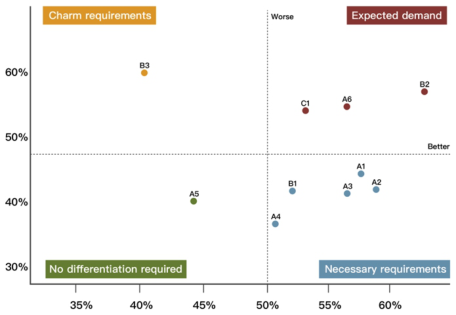
In this study, the Better and Worse values were plotted as the vertical and horizontal axes, respectively, as illustrated in Figure 2. According to the traditional Kano model ranking order of M > O > A > I, and considering that the absolute value of the Better–Worse coefficient and its distance from the coordinate axes represent the priority level of the needs, a prioritization ranking was determined. The prioritization was further refined based on the principle that within the same category, higher Better values indicate higher priority. The final priority ranking of user needs is as follows: Must-Have Needs (M): A2 > A3 > A4 > A1 > B1, Performance Needs (O): B2 > A6 > C1, Attractive Needs (A): A3, Indifferent Needs (I): A5.
Calculation of User Demand Weights for Wuhan City Emoticon Package Based on AHP To ensure the rationality of the design and the prioritization of user needs, the Analytic Hierarchy Process (AHP) was employed to calculate the weight of each user requirement. The process involved constructing an AHP hierarchical model, establishing a pairwise comparison matrix, and conducting a consistency check. Ultimately, the weight values of the various design elements were determined, providing a structured and systematic basis for prioritization.
Exploring Generative AI Empowerment in City Brand Building From a Human 105
Figure 2: Better-Worse analysis of user needs for Wuhan city emoji package.
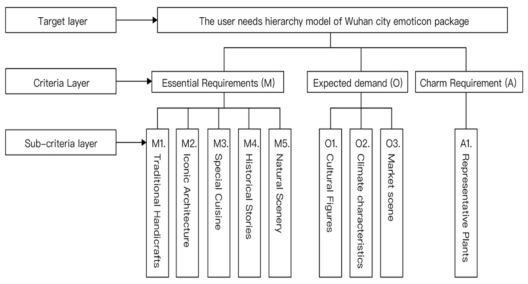
Based on the prior analysis using grounded theory and the classification results of the Kano model, the core design elements were identified. These elements were categorized into Must-Have Needs (M), including M1, M2, M3, M4, and M5; Performance Needs (O), including O1, O2, and O3; and Attractive Needs (A), represented by A1. Each category was further subdivided into multiple indicators, such as traditional handicrafts, iconic architecture, local culinary specialties, and natural landscapes, reflecting the cultural essence of Wuhan. As shown Figure 3.
Figure 3: Demand hierarchy analysis model for Wuhan city emoticon package design.
To ensure the scientific validity and objectivity of the user needs weighting results, a total of nine cultural industry professionals were invited to participate in the evaluation process. The participants included four PhD candidates specializing in visual design, three professors and associate professors specializing in industrial design, and two professionals from the cultural media industry.They were asked to conduct pairwise comparisons of various hierarchical needs for Wuhan city-themed emojis using the 1–9 scale rating method. The arithmetic mean of their ratings was calculated and used
as the basis for weight determination, resulting in the judgment matrices for each hierarchical level, as shown in Tables 3 and 4.
Table 3: Weights of indicators at the criteria level. (O) Expected
Table available in the original PDF paper.
Weight value ICR
Index (M) Essential Requirements Demand
(A) Charm Requirement
(M)Essential
1 1 5 0.6334 0.0372
Requirements (O)Expected 1/3 1 3 0.2605 Demand
(A)Charm 1/5 1/3 1 0.1062 Requirement
Table 4: Weights of indicators at the sub-criteria level.
Finally, consistency verification is required to assess the validity of the judgment matrix. The consistency check is considered satisfactory when the consistency index ratio (ICR) is ≤0.1; otherwise, the matrix fails the test. The calculation formulas are presented in Equations (1) and (2).
Equation reproduced from the original PDF.
The consistency verification results indicate that the ICR value for the criterion level is 0.0372, which satisfies the threshold condition (ICR ≤0.1). Additionally, the ICR values for the sub-criteria levels are 0.0118, 0.0273, and 0.0082, all of which are below the acceptable limit of 0.1. Therefore, the consistency test is successfully passed.
Exploring Generative AI Empowerment in City Brand Building From a Human 107
Table 5: Relative weight calculation and ranking analysis.
Based on the relative weight ranking results presented in Table 5, it is evident that within the Must-Have Needs (M) category, “M2: Iconic Architecture” and “M3: Local Cuisine” have the highest weight values. This finding indicates that users place the greatest emphasis on architectural landmarks and culinary elements that best represent Wuhan’s unique identity in the design of city-themed emojis. Therefore, when designing Wuhan city- themed emojis, priority should be given to fulfilling the essential needs related to representative architecture and local cuisine. At the same time, consideration should also be given to the environmental characteristics categorized under performance needs to enhance the cultural expressiveness of the emojis and strengthen users’ emotional connection.
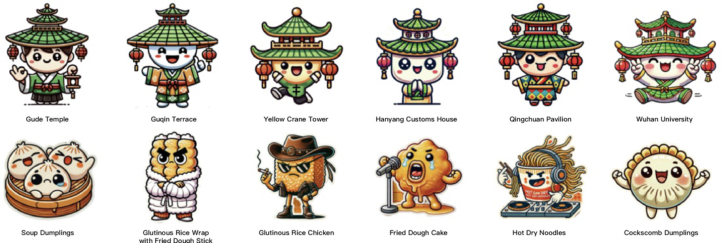
GENERATIVE AI EMPOWERS THE DESIGN PRACTIE OF WUHAN CITY EMOJI PACKAGE In the design practice, grounded theory and the Kano-AHP hybrid model were integrated to establish a user needs element model and determine the weight values of design elements. These insights were applied to the Midjourney platform to create a set of city-themed emojis that effectively showcase Wuhan’s unique characteristics. As illustrated in Figure 4.
Figure 4: Wuhan city emoticon pack design practice.
During the design process, several core elements representing Wuhan’s cultural identity were selected, including historical and cultural landmarks such as Yellow Crane Tower, Guqin Terrace, and Gude Temple. These symbols embody the city’s rich cultural heritage. Additionally, Wuhan University and other iconic architectural landmarks, such as Hanyang Pass and Qingchuan Pavilion, were incorporated to reflect Wuhan’s modern urban landscape and educational atmosphere. Local culinary specialties, including hot dry noodles, soup dumplings, cockscomb dumplings, and glutinous rice wraps with fried dough sticks, were also featured to highlight the
city’s distinctive food culture. To effectively translate these design elements into prompts for Midjourney, each element was meticulously described and key terms were extracted. The Kano-AHP model was applied to assign different weight values to the design elements, ensuring their appropriate representation in the generated content. In practice, multiple rounds of adjustments and refinements were conducted to fine-tune the keywords, enabling Midjourney to accurately capture Wuhan’s unique cultural symbols and emotional expressions in the emoji designs.
This emoji series is primarily intended for use on social media platforms, such as WeChat and Weibo, as well as in everyday social interactions, including holiday celebrations and routine communication. Users can incorporate these emojis into their social media interactions to express their emotional connection to Wuhan. Additionally, they serve as an effective tool for promoting Wuhan’s cultural identity in cross-regional communication, thereby enhancing the city’s image and strengthening its brand influence.
RESEARCH RESULTS AND CONCLUSIONS The research findings indicate that, through grounded theory coding, unique cultural elements of Wuhan—such as iconic architecture, local culinary specialties, and folk culture—were identified. User needs were classified into basic, performance, and excitement categories. By applying the Kano model for classification and the Analytical Hierarchy Process (AHP) for weight analysis, a prioritization framework for emoji design was established, providing a scientific foundation for efficient design processes. The designed emoji set achieved high user satisfaction in practical applications, demonstrating a comprehensive advantage in terms of visual appeal, cultural identity, and usability. The framework not only enhances design efficiency but also strengthens the expression of cultural connotations, offering valuable reference for the future development of city-themed emoji designs in other urban contexts.
REFERENCES
Cohn, N., Engelen, J., & Schilperoord, J. (2019). The grammar of emoji?
Constraints on communicative pictorial sequencing. Cognitive research: Principles and implications, 4, 1–18. Corbin, J. M., & Strauss, A. (1990). Grounded theory research: Procedures, canons, and evaluative criteria. *Qualitative sociology*, 13(1), 3–21. Danesi, M. (2017). The semiotics of emoji: The rise of visual language in the age of
the internet. *Bloomsbury Publishing*. Feuerriegel, S., Hartmann, J., Janiesch, C., & Zschech, P. (2024). Generative AI.
*Business & Information Systems Engineering*, 66(1), 111–126. Glaser, B., & Strauss, A. (2017). Discovery of grounded theory: Strategies for qualitative research. Routledge. Gong, R., Wang, Z., & Zhao, J. (2024, June). EmoNet: A Convolutional Neural
Network and Transfer Learning-Based Framework for Facial Micro-Expression Recognition and Emoticonification. In 2024 5th International Conference on Artificial Intelligence and Electromechanical Automation (AIEA), 265–269. IEEE.
Exploring Generative AI Empowerment in City Brand Building From a Human 109
Guo, Y., Ma, H., Zhou, J., Chen, Y., & Yuan, Y. (2024). The information needs of users in the metaverse communities: A grounded theory study. *Library Hi Tech*. Ju, G., & Zhao, R. (2024). How do emoticons affect youth social interaction? The
impact of emoticon use on youths online interpersonal interactions. *Frontiers in Communication*, 9, 1452633. Kang, J., & Wei, L. (2020): Machine Learning and AI in Marketing – Connecting Technological and Behavioral Perspectives, *Journal of Marketing Analytics*, vol. 8, pp. 157–159. Kano, N., Seraku, N., Takahashi, F., & Tsuji, S. (1984). *Attractive quality and
must-be qualit*y. Lee, S. (2015). Determination of priority weights under multiattribute decisionmaking situations: AHP versus fuzzy AHP. *Journal of construction engineering and management*, 141(2), 05014015. O’Toole, K., & Horvát, E. Á. (2024). Extending human creativity with AI. *Journal
of Creativity*, 34(2), 100080. Saaty, T. L. (1980). The analytic hierarchy process (AHP). *The Journal of the Operational Research Society*, 41(11), 1073–1076. Singh, G., Srivastava, V., Kumar, S., Bhatnagar, V., & Dhondiyal, S. A. (2024,
August). Exploring the Creative Capacities of Generative AI: A Comparative Study. In 2024 5th International Conference on Electronics and Sustainable Communication Systems (ICESC) (pp. 1809–1813). IEEE. Wang, Q. (2024). Creative city brand building on social media platforms. *Warwick Evans Publishing*, 4(2), 601–605. Xu, Q., Jiao, R. J., Yang, X., Helander, M., Khalid, H. M., & Opperud, A. (2009).
An analytical Kano model for customer need analysis. *Design studies*, 30(1), 87–110. Yehia, E. (2024). Developments on generative AI. In P. Pokhriyal, A. Patel, & S. Pandey (Eds.), *AI and emerging technologies*, 1–22. Zhang, M., Liu, F., Li, B., Liu, Z., Ma, W., & Ran, C. (2024). CrePoster:
Leveraging multi-level features for cultural relic poster generation via attention- based framework. *Expert Systems with Applications*, 245, 123136.
LISTED IN THE AHFE DIGITAL BOOKSTORE CATALOGUE
Explore the complete digital volume
Human Factors in Communication of Design
Read this individual research paper free through the original publisher, or explore the full digital proceedings book.
ISBN 978-1-964867-53-3
Explore this ISBN in the AHFE Bookstore ↗Listed in the July 2026 bookstore catalogue; search by ISBN to confirm current availability · Digital book purchase optional