Ching-yu Cheng, Liuchuan Yu, Lap-fai Yu, Behzad Esmaeili (2025). Visual Allocation of Teams in the Construction Industry: Shared Situation Awareness Under Information Overload in Human-AI Collaboration. In: Human Factors in Robots, Drones and Unmanned Systems. AHFE Open Access, vol. 179, pp. 1–12. https://doi.org/10.54941/ahfe1006369
The integration of AI has significant o pportunities f or e nhancing human-machine collaboration, particularly in dynamic environments like the construction industry, where excessive information affects decision-making and coordination. This study investigates how visual attention distribution relates to SA development under information overload by addressing three research questions: (1) How does visual allocation relate to individual SA under information overload? (2) How does visual allocation influence s hared S A f ormation? ( 3) D o h igh-shared S A t eams exhibit different visual allocation patterns compared to low-shared SA teams? To answer these questions, a multi-sensor virtual reality (VR) construction environment is created as testbed that includes realistic task simulations involving both human teammates and AI-powered cobots (e.g., drones and robotic dog). Participants completed a pipe installation task when navigating construction hazards like falls, trips, and collisions, while experiencing varying degrees of information overload. Shared situation awareness (shared SA)—the shared understanding of tasks and environmental conditions—was assessed using the situation awareness global assessment technique (SAGAT) and eye movements were tracked using Meta Quest Pro. The relationship between eye-tracking metrics and SA/shared SA scores is analyzed using linear mixed-effects models (LMMs) and a two-sample t-test compared visual allocation patterns between high- and low-shared SA teams. Results indicate that eye tracking metrics can predict SA’s levels, an individual’s SA may also be enhanced through dyadic communication with team members, allowing participants to acquire updates without directly seeing the changes. Furthermore, high shared SA teams significantly allocated more attention to environment-related objects and exhibited a more balanced visual allocation pattern (run count and dwell time) on task- and environment-related objects. In contrast, low shared SA teams were more task-focused, potentially reducing their awareness of broader situational risks. These findings helps to identify at-risk workers using their psychophysiological responses. This research contributes to developing safer and more effective human-AI collaboration in construction and other high-risk industries by prioritizing shared SA and AI-driven personalized feedback.
Integrating AI into the construction industry transforms traditional workflows, enabling enhanced safety, efficiency, and collaboration between human workers and intelligent machines (Rane, 2023; Sakib and Behzadan, 2025). AI-powered systems, such as drones and robotic assistants, are increasingly being adopted to automate repetitive tasks, detect hazards, and improve safety management (Ojha et al., 2023). However, besides the benefit of these advancements, new challenges were also generated, particularly in high-stress environments where workers must process and respond to a large volume of information in real-time. The cognitive demands of such information-rich settings can lead to information overload, impacting workers’ hazard perception and overall team coordination. Therefore, it is important to study the impact of information overload on performance in human-AI collaboration.
To understand how individuals and teams process and respond to complex environments under information overload, one should study situation awareness (SA) at individual and team level (i.e., shared situation awareness- shared SA). SA is defined as the perception (level 1), comprehension (level 2), and projection (level 3) of changes in one’s surroundings. At the same time, shared SA extends this concept to a collective level, emphasizing the shared understanding of changes in the surroundings (Endsley, 1995), emphasizing the shared understanding of tasks, environmental conditions, and team dynamics. Since construction tasks are highly interdependent, maintaining shared SA is crucial for effective coordination, hazard perception, and real-time decision-making (Cheng and Esmaeili, 2024).
The increasing integration of AI-powered teammates, such as robotic cobots and drones, adds another layer of complexity, requiring workers to incorporate AI-generated data into their shared mental model. If shared SA is compromised, the likelihood of misunderstanding, decision-making mistakes, and safety mishaps increases. In addition, SA is particularly vulnerable to information overload, which can fragment attention and disrupt team coordination (van de Merwe et al., 2024). To better understand the impact of information overload on SA, it is important to measure critical cognitive processes such as attention (e.g., via tracking eye movements).
In order to address this knowledge gap, this study examines the impact of information overload on SA (individual and team) in human-AI construction teams using a multi-sensor VR simulation. During the experiments, pairs of participants collaborate with both human teammates and AI-powered cobots in a pipe installation task while dynamic hazards are potentially happening in their surroundings. To ensure a comprehensive shared SA assessment, this study adopts a multi-faceted measurement approach, addressing the limitations of individual methods and enhancing cross-validation (Endsley and Jones, 2003). The Situation Awareness Global Assessment Technique (SAGAT) is used as a direct SA measurement, while eye-tracking technology serves as an indirect SA measurement, analyzing attention patterns to assess cognitive resource allocation. This multi-modal approach provides a
Visual Allocation of Teams in the Construction Industry: Shared Situation Awareness 3
more complete and dynamic understanding of shared SA, offering valuable insights into optimizing human-AI collaboration in high-risk construction environments.
LITERATURE REVIEW
This section presents three subsections: shared SA in dynamic environments, information overload and hazard perception, and eye-tracking techniques for SA in construction.
Information Overload and Hazard Perception Information overload occurs when the volume and complexity of incoming data exceed an individual’s cognitive capacity, leading to performance declines, slower decision-making, and increased errors (Arnold et al., 2023; Howie et al., 2023; Phillips-Wren and Adya, 2020). Moreover, information overload has been linked to increased stress, which shifts decision-making from analytical reasoning to instinctive, error-prone choices (Misra et al., 2020). In construction, where workers must process AI-generated alerts, digital blueprints, and real-time site conditions, information overload can disrupt hazard perception and team coordination, increasing the likelihood of safety incidents (Viscusi and Zeckhauser, 1996). Although information overload has been widely studied at the individual level, its implications on shared SA remain unclear, even though it plays a vital role in team coordination and hazard mitigation.
Shared SA in Dynamic Environments The study of SA has been well-established across various high-risk industries, including healthcare, aviation, military, and sports, with numerous validated methods for its measurement (Ge et al., 2022; Huffman et al., 2022). Common SA assessments include freeze-probe, self-rating, observer-rating, and process indices techniques that help evaluate an individual’s SA (Nguyen et al., 2019), and factors such as individual cognitive capacity, task attribute, and environmental conditions are known to significantly influence SA (Zhang et al., 2021). While SA has been investigated significantly at an individual level, studies explicitly focusing on shared SA are relatively scarce.
Shared SA extends SA beyond individual cognition, focusing on how team members align their understandings of tasks, environments, and shared goals. For a group of two people, different states of shared SA may exist, including (a) both are correct, (b) one is correct, and (c) both are incorrect (Figure 1) (Endsley, 2001). These variations significantly influence team performance, as misaligned SA can lead to errors, miscommunication, and safety risks (Jentsch et al., 1997). However, there is limited knowledge regarding how teams distribute visual attention and develop shared SA. Eye tracking, as a direct measure of visual attention, can help researchers understand how attention is related to shared SA development.
Figure 1: Different states of shared SA.
Figure available in the original PDF paper.
Tracking eye movements has gained traction for assessing SA, offering an objective, non-intrusive method to measure visual attention during hazard identification tasks (Zhang et al., 2023). For example, Hasanzadeh et al. (2018) conducted field research to explore the relationship between testers’ SA and attention under fall and tripping hazard conditions, demonstrating that eye-tracking can effectively capture how workers allocate visual resources in high-risk environments.
However, using eye-tracking to measure SA has some shortcomings as it does not directly reflect cognitive processes such as decision-making processes (Kok and Jarodzka, 2017). Additionally, most eye-tracking research has focused on individual SA, there is limited knowledge regarding its application in assessing shared SA. Considering that, in addition to visual attention, higher shared SA also requires enhanced team communication and shared understanding, there is a knowledge gap regarding the role of attention in enhancing shared SA at different levels.
POINTS OF DEPARTURE This study investigates the relationship between visual attention distribution and SA (individual and team levels) under information overload conditions. Specifically, it examines whether visual attention distribution toward different Areas of Interest (AOIs), including task-, environment-, and group-related elements, correlates with individual SA and shared SA scores. Therefore, this study tested three main hypotheses: (H1) Whether there is a correlation between visual allocation towards AOIs and individual SA scores under information overload; (H2) Whether there is a correlation between visual allocation towards AOIs and shared SA scores under information overload; and (H3) whether high-scored shared SA teams exhibit different visual allocation patterns compared to low-scored ones. The third hypothesis suggests that shared SA is not only a function of individual attentional allocation but also a team-level phenomenon.
METHODOLOGY
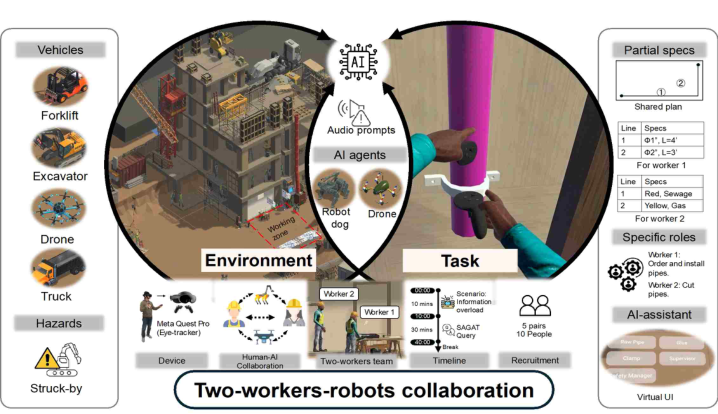
Experiment Setup and Task Design This study was conducted in the Col-Con VR environment, exploring cooperative behaviors among multiple users and AI agents (Yu et al., 2024). The experiment utilized Meta Quest Pro, which features full-body tracking and eye-tracking capabilities, providing an immersive experience through real-time voice communication, synchronized transformations, animations, sounds, and interactive virtual objects. Participants could move within an open 16’*26’ space and verbally coordinate with their human teammates to
Visual Allocation of Teams in the Construction Industry: Shared Situation Awareness 5
complete the task. Each participant was assigned a specific role and received partial task information, requiring them to communicate and exchange layout details to obtain a complete understanding of the plan before executing the installation. The AI system played a multifunctional role by providing audio cues for hazard alerts and task updates, supporting pipe installation through robotic cobots (a robot dog and drones), and offering a virtual UI for ordering and cutting materials.
Five pairs of participants were recruited to complete the task while interacting with AI-powered teammates and handling potential accidents such as struck-by hazards. At the start of the experiment, participants engaged in information exchange and coordination while common construction vehicles (excavators, forklifts, and trucks) operated in the background, creating a dynamic and hazard-prone environment. In addition, five instances of information overload, where they received irrelevant audio distractions (e.g., please give me your availability tomorrow for the shipment arrival), will be given randomly to participants throughout the session. They were required to respond aloud while continuing their task, simulating cognitive load under external interruptions. Before the 10-minute experiment froze, an impending hazard was introduced, accompanied by an AI-generated audio cue (e.g., warning: a truck is going to back up) to warn participants of the potential danger. The framework of the methodology can be referred to in Figure 2.
Figure 2: The methodology framework of this paper.
Shared SA and Eye-Tracking Data Measurement The experiment employed a multi-faceted measurement approach to assess shared SA, combining direct and indirect SA assessments. SAGAT (Endsley, 1988) was conducted immediately after the scenario freeze as a direct SA
measurement while eye-tracking data served as an indirect SA measurement. Participants answered 46 SAGAT queries independently across three topics— task, environment, and group awareness, each divided into three SA levels. Correct responses were scored as 1, and shared SA was recorded when both participants provided the same or correct answer.
Virtual objects were categorized into different areas of interest (AOIs) (Table 1). The run count metric represents how frequently participants shifted their focus to a specific AOI, and dwell time captures the duration spent fixating on an AOI. The average run count and dwell time were recorded to represent participants’ visual attention shifts and reactions to cognitive overload.
Table 1: Category of AOIs.
Table available in the original PDF paper.
Category Object Task Pipes, tools, layout, UI, wall, cobots. Environment Forklift, drone, truck, excavator. Group Human teammate.
Analysis Method Linear mixed-effects models (LMMs) were used to analyze H1 and H2, as they account for both fixed and random effects, allowing for a precise examination of the relationship between visual allocation and SA/shared SA scores while considering individual and team-level variations. Intraclass Correlation Coefficients (ICCs) were calculated within the LMM framework to assess the degree of variation in SA/shared SA scores attributable to individual versus team-level factors. A higher ICC suggests that shared SA is primarily shaped by team-level coordination, helping to determine whether shared SA functions as a collective process or remains largely an individual cognitive effort, directly informing H2 and H3.
To test H3, teams were classified into high-shared SA and low-shared SA groups based on their correct shared SA scores. Their run count and dwell time metrics were then compared between these groups. A two-sample t-test was conducted to identify differences in how well-coordinated teams allocate attention across tasks, environment, and group AOIs.
FINDINGS The findings for the H1 hypothesis are summarized in Table 2. The results show that environment SA had the most substantial group-level influence for both run count and dwell time, suggesting that it is primarily shaped by group factors rather than individual variation. Conversely, task SA and level 1 SA had negligible group-level variation, implying that these outcomes are driven mainly by individual attention patterns rather than shared team effects.
Visual Allocation of Teams in the Construction Industry: Shared Situation Awareness 7
Table 2: The impact of AOIs on individual SA scores.
Table available in the original PDF paper.
Run count (times) Dwell time (s) p-Value ICC SA Score AOIs Fixed Effects (β) p-Value ICC Fixed Effects (β)
.<0.1;*<0.05;**<0.01. Env: environment-related SA, Total: total SA for an individual.
For the fixed effects, spending more time or frequently revisiting environment-related objects improves the SA of task, level 1, level 2, and total score. In addition, more frequent revisits on task-related objects have higher task SA, while more times on environment-related objects lead to higher environment SA. Moreover, interacting with task- and environment- related AOIs improves level 1 SA. However, dwell time doesn’t show the same pattern. In addition, visual allocation towards all AOIs shows no correlation with group SA.
While these findings confirm H1, demonstrating multiple correlations between visual allocation toward AOIs and individual SA under information overload, they do not support H2. Despite robust correlations at the individual SA level, no significant relationship was found between visual attention and shared SA, regardless of whether both team members provided correct or incorrect responses.
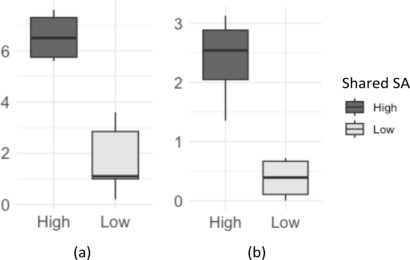
The findings of H3 are summarized in Table 3. The results indicate that high-shared SA teams revisited their attention more frequently and spent longer on environment AOI than low-shared SA teams (Figure 3). In addition, the high shared SA team exhibited a more balanced distribution of visual allocation across each AOI.
Table 3: Means of attention patterns across high and low shared SA levels.
Table available in the original PDF paper.
AOIs t-Test for Env-AOIs
Metrics Shared SA
Env Task Group t p- Value Run count (times) High 6.550021.3500 3.4000 5.8620 0.0004** Low 1.733329.9667 2.5667 Dwell time (s) High 2.39205.5660 0.7430 5.7430 0.0004**
Low 0.382010.2393 0.9117
.<0.1;*<0.05;**<0.01
Figure 3: Visual allocation toward environment AOI between high and low shared SA groups. (a) Run count. (b) Dwell time.
DISCUSSIONS The findings highlight that active visual engagement with relevant AOIs significantly enhances individual SA, reinforcing the strong link between perception and SA formation (Hasanzadeh et al., 2016). The strong group- level effects in environment SA and level 2 SA suggest that these aspects rely on team communication, shared perception, and coordinated responses, making team-based interventions essential for improving SA in dynamic environments. In contrast, the low ICCs observed in task SA and level 1 SA indicate that these aspects are primarily shaped by individual attention and responsibilities, rather than team-wide coordination. However, longer fixation does not necessarily lead to higher SA, likely because communication compensates for direct observation in teams. Instead of relying solely on visual attention, team members dynamically exchange information, allowing them to update their SA through verbal coordination rather than direct perception. This explains why high-shared SA teams may not require constant visual engagement with all AOIs but instead develop shared SA through strategic communication and distributed attention.
The lack of correlation between visual allocation and group SA suggests that shared SA formation is influenced by additional factors, such as communication and shared mental models (Cannon-Bowers et al., 1993; Endsley, 1999), rather than visual distribution alone. Additionally, SA in
Visual Allocation of Teams in the Construction Industry: Shared Situation Awareness 9 teams can be updated through communication rather than direct observation, meaning that high shared SA teams may rely on dyadic information- sharing, where one team member focuses on task execution while the other monitors environmental changes. This highlights the dynamic nature of shared SA, which is continuously calibrated through team interactions, coordination, and collective decision-making rather than solely through individual perception.
Furthermore, excessive focus on teammates may distract them from essential task-related or environmental information, potentially reducing individual SA. The failure to confirm H2 suggests that high team variability plays a significant role in shared SA formation, making it difficult to establish a direct relationship between visual allocation and shared SA. As a result, shared SA may not fully reflect individual perception but rather a dynamic outcome shaped by real-time communication and collaborative decision-making.
The classification of high and low shared SA teams suggests that groups with higher shared SA adopt a more balanced attention strategy, allocating more visual resources to environmental cues rather than solely focusing on task execution. These findings suggest practical strategies for training workers—and professionals in other high-risk fields such as military and emergency response—to improve SA by dynamically shifting attention between task execution and environmental monitoring. Rather than prioritizing task execution alone, teams in construction should be encouraged to balance their attention across different topics to develop stronger shared SA, enhancing both productivity and safety in human-AI teamwork. By integrating real-time communication, dynamic attention allocation, and structured coordination, teams can optimize individual and collective SA in complex environments.
CONCLUSION
Using a VR-based pipe installation task, this study investigated the relationship between visual allocation patterns, SA, and shared SA under information overload conditions in human-AI construction teams. By analyzing eye-tracking metrics (run count and dwell time) and SA/shared SA scores, this research evaluated how attention allocation across task-, environment-, and group-related AOIs influences Shared SA development and shared SA formation. The results indicate that SA can be maintained and updated through direct visual allocation and team communication. Additionally, high-shared SA teams exhibited more balanced attention distribution across task-, environment-, and group-related AOIs. This suggests that effective teamwork relies on strategic attention allocation rather than excessive focus on any single element.
The findings provide practical insights for training workers to adopt balanced attention strategies, ensuring task execution does not come at the expense of environmental awareness. They also lay the foundation for AI- driven adaptive feedback systems that enhance real-time coordination and shared SA in human-AI collaboration. Beyond construction, these insights can benefit other high-risk industries, such as aviation and emergency response, where effective teamwork and SA are critical.
However, the study is limited by its small sample size and controlled VR environment, which may not fully capture the complexity of real- world construction settings. Future research should expand to field studies to validate findings in practical applications. Additionally, incorporating psychophysiological sensors, such as neural activity monitors, vocal pattern analysis, and stress level indicators, could provide deeper insights into the cognitive and emotional factors influencing shared SA. These advancements will contribute to more comprehensive AI-driven interventions for improving SA and team coordination in high-risk environments.
ACKNOWLEDGMENT
The National Science Foundation is thanked for supporting the research reported in this paper through the Future of Work at the Human-Technology Frontier (FW-HTF) program. This paper was based on work supported by the National Science Foundation under Grant Nos. 2310210 and 2128867. Any opinions, findings, conclusions, or recommendations expressed in this material are those of the authors and do not necessarily reflect the views of the National Science Foundation.
REFERENCES
Arnold, M., M. Goldschmitt, and T. Rigotti. 2023. “Dealing with information overload: a comprehensive review.”Front Psychol, 14. Frontiers Media SA. https:// doi.org/10.3389/FPSYG.2023.1122200/FULL Cannon-Bowers, Janis A., Eduardo Salas, and Sharolyn Converse. 1993. “Shared
mental models in expert team decision making.” Individual and Group Decision Making: Current Issues. Cheng, C. Y., and B. Esmaeili. 2024. “Situation Awareness Study in the Construction Industry: A Systematic Review.” Construction Research Congress 2024, CRC 2024, 4: 843–853. American Society of Civil Engineers. https://doi.org/10.1061/ 9780784485293.084 Endsley, M. R. 1988. “Situation Awareness Global Assessment Technique (SAGAT).”
IEEE Proceedings of the National Aerospace and Electronics Conference, 789–795. IEEE. https://doi.org/10.1109/NAECON.1988.195097 Endsley, M. R. 1995. “Toward a Theory of Situation Awareness in Dynamic Systems.” Hum Factors, 37 (1): 32–64. Endsley, M. R. 1999. “Handbook of Aviation Human Factors.” Lawrence Erlbaum
Associates. Endsley, M. R.,. 2001. “A Model of Inter-and Intrateam Situation Awareness : Implications for Design, Training, and Measurement.” New Trends in Cooperative Activities : Understanding System Dynamics in Complex Environments, 46–67. Human Factors and Ergonomics Society. Endsley, M. R., and D. G. Jones. 2003. Designing for Situation Awareness: An
Approach to User-Centered Design Designing for Situation Awareness. Ge, L., Y. Li, Y. Li, J. Yan, and Y. Sun. 2022. “Smart Distribution Network Situation Awareness for High-Quality Operation and Maintenance: A Brief Review.” Energies (Basel). MDPI.
Visual Allocation of Teams in the Construction Industry: Shared Situation Awareness 11
Hasanzadeh, S., B. Esmaeili, and M. D. Dodd. 2016. “Measuring Construction Workers’ Real-Time Situation Awareness Using Mobile Eye-Tracking.” Construction Research Congress 2016: Old and New Construction Technologies Converge in Historic San Juan - Proceedings of the 2016 Construction Research Congress, CRC 2016, 2894–2904. American Society of Civil Engineers (ASCE). https://doi.org/10.1061/9780784479827.288 Hasanzadeh, S., B. Esmaeili, and M. D. Dodd. 2018. “Examining the Relationship
between Construction Workers’ Visual Attention and Situation Awareness under Fall and Tripping Hazard Conditions: Using Mobile Eye Tracking.” J Constr Eng Manag, 144 (7). American Society of Civil Engineers (ASCE). https://doi.org/ 10.1061/(asce) co.1943–7862.0001516 Howie, E. E., H. Dharanikota, E. Gunn, O. Ambler, R. Dias, S. J. Wigmore, R. J. E.
Skipworth, and S. Yule. 2023. “Cognitive Load Management: An Invaluable Tool for Safe and Effective Surgical Training.” J Surg Educ, 80 (3): 311–322. Elsevier. https://doi.org/10.1016/J. JSURG.2022.12.010 Huffman, S., D. Crundall, H. Smith, and A. Mackenzie. 2022. “Situation Awareness in sports: A scoping review.” Psychol Sport Exerc. Elsevier Ltd. Jentsch, F., J. Barnett, and C. Bowers. 1997. “Loss of Aircrew Situation Awareness:
A Cross-Validation.” Proceedings of the Human Factors and Ergonomics Society Annual Meeting, 41 (2): 1379–1379. SAGE Publications. https://doi.org/10.1177/ 1071181397041002165 Kok, E. M., and H. Jarodzka. 2017. “Before your very eyes: the value and limitations of eye tracking in medical education.” Med Educ, 51: 114–122. https://doi.org/ 10.1111/medu.13066 van de Merwe, K., S. Mallam, and S. Nazir. 2024. “Agent Transparency, Situation Awareness, Mental Workload, and Operator Performance: A Systematic Literature Review.” Hum Factors, 66 (1): 180–208. SAGE Publications Inc. https://doi.org/10.1177/00187208221077804/SUPPL_FILE/SJ-PDF-1-HFS- 10.1177_00187208221077804. PDF Misra, S., P. Roberts, and M. Rhodes. 2020. “Information overload, stress,
and emergency managerial thinking.” International Journal of Disaster Risk Reduction, 51: 101762. Elsevier. https://doi.org/10.1016/J. IJDRR.2020.101762 Nguyen, T., C. P. Lim, N. D. Nguyen, L. Gordon-Brown, and S. Nahavandi.
2019. “A Review of Situation Awareness Assessment Approaches in Aviation Environments.” IEEE Syst J, 13 (3): 3590–3603. Institute of Electrical and Electronics Engineers Inc. https://doi.org/10.1109/JSYST.2019.2918283. Ojha, A., Y. Liu, S. Shayesteh, H. Jebelli, and W. E. Sitzabee. 2023. “Affordable Multiagent Robotic System for Same-Level Fall Hazard Detection in Indoor Construction Environments.” Journal of Computing in Civil Engineering, 37 (1): 04022042. American Society of Civil Engineers (ASCE). https://doi.org/10.1061/(ASCE) CP.1943–5487.0001052/ASSET/ 74EBC688-97A4-42AA-AEAA-543941DC571B/ASSETS/IMAGES/LARGE/ FIGURE10.JPG Phillips-Wren, G., and M. Adya. 2020. “Decision making under stress: The
role of information overload, time pressure, complexity, and uncertainty.” J Decis Syst, 29 (sup1): 213–225. Taylor & Francis. https://doi.org/10.1080/ 12460125.2020.1768680 Rane, N. 2023. “ChatGPT and Similar Generative Artificial Intelligence (AI) for Building and Construction Industry: Contribution, Opportunities and Challenges of Large Language Models for Industry 4.0, Industry 5.0, and Society 5.0.” SSRN Electronic Journal. Elsevier BV. https://doi.org/10.2139/SSRN.4603221
Sakib, N., and A. H. Behzadan. 2025. “Human-AI Partnership to Improve Construction Workers’ Experience on Safety, Performance, and Health: A Systematic Review of The North American Construction Industry.” Journal of Engineering, Project, and Production Management, 15 (1): 1. Engineering Project and Production Management. https://doi.org/10.32738/JEPPM-2025-0006 Viscusi, W. K., and R. J. Zeckhauser. 1996. “Hazard Communication: Warnings
and Risk.” Ann Am Acad Pol Soc Sci, 545 (1): 106–115. https://doi.org/10.1177/ 0002716296545001011 Yu, L., C.-Y. Cheng, W. F. Ranc, J. Dow, M. Szilagyi, H. Huang, S. R. Hong, B.
Esmaeili, and L.-F. Yu. 2024. “Col-Con: A Virtual Reality Simulation Testbed for Exploring Collaborative Behaviors in Construction.” Zhang, T., J. Yang, N. Liang, B. J. Pitts, K. Prakah-Asante, R. Curry, B.
Duerstock, J. P. Wachs, and D. Yu. 2023. “Physiological Measurements of Situation Awareness: A Systematic Review.” Hum Factors, 65 (5): 737–758. SAGE Publications Inc. https://doi.org/10.1177/0018720820969071 Zhang, Z., B. H. W. Guo, A. Chang-Richards, R. Jin, and Y. Han. 2021.
“Digitalisation-based Situation Awareness for Construction Safety Management – A Critical Review.” Proceedings of the International Symposium on Automation and Robotics in Construction, 605–612. International Association for Automation and Robotics in Construction (IAARC).
LISTED IN THE AHFE DIGITAL BOOKSTORE CATALOGUE
Explore the complete digital volume
Human Factors in Robots, Drones and Unmanned Systems
Read this individual research paper free through the original publisher, or explore the full digital proceedings book.
ISBN 978-1-964867-55-7
Explore this ISBN in the AHFE Bookstore ↗Listed in the July 2026 bookstore catalogue; search by ISBN to confirm current availability · Digital book purchase optional