Lotta Straube (2025). From linear to circular: Redefining the customer journey in sustainable fashion. In: The Human Side of Service Engineering. AHFE Open Access, vol. 182, pp. 47–54. https://doi.org/10.54941/ahfe1006405
Given the planet’s finite resources, it is essential to rethink and move from the linear 'take-make-waste' approach to more sustainable circular economies. This shift includes designing products that can be easily recycled or biodegraded, considering their entire lifecycle from the start. However, this comes with severe changes affecting producers, consumers, and new stakeholders alike. That is why this study investigates the impact of circular transformation on the customer journey of consumer products. Analyzing the differences between linear and circular systems, as well as variances between the technical and biological loop, promotes a better understanding for future customer relationship management. Through the analysis of exemplary circularity-optimized fashion articles and mapping their journey, practical implications can be derived. The analysis shows that a linear approach to customer journey management does not suffice for circular products. Moreover, it can be seen that initial attraction and retention of consumers play a pivotal role in circular systems, as new business models like subscription services have the potential to lock them in. Significant differences also emerge in the end-of-life stages where products are either taken back by the producer or by another stakeholder for further treatment. This demonstrates the need for bespoke customer journey strategies, which is why an adapted model is proposed to provide a starting point for circularity-optimized customer relationship management, aligned with sustainable practices.
The fashion industry, historically built on a linear “take-make-waste” model, faces severe sustainability challenges. This is evidenced by the striking statistics presented in the Textiles Circularity Gap Report 2024, which indicate that only 0.3% of the global textile industry are considered circular (Saliba et al., 2024). The prevailing linear approach cannot continue indefinitely, given the planet’s boundaries and finite resources (Sariatli, 2017). To support a circular economy, innovative design paradigms must be introduced. Fortunately, there are emerging solutions, such as the industry- spanning “Jeans Redesign” initiative by the Ellen MacArthur Foundation (2021b), which developed guidelines for making denim jeans fit for a circular economy. Moreover, in 2025 Fashion For Good announced their “Closing
the Footwear Loop” project in collaboration with 15 fashion and footwear brands, to map waste streams, scout and validate end-of-life innovation, and develop circular design principles for footwear (Fashion for Good, 2025). Additionally, individual brands are launching initiatives and product innovation to re-think the linear system with new design approaches.
The recognized need for circular transformation, coupled with such new circular products entering the market raises a critical question: How does this fundamental change in the industry paradigm reshape the customer journey? To answer this question, the present article discusses the impacts of circular product design on the customer journey, focusing on footwear as an example. Analyzing three product examples provides a basis for proposing a new conceptual model to manage customer journeys of circularity-optimized products, as explored in the following discussion. But first, an understanding of key terms in the linear and circular economy is needed.
THEORETICAL FOUNDATION OF THE LINEAR VERSUS CIRCULAR ECONOMY IN THE FASHION INDUSTRY For decades, the linear economy played a crucial role in enabling material wealth in industrial nations (Sariatli, 2017). In this model, resources progress through a sequence of production, use, and disposal, a process often referred to as “take-make-waste.”While historically effective in facilitating large-scale manufacturing, such resource-intensive practices are increasingly at odds with the planet’s finite supply of materials.
Today, most products are not designed with consideration of the end-of- life. Complex modern items like a running shoe may contain 65 discrete parts and materials (Cheah et al., 2013). This complexity makes material recovery a challenge as different and composite materials require specialized treatment. Consequently, many products cannot be properly recycled, and are instead downcycled, incinerated, or landfilled. In contrast, a circular economy decouples economic growth from resource consumption and is designed to keep resources circulating (near) infinitely. The circular economy can furthermore be divided into two interconnected, yet distinct groups: the biological and the technical loop (Ellen MacArthur Foundation, 2021a). The biological loop is about circulating resources in accordance with nature. For footwear this means to design products in a way that they can biodegrade eventually, hence returning nutrients back to the soil. The technical loop deals with materials that cannot be returned to nature and should thus keep circulation in human-made systems through strategies such as repair, remanufacturing, and recycling. Optimizing a product for circularity thus means that it is developed to circulate either in the biological or technical loop. This happens by considering the full product lifecycle already during the design phase by choosing materials and constructions that are easy to disassemble, recycle and biodegrade, using lower impact technologies, and incorporating new business models to extend the product’s lifecycle. Over the last years, several examples of circularity-optimized products have emerged.
From Linear to Circular: Redefining the Customer Journey in Sustainable Fashion 49
Examples of Circular Footwear Innovation This research looks at three exemplary shoe models from the footwear brands Camper, Adidas, and Puma:
Camper’s Roku shoe is a remake of the brand’s 2000 Japanese-inspired shoe and was launched in a circularity-optimized version in 2024 (Camper, 2025). The product is completely modular, consisting of six separate components, each made of recycled materials. The use of monomaterials facilitates later recycling of the product components. Broken or damaged pieces can be replaced individually instead of discarding the entire shoe. Similarly, in case the wearer wishes to change the look, they can purchase different colors and create new combinations, aided by an instruction booklet for assembly (Camper, n.d). The Roku shoe is an example for technical loop innovation.
Adidas’s Futurecraft. Loop shoe was first announced in 2019, to be launched in 2021 (Adidas, 2019) and continues to be extended with new models (named Made to Be Remade). It is made of a single monomaterial (TPU) which can be fully recycled into a new shoe in a closed material loop (Adidas, 2019). The Futurecraft.Loop also serves as an example for the technical loop in the circular economy.
Puma’s Re:Suede is a compostable remake of the brand’s 1968 shoe and was launched in 2023 (Puma, 2023). The shoe was developed with composting partner Ortessa B.V. during a beta testing phase, and has since then been introduced to the market in 2024 (Bartunek, 2024). The Re:Suede serves as an example of product innovation in the biological loop.
Due to a limited (but emerging) offer of circularity-optimized products, there are only few research approaches on the impact that switching from linear to circular systems has on customer experience. The following chapter will discuss the foundational concepts of the customer experience and customer journey, before applying the concept to the introduced footwear innovation.
CONCEPTUAL FOUNDATION: CUSTOMER JOURNEY MAP To begin, it is essential to establish a clear understanding of the term customer experience. Lemon and Verhoef (2016, p. 71) define it as “a multidimensional construct focusing on a customer’s cognitive, emotional, behavioral, sensorial, and social responses to a firm’s offerings during the customer’s entire purchase journey”. Building upon this definition, effective customer experience management necessitates a holistic approach to designing interactions throughout the customer lifecycle, ultimately ensuring customer satisfaction and organizational success (Kreutzer, 2017). To further understand the customer experience, the customer journey concept is invaluable. It divides the experience into distinct touchpoints with the service or product provider, categorizing these interactions into pre-purchase, purchase, and post-purchase stages (Lemon and Verhoef, 2016). The
50 Straube
touchpoints along these stages can take the form of brand-owned, partner- owned, customer-owned, and social or external touchpoints and directly or indirectly influence customer behavior (Lemon and Verhoef, 2016). Recognizing the fluidity of online and offline interactions, Kreutzer (2017) advocates for a “noline” approach, emphasizing the interconnectedness between the touchpoints.
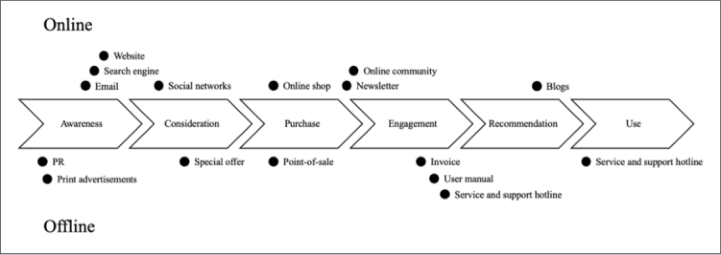
Figure 1: Customer journey map with exemplary online and offline touchpoints. (Translated and adapted from Kreutzer, 2017, p. 97).
As illustrated in Figure 1, a customer journey map outlines possible online and offline touchpoints between customer and an organization. For practical application, it is beneficial to tailor these maps to specific, concrete personas (Kreutzer, 2017). The customer journey map has become a strategic management tool, empowering organizations to understand their customers’ experiences and stimulating service innovation (Rosenbaum et al., 2017).
DISCUSSION
Customer Journey of Linear Products Annually, global footwear production exceeds 22 billion pairs of shoes (Bodoga et al., 2024). A significant portion of these shoes, often discarded after brief use depending on owner lifestyle (Dia et al., 2025), ends up in landfill. This linear economy trajectory from production to disposal, mirrors the one-way process flow of the customer journey map depicted in Figure 1. The customer journey begins in the pre-purchase stage, encompassing awareness and consideration, driven by marketing tools such as commercials, print and online advertisements. Then, the purchase stage describes the point- of-sale experience, including retail interactions or online order processes. The post-purchase phase encompasses the engagement, recommendation and product usage, which can happen through continued communication via email newsletters or through support services. The customer journey map proves effective in understanding and optimizing the customer experience for conventional products with their linear lifecycle. It effectively visualizes this straightforward journey, providing valuable insights on how to optimize the customer experience along the identified touchpoints. Yet, with emerging
From Linear to Circular: Redefining the Customer Journey in Sustainable Fashion 51
circular practices, new mapping approaches are needed to capture the complexity of customer relationships with circularity-optimized products that extend beyond the use phase.
Customer Journey of Circular Products The lifecycle of circularity-optimized goods is at first similar to that of a conventional product, moving through the customer journey stages from awareness to use. It is after this last stage that things start to differ: One of the core tenets of circularity is that the disposal is replaced by loops of repairing, remanufacturing, recycling, composting, or otherwise reusing the resources. A process flow with a defined “end” doesn’t capture this ongoing and active consumer engagement. Looking at the three examples the following differences can be observed:
Camper’s modular Roku may repeatedly be re-configured by the customer, by purchasing additional components, effectively revisiting earlier stages of the customer journey. After use, they may also return damaged modular product parts for technical recycling in a reverse resource flow, requiring prolonged and novel service support.
Adidas’ Futurecraft. Loop shoe exemplifies the reliance on reverse material flows inherent in technical loop circular systems: The system depends on customers returning old products at the end-of-life, so that the brand can create new ones, again highlighting the need of post-use phase engagement methods. Returning an old product and purchasing another pair made of old recycled ones also creates an additional loop to earlier customer journey stages. This provides additional opportunity for the brand to communicate and create a sense of community for customers in the same material cycle.
Puma’s Re:Suede needs special post-use handling to ensure proper decomposition and thereby returning nutrients to the biological loop. This could happen through a take-back mechanism by the brand or third-party provider. This introduction of new stakeholders into the ecosystem can forge unexpected connections. For instance, consumers may be enticed to purchase the created compost soil (Puma, 2023) that is made of the shoes they used to own; or conversely buyers of the compost may become aware of the Puma shoe. While the connection between sneakers and compost soil might seem tenuous, it symbolically illustrates the potential of novel network configurations in circular systems.
In essence, these three product examples underscore the limitations of the current models when it comes to circular innovation. Consequently, an adapted model, to be proposed in the following section, aims to incorporate the cyclical nature of these new, circular approaches.
Proposing an Adapted Model The inherent linearity of traditional process flows, with defined ends and beginnings, restricts the strategic customer experience management beyond single product lifecycles. McColl-Kennedy et al. (2018) emphasize that
52 Straube
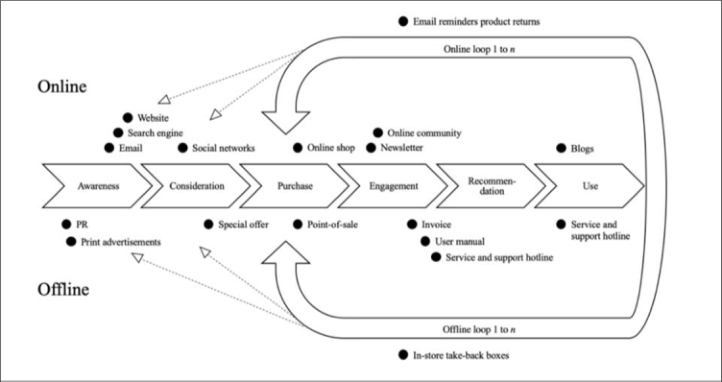
touchpoints can also occur across repeat purchases, which, in turn, impacts future interactions. However, despite such repetitions, the linear model depicted in Figure 1 fails to account for the cyclical nature of a circular economy. For instance, there is no dedicated consideration of consumers navigating a second, third, or later loop. Therefore, this section proposes an adapted model, illustrated in Figure 2, as a first step towards incorporating circularity in customer journey mapping.
Figure 2: Adapted customer journey map for circular products with exemplary online and offline touchpoints. (Translated and adapted from Kreutzer, 2017, p. 97).
This new model, while retaining a starting point for initial customer engagement, diverges by eliminating the endpoint. It suggests an infinite connection through iterative loops leading customers back to earlier stages, while considering the previous cycle. The model emphasizes a shift from customer acquisition to long-term retention, as the circular approach allows to build lasting relationships in such a new mapping approach. It also highlights the potential of “locking in” customers through sustained engagement, making the initial awareness even more essential.
CONCLUSION
This article reviewed the critical need for a paradigm shift from a linear to a circular economy through a customer experience lens. The analysis of three exemplary circularity-optimized shoes, revealed the limitations of traditional customer journey approaches in capturing the complexities of novel circular product lifecycles. The differences between biological and technical loops, and the challenges associated with end-of-life stages, all highlight the need for bespoke circular customer journey strategies. The findings show the important role of initial customer attraction and long- term retention, with novel business models offering new ways of customer engagement. The proposed model adaptation for circularity-optimized
From Linear to Circular: Redefining the Customer Journey in Sustainable Fashion 53
customer journey maps offers a foundational first attempt which needs to be further expanded and empirically tested. Future research should focus on refining this adapted model and exploring the nuances of consumer behavior within circular systems. This could be done by examining successful or emerging circular models in other industries, such as electronics, to gain additional insights. In conclusion, it can be said that the shift to circular systems will require adjustments on both the business and consumer sides. Ultimately, the successful implementation of circularity requires holistic service innovation that empowers consumers to become active participants in a more sustainable, circular future.
REFERENCES
Adidas. (2019). Adidas Unlocks a Circular Future for Sports with Futurecraft. Loop.
[Online] Available at: https://www.adidas-group.com/en/media/press-releases /adidas-unlocks-a-circular-future-for-sports-with-futurecraftloop (Accessed: 27 February 2025). Bartunek, R. J. (2024). Nach zwei-jährigem Kompostierungsexperiment: Puma bringt Re: Suede 2.0 Sneaker auf den Markt. Available at: https://about.puma.com/de/newsroom/corporate-news/2024/22-04-2024-nach-z weijaehrigem-kompostierungsexperiment-puma-bringt (Accessed: 27 February 2025). Bodoga, A., Nistorac, A., Loghin, M. C. & Isopescu, D. N. (2024). ‘Environmental Impact of Footwear Using Life Cycle Assessment—Case Study of Professional Footwear’, Sustainability Volume, 16(14), 6094. Camper. (2025). Roku. Available at: https://www.camper.com/de_DE/roku?section=
innovation (Accessed: 27 February 2025). Camper. (n.d.). Roku by Camper. Available at: https://www.camper.com/html/roku -contents/roku-instructions.pdf (Accessed: 27 February 2025). Cheah, L. et al. (2013). ‘Manufacturing-focused Emissions Reductions in Footwear
Production’, Journal of Cleaner Production, Volume 44, pp. 18–29. Dia, R., Islam, Q. & Islam, Q. (2025). Green Steps: The Evolution of Thaely in the Sneaker World. London: Sage Publications. Ellen MacArthur Foundation. (2021a). The Butterfly Diagram: Visualising the
Circular Economy. Available at: https://www.ellenmacarthurfoundation.org/circu lar-economy-diagram (Accessed: 27 February 2025). Ellen MacArthur Foundation. (2021b). The Jeans Redesign Guidelines.
Available at: https://content.ellenmacarthurfoundation.org/m/165bfe9c7cf5fc27/ original/The-Jeans-Redesign-Guidelines.pdf Fashion For Good. (2025) 15 Brands Unite With Fashion For Good For Ambitious Push Into Footwear Circularity. Available at: https://www.fashionforgood.com/o ur_news/closing-the-footwear-loop/ (Accessed: 27 February 2025). Kreutzer, R. T. (2017) Customer Experience Management – wie man Kunden
begeistern kann. In: A. Rusnjak & D. Schallmo, eds. Customer Experience im Zeitalter des Kunden. Wiesbaden: Springer Gabler, pp. 95–119. Lemon, K. N. & Verhoef, P. C. (2016) ‘Understanding Customer Experience Throughout the Customer Journey’, Journal of Marketing, 80(6), pp. 69–96. McColl-Kennedy, J. R. et al. (2018) ‘Gaining Customer Experience Insights That
Matter’, Journal of Service Research, 22(1), pp. 8–26.
54 Straube
Puma. (2023) Puma Re: Suede. Available at: https://about.puma.com/sites/def ault/files/documents/pdf/puma-resuede-handbook-german_0.pdf (Accessed: 27 February 2025). Rosenbaum, M. S., Otalora, M. L. & Ramírez, G. C. (2017) ‘How to Create a
Realistic Customer Journey Map’. The Business Horizons, 60(1), pp. 143–150. Saliba, M., Keys, A. & Murdie, M. (2024) The Circularity Gap Report Textiles.
Available at: https://www.circularity-gap.world/textiles Sariatli, F. (2017) ‘Linear Economy Versus Circular Economy: A Comparative and Analyzer Study for Optimization of Economy for Sustainability’, Visegrad Journal on Bioeconomy and Sustainable Development, 6(1), pp. 31–34.
LISTED IN THE AHFE DIGITAL BOOKSTORE CATALOGUE
Explore the complete digital volume
The Human Side of Service Engineering
Read this individual research paper free through the original publisher, or explore the full digital proceedings book.
ISBN 978-1-964867-58-8
Explore this ISBN in the AHFE Bookstore ↗Listed in the July 2026 bookstore catalogue; search by ISBN to confirm current availability · Digital book purchase optional