Gabriela Guadalupe Reyes Zárate, Eduardo Arturo Garzón Garnica (2025). Talent Development and Retention in Industry 4.0: Strategy to Overcome Talent Challenges in VUCA Environments and Drive Digital Transformation With Agility. In: Human Interaction and Emerging Technologies (IHIET-FS 2025): Future Systems and Artificial Intelligence Applications. AHFE Open Access, vol. 196, pp. 96–104. https://doi.org/10.54941/ahfe1005958
Publisher statistics will load when you open Metrics.
AHFE OPEN ACCESS OPEN ACCESS CONFERENCE PROCEEDINGS PAPER
Talent Development and Retention in Industry 4.0: Strategy to Overcome Talent Challenges in VUCA Environments and Drive Digital Transformation With Agility
Technologies have significantly changed the demands of work, and the skills needed for the future. Many companies have migrated towards automated processes; however, it is crucial to strengthen professional growth from the formative stage, developing skills that complement industrial digitization. In countries such as Mexico, the lack of specialized talent represents a major obstacle to progress in the digital transformation. This article analyzes an experience applied in a Mexican university, in which an agile approach was implemented in the management of projects developed by students of different engineering degrees. The comparison between the use of predictive and agile methodologies showed significant improvements in academic performance and the quality of the proposed solutions. In VUCA contexts, where uncertainty and complexity are constant, agile approaches are not only relevant, but necessary to train talent prepared for a globalized and constantly evolving labor market.
The digital transformation has generated a change in organizations, demanding professionals capable of adapting to agile, collaborative and highly technological environments. Despite this global trend toward digital transformation (Grupo Banco Mundial, n.d.), traditional educational models still present significant gaps between academic training and the competencies required by today’s labor market. According to Cornejo-Velazquez and Clavel-Maqueda, the lack of skilled human capital in the manufacturing industry hinders the adoption of digitalization (Cornejo-Velazquez and Clavel-Maqueda, 2023). Casalet explains in her article “Challenges and Opportunities of Digitalization in Mexico” that the obstacles companies face in the digital transformation process exist at both external and internal levels. Among the internal challenges, most responses highlighted the lack of human resources with the appropriate professional profile, also, there is shortage of qualified talent for digital transformation (Casalet,
Talent Development and Retention in Industry 4.0 97
2023). Higher education institutions must work in collaboration with industries, professional associations, and the government to keep their academic programs up to date, adapting them to the new competencies demanded by the market. This transformation requires engineers with innovative profiles who will be responsible for leading and managing it (Hernandez-de-Menendez et al., 2020). Engineering education must be adjusted to align with digital transformation in response to these changes (Garcés and Peña, 2020; Rodríguez-Abitia et al., 2020; Schatan, 2018). Adapting engineering education to the Industry 4.0 vision is mentioned as a relevant and pressing need (Pacher et al., 2024). In Mexico, employers are increasingly seeking professionals in the fields of Information Technology (IT) and data analysis, driven by the growing digital focus and the digital transformation of companies. In 2022, the talent shortage in Mexico reached 68% in IT and technology-related areas, and 66% in the manufacturing sector (ManpowerGroup, 2024). According to Avitia-Carlos et al. (2022), in Mexico, given the emergence of new technologies and their impact on the labor market, skill development must be a continuous effort involving close collaboration between companies and employees.
In a global context characterized by Volatility, Uncertainty, Complexity and Ambiguity, commonly known as VUCA environments, the ability to adapt has become a key competency, where individual, team, and organizational agility is essential to effectively manage such environments (Baran and Woznyj, 2020). The use of Agile methods to manage cognitive activity in the digital educational space can be useful in preparing students and increasing their employment opportunities (Salimzyanova, 2021).
In education, as in project management, waterfall management style is the most widespread style. It is called this because for an activity to start, it is mandatory for the previous one to have finished, resembling a waterfall (Iwersen et al., 2023).
The agile approach is classified as an adaptive method. This type of approach is particularly useful when project requirements involve a high level of uncertainty and are likely to change during development. At the beginning, an overall vision of the project is defined, while the initial requirements are gradually adjusted, refined, or even replaced based on user feedback, environmental changes, or unforeseen events. Some agile frameworks operate in short cycles, typically lasting one to two weeks, each ending with a presentation of the progress achieved (Project Management Institute, 2021).
This article presents an applied experience with engineering students in their last semester, in the context of a real company, in which the agile methodology was integrated as part of the teaching process. Through three specific projects, the impact of this implementation on student performance was evaluated, not only from a technical point of view, but also in terms of collaboration, leadership and strategic thinking. A characteristic of the project was the formation of multidisciplinary teams, composed of students from different engineering fields, who assumed key roles according to their area of specialization. This structure allowed replicating a real professional environment and favored the development of innovative solutions, such
98 Reyes and Garzón
as specialized software for the improvement of production processes and proposals applied to tooling management.
The experience was conducted at a private university in Mexico. This country is facing significant challenges in areas such as digital transformation and the continuous development of professional skills (Tecnológico de Monterrey, 2019). Mexico is in the process of digital transformation but faces several challenges that must be addressed to achieve a more complete and effective integration of digital technologies in all sectors (Casalet, 2023). According to Valdez Juárez et al, Mexico is among the five countries in the Latin American region with the highest level of digitalization and business innovation, but this is only true for medium and large companies, since for some SMEs there is a significant digital and technological gap (Valdez-Juárez et al., 2023). Initiatives such as the one presented in this article provide a strategy by integrating agile approaches to prepare future professionals for an increasingly dynamic, competitive and technologically advanced work environment.
METHODOLOGY
The present study was structured under a comparative design, with the objective of evaluating the differences in students’ performance when applying predictive (waterfall model) and adaptive (agile methodology) project management approaches. Thirty-six students in their final semester from different engineering disciplines participated: Industrial, Civil, Biotechnology, Mechanical Engineering and Information Technology. The academic diversity made it possible to form multidisciplinary teams with distributed functions according to the skills of each area. The experience took place in a large national company, with facilities in the region, where area managers acted as mentors, providing students with real information on internal processes and operational needs. This accompaniment made it possible to simulate an authentic professional environment, reinforcing the practical applicability of the project.
The work was divided into two main phases. In the first phase, teams managed their activities using the traditional predictive model (Waterfall). At the end of this phase, an evaluation was conducted with a focus on initial planning, metrics, and control. In the second phase, the teams adopted an agile approach, utilizing tools such as online Kanban boards, which facilitated workflow visualization and encouraged task self-management. Agile roles were assigned to students, promoting both individual and collective responsibility. At the end of this phase, a second evaluation was carried out. This agile or adaptive assessment emphasized project development through servant leadership and self-managed teamwork, organized in iterative and incremental sprints. The final evaluation enabled a comparison of the results achieved under both methodologies.
Projects Description During the experience, three projects were developed impacting operational processes of the company directly. Each project responded to specific needs
Talent Development and Retention in Industry 4.0 99
previously identified by the area managers, who acted as mentors for multidisciplinary teams.
1. Tooling management system and structural shelf design. This project addressed the optimization of the storage of tools used in production. A physical shelf structure was designed using 3D modeling, complemented by a digital solution for tool registry, control and inventory, that was developed using Python. It allows for real-time data querying and process automation that was previously managed manually using spreadsheets.
2. Measurement of operational efficiency and development of control tools. The second team proposed the implementation of the OEE (Overall Equipment Effectiveness) indicator in three productive areas of the company. Python was also used to develop an aid for simplifying wages calculation and recording the number of parts produced, which in turn allowed the automated calculation of the operating personnel’s efficiency. The user interface was designed to be intuitive and accessible to managers, supervisors and operators. In addition, this project included the design of two physical devices aimed at improving efficiency at three workstations.
3. Digital file manager for document centralization. The third team developed a digital platform using Power Apps for the centralized management of internal documentation. This tool replaced the extensive use of Excel spreadsheets, reducing the time spent by supervisors on administrative tasks and improving accessibility to critical information.
All three projects were developed over a five-week period. Starting from week 2, the agile methodology was implemented as a work structure, which facilitated iterative planning, continuous delivery of value and the incorporation of direct feedback from the mentors. At the end of the cycle, the projects were presented to the company, receiving positive feedback for their applicability, functionality and innovative approach.
RESULTS
The results obtained show a generalized improvement in student performance when comparing the grades obtained during the phase with predictive methodology with those obtained during the phase with agile approach. Descriptive statistics with Excel were used to analyze the students’ performance before and after the intervention. Measures such as mean, median, mode, standard deviation and coefficient of variation were calculated to examine the central tendency, dispersion, and distribution of the pre-test and post-test scores, as shown in Table 1. This analysis provided a clear overview of the changes in students’ academic performance, highlighting improvements in average scores and a reduction in variability, which indicates a more consistent learning outcome across the group.
100 Reyes and Garzón
Table 1: Comparative summary of descriptive statistics for the Waterfall and Agile scores.
Table available in the original PDF paper.
Indicator Waterfall Agile Observations Mean 77.36 94.42 Significant improvement in the average score (∼17 points) Median 80 94.57 Higher central tendency maintained Mode 88 100 Mode increased; more students reached
the maximum score Standard
11.52 3.94 Strong reduction in variability Deviation Coefficient 14.89% 4.18% Much lower CV, indicates greater
consistency in scores
of Variation
Based on the descriptive analysis of both scores, the following key conclusions can be drawn regarding the impact of the intervention on student performance: There was a notable increase in the average score, reflecting the positive impact of the learning intervention. The agile scores showed much less variability, indicating that most students improved and reached higher performance levels. The coefficient of variation decreased from 14.89% to 4.18%, which means students’ performance became more consistent and homogeneous. A greater number of students achieved top scores, as suggested by mode and maximum values. These changes strongly suggest that the learning activity was effective and equitable across the group.
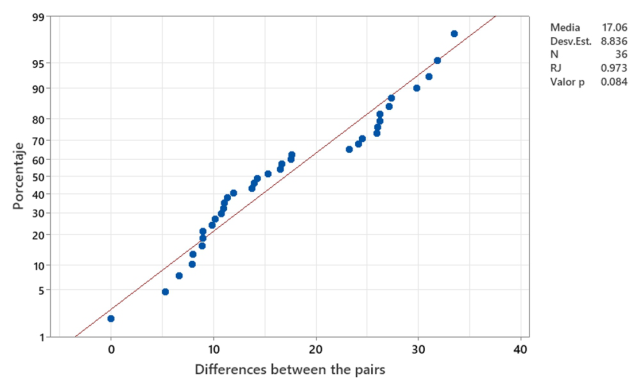
After conducting a descriptive statistical analysis, in which notable differences were observed between the means of both variables, it was deemed necessary to apply a paired sample t-test to determine whether these differences were statistically significant. This test was selected because the measurements correspond to the same subjects under two different conditions, allowing for the evaluation of the effect of a specific intervention or change. One of the assumptions for using the paired sample t-test is that the differences between pairs of observations approximate a normal distribution. This assumption was evaluated through a normality test using Minitab, as shown in Figure 1.
The plot and the p-value indicate that the differences between the paired observations follow an adequate normal distribution (p = 0.084). Therefore, it is appropriate to apply the paired sample t-test.
Based on this, the following hypotheses were established to guide the analysis: Ho: There is no difference between the means H1: There is a significant difference between the means Using the paired sample t-test, it was evaluated whether there was a significant difference between the means of two variables measured within the same group of 36 observations. The results show a substantial difference between the means: Waterfall scores (M = 77.36) and agile scores (M = 94.42).
Talent Development and Retention in Industry 4.0 101
Figure 1: Normal probability plot of the differences between pairs.
The obtained t statistic was −11.58, with a two-tailed p-value of 1.59 × 10⁻¹³, which is considerably lower than the commonly accepted significance level (α = 0.05). Additionally, the absolute value of the t statistic exceeds the critical value (|t| > t critical), which supports the rejection of the null hypothesis.
Therefore, it is concluded that there is a statistically significant difference between the two conditions evaluated, with agile methodology being significantly higher than waterfall. This result suggests that the intervention or treatment applied had a positive and meaningful effect on the analyzed group.
In addition, students were asked to document their reflections on the use of the agile model, and their responses revealed a generally positive experience. Their reflections included the following:
The agile methodology allowed continuous delivery and increased customer satisfaction.
The incremental approach allowed continuous adjustments based on feedback.
Each delivery added value with improvements in functionality and accessibility.
Features were validated prior to final integration.
Agile methodology facilitated rapid response to changes.
DISCUSSION
The results obtained in this educational experience consistently show a significant improvement in student performance when implementing the agile methodology. This improvement is not only reflected in the overall average grades, but also in the individual evolution, highlighting that all participants improved their grades in the second stage of the project.
102 Reyes and Garzón
One of the factors that may explain this result is the iterative and collaborative nature of the agile approach, which encourages constant participation, continuous feedback and shared responsibility. Unlike the predictive model, the agile methodology promotes adaptation, autonomous decision making and value delivery from the earliest iterations (Iwersen et al., 2023) Deliverables that involve a high degree of innovation, such as the development of technological tools, or those where the project team lacks prior experience, are better suited to a more adaptive approach. Likewise, deliverables that can easily adjust to change can also benefit from this type of approach (Project Management Institute, 2021).
The improvement was particularly significant among students who initially presented lower scores. This suggests that the agile approach not only favors those who are already high performers but also acts as a leveler that allows diverse profiles to integrate more effectively into teamwork and the achievement of concrete goals. In addition, the multidisciplinary dynamics and the direct participation of mentors from the company provide an environment where theory could be applied in a practical way. Agile learning fosters a positive learning environment, enhances academic results, and boosts motivation among both educators and students (Komar et al., 2020). This immersion increased student motivation and allowed them to tangibly experience the benefits of adaptive, end-user-centered management.
The results reinforce the importance of including agile methodologies in university education, not only as a trend aligned with the labor market, but also as an effective pedagogical tool to improve learning, collaboration and responsiveness in complex and changing contexts.
CONCLUSION
The implementation of agile methodologies in the studied environment appears to significantly contribute to the development of students’ technical, organizational, and collaborative competencies. Through an experience applied in a university in Mexico, with multidisciplinary teams and concrete business challenges, it was possible to observe improvements in academic performance.
The students’ reflections highlight that the implementation of the Agile methodology not only enhanced the development process but also contributed to a more dynamic and responsive learning experience. They recognized the value of continuous delivery and iterative feedback, which enabled them to make timely adjustments and improve both functionality and accessibility. The emphasis on delivering value with each increment, validating features before final integration, and adapting quickly to changes contributed to higher customer satisfaction and a deeper understanding of Agile principles. These insights suggest that incorporating Agile methodologies into academic projects can significantly strengthen students’ practical and collaborative skills in real-world scenarios. Likewise, in the face of VUCA environments - characterized by volatility, uncertainty, complexity and ambiguity - agile methodologies enable future professionals to develop an adaptive mindset, oriented towards change, collaboration and
Talent Development and Retention in Industry 4.0 103
continuous value delivery. These approaches, strategically integrated into higher education, become key catalysts to drive digital transformation from the classroom to the labor market.
This study, conducted with a group of engineering students at a university in Mexico, demonstrates that the strategic implementation of agile methodologies in higher education serves as an effective response to the challenges of talent development and retention in VUCA environments, preparing future professionals to drive digital transformation with agility. In the future, it is recommended to extend this experience to other areas of knowledge and explore the integration of hybrid methodologies that combine the best of both approaches (predictive and agile), allowing future professionals to develop with flexibility and judgment in dynamic contexts, both nationally and internationally.
ACKNOWLEDGMENT
The authors would like to acknowledge the financial support of Writing Lab, Tecnologico de Monterrey, Mexico, in producing this work.
REFERENCES
B. E. Baran and H. M. Woznyj, “Managing VUCA: The human dynamics of agility,”
2020. C. Pacher, M. Woschank, B. M. Zunk, and E. Gruber, “Engineering education 5.0: a systematic literature review on competence-based education in the industrial engineering and management discipline,” 2024, Taylor and Francis Ltd. doi: 10.1080/21693277.2024.2337224. C. Schatan, “Retos de la automatización y digitalizacion para el empleo en México,”
2018. E. Cornejo-Velazquez and M. Clavel-Maqueda, “Advances and Challenges to Adoption of Industry 4.0 in the Manufacturing Sector: Case of Mexico,” in Cyber- Physical Systems and Supporting Technologies for Industrial Automation, 2023, pp. 11–44. “Escases de talento en México,” ManpowerGroup. Accessed: Sep. 27, 2024. [Online]. Available: https://www.manpowergroup.com.mx/wps/wcm/ connect/manpowergroup/0c21fb22-e7e4-491e-b72b-fed3fb74cbf6/Infograf% C3%ADa+Escasez+de+Talento+M%C3%A9xico + 2022.pdf?MOD=AJPERES &CONVERT_TO=url&CACHEID=ROOTWORKSPACE. Z18_2802 IK01OORA70QUFIPQ192H31-0c21fb22-e7e4-491e-b72b-fed3fb74cbf6- o5tPeqE E. S. Salimzyanova, “VII International Forum on Teacher Education Agile in Digital
Didactics in the Era of the VUCA World in Education,” pp. 1417–1432, 2021, doi: 10.3897/ap.5.e1417. G. Garcés and C. Peña, “Ajustar la Educación en Ingeniería a la Industria 4.0: Una visión desde el desarrollo curricular y el laboratorio,” Revista de Estudios y Experiencias en Educación, vol. 19, no. 40, pp. 129–148, Aug. 2020, doi: 10.21703/rexe.20201940garces7. G. Rodríguez-Abitia, S. Martínez-Pérez, M. S. Ramirez-Montoya, and E. Lopez-
Caudana, “Digital gap in universities and challenges for quality education: A diagnostic study in Mexico and Spain,” Sustainability (Switzerland), vol. 12, no. 21, pp. 1–14, Nov. 2020, doi: 10.3390/su12219069.
104 Reyes and Garzón
Grupo Banco Mundial, “La digitalización mundial en 10 gráficos.” L. E. Valdez-Juárez, E. A. Ramos-Escobar, and E. P. Borboa-Álvarez, “Reconfiguration of Technological and Innovation Capabilities in Mexican SMEs: Effective Strategies for Corporate Performance in Emerging Economies,” Adm Sci, vol. 13, no. 1, Jan. 2023, doi: 10.3390/admsci13010015. L. H. L. Iwersen, L. Zem, and R. de A. Penteado Neto, “Choosing the Best Project Management Methodology for Research and Development Projects: Agile, Waterfall, or Hybrid?,” Revista Foco, vol. 16, no. 11, p. e3336, Nov. 2023, doi: 10.54751/revistafoco.v16n11-112. L. H. L. Iwersen, L. Zem, and R. de A. Penteado Neto, “Choosing the Best
Project Management Methodology for Research and Development Projects: Agile, Waterfall, or Hybrid?,” Revista Foco, vol. 16, no. 11, p. e3336, Nov. 2023, doi: 10.54751/revistafoco.v16n11-112. M. Casalet, “Challenges and Opportunities of Digitalization in Mexico,” in Digital and Sustainable Transformations in a Post-COVID World: Economic, Social, and Environmental Challenges, Springer International Publishing, 2023, pp. 451–474. doi: 10.1007/978-3-031-16677-8_17. M. Casalet, “Challenges and Opportunities of Digitalization in Mexico,” in Digital
and Sustainable Transformations in a Post-COVID World, Cham: Springer International Publishing, 2023, pp. 451–474. doi: 10.1007/978-3-031-16677- 8_17. M. Hernandez-de-Menendez, C. A. Escobar Díaz, and R. Morales-Menendez, “Engineering education for smart 4.0 technology: A review,”International Journal on Interactive Design and Manufacturing (IJIDeM), vol. 14, no. 3, pp. 789–803, Sep. 2020, doi: 10.1007/s12008-020-00672-x. O. A. Komar, Y. M. Chuchalina, A. N. Kramarenko, T. A. Torchynska, and I. V.
Shevchuk, “Agile approach in training future primary school teachers for resolving complex pedagogical situation,” International Electronic Journal of Elementary Education, vol. 13, no. 4, pp. 469–477, 2020, doi: 10.26822/iejee.2021.205. P. Avitia-Carlos, N. Candolfi-Arballo, J. L. Rodriguez-Verduzco, and B. Rodriguez- Tapia, “Conditions for the Development and Certification of Industry 4.0 Technical Competencies,” Revista Iberoamericana de Tecnologias del Aprendizaje, vol. 17, no. 4, pp. 336–342, Nov. 2022, doi: 10.1109/ RITA.2022.3217135. Project Management Institute, Guide to the project management body of knowledge
(PMBOK guide). Project Management Institute, Inc., 2021. Tecnológico de Monterrey, “Competencias transversales Una visión desde el Modelo Educativo DOCUMENTO GUÍA,” 2019.
LISTED IN THE AHFE DIGITAL BOOKSTORE CATALOGUE
Explore the complete digital volume
Human Interaction and Emerging Technologies (IHIET-FS 2025): Future Systems and Artificial Intelligence Applications
Read this individual research paper free through the original publisher, or explore the full digital proceedings book.
ISBN 978-1-964867-72-4
Explore this ISBN in the AHFE Bookstore ↗Listed in the July 2026 bookstore catalogue; search by ISBN to confirm current availability · Digital book purchase optional