Yutaka Watanabe, Akihiro Kashihara (2025). Motivating Information Explorers: AI-based Orientation System for Promoting Web-based Investigative Learning. In: Human Factors in Design, Engineering, and Computing. AHFE Open Access, vol. 199, pp. 1442–1453. https://doi.org/10.54941/ahfe1006956
Web-based investigative learning is an example of information exploration. Learners are expected to explore learning resources according to their interest in order to construct wider and deeper knowledge regarding their question. In our previous studies, we have modeled a process of investigative learning as a cycle of three phases: (1) searching and navigating Web resources, (2) knowledge construction, and (3) question expansion, and supported learners’ metacognitive activities with a cognitive tool we have developed. However, learners are required to be motivated for learning in order to engage in such self-regulated learning. In this paper, we propose an approach to promote learners’ motivation by providing information regarding their initial question so that they can perceive value in their investigation. To provide orientation according to learners’ values, we have classified the value types and viewpoints to present information about the question based on their values. We also propose a system that provides the orientation by generating summaries about their question using a large language model (LLM). According to a preliminary case study, it is suggested that the orientation approach promotes learners’ knowledge construction and deep question expansion.
Information exploration is an open-ended learning activity that allows learners to explore learning resources according to their interest to construct knowledge. Web-based investigative learning is a prominent example of information exploration. Learners can explore numerous and diverse Web resources to investigate their question widely and deeply. On the Web, there are no predetermined learning scenarios like those found in textbook-based learning, so they have to create their own learning scenarios as they explore resources. Consequently, learners need to exercise self-regulation, which requires them metacognition and motivation (Zimmerman & Moylan, 2009) in order to engage in investigation on the Web.
In our previous studies, we have designed a model that represents a process of investigative learning on the Web, and developed a cognitive tool named interactive Learning Scenario Builder (iLSB) to scaffold their investigation
Motivating Information Explorers: AI-Based Orientation System 1443
according to the model (Kashihara & Akiyama, 2017; Kashihara, 2023). Using both the model and the tool, we have supported learners’ self- regulation particularly in metacognition.
However, there has been insufficient research on promoting learners’ self- regulated learning via motivation. Even if learners have a question, they may not achieve deep understanding without motivation to investigate wider and deeper. It is additionally challenging for learners to find interesting contents that motivate them among vast resources on the Web. Consequently, some learners could not utilize their metacognition, and result in inadequate and superficial investigation. For these learners, it is crucial to foster their perception of the value in investigating the question (Zimmerman & Moylan, 2009). When they percept the value, they can be more intrinsically motivated for their investigation, and clarify why and what kind of information they should investigate, which leads learners to engage in detailed and deep investigation.
In this paper, we propose an approach to elicit a learner’s motivation with an orientation, which associates his/her values with a question to be investigated. To achieve the orientation, we have classified the value types into three based on existing literature (Kage, 2013): those derived from learner’s interests (type I), learner’s daily lives (type II), and socially important considerations (type III). The proposed approach identifies characteristics of learner’s value, specifically regarding types I and II, by inquiring about academic fields they are interested in and life situations they have prioritized. It is expected that the learners perceive type I and II values when presented with the information regarding the selected fields and situations, and perceive type III value when it is presented that the question is socially important. In addition, we have developed an AI-based orientation system to provide a summary introducing the question, enabling learners to perceive the value in investigating the question based on their identified characteristics. We also discuss the result of a preliminary case study to evaluate effectiveness of this approach and the system.
WEB-BASED INVESTIGATIVE LEARNING Web-based investigative learning is an example of information exploration that involves self-regulated learning. Learners can investigate an initial question by navigating Web resources according to their interests and construct knowledge (Hill & Hannafin, 1997). Unlike textbook-based learning, there are no predetermined learning scenarios. Accordingly, learners have to create their own learning scenarios via determining what and in what order they will investigate next by formulating further questions based on what they have learned. This requires learners to engage in metacognitive activities such as reflection and planning. Furthermore, learners need to perform these metacognitive activities while navigating Web resources, which requires self-regulation. Those metacognitive and self-regulated activities involve high cognitive load (Zumbach & Mohraz, 2008).
In order to support such learning activities, we have proposed a model of Web-based investigative learning (Kashihara & Akiyama, 2017; Kashihara,
1444 Watanabe and Kashihara
2023). In this model, the process of investigative learning is described as a three-phase cycle: (1) searching and navigating Web resources, (2) knowledge construction and (3) question expansion. By repeating these three phases, learners are expected to expand their initial question into sub-questions, thereby allowing them to investigate their question widely and deeply. Let us explain the three phases in detail.
In the first phase, learners are expected to search Web resources regarding their initial question using search engine and browse the retrieved resources. While browsing the resources, learners are also expected to extract keywords that represent what they have learned from the resources. This keyword extraction is referred to as keyword segmentation. For example, if learners have the question, “What is global warming?” and they learn concepts such as “greenhouse gas”, or “sea level rise” from related resources, they would extract these keywords. In the second phase, learners are expected to construct knowledge about the question through representing what they learned in the previous phase as a keyword structure. To create this keyword structure, learners are expected to make relationships among segmented keywords. In the third phase, learners are expected to expand the question into some sub-questions. The candidates of these sub-questions are the segmented keywords. Learners are expected to select keywords to be investigated further based on their knowledge constructed in the second phase.
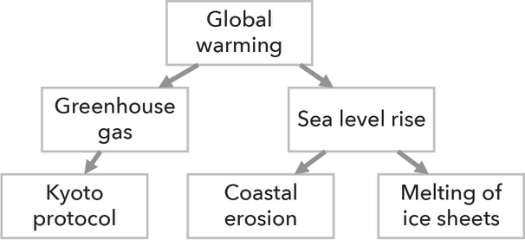
Learners are expected to repeat these three phases for each expanded sub- question until they consider their question expansion sufficient. The result of their question expansion can be represented as a question tree as shown in Figure 1, whose root node is initial question and other nodes are sub- questions. This tree is viewed as a learning scenario and can be considered an outcome of the investigative learning. The learning scenario represents the depth and width of their investigation.
Figure 1: An example of learning scenario.
Interactive Learning Scenario Builder (ILSB) We have developed the interactive Learning Scenario Builder (iLSB), a cognitive tool designed to scaffold learners’ investigative learning according to the modeled process, which is described in Section 2.1 (Kashihara & Akiyama, 2017; Kashihara, 2023). Figure 2 illustrates the user interface of
Motivating Information Explorers: AI-Based Orientation System 1445
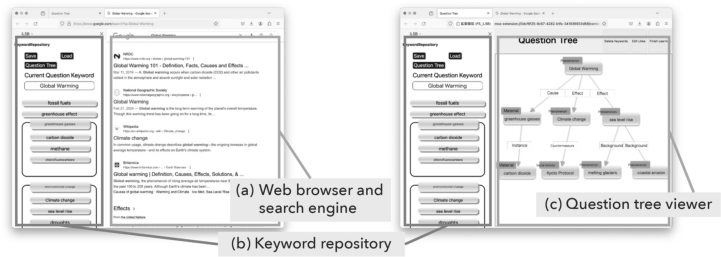
iLSB. It is implemented as a Firefox browser add-on, and offers three core functionalities: (a) Web browser and search engine, (b) keyword repository, and (c) question tree viewer. Keyword repositories are provided for initial question and each sub-question that is expanded.
Figure 2: Functions of interactive learning scenario builder.
The Web browser and search engine enables learners to search for and navigate Web resources. The keyword repository is used to store segmented keywords. Learners can extract keywords from Web resources into the keyword repository by mouse-dragging and dropping. Learners also create inclusion relationships among keywords within the repository. The question tree viewer is an area for creating learning scenarios. Learners can expand sub-questions by dragging a segmented keyword from the repository into the question tree viewer. Keywords that represent sub-questions are referred to as question keywords (q-keywords). Learners can connect a parent question and its child question by arrow links to represent the order of question expansion. By double-clicking the node of a q-keyword, learners can open the Web page where the question keyword is searched via the search engine.
Motivation Towards Investigative Learning Besides metacognitive skills, motivation is also an essential factor for engaging in self-regulated learning activities (Zimmerman & Moylan, 2009). In Web-based investigative learning, learners need to be motivated to investigate their question. However, some learners may not be motivated for investigation even if they have questions. Furthermore, it is difficult to find the content that motivates them through Web resource navigation, as there are vast resources on the Web. When they do not recognize why and what kind information they should investigate, they may not carry out their metacognitive skills (Boekaerts, 1997), which leads them to inadequate and superficial investigation.
While we have proposed an approach to promote learners’ metacognition during their investigation, research on promoting their motivation is still insufficient. To promote their motivation for open-ended learning, it would be effective to provide an orientation that introduces the topics addressed in their questions and stimulates their interest (Pedaste et al., 2015). Through
1446 Watanabe and Kashihara
this orientation, they are expected to be more intrinsically motivated to investigate the questions.
Purpose of This Study This paper proposes an approach to provide an adaptive orientation which introduces questions tailored to each learner’s characteristics. This paper also proposes AI-based orientation system based on this approach. This system generates summaries that introduce the questions according to their value. Learners are expected to read the generated summaries to be intrinsically motivated, thereby understanding why and what kind of information they should investigate. This approach aims to enable learners to effectively utilize metacognition, allowing them to engage in self-regulated learning and conduct more detailed and deep investigations.
PROMOTING PERCEPTION OF VALUES IN INVESTIGATION There are several factors that affect learners’ motivation, such as self- efficacy, outcome expectations, and goal orientations, while value is a crucial factor deeply related to intrinsic motivation (Zimmerman & Moylan, 2009). Accordingly, this paper focuses on the value that learners perceive in investigating their questions. By presenting information adapted to learners’ value, learners would become intrinsically motivated for their investigation.
In order to capture learners’ value, we have classified the value types into three based on existing literature (Kage, 2013). The value types are as follows: Type I Value derived from learners’ interests Type II Value derived from learners’ daily lives Type III Value derived from socially important considerations
Viewpoints for Grasping the Question In order to enable learners to perceive the three value types in investigation, we aim to adaptively present information regarding their questions to each learner. Let us consider what kind of information we should present to help learners perceive values. The differences of learners’ values are reflected in the kind of information they investigate about their initial questions. For example, when a learner having an interest in biology investigates the question “What is global warming?”, he/she would look into its impact on the ecosystem, whereas a learner having an interest in economics would look into its effect on the economy. Thus, the information from which learners perceive the value in investigation depends on the viewpoints of grasping their questions.
Accordingly, we present information from the viewpoints tailored to each learner’s three value types. By presenting information from the viewpoints that learners are interested in or have prioritized, or from socially important viewpoints, they are expected to be more interested in investigating the question and more motivated to investigate from these viewpoints.
Motivating Information Explorers: AI-Based Orientation System 1447
In our approach, we use academic fields as viewpoints for the first type of value, and life situations as viewpoints for the second and third value types. Tables 1 and 2 present the classifications of academic fields and life situations, respectively. We used academic fields based on the Classification Table of Academic Fields published by the Ministry of Education, Culture, Sports, Science and Technology of Japan (MEXT, 2024). We also used life situations based on the Japanese edition of International Classification of Functioning, Disability and Health (ICF) published by the World Health Organization and translated by the Ministry of Health, Labour and Welfare of Japan (WHO, 2002).
Table 1: Table of academic fields.
Table available in the original PDF paper.
Domains Fields Humanities Literature, philosophy, history Social sciences Jurisprudence, political science, economics, commercial science, sociology
Home economics Home economics, food science, clothing science, housing studies, child studies Education Education, physical education Arts Fine arts, design, music
Table 2: Table of life situation.
Table available in the original PDF paper.
Life Situations Explanation Self-care Situations regarding the care of one’s body and health management
Domestic life Situations regarding acquiring housing and daily necessities, performing housework, and aid for family life Interpersonal interactions and relationships
Situations regarding interacting with acquaintances and unfamiliar others in socially acceptable manner Continued
1448 Watanabe and Kashihara
Table 2: Continued Life Situations Explanation
Table available in the original PDF paper.
Independent living (originally “major life areas”)
Situations regarding receiving education, engaging in work or economic activities for an independent life, or preparing for those
Participation in society (originally “community, social and civic life”)
Situations regarding engaging in community, leisure, or religious activities, exercising human rights, or participating in political activities
Process and Expected Effects of Orientation In our proposed orientation, we allow learners to select academic fields they are interested in and life situations they have prioritized from viewpoints that are considered as relevant to their questions. We then identify learners’ values based on their selections. Subsequently, we synthesize information regarding their questions by associating it with the identified values, thereby fostering their interest and motivating for investigation.
Accordingly, learners can clarify why and what kind of information they should investigate, which enables them to carry out metacognition and self- regulation effectively. They are expected to carefully gather information and construct more detailed knowledge, as well as expand more sub-questions. Consequently, learners can achieve a more detailed and deep understanding of their questions, creating elaborate learning scenarios.
AI-BASED ORIENTATION SYSTEM Following the orientation approach, we have developed an AI-based orientation system. This system summarizes information on the Web regarding learners’ initial question, and provides orientation to them by presenting the generated a summary. First, the system diagnoses whether viewpoints are relevant to a learner’s initial question for each academic field or life situation defined in Tables 1 and 2, by calculating the relevance value. Second, the system presents a filtered list of relevant viewpoints, and asks him/her to select the academic fields they are interested in and the life situation they have prioritized. Through this selection, the system recognizes the selected field as a viewpoint to present information regarding the value type I, and the selected situation as a viewpoint to present information regarding the value type II. Additionally, it recognizes the most relevant situation not selected by the learner as a viewpoint to present information regarding the value type III.
Third, the system gathers Web resources regarding the initial question from the viewpoints. Finally, the system summarizes information from the gathered Web resources using GPT-4.1, a large language model (LLM) developed by OpenAI, and presents the generated summary to the learner. A part of the generated summary regarding the initial question “What is global warming?” from the viewpoints of “biology” for the value type I is shown in Figure 3.
Motivating Information Explorers: AI-Based Orientation System 1449
Figure 3: English translation of a generated summary regarding “global warming”.
PRELIMINARY CASE STUDY We conducted a preliminary case study in order to evaluate to what extent our proposed orientation promotes learners’ motivation for investigation. In this case study, we compared investigation with the orientation and investigation with predefined viewpoints that were provided to learners in advance, independent of their individual values.
Hypotheses To evaluate the effect of the orientation on motivation, we set the following hypotheses, focusing on its impact on engagement and self-regulation activities.
H1. The orientation promotes learners’ motivation and engagement on investigation.
H2. The orientation promotes learners’ Web resources navigation. H3. The orientation promotes learners’ knowledge construction. H4. The orientation promotes learners’ deeper question expansion.
Procedure Participants of this case study were 9 graduate and undergraduate students in informatics. They were divided into an experimental group (short for ex-group) including 5 participants and a control group (short for co-group) including 4 participants.
First, all participants were presented with the lists of academic fields and life situations, and asked whether the lists included their strongly interesting fields or situations. If so, they were asked to specify them. Then, they watched an explanation video of the investigative model and iLSB. Subsequently, they were given an initial question of “What is hay fever?” and investigated it for practice using iLSB in 20 minutes.
After the practice, they were given an initial question, “What is community revitalization?”. Then, the participants in the ex-group received an orientation regarding the question using the proposed system. They were allowed to select an academic field from seven fields, which were forest product science, housing studies, industrial arts, economics, sociology, management engineering and agricultural engineering, and select a life situation from four fields, which were independent living, participation in society, domestic life and self-care, listed in order of relevance. After selecting the viewpoints, they were presented a generated summary from the system.
1450 Watanabe and Kashihara
On the other hand, the participants in the co-group were presented two prepared viewpoints, which were economics and participation in society, which were diagnosed by the system as having moderate relevance.
Subsequently, they investigated the initial question using iLSB within 50 minutes. All participants were allowed to finish their investigation when they considered it sufficient. In this investigation, the participants in the co- group were required to conduct their investigation from the two presented viewpoints. After investigation, the participants answered a questionnaire to evaluate their motivation for the investigation.
In the questionnaire, the participants were asked about their awareness of each viewpoint, the extent of gathering information related to each viewpoint, and their engagement in investigation from each viewpoint, using a 7-point Likert scale. They were also asked about the extent of gathering information regarding the initial question and information that they were interested in throughout the entire investigation using a 7-point Likert scale.
In order to evaluate the participants’ sufficiency in Web resources navigation, we used the number of resource visits, the number of resources visited, and the number of keywords they extracted. To evaluate their sufficiency in knowledge construction, we used the number of inclusion relationships they constructed, and the number of associated keywords. To evaluate their sufficiency in question expansion, we used the number of q- keywords, the number of leaf nodes, the degree of the root node, and the average and maximum depth of the question trees.
RESULTS
Table 3 shows the results of the questionnaire. We identified the viewpoint with the highest awareness for each learner based on their responses, and then calculated the average scores for those viewpoints. This result shows the ex-group’s engagement in investigating from the viewpoint with highest awareness of the ex-group was higher than that of co-group. However, both groups showed moderate engagement. Also, the engagement of both groups was almost same throughout the entire investigation, which suggests H1is rejected.
Table 4 shows the average numbers and standard deviations (SD) of indicators regarding their information navigation, knowledge construction and question expansion. However, we excluded the results of the participants co01 who performed exceptionally wide and deep question expansion, and ex04 who did not seem to be influenced by the orientation, according to their learning scenarios. The co-group’s indicators regarding information navigation were either higher than or almost the same as those of the ex-group. Meanwhile, the ex-group’s indicators regarding knowledge construction were higher than those of the co-group, which suggests H2 is rejected and H3 is supported. Additionally, according to the results of question expansion shown in Table 4, while the participants in the co-group had wider investigation, those in ex-group performed deeper question expansion, which supports H4.
Motivating Information Explorers: AI-Based Orientation System 1451
Table 3: The average and SD of the questionnaire answers.
Information gathering 4.40 (1.52) 4.75 (0.96) Engagement 4.60 (2.51) 4.25 (1.50) 4.80 (0.84) 4.75 (1.26) Entire investigation Information gathering 6.00 (0.71) 5.25 (0.96) Gathering information regarding participants’ interests
Engagement 5.40 (0.89) 5.50 (1.29)
Table 4: The average and SD of indicators regarding the participants’ investigation.
Table available in the original PDF paper.
Ex-Group Co-Group The number of resource visits 22.75 (9.18) 28.67 (5.86) The number of resources visited 18.75 (7.41) 25.33 (5.69) The number of extracted keywords 63.25 (18.61) 62.00 (47.84) The number of associated keywords 27.50 (10.34) 16.00 (15.52) The number of inclusion relationships 8.25 (2.63) 5.33 (4.73) The number of q-keywords 12.25 (7.27) 17.00 (6.92) The number of leaf nodes 7.75 (3.30) 12.67 (6.11) The degree of the root node 3.00 (1.63) 8.33 (6.81) The average depth of the question tree 2.39 (0.99) 1.89 (0.53) The maximum depth of the question tree 3.25 (1.50) 2.67 (0.58)
DISCUSSION
First, we discuss whether the participants in ex-group were influenced by the orientation. According to their learning scenarios, the participants ex01, ex02 and ex03 tended to expand questions related to the viewpoints selected, and participant ex05 partially extended questions related to viewpoints selected. Therefore, it is considered that three of five participants were greatly influenced by the orientation.
According to Table 3, there were no large differences in engagement of entire investigations between the two groups. Also, among the viewpoints presented to the ex-group, investigation from viewpoints regarding life situations had the least engagement. This can be attribute to the vagueness of classification of life situations, which prevented the participants from predicting what kind of information would be presented. Therefore, it would be needed to refine this classification more detail. In addition, some summaries were too generic and lacked specificity, which prevent learners from being motivated. In order to motivate them more, it is necessary to generate more concrete summaries, for example, by incorporating specific examples.
According to Table 4, while the participants in the co-group performed resource navigation well, those in the ex-group performed knowledge
1452 Watanabe and Kashihara
construction well. Therefore, it is suggested that the participants in the ex-group could clarify why and what kind of information they should investigate, and gathered information just enough to construct knowledge, without unnecessary navigation. Additionally, while the participants in the co-group expanded more sub-questions, it was also showed that those in ex-group created deeper learning scenarios, according to Table 4. It is considered that detailed knowledge construction enables them to expand the sub-questions that were deeply investigable.
CONCLUSION
This paper addressed an orientation approach to promote learners’ motivation via providing summaries so that they perceive the value in investigation. We also developed a system to identify the characteristics of learners’ values and generate the summaries according to the identified value. A preliminary case study showed the orientation approach promoted learners’ knowledge construction and deep question expansion, which suggests the approach allowed learners to engage in self-regulation utilizing their metacognition skills and conduct detailed and deep investigation. However, it remains challenging to refine the classification of life situations and generate more concrete summaries incorporating specific examples, in order to motivate learners more. Future works will therefore focus on addressing these challenges and conducting further case studies.
REFERENCES
Boekaerts, M. (1997) Self-regulated learning: A new concept embraced by researchers, policy makers, educators, teachers, and students. Learning and Instruction, Vol. 7, No. 2, pp. 161–186. Hill, J. R., & Hannafin, M. J. (1997) Cognitive strategies and learning from the world wide web. Educational Technology Research and Development, Vol. 45, No. 4, pp. 37–64. Kage, M., 2013. Theories of Learning Motivation – Educational Psychology of
Motivation – (Gakushu Iyoku no Riron – Doukizuke no Kyouiku Shinrigaku –). Kanekoshobo, Tokyo, Japan. (in Japanese). Kashihara, A. (2023) Design of Web-Based Investigative Learning. Transactions of Japanese Society for Information and Systems in Education. Vol. 40, No. 2, pp. 105–116. (in Japanese). Kashihara, A., & Akiyama, N. (2017) Learning Scenario Creation for Promoting
Investigative Learning on the Web. The Journal of Information and Systems in Education, Vol. 15, No. 1, pp. 62–72. Ministry of Education, Culture, Sports, Science and Technology (MEXT) (2024) Classification Table of Academic Fields 2024 Edition. Available at: https://www.mext.go.jp/content/20241001-mxt_chousa01-000034363_18.pd f (Accessed: 18th May 2025) (in Japanese). Pedaste, M., Mäeots, M., Siiman, L. A., de Jong, T., van Riesen, S. A. N., Kamp, E. T., Manoli, C. C., Zacharia, Z. C., & Tsourlidaki, E. (2015) Phases of inquiry-based learning: Definitions and the inquiry cycle. Educational Research Review, Vol. 14, pp. 47–61.
Motivating Information Explorers: AI-Based Orientation System 1453
World Health Organization (WHO) (2002) International Classification of Functioning, Disability and Health. Available at: https://iris.who.int/bitstream/ handle/10665/42407/9241545429-jpn.pdf (Accessed: 6th June 2025) (in Japanese). Zimmerman, B. J., & Moylan, A. R. (2009) “Self-regulation: Where metacognition and motivation intersect”, in Hacker, D. J., et al. (ed.) Handbook of metacognition in education, Routledge/Taylor & Francis Group, New York, USA. pp. 299–315. Zumbach, J., & Mohraz, M. (2008). Cognitive load in hypermedia reading
comprehension: Influence of text type and linearity. Computers in Human Behavior, Vol. 24, No. 3, pp. 875–887.
LISTED IN THE AHFE DIGITAL BOOKSTORE CATALOGUE
Explore the complete digital volume
Human Factors in Design, Engineering, and Computing
Read this individual research paper free through the original publisher, or explore the full digital proceedings book.
ISBN 978-1-964867-75-5
Explore this ISBN in the AHFE Bookstore ↗Listed in the July 2026 bookstore catalogue; search by ISBN to confirm current availability · Digital book purchase optional