Karsten Huffstadt (2026). The Silent Impact of AI: Unveiling Motivational Side Effects in the Digital Workplace. In: Intelligent Human Systems Integration (IHSI 2026): Disruptive and Innovative Technologies. AHFE Open Access, vol. 200, pp. 351–361. https://doi.org/10.54941/ahfe1007094
As artificial intelligence (AI) becomes increasingly embedded in knowledge-intensive work, concerns are growing about its psychological impact on employees. While much of the existing literature emphasizes productivity gains and task automation, this study explores a less visible dimension: the potential motivational side effects of AI integration. Specifically, we investigate how the use of AI tools in professional contexts may affect perceived social presence, cognitive effort, motivation, and ultimately, task performance.Grounded in the High-Performance Cycle (Locke & Latham, 2002) and complemented by theories of social presence, perceptual fluency, and cognitive engagement, we develop a comprehensive mediation model. The model hypothesizes that AI usage may reduce motivation indirectly through decreased perceptions of social presence and lower cognitive investment in tasks. Motivation, in turn, is expected to predict self-reported performance outcomes. We further examine whether technological self-efficacy moderates these pathways.To empirically test our model, we conducted a cross-sectional survey with 297 professionals who regularly use AI systems such as generative language models, automation platforms, and AI-driven analytics tools. Participants were recruited via professional networks (e.g., LinkedIn, Prolific Academic) and selected based on their experience with AI in daily work tasks. All key variables - AI usage, perceived social presence, cognitive effort, motivation, and performance - were measured using validated Likert-scale instruments. Data were analyzed using structural equation modeling (SEM) and bootstrapped mediation tests.Results reveal that AI usage has a statistically significant negative effect on both social presence (β = -0.42) and cognitive effort (β = -0.38), which in turn positively influence motivation (β = 0.35 and β = 0.31, respectively). Motivation emerged as the strongest predictor of performance (β = 0.58). Mediation analyses confirmed that the effects of AI on performance are fully mediated by motivational and perceptual variables. Additionally, exploratory moderation analyses showed that technological self-efficacy buffers the negative impact of AI usage on motivation, suggesting individual resilience factors play a role.This study contributes to the literature by extending motivational theories into AI-mediated work contexts and identifying key psychological mechanisms behind technology-induced disengagement. It highlights that AI systems, while operationally efficient, may alter the subjective experience of work in ways that reduce intrinsic engagement. The findings have implications for organizational design, system architecture, and human-AI interaction strategies. They also call for the development of motivationally aware AI systems and for training programs that enhance technological self-efficacy.In sum, our results underscore that the impact of AI is not only functional but also psychological. The future of work will depend not just on how well machines perform, but on how well they preserve the human motivation to engage, create, and perform.
The rapid proliferation of artificial intelligence (AI) technologies in organizational environments is transforming the nature of work. What was once deemed exclusively human (e.g., decision making, knowledge processing, creative problem solving) is increasingly supported - or supplanted - by AI systems (Brynjolfsson et al., 2025). While such technologies promise enhanced efficiency and productivity, they also raise critical questions about the human side of work: How does the integration of AI change employees’ motivational drivers, perceptions of agency, engagement with tasks, and ultimately performance?
352 Huffstadt In particular, the deployment of AI in tasks that were formerly performed by humans may impact key psychological and behavioural elements - for instance, reducing opportunities for cognitive challenge, diminishing social interaction or presence, and altering perceptions of task meaningfulness. For example, recent work suggests that AI use can reduce cognitive effort requirements in tasks, which may sound beneficial, but this very reduction may lead to reduced personal investment or decreased feelings of competence (Chen, 2025). At the same time, studies on human-AI collaboration indicate that lower social presence (i.e., the feeling of interacting with another human or being socially connected) in AI augmented work may undermine trust, engagement and motivation (Zhang et al., 2021). Despite the emerging research, there remains a paucity of studies addressing how these psychological mechanisms mediate the relationship between AI usage and work performance in knowledge intensive tasks.
This paper addresses that gap by investigating how the use of AI in complex tasks affects employees’ motivation and performance, using knowledge work (with an example of informatics related tasks) as an illustrative case. Drawing on the High Performance Cycle of Locke and Latham (2002), which emphasises the role of goal setting, effort, persistence and performance, as well as concepts of social presence, cognitive effort, perceptual fluency, and the potential distortions from the Dunning-Kruger effect (Dunning and Kruger, 1999), we propose a process model in which AI utilisation reduces perceived social presence and cognitive effort, thereby decreasing employee motivation and ultimately performance.
To empirically test our model, we carry out a quantitative study with employee respondents engaged in informatics oriented tasks within organisations. We operationalise AI usage as our independent variable, and self reported performance as our dependent variable, with perceived social presence, cognitive effort, and motivation specified as mediators. Data are analysed using structural equation modelling (SEM) to test direct and indirect effects. The aim is to deepen theoretical understanding of human-AI interaction in work settings and to inform practitioners about the conditions under which AI may inadvertently undermine - rather than enhance - employee motivation and performance.
By focusing on informatics related tasks as a representative context (with an outlook that the findings may generalise to other complex task domains), the study contributes both to theory (by integrating motivational, cognitive and social psychological mechanisms in the AI work interface) and practice (by signalling when AI deployment may backfire from a human performance perspective).
THEORETICAL BACKGROUND One of the most widely accepted frameworks in work and organizational psychology is the High-Performance Cycle proposed by Locke and Latham (2002), which posits that clearly defined goals, high self-efficacy, and feedback mechanisms jointly promote motivation, effort, and ultimately job performance. Motivation channels attention and energy toward task success,
The Silent Impact of AI: Unveiling Motivational Side Effects 353 and goal clarity and perceived competence play a central role in sustaining effort. In AI-supported environments, however, these dynamics may shift. When AI takes over cognitively demanding tasks, individuals may experience a reduced sense of agency or control. Automated feedback and diminished self-construction of goals could interfere with the motivational feedback loop described in the High-Performance Cycle (Locke and Latham, 2002).
Social presence, defined as the perceived social or emotional engagement in mediated interaction (Short, Williams, and Christie, 1976), becomes relevant in AI contexts where human collaborators are replaced or reduced. Zhang et al. (2021) found that lower social presence in AI-supported settings reduces trust and engagement, while Oh et al. (2018) showed that social presence correlates positively with satisfaction and motivation. A lack of perceived interaction may reduce accountability and social energy, both of which are important for intrinsic motivation.
Cognitive effort, or the mental resources invested in tasks, is another critical factor. Westbrook et al. (2015) emphasize that effort signals engagement and ownership. When AI automates parts of the task, perceived effort may decrease. Although this can improve efficiency, it can also reduce the psychological value of success. Perceptual fluency - the ease of processing information - can further exacerbate this effect. Reber et al. (2004) note that overly fluent tasks may lead to underinvestment or disengagement. As Evans (2024) argues, cognitive offloading through AI may unintentionally reduce intrinsic motivation when success is no longer perceived as self-driven.
The Dunning-Kruger effect (Dunning and Kruger, 1999) adds a further layer to this discussion. Individuals with limited competence may overestimate their skills, and this tendency may be amplified in AI-supported environments. When users benefit from intelligent systems without understanding them, they may misattribute outcomes to personal ability, distorting feedback and weakening the learning process. In complex tasks, such misperceptions can reduce adaptive growth and long-term performance.
This study integrates these theoretical constructs into a comprehensive path model. The High-Performance Cycle serves as the motivational core, while social presence and cognitive effort represent mediating psychological states. Perceptual fluency and the Dunning-Kruger effect provide further explanatory depth by highlighting changes in perceived effort and self-assessment. Prior research by Jia et al. (2025) and Wu et al. (2025) has examined similar mechanisms. However, this study contributes a novel integration by explicitly modeling how AI use influences performance via cognitive and motivational pathways, while also accounting for distorted perceptions and social-emotional disruptions.
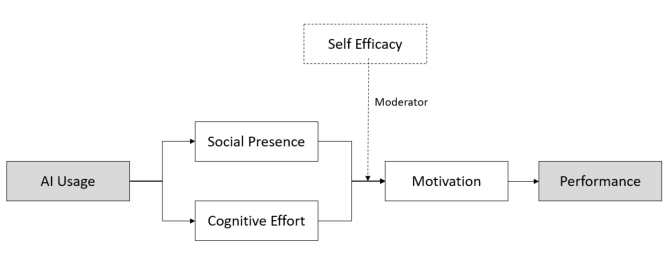
HYPOTHESES AND CONCEPTUAL MODEL We propose a path model in which the independent variable (IV) is the degree of AI usage in task processing, and the dependent variable (DV) is employee performance. The relationship between these two variables is mediated by three key constructs: perceived social presence, cognitive effort (or perceptual fluency), and motivation. Specifically, the model assumes that
354 Huffstadt AI usage reduces perceived social presence and alters the level of cognitive effort required, potentially increasing the perceived fluency of tasks. These altered perceptions are expected to influence motivation, which in turn drives performance outcomes.
Additionally, the model allows for the possibility of moderation. Technological self-efficacy, or an individual’s perceived competence in handling AI tools, may differentially affect certain pathways in the model, with the influence of AI usage on motivation appearing especially susceptible. In other words, individuals with higher self-efficacy may be less susceptible to the motivational side effects of AI integration. This conceptual framework captures both the cognitive and emotional dynamics of AI-mediated work, highlighting the importance of subjective experience in determining performance outcomes.
Figure 1: Conceptual path model (own illustration).
Below are our formal hypotheses, with theoretical justification and linkage to the model.
H1a: AI usage is negatively related to perceived social presence. When tasks are supported or replaced by AI systems, the human-human interaction (or sense of interacting with another conscious agent) may decline. Research in mediated settings emphasises that reduced social presence harms engagement and commitment (Oh et al., 2018). Studies of AI in collaborative tasks show that automation can undermine social cues.
H1b: AI usage is negatively related to cognitive effort (or positively related to perceptual fluency).
AI can reduce the mental workload by taking over complex processing, thereby lowering required cognitive effort. While this seems positive, it may reduce subjective investment and sense of challenge. For instance, research finds that AI collaboration improves immediate performance but results in lower intrinsic motivation.
H2a: Lower perceived social presence is negatively related to motivation. According to motivational theory (e.g., the High Performance Cycle, Locke and Latham, 2002), feelings of meaningful connection, feedback and goal oriented interaction help sustain effort and persistence. If social presence declines, motivation may suffer.
The Silent Impact of AI: Unveiling Motivational Side Effects 355 H2b: Lower cognitive effort or higher perceptual fluency is negatively related to motivation.
If tasks are perceived as too easy or lacking challenge (high fluency), the motivational drive to invest effort can diminish. Cognitive load literature suggests that too low or too high cognitive demand both reduce motivational engagement.
H3: Motivation is positively related to performance. This is directly drawn from the High Performance Cycle (Locke and Latham, 2002) which posits that effort, persistence and strategy (which stem from motivation) lead to improved performance.
H4: Perceived social presence and cognitive effort/fluency mediate the relationship between AI usage and motivation.
AI usage affects the psychological experience (social presence, cognitive effort/fluency), and these in turn influence motivation. This mediation chain is supported by emerging AI–work research showing that AI’s effects on motivation are partially indirect. For example, recent work shows AI boosts performance but undermines motivation due to altered task experience.
H5: Motivation mediates the relationship between perceived social presence / cognitive effort/fluency and performance.
This is the final step in the path from experience to outcome: altered task experience leads to motivation, and motivation, in turn, leads to performance.
H6 (Optional moderator hypothesis): Technological self efficacy (or AI competence) moderates the effect of AI usage on motivation, such that the negative effect of AI usage on motivation is weaker for employees with high self efficacy.
Individuals confident in using technology may interpret AI assistance differently (e.g., as supportive rather than controlling), thus mitigating the negative effect. Although direct literature is scarce, research on human AI collaboration indicates that user characteristics (such as motivation and perceived competence) shape outcomes.
In summary, the model posits that the use of AI in task environments can initiate a chain of psychological consequences - reduced social presence and altered cognitive engagement - which in turn diminish motivation, thereby reducing performance. Individuals’ technological self efficacy may buffer these negative pathways.
METHODOLOGY
To investigate the proposed mediation model, we employed a quantitative, hypothesis-driven approach using structural equation modeling (SEM). A cross-sectional survey was conducted among knowledge workers from various industries who regularly engage in cognitively demanding digital tasks, some of which are supported or augmented by AI technologies (e.g., large language models, automation tools, predictive systems). Using purposive sampling, we targeted individuals with documented experience in using AI tools at work. Participants (N = 297) met inclusion criteria requiring them to be over 18 years of age, currently employed in digital roles, and to have
356 Huffstadt prior exposure to AI systems, as confirmed through a filter item in the survey. This sample size exceeds recommended guidelines for models involving five latent variables (Kline, 2015).
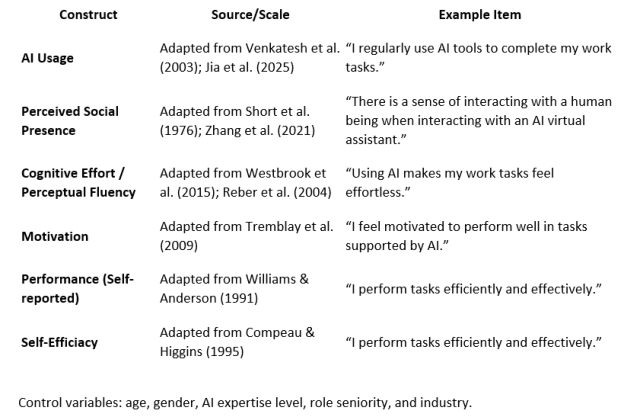
Data collection was performed via an online questionnaire disseminated through LinkedIn groups, professional mailing lists, and curated networks in the technology and consulting sectors. Participation was anonymous and voluntary. All constructs were assessed using validated Likert-scale items (1 = strongly disagree to 7 = strongly agree), adapted to the AI-supported work context. Minor phrasing adjustments ensured relevance to participants’ experiences.
Data analysis followed a two-step SEM procedure using AMOS. First, confirmatory factor analysis (CFA) assessed the measurement model, evaluating internal consistency, convergent validity, discriminant validity, and global model fit using CFI, RMSEA, and SRMR. Second, the structural model was tested to estimate the hypothesized relationships, including direct, indirect, and mediated effects. Mediation was examined through bias- corrected bootstrapping with 5,000 resamples. To further assess the model’s robustness, a multi-group analysis was conducted to test for moderation effects of technological self-efficacy.
Figure 2: Constructs, scales and example items (own illustration).
RESULTS
Data were collected over a three-week period via an online questionnaire targeting professionals actively engaged in digital and knowledge-based work. Recruitment occurred through LinkedIn groups, Slack communities, and internal mailing lists in the tech and consulting sectors. Participants were informed that the study focused on psychological effects of AI in the workplace, particularly in relation to motivation and task engagement. Inclusion criteria required active employment in digital roles, regular exposure to AI-supported tools (e.g., ChatGPT, Copilot), and informed consent. Out of 344 responses,
The Silent Impact of AI: Unveiling Motivational Side Effects 357 297 valid cases remained after excluding incomplete entries and participants who did not meet the inclusion criteria.
The gender distribution was 54% male, 44% female, and 2% diverse. The average age was 34.7 years (SD = 7.2), with a mean of 6.8 years of professional experience (SD = 4.1). Participants represented a range of industries, including information technology (38%), consulting (26%), analytics (21%), and other sectors (15%). Self-reported frequency of AI usage varied across the sample, with 34% indicating high usage, 48% moderate usage, and 18% low usage.
To ensure measurement quality, a confirmatory factor analysis (CFA) was conducted in AMOS 29. All factor loadings exceeded 0.70 (p < .001), composite reliability values ranged from 0.81 to 0.90, and AVE values met or exceeded 0.50, indicating strong convergent validity. Discriminant validity was supported by the Fornell-Larcker criterion. The model exhibited good fit: χ²/df = 1.87, CFI = 0.951, RMSEA = 0.044, and SRMR = 0.041 (Hu and Bentler, 1999).
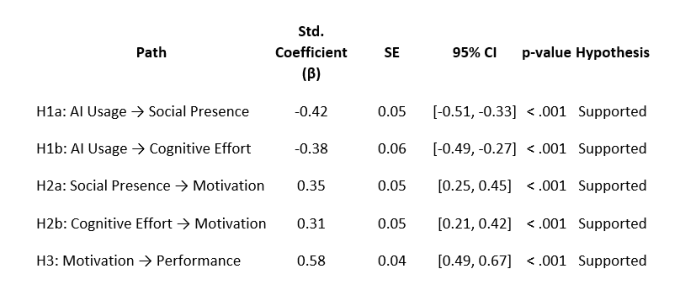
Structural equation modeling confirmed the hypothesized mediation structure. AI usage negatively affected perceived social presence (β = −0.42) and cognitive effort (β = −0.38), which in turn positively predicted motivation (β = 0.35 and β = 0.31). Motivation emerged as the strongest predictor of performance (β = 0.58).
Figure 3: Direct effects (own illustration).
Indirect effects confirmed full mediation: AI usage influences performance only through psychological mechanisms rather than direct functional disruption.
An exploratory moderation analysis revealed that technological self- efficacy buffered the negative impact of AI on motivation. Participants with low efficacy showed a strong negative path from AI usage to motivation (β = −0.33, p < .01), while the path was weaker and non-significant in the high-efficacy group (β = −0.12). A chi-square difference test supported the moderating role (Δχ² = 6.12, p < .05).
Overall, these results validate the proposed model and highlight that AI integration affects work not ownly operationally but also psychologically. The role of motivation as a central driver, shaped by both social and
358 Huffstadt cognitive perceptions, underlines the importance of designing AI systems and workplace strategies that preserve intrinsic engagement and human agency.
DISCUSSION AND LIMITATIONS This study aimed to uncover how AI integration in knowledge-intensive work environments impacts psychological mechanisms such as motivation and performance. Drawing from the High-Performance Cycle (Locke and Latham, 2002) and informed by theories of social presence, cognitive effort, and perceptual fluency, the results affirm the model’s validity: AI usage lowers perceived social presence and cognitive engagement, which in turn reduces motivation - an essential driver of self-reported performance. These findings contribute to a more nuanced view of AI’s role in the workplace, emphasizing its psychological effects rather than solely functional outcomes. AI does not diminish performance directly but alters task perception and experience in ways that indirectly weaken motivational drivers.
Additionally, individuals with higher technological self-efficacy were less susceptible to these effects, suggesting that perceived competence may mitigate the motivational erosion associated with automation - an insight aligned with competence-based theories of motivation (Deci and Ryan, 2000). Theoretically, this work expands the High-Performance Cycle into AI-mediated contexts by showing how technology influences core motivational processes such as goal engagement and feedback. It also demonstrates that social presence, often overlooked in performance modeling, plays a vital mediating role. Furthermore, the findings support fluency-effort trade-off theories, as reduced cognitive challenge - while seemingly beneficial - can decrease intrinsic motivation. These elements together create a framework for future studies that explore the relational and emotional dynamics of human-AI interaction.
From a practical standpoint, the results suggest that organizations should consider psychological as well as technical criteria when integrating AI. While automation may improve productivity, it may also diminish perceived meaning and responsibility in work. Companies should proactively preserve motivational integrity by embedding feedback loops, supporting hybrid workflows, and fostering digital confidence through training. The moderating effect of technological self-efficacy indicates that targeted competence- building could serve as a buffer against unintended motivational fallout. Design implications also emerge: AI systems that maintain interpersonal cues or modulate difficulty dynamically may sustain engagement more effectively than overly fluent, impersonal interfaces.
Ethically, these findings urge a broader view of responsible AI. When systems reduce interpersonal and cognitive involvement, they risk undermining work’s meaningfulness. Psychological safety, motivational fairness, and inclusivity in digital transformation must be central to organizational ethics. Disparities in digital readiness could exacerbate motivational disengagement, particularly among employees with limited tech experience. Thus, ethical AI is not just a
The Silent Impact of AI: Unveiling Motivational Side Effects 359 question of compliance or transparency, but a human-centered commitment to preserve dignity, agency, and equitable opportunity in evolving work settings.
Despite these contributions, the study has limitations. Its cross-sectional design restricts causal inference, and self-report measures, though validated, may introduce bias. The generalizability of findings is also constrained by the self-reported nature of AI usage and the heterogeneity of systems included.
Demographic variables such as age, gender, and professional experience were collected but not modeled as control variables in the interest of parsimony. Future research could examine whether such factors interact with AI-related perceptions or moderate motivational effects in specific subgroups.
While the moderation analysis yielded promising insights, it was exploratory and should be interpreted cautiously. Future research would benefit from longitudinal data, objective performance indicators, and more granular distinctions between AI technologies to refine our understanding of how – and for whom – AI changes the experience and outcomes of work.
CONCLUSION
This study set out to explore how the integration of AI into knowledge- intensive work environments affects employee motivation and performance. Grounded in the High-Performance Cycle and enriched by theories of social presence, cognitive effort, and perceptual fluency, we developed and empirically tested a path model involving key psychological mediators.
These findings provide compelling evidence that AI usage, while potentially enhancing efficiency, can unintentionally undermine motivational mechanisms by reducing perceived social connection and diminishing cognitive investment. These effects cascade through lower motivation, ultimately weakening performance outcomes. Importantly, individuals with higher technological self-efficacy appear less susceptible to these effects, offering a valuable avenue for organizational intervention.
From a theoretical perspective, the study extends established motivational frameworks into the realm of AI-mediated work, demonstrating that technology shapes not only what we do, but how we feel about what we do. Practically, it underscores the need for human-centered design and implementation strategies that take into account the psychological consequences of automation.
Looking forward, future research should explore these dynamics over time, in collaborative team contexts, and across different types of AI systems. The goal is not to resist automation, but to integrate it in ways that sustain human agency, engagement, and meaning. In doing so, we move closer to a truly intelligent future, one that is not only artificial, but also deeply human.
REFERENCES
Brynjolfsson, E., Li, D., and Raymond, L. (2025). Generative AI at work. The Quarterly Journal of Economics, 140(2), 889–942. https://doi.org/10.1093/qje/ qjae044
360 Huffstadt Chen, Y., Wang, Y., Wüstenberg, T., Kizilcec, R. F., Fan, Y., Li, Y., Lu, B., Yuan, M.,
Zhang, J., Zhang, Z., Geldsetzer, P., Chen, S., and Bärnighausen, T. (2025). Effects of generative artificial intelligence on cognitive effort and task performance: Study protocol for a randomized controlled experiment among college students. Trials, 26, Article 244. https://doi.org/10.1186/s13063-025-08950-3 Compeau, D. R. and Higgins, C. A. (1995). Computer self-efficacy: Development of a measure and initial test. MIS Quarterly, 19(2), 189–211. https://doi. org/10.2307/249688 Deci, E. L. and Ryan, R. M. (2000). The “what” and “why” of goal pursuits: Human
needs and the self-determination of behavior. Psychological Inquiry, 11(4), 227– 268. https://doi.org/10.1207/S15327965PLI110401 Dunning, D. and Kruger, J. (1999). Unskilled and unaware of it: How difficulties in recognizing one’s own incompetence lead to inflated self-assessments. Journal of Personality and Social Psychology, 77(6), 1121–1134. https://doi. org/10.1037/0022-3514.77.6.1121 Evans, P., Vansteenkiste, M., Parker, P., Kingsford-Smith, A., and Zhou, S. (2024).
Cognitive load theory and its relationships with motivation: A self-determination theory perspective. Educational Psychology Review, 36(1), Article 7. https://doi. org/10.1007/s10648-023-09841-2 Hu, L. T. and Bentler, P. M. (1999). Cutoff criteria for fit indexes in covariance structure analysis: Conventional criteria versus new alternatives. Structural Equation Modeling: A Multidisciplinary Journal, 6(1), pp. 1–55. https://doi. org/10.1080/ 10705519909540118 Jia, J., Ning, X., and Liu, W. (2025). The consequences and theoretical explanation
of workplace AI on employees: A systematic literature review. Journal of Digital Management, 1, Article 14. https://doi.org/10.1007/s44362-025-00016-3 Kline, R. B. (2015). Principles and Practice of Structural Equation Modeling. 4th ed.
New York: Guilford Press. Locke, E. A. and Latham, G. P. (2002). Building a practically useful theory of goal setting and task motivation: A 35-year odyssey. American Psychologist, 57(9), 705–717. https://doi.org/10.1037/0003-066X.57.9.705 Oh, C. S., Bailenson, J. N., and Welch, G. F. (2018). A systematic review of social
presence: Antecedents and implications. Frontiers in Psychology, 9, Article 1141. https://doi.org/10.3389/fpsyg.2018.01141 Reber, R., Schwarz, N., and Winkielman, P. (2004). Processing fluency and aesthetic pleasure: Is beauty in the perceiver’s processing experience? Personality and Social Psychology Review, 8(4), 364–382. https://doi.org/10.1207/ s15327957pspr0804_3 Short, J., Williams, E., and Christie, B. (1976). The social psychology of
telecommunications. Wiley. Tremblay, M. A., Blanchard, C. M., Taylor, S., Pelletier, L. G., and Villeneuve, M.
(2009). Work extrinsic and intrinsic motivation scale: Its value for organizational psychology research. Canadian Journal of Behavioural Science, 41(4), 213–226. https://doi.org/10.1037/a0015167 Venkatesh, V., Morris, M. G., Davis, G. B., and Davis, F. D. (2003). User acceptance of information technology: Toward a unified view. MIS Quarterly, 27(3), 425–478. https://doi.org/10.2307/30036540 Westbrook, A., Kester, D., and Braver, T. S. (2013). What is the subjective cost of
cognitive effort? Load, trait, and aging effects revealed by economic preference. PLoS ONE, 8(7), e68210. https://doi.org/10.1371/journal.pone.0068210 Williams, L. J. and Anderson, S. E. (1991). Job satisfaction and organizational commitment as predictors of organizational citizenship and in-role behaviors. Journal of Management, 17(3), pp. 601–617. https://doi. org/10.1177/014920639101700305
Wu, S., Liu, Y., Ruan, M., Chen, S., and Xie, X.-Y. (2025). Human–generative AI collaboration enhances task performance but undermines human’s intrinsic motivation. Scientific Reports, 15(1), 15105. https://doi.org/10.1038/s41598- 025-98385-2 Zamora, J. (2017). I’m sorry, Dave, I’m afraid I can’t do that: Chatbot perception and
expectations. In Proceedings of the 5th International Conference on Human-Agent Interaction (pp. 253–256). ACM. https://doi.org/10.1145/3125739.3125766 Zhang, S., Meng, Z., Chen, B., Yang, X., and Zhao, X. (2021). Motivation, social emotion, and the acceptance of artificial intelligence virtual assistants - Trust- based mediating effects. Frontiers in Psychology, 12, 728495. https://doi.org/ 10.3389/fpsyg.2021.728495
LISTED IN THE AHFE DIGITAL BOOKSTORE CATALOGUE
Explore the complete digital volume
Intelligent Human Systems Integration (IHSI 2026): Disruptive and Innovative Technologies
Read this individual research paper free through the original publisher, or explore the full digital proceedings book.
ISBN 978-1-964867-76-2
Explore this ISBN in the AHFE Bookstore ↗Listed in the July 2026 bookstore catalogue; search by ISBN to confirm current availability · Digital book purchase optional