Yoshitaka Maeda, Kosuke Oiwa, Masahiro Katano, Mariko Tsurumi (2025). The Impact of Pharmacist Expertise on Information Gathering During Prescription and Medication Verification: Eye-Tracking in a Simulated Experiment. In: Human Factors in Design, Engineering, and Computing. AHFE Open Access, vol. 199, pp. 1494–1503. https://doi.org/10.54941/ahfe1006961
In Japan, pharmacists perform "prescription verification" to assess the medical and pharmaceutical validity of prescriptions and "medication verification" to ensure that dispensed medications match the prescriptions. These processes are critical for patient safety. Experienced pharmacists are generally more accurate and efficient than novices, but their expertise remains largely tacit and unshared. This study aimed to compare eye-gaze patterns between experienced and novice pharmacists in a simulated verification task and to clarify how expertise influences information-gathering behaviors.[Methods] In the simulated verification experiment, 22 fictional prescriptions (each containing three medications) and 66 corresponding medication packages were prepared. Eleven of these prescriptions included typical dispensing errors based on actual incidents at our hospital. Eight pharmacists participated (novices: five with 1–2 years of experience; experts: three with over 20 years of experience) and performed the medication verification as they would in routine practice. Eye-tracking data were collected using Tobii Pro Glasses 2 (100 Hz). Average fixation duration and fixation count were calculated using Tobii Pro Lab. The statistical analysis of these data was conducted using the Mann–Whitney U test to compare the two groups of experts and novices (Matlab R2024b). Additionally, Heatmaps and Gaze plots were generated, and these data were input into Google NotebookLM to analyze the differences in gaze patterns between the two groups.[Results] The statistical analysis showed that experts had significantly longer average fixation durations than novices (experts: 263.0 ± 19.8 ms; novices: 182.3 ± 16.8 ms; U = 6.00, z = –0.45, p = .036). However, no significant difference was observed in total fixation counts (experts: 4333.3 ± 380.7; novices: 5708.2 ± 913.8; U = 8.00, z = –4.62, p = .071). Heatmaps indicated that experts broadly scanned patient names and multiple prescription items, whereas novices concentrated on limited information such as medication names and dosage instructions. Gaze plots revealed that experts tended to have longer saccades, rapidly shifting between distinct information blocks, while novices displayed shorter saccades with repetitive focus on limited areas.[Discussion] Although the total number of fixations was not significantly different between novices and experts, novices exhibited significantly shorter average fixation durations. In addition, the fixation areas for novices were limited to critical information areas on the prescription, and they frequently moved back and forth between limited information blocks. This suggests that novices may frequently recheck minimum required information such as medication names and dosage instructions in a short time. On the other hand, experts had longer average fixation durations and may have been deeply concentrating on the target, reading the information thoroughly in a single fixation, suggesting deeper cognitive processing during each fixation. Experts also showed broader visual coverage of the prescription, potentially enhancing verification accuracy through comprehensive checking. These findings may contribute to the development of eye-tracking-based expertise assessment, feedback-driven training programs, and improved prescription interface designs for pharmacists.
Over a five-year period ending in September 2020, a total of 1,539 medical incident reports were submitted to the Japan Medical Safety Research Organization, of which 273 cases (17.7%) involved drug-related fatalities
The Impact of Pharmacist Expertise on Information Gathering During Prescription 1495
(Japan Medical Safety Research Organization, 2022). In response to the global burden of medication-related harm, the World Health Organization has set a target of reducing avoidable medication harm by 50% by 2022 (World Health Organization, 2017; Sheikh et al., 2019). Against this backdrop, pharmacists play a critical role in ensuring the safety and effectiveness of medical care (Arakawa, 2022). In Japan, pharmacists perform “prescription verification” to assess the medical and pharmaceutical validity of prescriptions and “medication verification” to ensure that dispensed medications match the prescriptions. These processes are critical for patient safety. Experienced pharmacists are generally more accurate and efficient than novices, but their expertise remains largely tacit and unshared. In addition, there is a shortage of pharmacists, and their workload is heavy. Due to limited time resources, they are constantly required to balance a trade-off between efficiency and safety (Elgebli et al., 2023).
We aim to identify key components for future training of novice pharmacists. As an initial investigation, we aimed to compare eye-gaze patterns between experienced and novice pharmacists in a simulated verification task, focusing on how expertise influences information-gathering behaviors.
METHODS
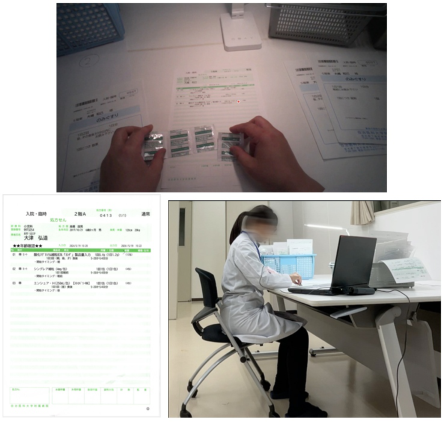
In the simulated verification experiment, 22 fictional prescriptions (each containing three medications) and 66 corresponding medication packages were prepared (Figure 1). Eleven of these prescriptions included typical dispensing errors based on actual incidents at our hospital (Table 1).
Eight pharmacists participated (novices: five with 1–2 years of experience; experts: three with over 20 years of experience). Participants were instructed to mark an “X” on the relevant part of the prescription when they detected an error.
Table 1: Types of errors embedded in the simulated verification task.
Table available in the original PDF paper.
Error Type Description Name similarity A medication with a similar name is erroneously dispensed.
Strength mismatch A medication with a different strength (e.g., 5 mg instead of 10 mg) is dispensed.
Incorrect administration instructions A medication with an incorrect administration instruction is dispensed.
Appearance similarity A medication with a similar appearance (e.g., Kampo medicine) is dispensed.
Patient mismatch A formulation intended for adults is dispensed to a pediatric patient.
Pharmacological conflict Medications with duplicative or contraindicated pharmacologic actions are dispensed together.
Continued
Table 1: Continued Error Type Description
Table available in the original PDF paper.
Dosage form error A different dosage form (e.g., suppository instead of ointment) is dispensed.
Therapeutic duplication Medications with overlapping active ingredients are dispensed concurrently.
Packaging error Medications are dispensed in a packaging format inconsistent with the prescription (e.g., PTP vs. unit dose).
Dispensing quantity error A different dispensing quantity (e.g., per dose or per packet) is provided.
Patient identification error Medication labeled for a different patient is dispensed.
Figure 1: Experimental setup (top: the experimental workstation; bottom left: the simulated prescription used in the task; bottom right: a participant during the task). All patient information on the prescription is fictitious.
Participants were allowed to use a computer to access package inserts of the medications during the verification task. The order of the 22 simulated prescriptions was counterbalanced across participants. Eye-tracking data were collected using Tobii Pro Glasses 2 (100 Hz). The eye detection rate throughout the task exceeded 60% for all participants. After the verification task, participants were interviewed using open-ended questions to explore their strategies, difficulties, and detection tips for each error.
Average fixation duration and fixation count were calculated using Tobii Pro Lab (Tobii Technology, Inc., Stockholm, Sweden). The statistical analysis
The Impact of Pharmacist Expertise on Information Gathering During Prescription 1497
of these data was conducted using the Mann–Whitney U test to compare the two groups of experts and novices (Matlab R2024b). Additionally, heatmaps and gaze plots were generated using Tobii Pro Lab, and these data were input into NotebookLM (Google LLC., CA, USA) to analyze the differences in gaze patterns between experts and novices.
This study was conducted in accordance with the Declaration of Helsinki and was approved by the Ethics Review Committee of Jichi Medical University (25-016). We explained that consent to participate in the study could be withdrawn at any time, that the results of this study would be published after processing, and that the participants’ personal information would not be revealed in the publication.
RESULTS
A Mann–Whitney U test revealed that experts completed the verification task significantly faster than novices. (experts: 28.2 ± 1.8 min; novices: 41.6 ± 4.9 min; U = 0.00, z = 2.24, p = .025). There was no substantial difference between the two groups in the number of errors overlooked during the verification task (experts: 2.7 ± 0.5; novices: 2.8 ± 1.2). However, the types of errors overlooked showed different tendencies between the two groups (Table 2). Among both groups, pharmacological conflicts and patient identification errors were the most commonly overlooked. In contrast, administration instruction errors were often overlooked by experts, but not by novices. Representative responses from the post-task interviews are presented in Table 3.
Table 2: Types of errors that were overlooked during verification.
Table available in the original PDF paper.
Novices (Five with 1–2 Years of Experience) Participant #001 Pharmacological conflict, Name similarity Participant #002 Pharmacological conflict, Dosage form error Participant #003 Pharmacological conflict, Name similarity, Dosage form error, Dispensing quantity error, and Patient identification error
Participant #004 Pharmacological conflict, Patient identification error Participant #005 Dosage form error, Patient identification error, Strength mismatch Experts (three with over 20 Years of Experience) Participant #006 Incorrect administration instructions, Pharmacological conflict
Table 3: Representative Responses from the Post-Task Interviews.
Table available in the original PDF paper.
Novices
I always check the strength and quantity.
I tend to overlook errors when the drug name, strength, and indication are similar.
I’ve never been able to notice drug combinations.
Although I try to pay attention to drug combinations, my focus tends to shift toward processing a large number of prescriptions.
Experts
I imagined the color and shape before checking the actual drug.
I mentally visualize how the drug is usually prescribed.
The drug name reminded me of the brand-name product.
I assumed it was a psychotropic drug because the name included “-clon,” but it turned out not to be.
Generic names tend to be long and hard to process quickly.
I’m afraid I might overlook new or generic drugs that I don’t have a clear mental image of.
The statistical analysis showed that experts had significantly longer average fixation durations than novices (experts: 263.0 ± 19.8 ms; novices: 182.3 ± 16.8 ms; U = 6.00, z = −0.45, p = .036). However, no significant difference was observed in total fixation counts (experts: 4333.3 ± 380.7; novices: 5708.2 ± 913.8; U = 8.00, z = −4.62, p = .071).
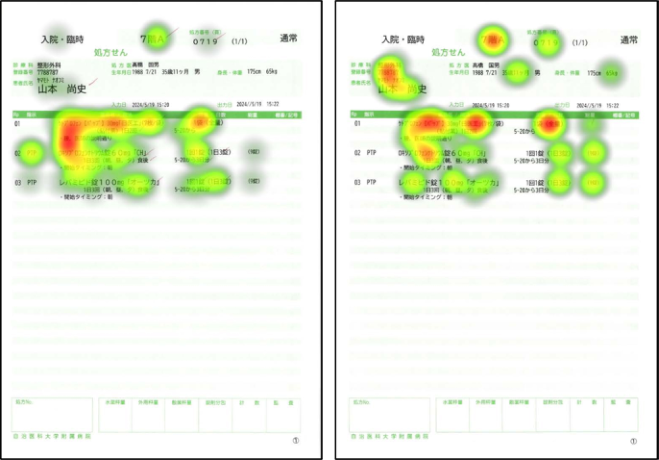
Figure 2: Heatmaps of the same prescription: novice (left) vs. expert (right).
The Impact of Pharmacist Expertise on Information Gathering During Prescription 1499
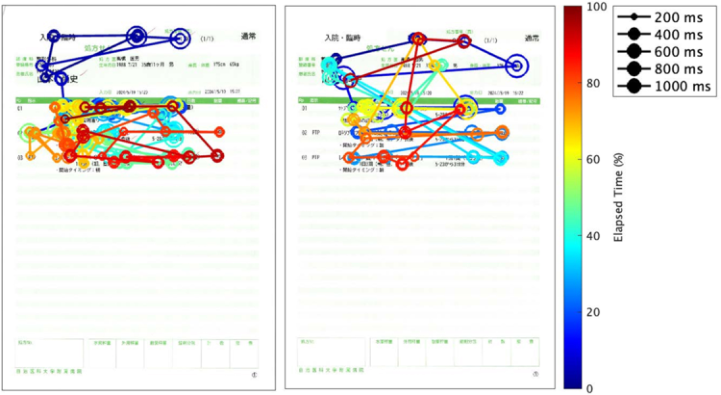
Heatmaps indicated that experts broadly scanned patient names and multiple prescription items, whereas novices concentrated on limited information such as medication names and dosage instructions (Figure 2). Gaze plots revealed that experts tended to have longer saccades, rapidly shifting between distinct information blocks, while novices displayed shorter saccades with repetitive focus on limited areas (Figure 3).
Figure 3: Gaze plots of the same prescription: novice (left) vs. expert (right).
DISCUSSION
First, the hypothesis that experienced participants would overlook fewer errors than novices was rejected. Both groups overlooked an average of 2.7 to 2.8 out of the 11 errors, corresponding to an overlook rate of approximately 25%. Soeda et al. (2017) calculated the error overlook rate during dispensing verification at three hospitals, reporting a rate of 3.85–4.79%. Although our experiment involved a much higher frequency of embedded errors than in routine practice, the overlook rate observed in this study appears to be substantially higher than that reported by Soeda et al. One possible reason, as noted in their paper, is that previous studies could only calculate overlook rates based on reported overlooks and were unable to capture the true overlook rate, including unreported or latent errors. In other words, overlook during dispensing verification occurs regardless of experience level—among both novices and experts— highlighting the importance of improving verification accuracy. On the other hand, the average verification time was shorter for experienced participants than for novices. This suggests that experts performed verification more efficiently, even with similar overlook rates.
Although the total number of fixations was not significantly different between novices and experts, novices exhibited significantly shorter average
fixation durations. In addition, the fixation areas for novices were limited to critical information areas on the prescription, and they frequently moved back and forth between limited information blocks. This suggests that novices may frequently recheck the minimum required information, such as medication names and dosage instructions, in a short time. A number of novice participants failed to detect pharmacological conflicts—that is, errors in drug combinations. One possible reason is that novices tend to focus on limited types of information, such as drug names and strengths, emphasizing the accuracy of dispensing rather than broader clinical considerations. This interpretation is supported by post-task interviews, in which one participant stated, “I always check the strength and quantity.” It is presumed that novices pay close attention to checking names, strengths, and quantities, as these are commonly associated with dispensing errors in practice. In fact, incident reports from the Department of Pharmacy at our hospital in FY2022 showed that most errors involved drug names, strengths, and quantities. This institutional awareness may have shaped the verification behavior of novices, leading to a disproportionate focus on accuracy checking. Elgebli et al. (2023) pointed out the challenges associated with pharmacists conducting accuracy checking (verifying that the prescribed drug is dispensed correctly) and clinical checking (ensuring that the dispensed drug is safe and appropriate for the patient) simultaneously. Specifically, they noted that when both checks are performed concurrently, attention tends to be biased toward accuracy checking. Similarly, in our study, one novice pharmacist remarked, “I’ve never been able to notice drug combinations,” suggesting that some novices may not be performing clinical checking at all. Another participant stated, “Although I try to pay attention to drug combinations, my focus tended to shift toward processing a large number of prescriptions,” indicating that when under time pressure, the emphasis on accuracy checking may become even stronger. This finding aligns with the Efficiency–Thoroughness Trade-Off (ETTO) principle described by Hollnagel (2017). In other words, pharmacy environments are constantly exposed to high workloads, staff shortages, and time constraints, which can result in prioritizing the quantity of checks over their quality. Novices, in particular, may not yet have developed efficient checking strategies, which could lead to a compromise in the thoroughness of their checks—specifically, in clinical checking. In summary, providing training on efficient verification strategies and enhancing education on clinical checking may help improve the quality of verification performed by novices.
On the other hand, experts had longer average fixation durations and may have been deeply concentrating on the target, reading the information thoroughly in a single fixation, suggesting deeper cognitive processing per fixation. Experts also showed broader visual coverage of the prescription, potentially enhancing verification accuracy through comprehensive checking. One possible explanation for the longer average fixation durations observed among experienced participants is that they were mentally visualizing the medications and patient conditions underlying each prescription while conducting their verification. In general, the verification behaviors of experts are believed to be based on Naturalistic Decision Making (NDM), in which
The Impact of Pharmacist Expertise on Information Gathering During Prescription 1501
intuitive judgments are made based on personal knowledge and pattern recognition (Zsambok & Klein, 1997). In the present study, experienced participants made statements such as, “I imagined the color and shape before checking the actual drug,” and “I mentally visualize how the drug is usually prescribed,” indicating that they were verifying while actively recalling the usual appearance, usage, and prescribing intent associated with each medication. This aligns with the clinical checking process that pharmacists typically perform, and reflects a strategy adopted to ensure efficient and safe decision-making in busy pharmacy environments with limited information (Elgebli et al., 2023). In other words, the experts appeared to concurrently perform clinical and accuracy checking by drawing on mental imagery. However, the NDM process also has potential drawbacks. In this study, all experienced participants overlooked the error in administration timing for Eszopiclone tablets (a hypnotic typically prescribed at bedtime), which had been intentionally prescribed for administration after breakfast. One participant stated, “I assumed it was a psychotropic drug because the name included ‘clon,’ but it turned out not to be,” suggesting that the misinterpretation of the drug’s effect may have contributed to the overlook. As noted by Elgebli et al. (2023), such reliance on intuitive inference can sometimes lead to erroneous judgments. Furthermore, the influence of NDM is not limited to clinical checking; it may also impact the quality of accuracy checking. For instance, in this study’s name similarity error condition, generic drugs with similar names and identical indications were used. Experienced participants made remarks such as, “Generic names tend to be long and hard to process quickly,” “The drug name reminded me of the brand-name product,” and “I’m afraid I might overlook new or generic drugs that I don’t have a clear mental image of.” These comments suggest that their habitual reliance on brand-name recognition and pharmacological familiarity may have contributed to misidentifications. In contrast, novices tended to perform pure matching-based accuracy checking without relying on such inference, indicating that the underlying causes of overlook may differ between the two groups. This suggests a need for educational interventions targeting experts as well. For example, raising awareness of the limitations of NDM and implementing peer reviews of verification practices among experienced staff may help reduce such risks.
As discussed earlier, education for both novices and experts is essential; however, it must be accompanied by improvements in workflow and the working environment. For example, Elgebli et al. (2023) proposed separating clinical checking from accuracy checking. Previous studies have shown that when accuracy checking is performed by trained non-pharmacist personnel, the results are comparable to those achieved by pharmacists (Snoswell, 2020). This highlights the need to create an environment in which pharmacists can focus exclusively on clinical checking. In addition, based on the gaze patterns and attentional characteristics identified in this study for both novices and experts, it is necessary to reconsider how information is presented to pharmacists—including the design of prescriptions—to better support their decision-making.
CONCLUSION
This study used eye-tracking to investigate how pharmacist expertise affects information gathering during prescription and medication verification. As a result, the hypothesis that experienced participants would overlook fewer errors than novices was rejected. Although the difference in overall error overlook rates between novice and experienced groups was small, the nature of the overlooks and the way prescriptions and medications were interpreted during verification appeared to differ between the two groups. Novices tended to engage in information gathering biased toward accuracy checking, while experts exhibited longer fixation durations on relevant information and more efficient saccades, suggesting that they performed both accuracy and clinical checking based on Naturalistic Decision Making (NDM). Neither verification strategy was clearly superior. These insights could inform the development of eye-tracking-based expertise assessment, feedback-driven training programs, and improved prescription interface designs for both novices and experts.
ACKNOWLEDGMENT
This study was supported by the JSPS KAKENHI (Grant Number JP23K04309).
AUTHORS’ NOTE Part of this study was presented at the 66th Annual Meeting of the Japan Ergonomics Society.
REFERENCES
Arakawa, N. (2022). Eikoku no Yakuzaishi no Yakuwari to Yakugaku Kyoiku no Henkaku (The Role of Pharmacists and the Transformation of Pharmacy Education in the United Kingdom), Japanese Journal of Community Medicine and Pharmaceutical Sciences, Volume 9, No.1, pp. 59–61. [in Japanese]. Elgebli, A., Hall, J., & Phipps, D. L. (2023). Clinical checking in practice: Qualitative
perspectives from community pharmacists. Int J Pharm Pract, Volume XX, pp. 1–8. Hollnagel, E. (2017). The ETTO Principle: Efficiency-Thoroughness Trade-Off: Why Things That Go Right Sometimes Go Wrong (1st ed.). London: CRC Press. Japan Medical Safety Research Organization. (2022). Recommendations for the prevention of recurrence of medical accidents (Number 15): Analysis of Deaths Related to “Erroneous Administration of Medicine”. Available: https:// www.medsafe.or.jp/uploads/uploads/files/teigen15english.pdf [Accessed 4 Aug 2025]. Sheikh, A., Rudan, I., Cresswell, K., et al. (2019). Agreeing on global research
priorities for medication safety: An international prioritization exercise. J Glob Health, Volume 9, p.010422. Snoswell, C. L. (2020). A meta-analysis of pharmacists and pharmacy technicians’ accuracy checking proficiency. Res Social Adm Pharm, Volume 16, No.5, pp. 760–765.
The Impact of Pharmacist Expertise on Information Gathering During Prescription 1503
Soeda, S., Takayanagi, R., Watanabe, M., et al. (2017). Study of Safety Evaluation in Dispensing of Medicines—Analysis of Relationship between Dispensing Error Rate, Inspecting Error Rate, and Malpractice Rate—Yakugaku Zasshi, Volume 137, No. 5, pp. 589–593. [in Japanese]. World Health Organization. (2017). Medication Without Harm–Global Patient
Safety Challenge on Medication Safety. Geneva: World Health Organization. Zsambok, C. E., & Klein, G. (Eds.). (1997). Naturalistic Decision Making (1st ed.).
East Sussex: Psychology Press.
LISTED IN THE AHFE DIGITAL BOOKSTORE CATALOGUE
Explore the complete digital volume
Human Factors in Design, Engineering, and Computing
Read this individual research paper free through the original publisher, or explore the full digital proceedings book.
ISBN 978-1-964867-75-5
Explore this ISBN in the AHFE Bookstore ↗Listed in the July 2026 bookstore catalogue; search by ISBN to confirm current availability · Digital book purchase optional