Zhao Xuanang (2025). Lighting the Way to Ergonomics Healthcare: Eye-blink-inferred Cognitive Load and Illumination in Medical Administration Tasks. In: Human Factors in Design, Engineering, and Computing. AHFE Open Access, vol. 199, pp. 1670–1680. https://doi.org/10.54941/ahfe1006978
The present study was designed to undertake an investigation into the effects of varying ambient illumination levels on the cognitive load of prospective healthcare professionals engaged in a simulated medication administration task.Background: The occurrence of medication errors constitutes a significant risk within healthcare systems, with such errors frequently being attributed to the substantial cognitive load imposed upon clinical personnel. Although ambient illumination is a fundamental component of the healthcare environment, its direct influence on cognitive load remains insufficiently understood. The application of objective methodologies such as eye-tracking offers the potential for precise insights where subjective assessments may be inadequate.Design: Our experiment employed a within-subjects design.Methods: Twenty-nine nursing and medical students performed a computer-based prescription verification task under three rigorously controlled ambient light conditions: 50 lux (dim), 500 lux (standard), and 1000 lux (bright). An eye-tracking technique was utilized to record the spontaneous blink frequency of participants, serving as an objective proxy for cognitive load. The resultant data were subjected to a repeated measures Analysis of Variance (ANOVA).Results: A statistically significant main effect of the illumination condition on cognitive load was identified (F(2,56)=4.90,p=.011). Post-hoc analyses revealed that the 1000 lux condition elicited a significantly higher blink frequency in comparison to the 50 lux condition, indicating an elevation in cognitive strain under bright illumination. Critically, a more granular analysis of individual response patterns exposed a predominant "U-shaped" relationship in the majority of participants (51.7%), wherein the minimum cognitive load was observed at the intermediate 500 lux level.Conclusion: The findings of this study contest the simplistic "brighter is better" paradigm often applied to environmental design. Strong evidence is provided to suggest that while excessively bright illumination can function as a cognitive stressor, a moderate level of approximately 500 lux constitutes an "ergonomic sweet spot" for screen-based tasks. The optimization of workplace illumination is therefore presented as a critical, evidence-based strategy for the management of cognitive strain and the enhancement of patient safety.
Lighting the Way to Ergonomics Healthcare: Eye-Blink-Inferred Cognitive Load 1671
INTRODUCTION
The physical environment of the workplace is a significant, though often underestimated, source of such extraneous load. Ambient illumination, a ubiquitous feature of all clinical settings, is one such factor. While the fundamental necessity of adequate lighting for tasks demanding high visual acuity is well-established (Boyce, 2014), the relationship between illumination intensity and higher-order cognitive functions is considerably more complex. Various studies have shown that brighter light, up to a point, can improve alertness, fight sleepiness, and help performance on tasks that need constant attention or quick reactions (Cajochen, 2007; Phipps et al., 2010). Reasons for these effects might include increased physical arousal, changes in brain chemicals, or effects from improved mood (Vandewalle et al., 2009). On the other hand, other experiments have found little significant effect of normal changes in indoor light levels on cognitive task performance. Some have even reported worse performance under very bright lights, possibly because of discomfort or glare (Borisuit et al., 2015). This variation in findings shows we need research that looks at specific situations, considering the task, light details, and the people being studied.
The prevailing yet simplistic notion that “brighter is better” has been challenged by research indicating that excessively bright lighting may, in fact, impair performance, potentially through mechanisms such as glare or visual discomfort. While past work has been justifiably using eye- tracking to measure cognitive workload in other contexts (Biondi et al., 2023), and broad effects of lighting on cognition have been explored, there remains a specific gap in research. Very few have investigated explicitly how commonly experienced ambient indoors lighting levels affect objectively measured cognitive workload, specifically with blink rate, under simulated medicine administration tasks for nursing and medicine students. The present study differs from others in that it attempts to close this gap with objective eye-tracking measuring cognitive load under a realistic simulated medicine administration under standard indoor lighting levels (50, 500, and 1000 lux). It further contributes to literature in that it not only explores healthcare space ergonomics but also considers individual variability in lighting reaction and contributes to an understanding of individual differences over and beyond group means. Findings are to inform education and practice with an aim of making environments safer and supportive of cognitive function for future healthcare providers. To address this gap, objective measurement techniques are required that can circumvent the limitations of subjective self-report. Eye-tracking technology provides a non-invasive, real-time window into the physiological correlates of cognitive processes. Specifically, spontaneous eye-blink rate (EBR) has been validated as a robust physiological index of mental effort and fatigue (Stern et al., 1994). Although the relationship is multifaceted, variations in EBR can reflect shifts in cognitive states; for instance, an increased blink rate has been demonstrated to correlate with rising cognitive load as the brain expends greater effort to process information or contend with environmental stressors (Biondi et al., 2023).
1672 Zhao
The present study was therefore conceived to fill an existing lacuna in the literature by employing objective eye-tracking methodology to investigate the effects of common indoor illumination levels on the cognitive load of healthcare students. By simulating a safety-critical prescription verification task, this research aimed to provide rigorous, empirical evidence to inform the design of safer and more ergonomically sound healthcare environments. It was hypothesized that ambient illumination levels would exert a significant influence on blink frequency, serving as a proxy for cognitive load.
METHODS
Experimental Design We tested in this experiment how light intensity impacts cognitive load during a simulated computer-based nursing medication administration task. The cognitive workload was expressed by blink rates and captured by eye- tacking devices. In our study, a within-subjects experimental design was used. The independent variable was Ambient Illumination Level, having 50 lux, 500 lux, and 1000 lux as its levels. The primary dependent variable was Cognitive Load as indexed by Average Blink Rate (blinks per minute) and Task Completion Time was included as a secondary performance measure. Control variables included computer monitor brightness/contrast, viewing distance, inherent difficulty of the task, ambient noise level, and room temperature. Ethical approval for this research was obtained from the Human Research Ethics Committee (HREC) of the University of Hong Kong, under reference number: EA240520.
Participants An a-priori sample size calculation was performed in order to have enough statistical power to detect meaningful effects. Based on parameters for a within-subjects ANOVA, the analysis revealed that a sample size of approximately N = 20 participants was necessary to detect a medium-sized effect with 80% power at an alpha = 0.05 level of significance. The research recruited an initial sample of N = 30 participants, with a final sample of N = 29 used for blink frequency analysis. This indicates the study was well-powered.
Participants were recruited from the nursing and medical student population at The University of Hong Kong. Inclusion criteria included: (i) familiarity with computer operation and medicine names; (ii) normal or corrected-to-normal vision and self-reported non-colorblindness. Exclusion criteria included photosensitive epilepsy or other conditions significantly affected by light changes. After data cleaning and exclusion due to eye- tracking data quality issues, data from N = 29 participants (3 male and 26 female) were included in the final blink frequency analysis.
Task and Procedure The aim of the present study was to measure cognitive functioning on the basis of a simulated drug verification task, modeled on a key step in the
Lighting the Way to Ergonomics Healthcare: Eye-Blink-Inferred Cognitive Load 1673
drug administration process where the practitioner has to correctly identify a drug and dose from a written order. The essence of the methodology was a two-slide sequential process per trial. On the first slide, they were presented with a standardized, computer-generated prescription with clear wording of a particular name of medicine and dosage. Once they moved on to the second slide, they were presented with a four-alternative forced-choice item. These participants were asked to choose the option that was the best match of the medicine and dosage information they were shown.
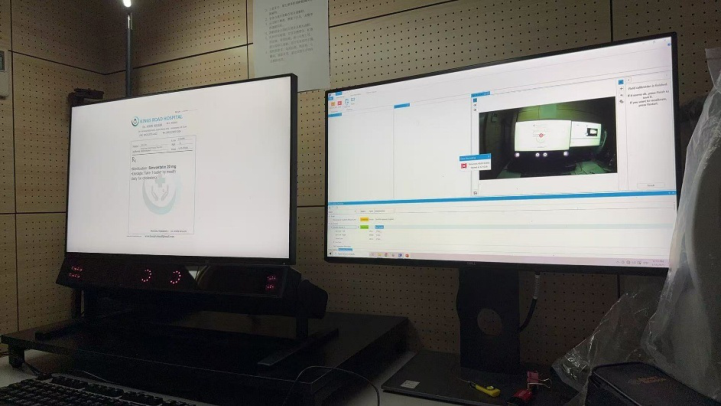
Apparatus and Data Collection A DG-3 eye tracker was used to record detailed oculomotor data continuously throughout all processes of the simulated task. Three different lighting conditions were created in the laboratory, and each participant completed the task under all three conditions. We employed a Digital Lux Meter (model AS813) to record light intensity levels. The three lighting levels were achieved by controlling the main laboratory lights as well as an additional desk lamp, as depicted in Figure 1.
Figure 1: Experimental setup.
Eye-Tracking Data Processing Raw eye-tracking data, recorded with a DG-3 eye tracker at a 60-Hz sampling rate, was initially processed to de-interleave the data streams for each of the right and left eyes. These data for each eye were separated out in their own tables using a custom script that retained only those columns that would be required for analysis: time, pupil width, and pupil height.
Then blink events were algorithmically defined and counted out of these cleaned tables of information. The process first flagged candidate blinks that were successive samples in which pupil height and pupil width were both registered as zero, a characteristic attribute of pupil-based trackers when an
1674 Zhao
eyelid closes. To ensure these events represented physiologically valid blinks, a set of temporal constraints was then enforced. The duration of a candidate event must have been in a range of at least 50 ms to at most 400 ms; events that short of this minimum duration or longer than this maximum duration that would represent other types of artifacts were ignored. To adequately disassociate individual blinks that occurred immediately one right after the other in rapid succession, any spacing between successive zero-value samples that took longer than 350 ms was used to define an end to one event and a beginning to another. Only events that satisfied these minimum duration and maximum duration constraints were counted as valid blinks for individual eyes.
Finally, in order to make sure that only the best recording of each trial was used in the analysis, a data quality selection process was operational. It involved calculating an “Error Count” for each eye that was simply equal to the total number of times of data-loss that did not satisfy time criteria of a valid blink and thus served as a proxy for tracking noise or non-blink artifact. On a section-wise basis for each experiment, automatically it would compare ErrorCounts for right and left eyes and would use the data of that eye with lesser Error Count. By this automated routine of making a decision about best data quality available for each trial to use, it created a consolidated final dataset in which blink frequency was calculated from count of valid blinks of chosen eye and experiment section duration.
Statistical Analysis The main statistical analysis employed was a one-way repeated measures Analysis of Variance (RM ANOVA) to analyze the impact of ambient illumination levels on blink rate. Prior to interpreting the main results, Mauchly’s Test of Sphericity was used to assess the sphericity assumption, which was met (p = .378). The Shapiro-Wilk test was also used to check for normality in each condition, and this assumption was also met. A similar ANOVA analysis appropriately assessed task completion time as a function of lighting level. Furthermore, a Pearson correlation analysis assessed task completion time and blink rate relationships under each condition.
When a significant main effect was found, post-hoc pairwise comparisons using a Bonferroni adjustment were performed. A significance level of alpha = .05 was applied to all statistical tests.
RESULTS
Group-Level Finding: Brighter Light Increases Cognitive Load When we looked at the data for all 29 participants combined, we saw a straightforward trend: as the light got brighter, the average blink rate went up.
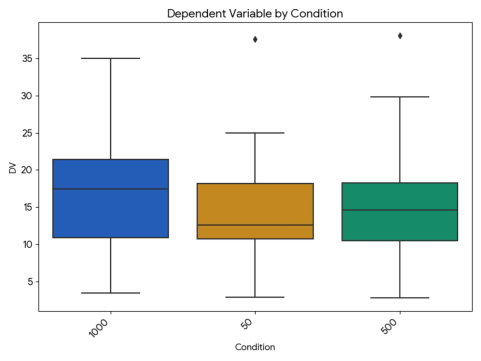
The mean blink frequency increased from 14.36 blinks per minute at 50 lux, to 15.40 at 500 lux, and finally to 17.49 at 1000 lux. This trend is visualized in the box plot in Figure 2.
Lighting the Way to Ergonomics Healthcare: Eye-Blink-Inferred Cognitive Load 1675
Figure 2: Box plot of blink frequency across different lux conditions.
Our ANOVA analysis confirmed this observation was not due to chance. There was a significant main effect of the illumination condition on blink frequency (F(2,56) = 4.90, p = 0.011, partialeta2 = .149). The effect size was large, suggesting that about 14.9% of the blink frequency variability can be explained by the change in lighting.
Post-hoc tests pinpointed where this difference was most significant. The blink rate at 1000 lux was significantly higher than at 50 lux (p = .029). This result directly supports our hypothesis and provides strong evidence that, at a group level, very bright lighting imposes a greater cognitive load than dim lighting. The full results are summarized in Table 1.
Table 1: Summary of repeated measures ANOVA and pairwise comparisons for blink frequency.
Table available in the original PDF paper.
Analysis Statistic Value p-Value Repeated Measures ANOVA Main Effect of Light F(2, 56) 4.90 0.011 Effect Size Partial η2 0.149 -
Bonferroni Pairwise Comparisons 50 lux vs. 500 lux Mean Difference –1.04 0.775 50 lux vs. 1000 lux Mean Difference –3.14 0.029 500 lux vs. 1000 lux Mean Difference –2.10 0.147
Individual Analysis: Discovery of the U-Shaped Response While a significant major-effect at the group level provides a broad picture, these summary statistics may obscure deep individual variation in response pattern. To determine if this group-level trend corresponded to that of most participants or if there were discernible sub-patterns, an intensive descriptive analysis of individual response profiles was undertaken.
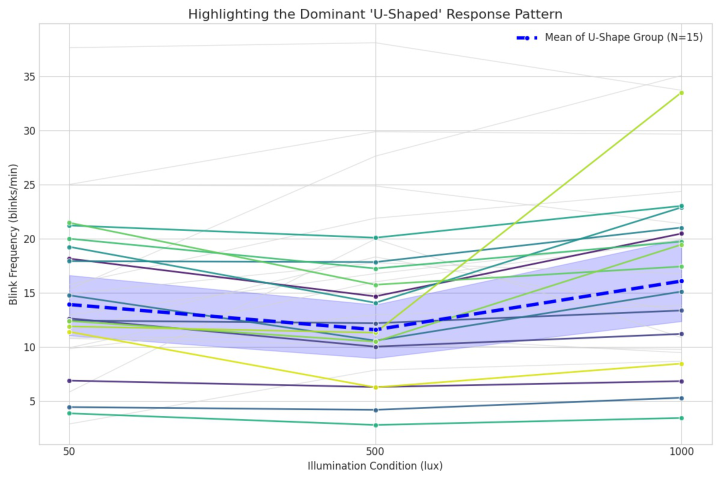
The most noteworthy finding of this individual analysis was the predominance of a ‘U-shaped’ response pattern. This was the most ubiquitous
1676 Zhao
pattern, seen in a clear majority of the sample—15 out of 29 participants (51.7%).
Figure 3: Individual participant changes in blink frequency by illumination. Each thin line represents a single participant (N = . 29).
This trend is significant because it implies that for the majority of participants, their cognitive load was lowest with the typical office lighting of 500 lux. For this large group, the 500 lux treatment was an ‘ergonomic sweet spot’. By comparison, both the dimness of the 50 lux treatment and the brightness of the 1000 lux treatment induced a greater cognitive load, as illustrated in Figure 3.
DISCUSSION
The present study furnishes robust physiological evidence that ambient illumination functions not as a passive environmental variable, but as an active factor capable of significantly modulat ing cognitive load. The findings advance our understanding through a dual-layered contribution. The first is a statistically significant confirmation that high-intensity illumination (1000 lux) operates as a cognitive stressor at the group level. The second, more profound insight, derived from the analysis of individual heterogeneity, is the revelation that the relationship between illuminance and cognitive load is, for a majority of individuals, non-linear. The predominance of a U-shaped response curve, which minimizes at 500 lux, strongly suggests the existence of an “ergonomic sweet spot” for lighting in environments where screen-based work is prevalent. This non-linear relationship is congruent with established theoretical frameworks of arousal and performance, most
Lighting the Way to Ergonomics Healthcare: Eye-Blink-Inferred Cognitive Load 1677
notably the Yerkes-Dodson Law (Yerkes & Dodson, 1908), which posits that 7 optimal performance is achieved at a moderate level of arousal, with decrements occurring at levels of both under- and over-arousal. In the context of this study, the 50 lux condition may have induced a state of under- stimulation or direct visual strain, while the 1000 lux condition likely induced over-stimulation via glare and visual discomfort. Both extremes appear to impose an extraneous cognitive load, requiring additional mental resources to compensate, whereas the 500 lux condition appears to represent an optimal balance.
Likewise, research from Li et al. (2023) has shown that subjects performing cognitive work in an office setting had the greatest performance measures at 500 lux as well as at 750 lux.
Implications for Practice The empirical findings of this research have significant and immediately applicable implications for evidence-based design in healthcare settings. The identification of an approximate 500 lux “ergonomic sweet spot” provides a powerful, actionable guideline for the specification of lighting in clinical workspaces characterized by intensive computer-based tasks, such as nurses’ stations, pharmacies, and diagnostic imaging rooms. This recommendation moves beyond subjective preference or aesthetic considerations, grounding design decisions in the objective physiological well-being of staff.
This is fundamentally an issue of patient safety. An improperly illuminated environment can function as a chronic, low-level systemic stressor, continually taxing the finite cognitive resources of healthcare professionals (Hall et al., 2016). Relief of this unnecessary environmental burden can free vital mental resources for complex clinical judgment, attention, and decision-making and so may lessen the incidence of fatigue-related medical errors. That’s significant because the World Health Organization (WHO) has termed error in medications as among global healthcare’s highest causes of avoidable harm. Our findings suggest that poor lighting may be an ‘invisible’ systemic factor, persistently escalating ground-level error-risk by imposing an unnecessary cognitive burden on staff. Secondly, chronic cognitive burden from less-than-ideal lighting may induce worker burnout and turnover, significant issues in healthcare. Investment in optimistic light environment may therefore offer a means of enhancing patient safety as well as improving worker well-being and minimize worker turnover.
The reduction of this extraneous environmental load can free up essential mental capacity for complex clinical reasoning, vigilance, and decision- making, thereby potentially mitigating the incidence of fatigue-related medical errors.
Furthermore, the discovery of significant individual variability in response to illumination provides a compelling scientific rationale for the implementation of personalized and controllable lighting systems. While 500 lux serves as a robust evidence-based benchmark for a majority, the existence of linear responders underscores the fact that a “one-size-fits- all” approach is suboptimal. Empowering clinical staff with the ability
1678 Zhao
to modulate the illumination at their individual workstations represents an advanced ergonomic strategy to accommodate the diverse physiological needs of the workforce, maximizing cognitive comfort and performance for all. The financial justification for such systems should therefore encompass not only energy efficiency but also the projected return on investment from reduced medical error rates and improved staff retention.
Implications for Research Arguably the most promising area for future research is examining systematically the determi nants underlying the observed individual differences in the responses to brightness. Future re search designs ought to include possible predictor variables such as chronobiology (morningness eveningness), as a person’s chronotype might interact with their light- response, particularly when work is carried at non-standard times of day (Vandewalle et al., 2009). Other factors could include inherent attributes of an individual’s visual system, such as baseline pupil size, accommodative facility, or existing conditions such as photophobia. To develop a more holistic understanding, future research needs to move beyond ambient illumi nance to examine other essential attributes of light. The use of a finer gradation of illuminance levels (e.g., 50, 250, 400, 500, 600, 750, 1000+) will assist in better defining the U-shaped 8 curve. Furthermore, Correlated Color Temperature (CCT) and Spectral Power Distribution (SPD) have critical effects on alertness and comfort, which in many cases interact with illu minance levels. The external validity of the findings should also be examined in a broader range of healthcare tasks, such as paper-based charting, interpretation of diagnostic images, or medication preparation at a bench, where the interaction between ambient and localized task illumination is important. Finally, the effects of these illumination conditions over extended time periods, such as those simulating real 8- or 12-hour workdays, need to be examined to determine cumulative effects on cognitive burden and the accumulation of mental fatigue
Implications for Policy This work helps to redefine lighting as an essential element in patient safety infrastructure, as opposed to a merely aesthetic or utilitarian element. By recognizing and designing in antici pation of the cognitive impacts of light, healthcare facilities can shape work spaces to actively facilitate attention, decrease cognitive load, and optimize the well-being of their staff. This is in keeping with general calls for healthcare environment design to promote staff well-being as a strategy for preventing burnout and increasing patient safety (Hall et al., 2016). This might imply policy extensions beyond guidelines governing hospital design to occupational health. If suboptimal lighting is proven to be a substantial cognitive load modulator and hence an occupa tional hazard, there might be an argument to introduce specific considerations in occupational health and safety policy for healthcare workers, demanding employers to evaluate and manage risks related to inadequate light. Lastly, applying these research outcomes to practice
Lighting the Way to Ergonomics Healthcare: Eye-Blink-Inferred Cognitive Load 1679
neces sitates concerted efforts in training and awareness. Spreading these findings through focused initiatives aimed at facility designers, managers, and healthcare staff is essential to facilitate the utilization of enhanced lighting arrangements.
Limitations of the Present Study Despite the robust findings and valuable contributions provided by this work, recognizing its limitations is necessary to properly frame these findings and inform further research. First, the sample characteristics must be considered. The sample consisted of university students who may have different physiological and cognitive responses compared to experienced healthcare professionals. As such, straightforward generalizability to all practicing clinicians should be approached with care (Smolders et al., 2018). Second, the research took place in a controlled laboratory environment. Although such an environment is essential for high internal validity, it naturally fails to incorporate the real-world combinations of ambient distractions, interruptions, and multi-tasking pressures inherent in an authentic clinical ward.
CONCLUSION
This research provides critical scientific evidence that ambient light is not a neutral background factor but a powerful modulator of cognitive load. The key take-home message is that the relationship between illuminance and cognitive performance is non-linear; it empirically debunks the “brighter is better” myth and identifies an optimal “ergonomic sweet spot” around 500 lux for most individuals in screen-based tasks. Therefore, human-centered lighting design should be considered an essential, evidence-based strategy for mitigating cognitive strain, reducing the potential for human error, and enhancing patient safety in clinical environments.
REFERENCES
Biondi, F. N., et al. (2023). Distracted Worker: Using Pupil Size and Blink Rate to Detect Cognitive Load During Manufacturing Tasks. Applied Ergonomics, 106, 103867. https://doi.org/10.1016/j.apergo.2022.103867 Borisuit, A., et al. (2015). Effects of Realistic Office Lighting Conditions on Visual
Comfort, Vigilance-Related Brain Activity and Mood. Lighting Research & Technology, 47(2), 192–209. https://doi.org/10.1177/1477153514531518 Boyce, P. R. (2014). Human factors in lighting (3rd ed.). CRC Press. Cajochen, C. (2007). Alerting Effects of Light. Sleep Medicine Reviews, 11(6), 453–64. https://doi.org/10.1016/j.smrv.2007.07.009 Hall, L. H., Johnson, J., Watt, I., Tsipa, A., & O’Connor, D. B. (2016). Healthcare
staff wellbeing, burnout, and patient safety: A systematic review. PloS one, 11(7), e0159015. Li, T., Liu, N., Hu, S., Lu, M., Zhang, Y., & Ma, X. (2023). Research on the Preferred Illuminance in Office Environments Based on EEG. Buildings, 13(2), 467. https: //doi.org/10.3390/buildings13020467
1680 Zhao
Phipps, R. L., et al. (2010). The Effects of Correlated Colour Temperature of Fluorescent Lamps on Office Worker Performance, Mood, and Alertness. Lighting Research & Technology, 42(2), 167–81. doi: 10.1186/1740–3391-5–2. Stern JA, Boyer D, Schroeder D. Blink rate: A possible measure of fatigue. Hum
Factors. 1994 Jun; 36(2): 285–97. doi: 10.1177/001872089403600209. PMID: 8070793. Vandewalle, G., et al. (2009). Light as a Modulator of Cognitive Brain Function.
Trends in Cognitive Sciences, 13(10), 429–38. https://doi.org/10.1016/j.tics.2009. 07.004 Yerkes, R. M., & Dodson, J. D. (1908). The relation of strength of stimulus to rapidity of habit-formation. Journal of Comparative Neurology and Psychology, 18(5), 459–482.
LISTED IN THE AHFE DIGITAL BOOKSTORE CATALOGUE
Explore the complete digital volume
Human Factors in Design, Engineering, and Computing
Read this individual research paper free through the original publisher, or explore the full digital proceedings book.
ISBN 978-1-964867-75-5
Explore this ISBN in the AHFE Bookstore ↗Listed in the July 2026 bookstore catalogue; search by ISBN to confirm current availability · Digital book purchase optional