Kenji Nakamura, Taku Obara, Mami Ishikuro, Aoi Noda, Genki Shinoda, Taeka Matsubara, Hideki Ishii, Masahiro Onishi, Yoshiaki Ohyama (2025). Behavioral Change through Shared Activity Data and Future Body Prediction Using Wearable Devices in Older Adults. In: Human Factors in Design, Engineering, and Computing. AHFE Open Access, vol. 199, pp. 1730–1739. https://doi.org/10.54941/ahfe1006984
This study explores the behavioral and psychological impacts of a health information-sharing system that integrates wearable devices with a metaverse-based virtual environment, aiming to promote exercise and medication adherence among older adults. The proposed system allowed participants to visualize their own and others’ health behaviors—such as step counts, meal frequency, and medication adherence—via avatars acting as digital twins. These avatars reflected not only current health metrics but also projected future body composition based on collected data, thereby enhancing health awareness and risk perception. Ten participants, mainly older adults living in Gunma Prefecture, took part in a two-week intervention following a baseline monitoring phase. Health data collected through smartwatches were automatically transmitted to a tablet interface and visualized in a simplified metaverse environment. Importantly, the system was designed with minimal operational complexity—requiring only that users wear the device—thereby ensuring high usability even among first-time users of digital health technologies. Participants could passively observe anonymized avatars and data from others, fostering a sense of mutual recognition and engagement without the need for direct interaction. Statistical analysis revealed a significant increase in daily step counts after the intervention (paired t-test, p = 0.0001), while no meaningful change was observed in meal frequency (p = 0.343). Post-intervention interviews and survey results highlighted strong user satisfaction and acceptance. Participants consistently praised the intuitive interface, the motivating effect of avatar-based feedback, and the ease of use. Notably, average satisfaction scores ranged from 4.5 to 5.0 across items related to interface design, perceived usefulness, and behavioral impact—indicating that even a non-immersive, lightweight system can yield meaningful behavioral outcomes. These findings demonstrate that immersive VR is not a prerequisite for effective health promotion. Rather, simplified digital spaces leveraging mutual awareness, self-projection, and intuitive design can motivate behavioral change and enhance health literacy among older adults. This approach shows strong potential for real-world application, particularly when integrated with local healthcare services and conversational agents. The system also presents a scalable framework for future digital therapeutics targeting broader populations and specific chronic disease management.
Behavioral Change Through Shared Activity Data and Future Body Prediction 1731
INTRODUCTION
In Japan, population aging has progressed to the point where individuals aged 65 years and older now account for approximately 30% of the total population (Kinoshita, 2024). To extend healthy life expectancy and reduce the burden on healthcare and long-term care systems, it is essential to promote regular physical activity and adequate nutritional intake among older adults (Valenzuela, 2023). However, sustaining exercise habits and maintaining appropriate nutritional management independently can be challenging for this population, highlighting the need for effective systems that foster motivation and provide monitoring.
The proliferation of wearable devices has made it easier to measure and record daily physical activity and health indicators. Devices such as smartwatches can capture heart rate, step count, and sleep patterns in real time, enabling older adults to better understand and manage their health (Mei, 2024; Kononova, 2019). Initiatives have also emerged in which such data are shared with healthcare professionals or used for remote monitoring (Doherty, 2024).
Advancements in metaverse technology have made it possible for individuals to interact with others through avatars and to reflect real- world activities in virtual environments (van Brakel, 2023). In healthcare, metaverse applications are increasingly recognized for their potential to provide physical, social, and psychological benefits that support healthy longevity (Pillay, 2024). Among these developments, the concept of the digital twin has gained particular attention (Sharma, 2022). A digital twin is a digital representation—such as an avatar or model—that mirrors an individual’s real-world condition in real time, functioning as a “second self” in cyberspace (Corral-Acero, 2020). Applying digital twin technology to support older adults can facilitate self-management by making their health status visible and helping them address age-related challenges. Previous studies have suggested that digital twins could serve as a promising approach to maintaining and improving quality of life among older adults (Nakamura, 2024). Building on these developments, we developed a metaverse-based pharmacy platform designed to support local communities. Furthermore, by sharing health habit data such as step counts with other companies, they have successfully conducted experiments that improve exercise habits (Nakamura, 2023). Nevertheless, research integrating health data from wearable devices into metaverse spaces to promote behavioral changes—such as improving exercise habits or enhancing medication adherence—remains limited. Reports of metaverse-based interactions involving three or more participants are scarce. In particular, it is necessary to examine how visualizing one’s own health status via a digital twin, combined with mutual observation and support among peers, influences intrinsic motivation and health-related behavior change.
In this study, we developed a health information-sharing system for older adults that leverages wearable devices and a metaverse environment, and we evaluated its effectiveness. Specifically, we created a virtual space
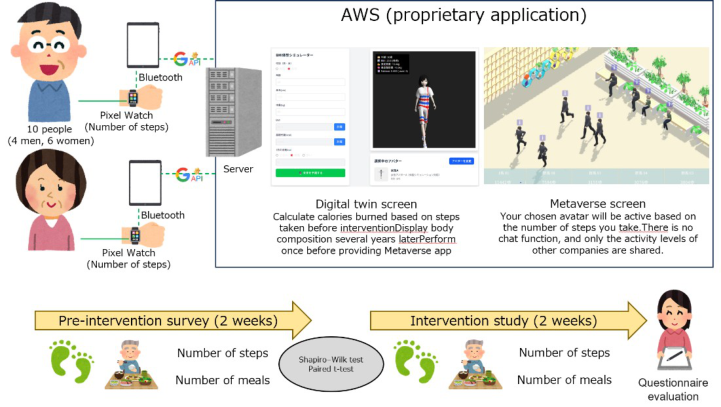
where participants could share real-time data—such as step counts and meal patterns—collected from wearable devices via their avatars, allowing them to observe and compare each other’s health habits. Additionally, the system predicted each participant’s future body composition based on physical activity data and visualized the results using a digital twin, enabling participants to anticipate potential health risks. This approach was designed to determine whether such visualization would influence health behaviors, particularly in terms of physical activity and dietary management. Figure 1 illustrates the overall research framework.
Figure 1: Illustrates the overall research framework.
Experimental Method Participants and Experimental Conditions Ten participants, predominantly older adults residing in Gunma Prefecture, were recruited to take part in the intervention study using the developed system. Written informed consent was obtained from all participants. Eligibility criteria included having no prior medical history or record of home medical visits and maintaining generally good exercise and dietary habits. This study was approved by the Institutional Review Board of Gunma University for medical research involving human participants under the title Development of a Health Consultation Agent and Preliminary Verification of Behavioral Change. The final sample consisted of four men and six women, all recruited through public advertisement.
Equipment Setup All participants were provided with a smartwatch-type wearable device, such as the Google Pixel Watch, to be worn only on weekdays. The devices were worn from the time of waking until 8:00 p.m. each day. The smartwatches automatically recorded step counts and heart rate, transmitting the data via
Behavioral Change Through Shared Activity Data and Future Body Prediction 1733
Bluetooth to a dedicated tablet application. Step counts were automatically aggregated using the Google API, while meal frequency was entered manually in the application. A Lenovo YogaPad was used to interface with the Google Pixel Watch. Prior to the intervention, body composition—including muscle mass and body fat—was measured using a Tanita body composition analyzer (model MA780), and these data were incorporated into the digital twin for baseline measurement.
Intervention Period and Procedure The experiment was conducted in two phases: a pre-intervention measurement period and the intervention period. During the approximately two-week pre-intervention baseline phase, participants wore the smartwatch as usual but did not share their data in the virtual space; only their own step counts and medication adherence data were recorded. Based on the data collected during this baseline phase, the system calculated current energy expenditure and generated a digital twin to predict each participant’s future body composition.
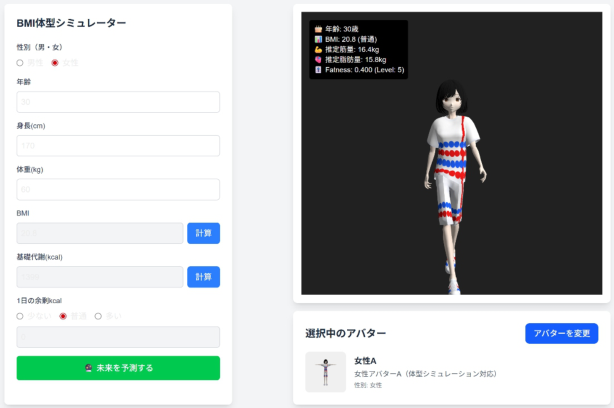
The subsequent intervention phase lasted approximately two weeks. Participants were granted access to the shared metaverse environment, where they could view each other’s data and engage in indirect interaction via avatars. They were encouraged to log in to the virtual space at their convenience during daily life to check their own and others’ avatars and health information. Prior to the intervention, future BMI was calculated for each participant using the previous two weeks’ step count data and body composition measurements, and the projected changes in body composition were displayed to them via the digital twin interface. Fig. 2 shows the digital twin screen.
Figure 2: Digital twin screen.
Data Display Method Within a metaverse-based virtual room, each participant was represented by a corresponding avatar accompanied by a shared virtual monitor. The avatar acted as the participant’s digital proxy, while the virtual monitor positioned behind it displayed the participant’s latest health data—such as step counts, medication adherence, and meal frequency—in real time. Multiple participants could access the virtual space simultaneously, allowing them to view each other’s avatars and health data in anonymized form. For example, when a participant achieved their daily step goal, this achievement was visualized on their virtual monitor and made visible to other participants. No verbal communication, such as chat, was conducted in this space; only health data visualization was provided. Figure 3 presents a screenshot of the metaverse environment.
Figure 3: Metaverse space screen.
Evaluation and Analysis For each participant, changes in average daily step count and meal frequency before and after the intervention were calculated and statistically compared. A paired t-test was performed to assess whether significant differences occurred as a result of the intervention, with the significance level set at 5%. Upon completion of the intervention, semi-structured interviews were conducted to gather participants’ reflections on their virtual space experience and any perceived behavioral changes. Interview transcripts were analyzed qualitatively to identify themes related to motivation and system acceptability.
User Interface Features The system’s user interface allowed each participant to select their preferred avatar from six available designs. These avatars were “age-less” in appearance, enabling participants to project an idealized or familiar self- image regardless of chronological age. Data integration was fully automated,
Behavioral Change Through Shared Activity Data and Future Body Prediction 1735
so that simply wearing the smartwatch updated the avatar’s step count and other metrics without requiring complex operations. No specialized VR hardware was necessary, reducing the burden on older participants and enhancing usability.
RESULT
A comparison of step counts and meal frequency before and after the intervention revealed a significant increase in step counts (p = 0.0001), whereas no significant change was observed in meal frequency (p = 0.343).
Qualitative feedback from the interviews provided further insight into participants’ experiences. Many reported feeling motivated by being able to view others’ health habits, with comments such as, “Seeing others’ health routines encouraged me to put in more effort” and “Having my status reflected in my avatar increased my sense of responsibility.” These responses suggest that visualization and mutual recognition within the virtual space helped stimulate intrinsic motivation.
Table 1. Number of steps and number of meals before and after intervention.
This study demonstrated the potential of sharing health information via wearable devices and a metaverse environment to positively influence exercise habits among older adults. Despite the brief two-week intervention period, participants showed a statistically significant increase in average daily step counts, highlighting the immediacy and practical feasibility of such a technological intervention.
The observed motivational changes resulting from the visualization and sharing of health data in the virtual space are consistent with previous findings. For instance, (Zhang, 2022) reported that visualizing step counts through wearable devices significantly improved physical activity levels in older adults, aligning with our results. Similarly, (Kononova, 2019) emphasized the importance of social support in maintaining exercise habits among older adults, which resonates with our finding that the ability to observe others’ health routines stimulated intrinsic motivation.
Importantly, our study found that a simplified virtual space—without the use of head-mounted displays—was sufficient to achieve measurable effects. This supports the argument by (Pillay, 2024; Bertolazzi, 2024) that, for older adults, usability and intuitive operation often outweigh immersive realism, and that simple, easy-to-understand UI/UX design enhances acceptance and fosters behavioral change. Furthermore, the findings of (Lundstedt, 2023), showing that incorporating natural scenery into virtual environments can boost exercise motivation, suggest that our avatar and virtual environment design may have positively influenced psychological engagement.
In addition, as reported by (Lehmann, 2023), real-time reflection of health status through digital twin technology can serve as a powerful tool for enhancing self-awareness and driving behavior change. In this study, visualizing predicted future body composition within avatars allowed participants to concretely recognize potential health risks, which may have contributed to improvements in their behavior.
Collectively, these results indicate that the proposed system could be an effective means of supporting healthy behaviors among older adults. Future research should verify the sustainability of these effects through long-term interventions, examine applicability across more diverse participant groups, and explore real-world implementation in collaboration with local healthcare providers.
The study also found that the developed health consultation agent application was highly rated by participants and contributed to improvements in both behavior and health awareness. Notably, all participants reported having no prior experience with health management apps, yet expressed no reluctance to enter their health data—suggesting a high degree of acceptability. Interaction with the conversational agent was evaluated favorably, with items such as “the dialogue was easy to understand,” “the advice provided was useful,” “the flow of conversation was natural,” “the agent was trustworthy,” and “the information was accurate” all receiving average ratings of 4.0–4.5 on a 5-point scale. Interface
Behavioral Change Through Shared Activity Data and Future Body Prediction 1737
design and usability were also well received, indicating strong performance in both UI design and agent responsiveness.
The most significant achievement of this study was its measurable impact on participants’ health behaviors and awareness. According to survey results, participants reported an increased sense of commitment to maintaining and improving their health, and most acknowledged gaining more health-related knowledge. Concrete behavioral changes included increased frequency of exercise, greater focus on setting exercise goals, and improved attention to dietary content, all with average ratings between 4.5 and 5.0—indicating near-unanimous positive perception. Particularly, the question “Did the app’s feedback help improve your behavior?” received a perfect score, underscoring the role of personalized feedback from the conversational agent in prompting tangible improvements. Taken together, these findings suggest that the system can be easily adopted even by first-time users of health management applications and that dialogue-based support can effectively promote and reinforce healthy habits. The fact that participants rated their overall study experience as highly positive (4.5–5.0) further supports its perceived usefulness, even over a short intervention period.
Nonetheless, this was a preliminary study with a limited sample size, and caution is warranted in generalizing the findings. A key priority for future research is to conduct larger-scale experiments to validate the system’s effectiveness across more diverse target populations. Expanding the sample size would allow more detailed evaluation of potential differences in outcomes across age groups and health statuses, as well as more robust statistical analysis. Another important avenue is the adaptation of the system for specific disease management, such as diabetes, hypertension, or smoking cessation. Indeed, conversational applications for smoking cessation have demonstrated significantly higher quit rates than conventional treatment in clinical trials (Masaki, 2020), indicating the promise of disease-specific digital health interventions. Our future plans include evolving the system into a medically grounded digital therapeutic by incorporating domain-specific knowledge and clinical guidelines tailored to individual conditions.
Moreover, adding multi-user capabilities could further deepen behavior change by enabling participants to interact and collaborate within the app. For example, implementing peer-support group functions that allow family members or peers to share goals and encourage one another could leverage social support to enhance motivation (Jung, 2023). In fact, mobile applications for cancer survivors have reported that participation in in-app peer communities can increase physical activity and reduce psychological stress (Jung, 2023). By integrating such extensions, the utility of the conversational agent developed in this study could be further strengthened, leading to more sustained and meaningful improvements in health behavior.
In conclusion, the proposed health consultation agent system demonstrated both high usability and significant effects on behavior change. With further refinement and validation, it has the potential to serve not only as a general health promotion tool but also as an evidence-based application for disease prevention and management. The outcomes of this study are expected to contribute to raising health awareness, fostering sustainable
healthy habits, and offering a novel intervention approach in the digital health domain.
ACKNOWLEDGMENT
The authors would like to express their deep gratitude to Mr. Taiga Kubota and Mr. Kazumitsu Kubota of Gunma University for their cooperation in creating the program and conducting the experiments. We also wish to thank Mr. Hisashi Tatsuo of Kyoto University for his assistance with the analysis.
This research was conducted as part of a commissioned study (No. 23609) by the National Institute of Information and Communications Technology (NICT). Furthermore, the conceptual framework underlying this research was informed by the Japan Society for the Promotion of Science (JSPS) Grant-in-Aid for Scientific Research (Grant Number 23KK0032), titled “International Comparative Study on Remote Technology Support for Medical Care and Daily Living Assistance in an Ultra-Aged Society.” We extend our sincere gratitude and respect to Professor Keiichi Yamazaki of Saitama University and Ms. Akiko Yamazaki of Tokyo Institute of Technology for their invaluable support and collaboration in developing this conceptual framework.
REFERENCES
Corral-Acero J, Margara F, Marciniak M, Rodero C, Loncaric F, Feng Y, Gilbert A, Fernandes JF, Bukhari HA, Wajdan A, Martinez MV, Santos MS, Shamohammdi M, Luo H, Westphal P, Leeson P, DiAchille P, Gurev V, Mayr M, Geris L, Pathmanathan P, Morrison T, Cornelussen R, Prinzen F, Delhaas T, Doltra A, Sitges M, Vigmond EJ, Zacur E, Grau V, Rodriguez B, Remme EW, Niederer S, Mortier P, McLeod K, Potse M, Pueyo E, Bueno-Orovio A, Lamata P. (2020) The ‘digital twin’ to enable the vision of precision cardiology. European Heart Journal, 41(48), 4556–4564. Doherty C, Baldwin M, Keogh A, Caulfield B, Argent R. (2024) Keeping pace with
wearables: A living umbrella review of systematic reviews evaluating the accuracy of consumer wearable technologies in health measurement. Sports Medicine, 54(11), 2907–2926. Jung M, Lee SB, Lee JW, Park YR, Chung H, Min YH, Park HJ, Lee M, Chung S, Son BH, Ahn SH, Chung IY. (2023) The impact of a mobile support group on distress and physical activity in breast cancer survivors: Randomized, parallel- group, open-label, controlled trial. Journal of Medical Internet Research, 25, e47158. Kenji Nakamura, Keiichi Yamazaki, Yusuke Arano, Akiko Yamazaki, Hiroshi Koga,
Naoya Ohta, Takuya Mitsuhashi, Hideru Obinata, Yoshiaki Ohyama. (2023) Pilot test of the mutual assistance system using a wearable device for the elderly in WEB3.0 technology. IIAI-AAI2023, IEEE, pp. 705–708. Kinoshita S, Kishimoto T. (2024) Ageing population in Japan: Immediate shakeup in healthcare required. QJM: An International Journal of Medicine, 117(12), 829–830. Kononova A, Li L, Kamp K, Bowen M, Rikard RV, Cotten S, Peng W. (2019) The
use of wearable activity trackers among older adults: Focus group study of tracker perceptions, motivators, and barriers in the maintenance stage of behavior change. JMIR mHealth and uHealth, 7(4), e9832.
Behavioral Change Through Shared Activity Data and Future Body Prediction 1739
Lundstedt R, Persson J, Håkansson C, Frennert S, Wallergård M. (2023) Designing virtual natural environments for older adults: Think-aloud study. JMIR Human Factors, 10, e40932. Masaki K, Tateno H, Nomura A, Muto T, Suzuki S, Satake K, Hida E, Fukunaga
K. (2020) A randomized controlled trial of a smoking cessation smartphone application with a carbon monoxide checker. NPJ Digital Medicine, 3, 35. Mei L, He Z, Hu L. (2024) Accuracy of the Huawei GT2 Smartwatch for measuring physical activity and sleep among adults during daily life: Instrument validation study. JMIR Formative Research, 8, e59521. Nakamura K, Ohyama Y. (2024) Demonstration of pharmacy metaverse and the
realization of smart medicine. Transactions of the Virtual Reality Society of Japan, 29(3), 161–164. Pillay SS, Candela P, Croghan IT, Hurt RT, Bonnes SL, Ganesh R, Bauer BA. (2024) Leveraging the metaverse for enhanced longevity as a component of Health 4.0. Mayo Clinic Proceedings: Digital Health, 2(1), 139–151. Sharma A, Kosasih E, Zhang J, Brintrup A, Calinescu A. (2022) Digital twins: State
of the art theory and practice, challenges, and open research questions. Journal of Industrial Information Integration, 30, 100383. Valenzuela PL, Saco-Ledo G, Morales JS, Gallardo-Gómez D, Morales-Palomo F, López-Ortiz S, Rivas-Baeza B, Castillo-García A, Jiménez-Pavón D, Santos-Lozano A, Del Pozo Cruz B, Lucia A. (2023) Effects of physical exercise on physical function in older adults in residential care: A systematic review and network meta-analysis of randomised controlled trials. Lancet Healthy Longevity, 4(6), e247–e256. van Brakel V, Barreda-Ángeles M, Hartmann T. (2023) Feelings of presence and
perceived social support in social virtual reality platforms. Computers in Human Behavior, 139, 107531. Zhang Z, Giordani B, Margulis A, et al. (2022) Efficacy and acceptability of using wearable activity trackers in older adults living in retirement communities: A mixed method study. BMC Geriatrics, 22, 231.
LISTED IN THE AHFE DIGITAL BOOKSTORE CATALOGUE
Explore the complete digital volume
Human Factors in Design, Engineering, and Computing
Read this individual research paper free through the original publisher, or explore the full digital proceedings book.
ISBN 978-1-964867-75-5
Explore this ISBN in the AHFE Bookstore ↗Listed in the July 2026 bookstore catalogue; search by ISBN to confirm current availability · Digital book purchase optional