Anne Bouyssou Chen, Magnus Nylin, Franklin Nyairo, Emilia Lindroos (2025). The use of eye-tracking in maritime simulator-based training. In: Human Factors in Design, Engineering, and Computing. AHFE Open Access, vol. 199, pp. 856–862. https://doi.org/10.54941/ahfe1006898
Incorrect human behavior is a significant contributor to maritime accidents. Navigation skills therefore represent a critical factor for safety at sea. Integration, digitalization, and intelligent navigation technologies impact Maritime Education and Training (MET).The study aims at understanding how maritime experts and maritime trainees allocate their visual attention to avoid collision during intense maritime traffic in a full-mission bridge simulator. A sample of two experienced active navigators and seven maritime students were fitted with a wearable eye-tracker and placed in different navigational watchkeeping simulation contexts. Individual visual attention was quantified through the analysis of areas of interest (AOIs) and gaze shifts between these AOIs.Experts and novices differ in their gaze patterns. The most prominent difference is that experts make less use of instruments and look out more for information gathering. As ships are complex socio-technical systems, the results of this study may provide Integrated Bridge Systems (IBS) designers and MET professionals with useful insights on the interaction between humans and navigation instruments.
Despite advances in maritime safety and maritime technology, as well as a decrease in major marine casualties, there are still challenges to keep ships safe: machinery damage/failure, vessel collision and fire/explosion are the main adverse outcomes reported globally (Allianz, 2025).
Accidents result from a combination of organizational, technical and operational failures (Reason, 1997; Dekker, 2006). Professionalism and training of crews play a crucial role in the resilience of ships. First, because ships are complex socio-technical systems operating in a highly dynamic environment. Second, because ships’ crews must rely on themselves, with limited support from the shore, in sometimes very hostile conditions (Roberts, 2008).
Situation awareness, which is critical in maritime safety, is a three-level concept described by Endsley (1995) as the capacity for the officer of the watch to i) perceive the relevant elements in the surrounding environment, to ii) make a synthesis of these elements so as to comprehend the current situation, and ultimately to iii) project the future situation based on the dynamics of the elements.
The Use of Eye-Tracking in Maritime Simulator-Based Training 857
The Convention on the International Regulations for Preventing Collisions at Sea 1972, (COLREGs) is a set of 38 Rules for the prevention of collisions of three types: grounding, collision with fixed objects (allision), and collision with another ship. The correct implementation of the COLREGs might be difficult (for example when a situation involves three ships), subject to interpretation and/or ambiguity, and therefore requires learning (Marine Accident Investigation Branch, 2005; Acar et al., 2012).
Simulator-based training allows maritime trainees to acquire knowledge and skills in a safe environment. Simulators are used in Maritime Education and Training (MET) Institutes with the educational objective of preparing trainees to apply normal, abnormal and emergency procedures. The scenarios are designed either through an analytical or a real-life approach. In the first case, the exercise consists in implementing a specific procedure (for example, emergency recovery of a man overboard): the process can be interrupted by the instructor for coaching and explanations, then resumed to achieve a satisfactory result. In the second case, the exercise reproduces actual navigation conditions, with little (for example, a radio call to the bridge) or no intervention from the instructor (Da Conceição, Basso, Lopes & Dahlman, 2017; Sellberg, 2018). This study integrates eye-tracking metrics in the assessment of navigation skills to determine how active expert navigators and maritime trainees allocate their visual attention during a high-traffic navigation scenario in a full-mission bridge simulator.
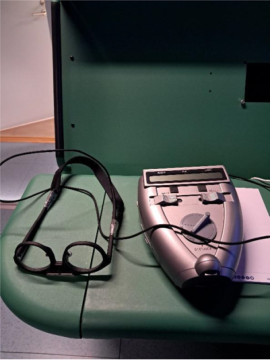
EXPERIMENT A total of nine simulations were conducted in this study with two active expert navigators and seven maritime trainees using a full-mission bridge simulator at Aboa Mare, Turku, Finland. The participants were equipped with a wearable Pupil Labs Neon eye-tracker. Interpupillary distance was measured to calibrate the eye-tracker (Figure 1).
Figure 1: Pupil labs eye-tracker and pupillary distance measuring tool.
Each simulation exercise included ten minutes for briefing the participant (no other prior preparation or passage planning from the participant), forty- five minutes for navigation (without any interruption by the instructor), and ten minutes for debriefing with the instructor in the simulator instructors’ room.
During the debriefing, the participant’s maneuvering intentions were recorded to better understand the decisions made during the exercise.
The simulation scenario reproduced the conditions onboard a container ship and was designed on purpose to create basic encounter situations, in which the participants had to apply the COLREGs to avoid collision: mainly, Overtaking (Rule 13) and Crossing (Rule 14).
To detect over-reliance on Automatic Identification System (AIS) information, non-AIS vessels were included in maritime traffic. It was expected that the participant detecting non-AIS targets would reinforce attention towards visual lookout and/or radar observations, thereby challenging the Electronic Chart Display and Information System (ECDIS) as a source of information to get a reliable overview of the traffic situation and help in decision-making.
To manage the collision risk, the participants had to keep a Closest Point of Approach (CPA) of 0.5 nautical miles and a Time to CPA (TCPA) of more than 10 minutes, ensuring compliance with Rule 8 (a) ‘Action to avoid collision’ which stipulates that “any action to avoid collision shall be (…) made in ample time and with due regard to the observance of good seamanship”.
Bow Crossing Range (BCR) had to be maintained at 1 nautical mile. Speed was constantly full ahead, i.e. approximately 20 knots. No change in speed was allowed. Since there are three alternatives to avoid collisions, namely course alteration to starboard, reduction in speed, a combination of course alteration and reduction in speed, preventing the participant from changing the speed implicitly meant forcing the participant to give a rudder angle.
VHF calls, either ship-to-ship for collision avoidance, or ship-to-shore for traffic information, were permitted. Some of the students did use the VHF, while none of the experts did.
The participants had no access to paper charts in the bridge simulator. They remained seated throughout the experiment.
RESULTS
The data collected consisted of nine eye-tracking recordings (duration between 53 and 57 minutes), of which seven were from the students and two from the experienced navigators. They were analyzed by the Swedish National Road and Transport Research Institute (VTI) using the Neon Player 5.0.4 software. Within the visual field, three areas of interest (AOIs) were defined: the radar, the ECDIS, and the outside window. Fixations outside these three areas were labelled as ‘Other areas’. The distribution between the different AOIs was manually identified with a one-second resolution. The AOIs for the radar and ECDIS included not only the screens, but also the input devices (keyboards) as this was a part of working with the navigation systems.
The results show that almost all time was spent looking at the three different AOIs defined. On average, most time was spent looking at the radar,
The Use of Eye-Tracking in Maritime Simulator-Based Training 859
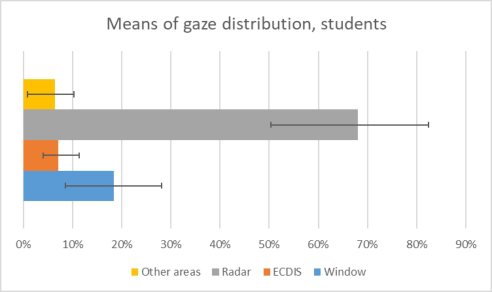
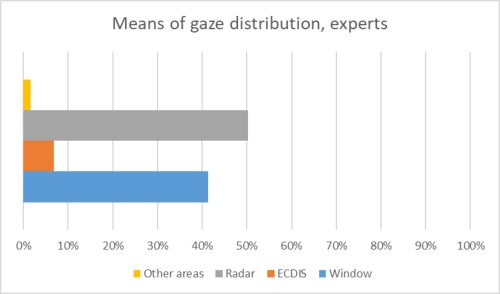
68% of the time for students and 50% for the experts. This was followed by 18% for students and 41% for experts looking out through the windows. The ECDIS was much less frequently used by both groups (7% for both students and experts). This leaves only 6% (students) and 2% (experts) when visual attention was not given to any of the three AOIs. Figures 2 and 3 show the mean gaze distribution for students and experts respectively. For the students (Figure 2), minimum and maximum values are also visualized as well. Even though the maximum value for ECDIS overlaps with the minimum value of the Window category, this was not for the same individual; all students looked most at the radar, second most at the window and least at the ECDIS display.
Figure 2: Students’ gaze distribution. The black lines indicate the span from the minimum value for any student to the maximum value for any student.Figure 3: Experts’ gaze distribution. No minimum or maximum value visualized due to the small sample size.
When looking at the short summaries, including a grading (0-5), made by the simulator instructor on each student’s performance and comparing it to the individual gaze distribution, no clear relation could be observed.
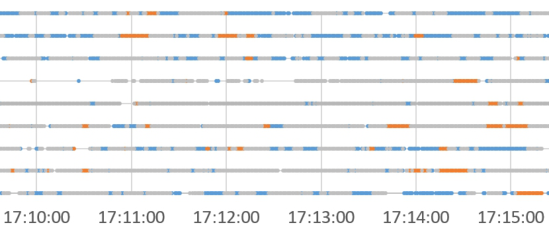
The patterns were plotted for each participant to give an overview of the gaze distribution over time. Figure 4 shows a five minute sample to give an
example of what it could look like. As can be seen, there are large variances both in and between participants, and no particular search behavior other than a constant shift of attention appeared.
Figure 4: Sample showing five minutes of gaze distribution (participant identification is kept anonymous). Grey depicts radar, blue window, and orange is ECDIS. Other areas are seen as blank spaces.
Three of the students (but no expert) used the possibility to turn the outside view to look over the starboard or port bridge wing or used the binocular view. However, that did not correlate with less or more extensive use of the window view in general.
DISCUSSION
According to Rule 5 of the COLREGs “a proper lookout by sight and hearing as well as by all available means appropriate in the prevailing circumstances and conditions [shall be maintained at all times] so as to make a full appraisal of the situation and the risk of collision”.
Experts and novices differ in their visual scanning behavior. The comparison of students’ and experts’ gaze distribution suggests that experts give more attention to the outside window and focus less on other elements than novices. Experienced navigators rely more on keeping visual lookout than novices do to make a cognitive assessment of the navigational situation. From this single observation, it is not possible to infer that experts’ navigation profile is ‘safer’ or ‘better’ than novices’. The characterization of their differences should be further explored, for example with relation to information gathering and situation awareness.
It could have been expected that a lot of head-down time should lead to less good performance among the students given that the experts did look out more. Though it could not be observed as a pattern, or a clear relation between performance and radar-time, it was nevertheless true that the participants receiving the lowest score happened to have spent most of their time looking at the radar. To further explore that, it would probably be needed to look at specific situations rather than at the overall gaze pattern.
Regarding the ECDIS, it is worth mentioning that navigators show a wide variety of user profiles depending on their experience and knowledge about ECDIS functionalities. Some of them merely consider ECDIS as a paper chart displayed on screen, while others use it for more advanced functions such as route planning and/or route monitoring, and even as an aid in making
The Use of Eye-Tracking in Maritime Simulator-Based Training 861
Bridge systems integration is resulting in today’s ship bridge designs to look like the cockpit of jet aircraft. The navigator can monitor the ship’s position and the ship’s route, gathering data from various instruments (radar, ARPA, AIS, ECDIS, echo sounder, etc.), while being seated instead of ‘moving around’ from one console to another within the ship’s bridge. The ‘concentration’ of displays is meant, in principle, to improve situation awareness. The proliferation of data display screens may also generate technostress, which has an impact on navigation performance (Lopes, Aparicio & Neves, 2025).
LIMITATIONS The number of participants, especially the experts, was low. Hence, not enough data was collected to perform any statistical analysis, and it could not be assessed to what extent the visual attention differs between experts, or if there are more or less differences within the expert group than within the students group.
FURTHER RESEARCH Further research could combine eye movements measurements with an analysis of physiological data, such as Heart Rate Variability (HRV) and Electroencephalogram (EEG),to enhance the evaluation of navigators’ spatial attention and cognitive workload.
Two female navigators contributed to the study. In future research, gender could be considered to determine if women and men differ in their use of information sources.
SUMMARY The purpose of this study was to gain a better understanding of information acquisition by navigators, experts and novices, in a full-mission bridge simulator through the analysis of their eye fixations’ distribution.
Nine participants, two experienced active officers and seven maritime trainees, equipped with an eye-tracker, conducted a watch in dense maritime traffic where they had to manage the risk of collision by a course alteration.
Although both groups relied primarily on the radar to identify and manage the risk of collision, the results show that experts acquire situational awareness from a visual lookout more than students.
CONCLUSION
If we adopt a system view on the ship, then we see a set of connections across its components. These components are not randomly interconnected, they display patterns. If we can enhance our understanding of this network of patterns, then we may improve the system’s design as well as the system’s functioning. The analysis of navigators’ eye movements gives information about the human/navigation equipment interface, as well as
the human/bridge procedure interface (time needed for completion of the procedure, repetition of the procedure).
ACKNOWLEDGMENT
This study is part of the Integrating Adaptive Learning in Maritime Simulator-Based Education and Training with Intelligent Learning System (i-MASTER) project supported by the European Union’s Horizon Europe research and innovation programme under grant agreement No. 101060107.
REFERENCES
Acar, U., Ziarati, R. & Ziarati, M. (2012). An investigation into COLREGs and their applications at sea. Safe Return to Port, 40. https://maritimesafetyinnovati onlab.org/wp-content/uploads/2016/02/an_investigation_into_colregs_and_thei r_applications_at_sea.pdf Allianz, 2025. Safety and Shipping Review 2025. Available at https://commercial.all
ianz.com/news-and-insights/reports/shipping-safety.html Da Conceição, V. P., Basso, J. C., Lopes, F. C. & Dahlman, J. (2017). Development of a behavioral marker system for rating cadets’ non-technical skills. The International Journal on Marine Navigation and Safety of Sea Transportation. Volume 11, No. 2. doi: 10.12716/1001.11.02.07 Dekker, S. (2006). The field guide to understanding human error. Aldershot, UK.
Ashgate. Endsley, M. R. (1995). Measurement of Situation Awareness in Dynamic Systems.
Human Factors. 37(1). 65–84. https://doi.org/10.1518/001872095779049499 Lopes, N. M., Aparicio, M. & Neves, F. T. (2025). Analysing the drivers of pilots’ individual performance in simulation training, Computers in Human Behaviour Reports, Vol. 19. https://doi.org/10.1016/j.chbr.2025.100731 Marine Accident Investigation Branch. (2005). Report on the investigation of the
collision between Hyundai Dominion and Sky Hope in the East China Sea 21 June 2004. Report No. 17/2005. https://assets.publishing.service.gov.uk/media /547c70b8ed915d4c100000a9/Hyundai_Sky_Hope.pdf Marine Accident Investigation Branch & Danish Maritime Accident Investigation Board. (2021). Application and usability of ECDIS: A MAIB and DMAIB collaborative study on ECDIS use from the perspective of practitioners. Pages 11–17 https://assets.publishing.service.gov.uk/media/612e1535e90e 07054107585f/ECDIS_Application_and_Usability.pdf Reason, J. T. (1997). Managing the risks of organizational accidents. Aldershot, UK.
Ashgate. Roberts, S. E. (2008). Fatal work-related accidents in UK merchant shipping from 1919 to 2005. Occupational Medicine. Volume 58, Pages 129–137. https://doi.or g/10.1093/occmed/kqm149 Sellberg, C. (2018). From briefing, through scenario, to debriefing: the maritime
instructor’s work during simulator-based training. Cognition, Technology and Work. Volume 20, Pages 49–62. https://doi-org.ezproxy.novia.fi/10.1007/ s10111-017-0446-y
LISTED IN THE AHFE DIGITAL BOOKSTORE CATALOGUE
Explore the complete digital volume
Human Factors in Design, Engineering, and Computing
Read this individual research paper free through the original publisher, or explore the full digital proceedings book.
ISBN 978-1-964867-75-5
Explore this ISBN in the AHFE Bookstore ↗Listed in the July 2026 bookstore catalogue; search by ISBN to confirm current availability · Digital book purchase optional