Venétia Santos, Maria Cristina Zamberlan, José Luis Oliveira, Fernando Cardoso Ribeiro, Priscilla Streit, Flavia Hofstetter Pastura, Thaly Malka y Negri, Carla Patrícia Guimarães, Gloria Lopez Cid (2018). Social Interaction Simulators for the Increase in Human Reliability in the Design of New Industrial Plants. In: Advances in Human Factors, Software, and Systems Engineering. AHFE Open Access, vol. 4. https://doi.org/10.54941/ahfe100123
Industrial projects today should be executed as soon as possible, taking into consideration current standards, corporate technical specifications, best practices and other information. Industrial plants are becoming more complex, and therefore so are the projects. The number of teams involved is large, as are the number of documents generated and manipulated. Consequently, it becomes necessary to develop new tools that are agile and that can be used by managers and designers. In order to increase the reliability of the human design of new refineries, a simulator of social interactions has been developed, based on serious games, to be used in the design process, in the management of new projects and in the training of new operators. Into this simulator are inserted the PDMS database of the new project, the database of 3D digital human models, and criteria established by the required standards. With this simulator one can evaluate new plants, test human interactions to the operation of valves and other components in the industrial area, test collective work in specific scenarios, as well as simulate maintenance work. One can quickly test different scenarios and different design alternatives. The simulator stores the actions performed by the avatars or virtual operators, which routes were taken, communications exchanged and strategies adopted by each operator, in order to incorporate them in the training for novice operators. According to the results obtained, these simulators contribute to the compliance of the project, and to reduce time and errors during the design process. They optimize control in implementation and validation of the project, and also contribute to the training of new operators.
Serious games concepts have been discussed in collaborative virtual environment as a tool for knowledge transfer and experience gaining through simulation and non-physical interactions through life-like experiences using various techniques to embody human-artifacts interactions. There is a clear need for considering new frameworks, theories, methods and design strategies for making serious games applications and virtual environment technologies more effective and useful as part of education, health and training. Virtual simulation has been used in Ergonomics for the design of control centers, transport design and product evaluation. (Santos, et al. 2009; Santos, et al. 2008; Guimarães, et al. 2010).
This paper presents a project in which virtual reality and game engines were used to improve the design process of the new plants in the oil company, based on Human centered Design (HCD). These interactive environments provided the possibility of realistic scenario based drills among the use of Digital Human Models (DHM) built from
3D anthropometric data and Motion Capture (MOCAP), aiming to evaluate the new plant design and train new personnel based on the virtual simulation of activities performed by the workers themselves. The benefits of using 3D DHM with each operator’s own features are the possibility of recognition not only by himself, but also by the team. One who is acquainted can recognize others movements and sometimes predict actions without a need for verbal communication. By mapping these interactions in a visual manner, it is possible to use the information acquired to train new personnel (Guimarães, et al. 2012). In the design process of the new plants we were able to apply different 3D DHM, which represented the Brazilian population.
Using their own movements allowed the assessment of valves position, circulation, occupied volume, reaches and posture. It was also possible to simulate maintenance activities and study how to move equipments around the area. The project was based in the new plant of the oil and gas industry among the stages of the project was considered: a. Gathering information of the activities performed in the existents plants and the operators, which
provided tools for the diagnosis based on Ergonomic Work Analysis. These data provided the multidisciplinary team with knowledge and understanding regarding the procedures, such as maintenance and operation activities. b. 3D scanning of the operators in functional postures, wearing safety individual equipments, aiming the design of workstations, proposals of new working conditions and the development of their 3D DHM for the virtual interactive environment; and c. MOCAP of the same workers performing daily activities in order to apply their movements on their
own scanned models.
METHODS
The development of the simulator had to follow a few criteria, as described below:
It should be easily adaptable due to constant updates on the 3D model;
The complexity should be considered in order for the simulator to run in computers with lower operational processing and still maintain the desirable features, such as speed and control.
The controlled 3D Digital Human Model should be able to interact with predetermined elements inside the platform; and
Visual aids should be developed specifically for each simulator in order to attend their own functionalities.
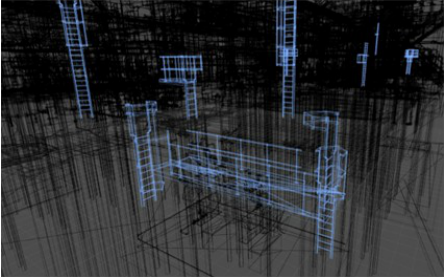
The first stage of the simulator’s development consisted in importing the PDMS model from the refinery into the game engine. One of the issues found in this stage was regarding objects clusters (Figure 1), which would not make possible to visualize and interact with them individually (Figure 2).
The second stage consisted in the design of the 3D DHM based on 3D laser scanning and MOCAP of the operator themselves. In this stage, a MOCAP database was created, allowing animation modules to be inserted in the 3D models (Figure 2) according to activity simulation requirements. All these features are used to complement this complex DHM, that has the capability of representing the technicians with visual accuracy, and still give them a human like movement, much more trustable than a robotic or parametric movement created by algorithms.
To ensure Brazilian and International standards were applied in its best way, some functional poses were acquired with the laser scanners and used to have a most efficient evaluation of internal area and occupancy, avoiding conflicts between the adopted postures of the DHM animated by motion capture and the exact space required when assuming certain postures represented by the functional poses.
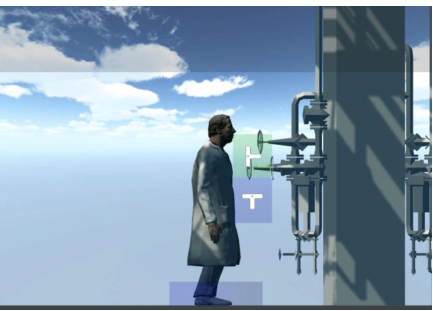
The fourth stage was implementing the 3D DHM in to the game engine and suit their functionalities, such as the possibility to generate independent NPCs with the ability to dodge from obstacles and chose the smaller way between two points, physical and interactive simulation - where the characters are able to identify potentially interactive objects and interact with them. Additional functionalities were developed as follows: -A top view visualization system, which allows users to map the DHM positioning and displacement inside the scenario; -A lateral point of view with ideal heights for evaluation of activities based on valves manipulation (Figure 3); -A general visualization of ideal height can be projected in order to evaluate activities based on valves manipulation (Figure 4); -A coordinate system placed in each DHM to allow relative positions to be identified within the scenario, enabling the integration of other viewers and programs; -A vertical displacement system for faster transition between floors.
Figure 3. Lateral view with ideal heights projected Figure 4. General view with ideal heights projected.
RESULTS AND DISCUSSION
One of the interaction virtual simulator's goals was to allow multiple users to interact with each other using their own avatars, participating in a pervasive method of interaction design, described by Kaptelinin & Nardi (2006) as something that comprises all efforts to understand human engagement with digital technology and all efforts to use that knowledge to design more useful and pleasing artifacts.
So far, it has allowed all stakeholders, from operators to managers and design team to engineers, to discuss and evaluate solutions, avoiding mistakes and misunderstandings between both parts when concerning about new solutions. Being able to visualize 3D environment and populate it with 3D DHM based on the users themselves and equipments and valves from the area has shown to be more productive than a 2D floor plan traditional approach, once it leads to knowledge and awareness democratization.
It has also made possible to study occupancy of equipments and analyze the workflow to executed the operators activities. All activities were simulated at once, in this virtual environment, with controlled situations and multiple points of view for the same scene, even been able to rewind and see everything.
The technologies used in this project, regarding the development of the 3D DHM are still being improved in order to decrease production time and enhance both movement and visual accuracy of the models. The MOCAP system used in the project is based on inertial sensors, which have the disadvantage of losing reference when near metal surfaces. Although the data acquired from this system can easily be edited, new systems are being studied to complement MOCAP data.
CONCLUSIONS
Nowadays, industrial projects are developed with the use of 3D software engines instead of 2D tools, allowing the main focus to be human labor and not only the project itself. Allowing it to the study of social interactions at work helps to project better environments (Santos, et al. 2011). The use of virtual environments gives the possibility to discuss, change, create and deliver a better result as it is more graphic and visual for non architects and designers professionals, to understand and discuss the new layout of the work space where can be chosen a better design alternative, optimize the interfaces, integrate countless projects and a great number of professionals involved.
Transparency of the future project allows adjustments and error recovery throughout the design process. Projects become more robust, since the scenarios and future activities may be simulated and also the risks involved studied. These simulations may be used to evaluate technology, industrial safety and/or human performance. One may map process risks, ergonomic and architectural problems, escape routes, displacement of people in crisis situations, assembly and maintenance problems.
Therefore the conclusion is that virtual simulators of social interactions contribute towards: the activity of designers in the occupation of three-dimensional space; evaluation of possible alternatives to place equipments and valves; detailing the environment; validation of the future project by users, managers, and others; safety, health and environment evaluation; training of human resources.
As observed in this work, engineers can use this simulation platform in the design of future plant, thus minimizing the time required for similar projects and increasing the compliance of these environments to standards. Even if character interaction cannot always be done in the virtual space, stakeholders can easily project their knowledge of the working situation in order to assess part of the new working space characteristics improving the participative dimension of the project. Organizational decisions were taken around these tools; they help people to project themselves in their future working spaces and furthermore it was a great tool to improve the feeling of participation.
REFERENCES
Guimarães, C.P.., Cid, G.L., Paranhos, a. g., Pastura, G.C.H.., Franca, G.A.N., Santos, V, Zamberlan, M.P.C , Streit, P, Oliveira, J.L.., Correa, t. g. v. Ergonomic work analysis applied to chemical laboratories on an oil and gas research center. in: vincent g. duffy. (org.) advances in applied human modeling and simulation. 1ed. Boca Raton: CRC press, v. 1, p. 471-477, 2012. Guimarães, C.P.., Pastura, F.C, Pavard, B., Pallamin, N., Cid, g., Santos, V., Zamberlan,,M.C.P.Ergonomics design tools based
on human work activities. in: 3d human models and social interaction simulation ihx congress, Miami, 2010. Kaptelinin, V., Nardi, B.. Acting with technology: activity theory and interaction design, the mit press, Cambridge, 2006. Santos, V., Guimarães, C.P.., Cid, G. Simulação virtual e ergonomia. in: xv Congresso brasileiro de ergonomia - vi fórum Brasileiro de Ergonomia, Porto seguro, 2008. Santos, V, Aamberlan, M.C.P, Pavard, B. Confiabilidade humana e projeto ergonômico de centros de controle de processos de
alto risco, ed., Synergia, Rio de Janeiro, 2009. Santos, V., Zamberlan, M.C.P., Pavard, B., Streit, P., Oliveira, J.L., Guimarães, C.P., Pastura, F.C. Social interaction simulators: serious games for the design of complex socio-technical systems. in: DHM 2011 - first international symposium on digital human modeling, ucbl -Université Claude-Bernard Lyon, 2011.
LISTED IN THE AHFE DIGITAL BOOKSTORE CATALOGUE
Explore the complete digital volume
Advances in Human Factors, Software, and Systems Engineering
Read this individual research paper free through the original publisher, or explore the full digital proceedings book.
ISBN 978-1-4951-2096-1
Explore this ISBN in the AHFE Bookstore ↗Listed in the July 2026 bookstore catalogue; search by ISBN to confirm current availability · Digital book purchase optional