Benny Platte, Anett Platte, Rico Thomanek, Christian Roschke, Marc Ritter (2025). Streamline Information, Personalize Learning: Patient-Centered Knowledge Delivery for Medical Professionals. In: Human Factors in Design, Engineering, and Computing. AHFE Open Access, vol. 199, pp. 1740–1750. https://doi.org/10.54941/ahfe1006985
This paper presents a prototype recommendation system for personalized medical education, which leverages patient-specific diagnostic data to automatically identify and deliver relevant scientific literature on an individual basis. Diagnosis selectors extract key terms from practice management data, which are used as search queries in medical databases (e.g., PubMed). The relevance of the retrieved publications is calculated using a weighted Jaccard similarity and presented interactively on a companion tablet. The system is complemented by manually curated literature to ensure quality. Initial tests with synthetic data demonstrate the technical feasibility and potential to reduce workload in daily medical practice. By addressing the challenges of information overload and time constraints, the system offers a low-threshold entry point for continuing education tailored to the actual needs of a physician’s own patient population.
Advances in medical research, together with the rapidly expanding volume of scientific publications and clinical evidence, create a significant challenge for physicians in private practice. Working largely as “lone fighters” (Doctolib, 2022; Virchowbund, 2018), they must balance their daily workload with the requirement to continuously integrate emerging knowledge into patient care. Against this backdrop, the question arises how personalized and data- driven approaches in medical informatics can capture individual motivation and provide efficient continuing education, while minimizing additional workload for healthcare providers.
In the midst of the heated debate surrounding sponsored lecture events and educational trips, where “hidden compensations” are often implied (KBV, 2018), speakers receive “inadequately high sums” (“Der Arzneimittelbrief,
2016–03”), and discussions reference the counterpart of the “Anti-Kickback Statute” (Fraud - Office of Inspector General, 2021; Publication of OIG Special Fraud Alerts, 2022; Schott et al., 2022), the focus on personal, individualized further education is frequently neglected.
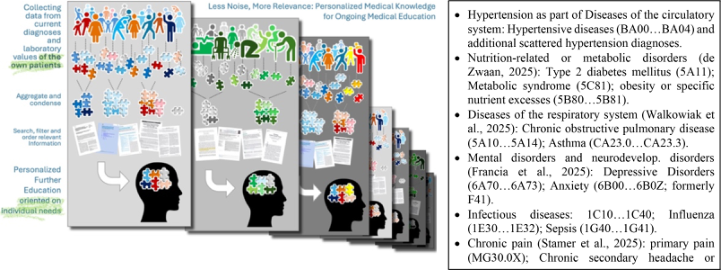
Figure 1: Overview of the proposed concept. Cohort-specific needs vary by practice and profession (color-coded, top). The system leverages patient-specific data to guide the selection of relevant and current scientific literature. – Right side: Prototype coverage of ICD-11 categories (selected examples, not exhaustive)”.
The critical question remains: What are effective approaches to foster personal motivation and achieve the most efficient continuing education for physicians, without increasing the necessary effort on their part?
Starting Point for Continuing Medical Education In most countries, physicians are legally required to participate in continuing education, e.g., in Germany 250 hours every 5 years (Ärztliche Weiterbildung, 2024; Fortbildungszertifikat und Punktekonto, 2024). We all remember the overcrowded classrooms. The teacher at the blackboard explaining things up front at a pace that is too slow for some, right for others, and others would like to ask questions much more often. It’s the same with further training for adults, which is no different in the field of medicine. A standard training course consists of lectures that are more or less ticked off in order to obtain a certificate. Taken together, the usual training courses have 4 shortcomings:
1. passive participation: listening without interaction leads to poor knowledge retention (Sharma et al., 2022). 2. fixed times: Conventional training formats take place at fixed times and locations. Different people are receptive to different things at different times (Padmanabhan, 2024, p. 733). These time frames are often incompatible with daily practice (Samannodi et al., 2022, p. 742).
3. fixed topics: The format of the usual continuing education events with lectures, interrupted by coffee breaks, delivers a fixed programme of important and unimportant topics en bloc with: a person willing to learn can participate or not, but the time at the venue is still wasted (Claborn et al., 2021, p. 11; Lu et al., 2022). 4. lack of individualisation: differing entry levels and needs are not considered (Claborn et al., 2021).
To address these challenges, innovative approaches are needed that adapt to individual requirements. Personalized learning offers such a path by enabling targeted and efficient continuing education.
Personalized Learning Personalized Learning Starts from the Learner’s Individual Level, Adapting Materials to Specific Needs and Fostering Active Engagement. Effective Implementation in Medical Practice Requires Mechanisms to Observe, Categorize, and Measure Prerequisites.
Educational research consistently confirms the benefits of personalized approaches. Bloom (Bloom, 1984, p. 5) showed that individualized instruction such as tutoring can improve performance by up to two standard deviations—the 2-sigma problem—a finding repeatedly validated (Gannon & Abdullahi, 2013, p. 1; Guskey, 2007, p. 26) and more recently confirmed in current studies (Prónay et al., 2023, p. 130; Thuan et al., 2024, p. 35).
Adaptive learning methods build on personalized learning by not only providing learner-tailored information, but also dynamically adjusting to the learner as “content, methods, and pace of learning are adjusted based on individual needs, abilities, and learning styles” (Thuan et al., 2024, p. 35). Concepts such as Adaptive Hypermedia and Intelligent Tutoring (Brusilovsky & Peylo, 2003, p. 159) as well as adaptive training technologies (Durlach & Lesgold, 2015, p. 12) demonstrate how such systems improve efficiency, especially in professional contexts where time is scarce.
In adult education, mobile learning approaches offer additional flexibility. Personalized mobile tools support continuous professional development by enabling context-sensitive, location- and time-independent learning (Kellam, 2015; Kukulska-Hulme & Traxler, 2005, p. 2). Closely related is competence- based learning (Mulder, 2017), which emphasizes learner individuality, and self-directed learning (Knowles et al., 2014), which is particularly relevant for physicians.
In sum, personalized and adaptive learning approaches can systematically optimize continuing medical education by aligning training with learners’ needs, improving outcomes, and making more efficient use of limited time.
APPROACH We developed a prototype for a personalized, adaptive continuing education system for general practitioners that uses patient-specific data
to make medical education more efficient. The system provides literature recommendations tailored to the individual and current needs of each patient cohort. By integrating data such as laboratory results and diagnoses from practice management systems (PMS), relevant information can be delivered promptly to support professional development while avoiding time- consuming searches. Weekly updates ensure that recommendations remain aligned with the physician’s current patient population.
Environment The key challenge for personalized learning in primary care is the high workload of daily practice. Physicians report lack of time as a major barrier: 94% cite unnecessary administrative tasks and 67% excessive stress, while rural practitioners face even heavier workloads, averaging 50 hours per week due to house visits (Pochert et al., 2019). A typical day involves rapid patient turnover, interpretation of diagnostic results, and preparation of treatment plans, leaving little opportunity to systematically search for new publications. Any system must integrate seamlessly without adding workload beyond the learning activity itself.
Terms In this paper, the term healthcare institution is used synonymously with physician, following the German Health Data Use Act (GDNG, § 2 lit. 5), which classifies private practitioners as “healthcare institution.” Personalized learning advances this approach by giving learners control over the content, allowing them to decide for themselves which aspects are most relevant. Learning takes place in groups that differ in pace and topics. Personalized education shifts this group-based approach toward the individual. To enable true individualization, contextual data, resources, and tools must be taken into account.
In our system, personalized learning refers specifically to the physician as the learner: content is tailored to the patient and case context so that relevant information can be extracted from an otherwise overwhelming data space. This is not based on personal preferences but on a stratified information base derived from patient data. Patients are grouped into strata (e.g., phenotypes, diagnostic markers), an approach rooted in stratified medicine. By reducing information overload to subgroup-specific content, continuing education is aligned with the actual patient reality in the physician’s own practice.
User-related Requirements: The system must integrate seamlessly into daily workflows. It should require minimal time investment—at most time- neutral compared with traditional searches—operate unobtrusively in the background, and offer customization options such as preferred reading times.
Technical Requirements: The system must integrate data from common practice management systems (PMS), including diagnoses, lab results, and treatment histories. Interoperability must comply with data protection rules and established healthcare security and GCP standards (EMA (European Medicines Agency), 2023; WHO, 2018).
Functional Requirements: The system must provide personalized literature suggestions, regularly updated and aligned with patient-specific conditions. The user interface should ensure ease of use, enabling quick access without extensive training.
SYSTEM ARCHITECTURE AND PROCEDURE The prototype integrates and analyzes patient-specific data from practice management systems (PMS) to recommend relevant scientific publications. As ethics approval is still pending, only synthetic data are currently used. PMS serve as the central documentation hub, containing diagnoses, lab results, and medical records. For the prototype, only secured diagnoses recreated with synthetic data are processed.
Data are exported from the PMS to a dedicated research computer via secure transfer (currently USB stick). This separation ensures that practice workflows remain unaffected and networks stay isolated to prevent data leaks. Although synthetic data are used, the export follows the exact same procedure as with real data, allowing early validation of all processing algorithms.
Processing occurs in two steps: (1) heuristic keyword extraction from ICD-11–coded diagnoses using predefined selectors and medical ontologies, and (2) automated literature search in databases such as PubMed (PubMed, 2024). Results are stored with metadata and linked to the extracted keywords.
To enable patient-specific recommendations, a catalog of 54 diagnosis selectors was implemented. Each selector consists of regular expressions or text patterns mapped to ICD-11 entries and serves as a bridge between clinical diagnoses and relevant literature (Chute & Çelik, 2022; WHO, 2025). These selectors cover major groups such as cardiovascular, metabolic, respiratory, psychiatric, infectious, and pain-related conditions. A abbreviated list in Fig. 1 on the right side.
The extracted diagnosis selectors are automatically linked to keywords for literature search. For instance, BA00 (essential hypertension) generates the terms Hypertension, Primary Hypertension, and Blood Pressure Control, which are then used for PubMed queries. Each patient can match multiple selectors, and the corresponding keywords are aggregated.
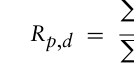
To prioritize the relevance of individual publications within the resulting pool, a heuristic relevance score Rp,d is calculated. The score is based on a weighted match between the diagnosis selectors and the tags (keywords) associated with each publication. For each patient d, there is a set of active selectors Sd ={s1,..., sn}, from which a keyword list Kd is generated. Similarly, each publication p has a tagged keyword list Kp.
The similarity between keywords is determined by the weighted Jaccard similarity, i.e., the ratio of the weighted intersection to the weighted union (Popping, 2019, p. 122). This metric – also referred to as Intersection over Union – compares binary or categorical feature sets, where the presence of an attribute (here: keyword) is informative, while its absence is not. In such asymmetric contexts, as is the case here, the absence of terms on both sides
does not contribute to similarity and is therefore ignored (Gräßer, 2021, p. 28f). The final relevance score Rp,d for a publication p and a patient d is defined as: P
k denotes the weight of keyword (k).
Equation reproduced from the original PDF.
k∈Kp∩Kd w(k) P
k∈Kp∪Kd w(k) where w
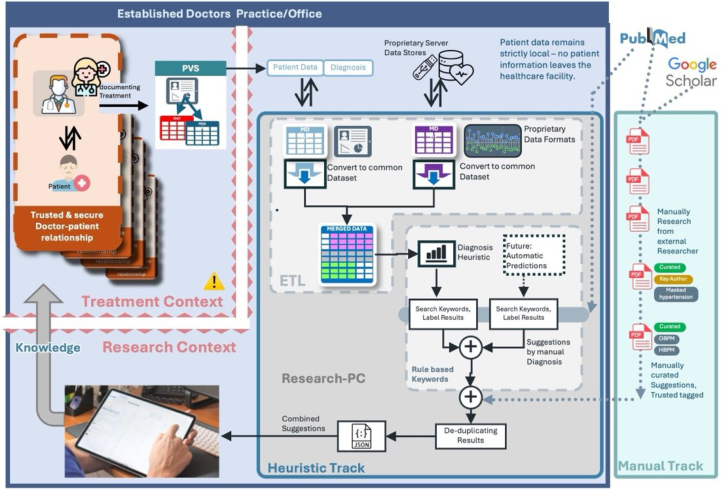
Figure 2: Legal situation and data flow schema. In the legal domain, the barrier between the treatment context and continuing education is crucial, represented here by a chain of triangle symbols ▲. Since this work is a proof of concept within the framework of researching continuing education opportunities, the research area (“Research Context”) is legally and physically separated. The physical separation is ensured through dedicated devices, which are relevant exclusively for the research domain. The processing area consists of two parts: the “Heuristic Track” and the “Manual Track.” The individualized component, including the processing of patient data, remains within the operational sphere of a medical practice, while the general component – marking curated publications – takes place externally.
In the current prototype, all weights are set to 1. Future versions will allow physicians to assign weights according to individual learning priorities. The score Rp,d ∈[0, 1] is used to sort publications on the companion tablet: higher values indicate stronger matches. The system does not aim at precise patient- level predictions but at presenting, within self-chosen intervals (e.g., weekly or monthly), the most relevant literature linked to current diagnoses.
Information Provision The system consists of two devices: a research PC and a companion tablet (Fig. 2). The research PC runs in the background and only requires interaction when new data snapshots are imported. The tablet, synchronized via JSON
files from the PC,displays publications matching patient diagnoses and health data. Its interface is designed for quick, intuitive access.
In parallel, external experts curate additional literature. They review publications for selected diagnoses, ensure quality, and add PDFs to the database, providing physicians with a reliable supplement to the automated process.
Security and Data Protection The protection of sensitive patient data is of utmost priority. All processing remains within the practice, with access limited to the physician. This allows patient names to be displayed while ensuring confidentiality. Data transfer currently occurs via wired connection; after supervisory approval, encrypted wireless transmission will replace it. Access to individual patient data on the tablet is recorded in an audit log to guarantee compliance with data protection rules, including GDPR.
RESULTS
The developed prototype of our personalized continuing education system has been successfully implemented. Due to pending data approvals from the supervisory authority, the tests were conducted using synthetic data from a total of 130 patients, consisting of 67 men and 63 women. By applying 50 predefined diagnosis selectors, the patients were assigned to corresponding diagnoses.
The automated literature search, based on heuristically extracted keywords, resulted in an initial collection of 864 scientific publications. In addition, 47 works were manually curated and independently integrated into the system. These publications include key research findings and foundational works, including current medical guidelines and studies on hypertension thresholds across different countries.
The user interface of the accompanying tablet is functional and presents overviews of all patients and their assignments reactively and without noticeable delay. The display provides the following overviews:
Patient list – for selecting individual persons.
Individual patient view – allows checking whether diagnosis selectors or automatic keywords were extracted, and which publications are recommended as a result.
Individual suggestions – displays individually recommended documents in reading view together with the assigned tags.
Selector view – displays the previously defined selectors as expandable categories with recommended publications.
DISCUSSION
Due to the pending ethics approval, we were only able to work with synthetic data. To nonetheless test the functionality in a real system environment, consisting of various software systems and data formats, we entered several sets of patient data into the original software as if they were real patients.
In this way, data collection occurs from the same source and systems, and the corresponding connectors are prepared for future real data, allowing errors to be detected early.
The recommender system demonstrates the ability to perform an effective automated literature search from a wealth of patient-specific information and present it interactively and in an easily consumable manner. The 864 scientific publications represent an effective filtering and selection after an initial review.
The integration of manually curated works allows (similar to curated collections in other digital domains) a minimum level of quality assurance for the provided content, giving users confidence that essential and relevant information will always be available aside from automated processes. We conducted this curation for a narrow professional field to test the suitability of such a recommender system as a whole and to establish functionality limited to a specific subfield.
After initial interviews, the integration of manually curated works is absolutely necessary in order to establish initial trust in the system from the medical side. Manual curation also does not run counter to the idea of automation, as expert teams curate in the respective specialist area and act as multipliers through their careful selection of publications relevant to the specialist area.
LIMITATIONS Several limitations must be acknowledged. The use of synthetic data restricts generalizability; validation with real patient data will be required once ethics approval is granted to test diagnosis extraction, model performance, and recommendation effectiveness. A further issue is the quality of automatically suggested publications: while manual curation ensures reliability, it is time- consuming and not scalable, although commercial curation services could provide a solution. Future improvements may rely on text mining and NLP to extract keywords from long-term documentation. Yet challenges remain, including heterogeneous recording practices, the wide range of possible diagnoses, and regulatory concerns—any inference of diagnoses would classify the system as a medical device subject to strict requirements. Advanced prediction algorithms could also increase relevance but pose societal risks if the system were mistaken for a diagnostic tool, potentially leading to over-reliance and de-skilling (Bienefeld et al., 2024, p. 17; Hilbig, 2024, p. 1). Finally, the system benefits only intrinsically motivated users willing to invest personal effort in reviewing recommendations. It remains a prototype; broader adoption would require integration into the formal framework for accredited continuing medical education.
CONCLUSION
This study introduced a prototype of a personal, adaptive continuing education recommendation system that integrates seamlessly into clinical
workflows and provides personalized educational resources derived from patient-specific data.
The development and successful proof-of-concept implementation demonstrate the technical feasibility of data-driven methods for individualized medical education and underline their potential role as a complementary element of medical informatics. Beyond proving functionality, the prototype illustrates how information filtering and recommendation – commonly applied in other domains – can be transferred to healthcare to support evidence-based continuing education.
The system employs a mobile, interactive tablet interface that automatically processes data from the physician’s own patient population, filters the overwhelming volume of scientific literature, and delivers structured, targeted recommendations at self-selected intervals. In doing so, it minimizes the burden of manual search while aligning continuing education directly with the realities of daily patient care.
Overall, the findings highlight that such a system is not only technically feasible but also has the potential to function as a lightweight decision- support tool in professional education, increasing efficiency and fostering continuous knowledge transfer. In the long term, this approach may contribute to both more sustainable medical education and improved quality of patient care.
ACKNOWLEDGMENT
This research was funded by the Federal Ministry (BMFTR) through the Medical Informatics Hub in Saxony (MiHUBx, https://mihubx.de), under the grant numbers 01ZZ2101D (University of Applied Sciences Mittweida), 01ZZ2101C (Chemnitz University of Technology), and 01ZZ2101E (Klinikum Chemnitz).
Further information: https://www.medizininformatik-initiative.de/de/use- cases-und-projekte/digitale-fortschrittshubs-gesundheit
REFERENCES
Ärztliche Weiterbildung. (2024, January). Bundesärztekammer. https:// www.bundesaerztekammer.de/themen/aerzte/aus-fort-und-weiterbildung/ aerztliche-weiterbildung. Bienefeld, N., Keller, E., & Grote, G. (2024). Human-AI Teaming in Critical Care: A Comparative Analysis of Data Scientists’ and Clinicians’ Perspectives on AI Augmentation and Automation. Journal of Medical Internet Research, 26(1), e50130. https://doi.org/10.2196/50130. Bloom, B. S. (1984). The 2 Sigma Problem: The Search for Methods of Group
Instruction as Effective as One-to-One Tutoring. Educational Researcher, 13(6), 4–16. https://doi.org/10.3102/0013189X013006004. Brusilovsky, P., & Peylo, C. (2003). Adaptive and Intelligent Web-based Educational Systems. International Journal of Artificial Intelligence in Education, 13, 14. Claborn, K., Scott, K., & Becker, S. J. (2021). Cross-Training Needs Among
Community-Based Clinicians in HIV and Substance Use. Research Square. https:// doi.org/10.21203/rs.3.rs-642309/v1.
Doctolib. (2022, March 31). Arztpraxis eröffnen – welche Rechtsform passt?
Doctolib Pro - Deutschland. https://info.doctolib.de/blog/ welche-rechtsform- passt/. Durlach, P. J., & Lesgold, A. M. (Eds.). (2015). Adaptive technologies for training and education (Paperback Edition). Cambridge University Press. EMA (European Medicines Agency) (Ed.). (2023, May 25). Guideline on good
clinical practice (GCP) ICH E6 (R3)—Draft Version—Step 2b, Release for public consultation on 2023–05-26. International Council for Harmonisation of Technical Requirements for Pharmaceuticals for Human Use. Fortbildungszertifikat und Punktekonto. (2024, April). Sächsische Landesärztekammer. https://www.slaek.de/. Fraud—Office of Inspector General. (2021, March 31). Government Oversight | U. S.
Department of Health and Human Services. https://oig.hhs.gov/fraud/. Gannon, M. N., & Abdullahi, A. S. (2013). Effect of Open Note Quizzes on Community College Science Students Grades and Attrition Rates. Journal of Curriculum and Teaching, 2(2), Article 2. https://doi.org/10.5430/jct.v2n2p1. Gräßer, F. M. (2021). Data-based Therapy Recommender Systems. Guskey, T. R. (2007). Closing Achievement Gaps: Revisiting Benjamin S. Bloom’s
“Learning for Mastery.” Journal of Advanced Academics, 19(1), 8–31. https:// doi.org/10.4219/jaa-2007–704. Hilbig, A. (2024). Trainee Focus debate: Artificial intelligence will have a negative impact on emergency medicine. Emergency Medicine Australasia, 36(4), 639–640. https://doi.org/10.1111/1742–6723.14460. Industrielles Sponsoring Von Ärztefortbildungen, Patientenverbänden Und Anwendungsbeobachtungen | Der Arzneimittelbrief. (2016). Der Arzneimittelbrief, Jahrgang 50(03/2016), 17–22. KBV. (2018). Gesponserte Fortbildungen. Kassenärztliche Bundesvereinigung. https://www.kbv.de/html/30484.php. Kellam, H. J. D. (2015). A Conceptual Framework to Guide the Design, Delivery
and Evaluation of Quality Mobile Learning Experiences [Université d’Ottawa / University of Ottawa]. http://hdl.handle.net/10393/32955. Knowles, M. S., III, E. F. H., & Swanson, R. A. (2014). The Adult Learner: The definitive classic in adult education and human resource development (8th ed.). Routledge. https://doi.org/10.4324/9781315816951. Kukulska-Hulme, A., & Traxler, J. (2005). Mobile Learning: A Handbook for
Educators and Trainers. Psychology Press. Lu, P.-Y., Hsu, A. S. C., Green, A., & Tsai, J.-C. (2022). Medical students’ perceptions of their preparedness to care for LGBT patients in Taiwan: Is medical education keeping up with social progress? PLOS ONE, 17(7), e0270862. https://doi.org/ 10.1371/journal.pone.0270862. Mulder, M. (Ed.). (2017). Competence-based Vocational and Professional Education:
Bridging the Worlds of Work and Education (Vol. 23). Springer International Publishing. https://doi.org/10.1007/978–3-319–41713-4. Padmanabhan, V. (2024). Outline for Empathy-Based Medical Education. Clinical Medicine And Health Research Journal, 4(1), Article 1. https://doi.org/10.18535/ cmhrj.v4i1.297. Pochert, M., Voigt, K., Bortz, M., Sattler, A., Schübel, J., & Bergmann, A. (2019). The
workload for home visits by German family practitioners: An analysis of regional variation in a cross-sectional study. BMC Family Practice, 20(1), 3. https://doi.org/ 10.1186/s12875–018-0891–6.
Popping, R. (2019). Introduction to Interrater Agreement for Nominal Data.
Springer International Publishing. https://doi.org/10.1007/978–3-030–11671-2. Prónay, S., Majó-Petri, Z., Dinya, L., & Huszár, S. (2023). Investigating a MOOC educational model and the attitude of university students towards digital education. International Journal of Technology Enhanced Learning, 15(2), 123–142. https://doi.org/10.1504/IJTEL.2023.130093. Publication of OIG Special Fraud Alerts. (2022, August 23). Federal Register. https://www.federalregister.gov/documents/2022/08/23/2022–18063/ publication-of-oig-special-fraud-alerts. Samannodi, M., Bulkhi, A., Alwafi, H., Bukhari, R., Salawati, E., Hafiz, B.,
Minshawi, F., Dahlawi, M., Kamfar, S., Halawani, H., Naser, A. Y., Mandora, R., Ali, M. A., & Almatrafi, M. A. (2022). Impact of COVID-19 Pandemic on Medical Education: A Cross-Sectional Study in the Western Region of Saudi Arabia. Advances in Medical Education and Practice, 13, 741–754. https:// doi.org/10.2147/AMEP. S369213. Schott, G., Baethge, C., Klemperer, D., Köbberling, J., Lempert, T., Ludwig, W.-D., Müller-Oerlinghausen, B., Schneider, B., & Lieb, K. (2022). Unabhängige ärztliche Fortbildung – Entwicklungen in den USA Vorbild für Deutschland? Arzneiverordnung in der Praxis. Sharma, M., Murphy, R., & Doody, G. A. (2022). Barriers and facilitators for
implementation of a national recommended specialty core-curriculum across UK medical schools: A cross-sectional study using an online questionnaire. BMJ Open, 12(3), e053565. https://doi.org/10.1136/bmjopen-2021–053565. Thuan, T. Q., De, N., & V˘an Toai, N. (2024). Developing an adaptive learning platform based on artificial intelligence (AI) to personalize the learning experience. International Journal of Management and Organizational Research, 3(3), 34–38. https://doi.org/10.54660/IJMOR.2024.3.3.34–38. Virchowbund. (2018, December 20). Kooperationsformen – Teil 3: Praxisgemeinschaft. DocCheck. https://www.doccheck.com/de/detail/articles/ 21146-kooperationsformen-teil-3-praxisgemeinschaft. WHO. (2018, October 25). Global Conference on Primary Health Care: Declaration
of Astana. World Health Organization and the United Nations Children’s Fund (UNICEF).
LISTED IN THE AHFE DIGITAL BOOKSTORE CATALOGUE
Explore the complete digital volume
Human Factors in Design, Engineering, and Computing
Read this individual research paper free through the original publisher, or explore the full digital proceedings book.
ISBN 978-1-964867-75-5
Explore this ISBN in the AHFE Bookstore ↗Listed in the July 2026 bookstore catalogue; search by ISBN to confirm current availability · Digital book purchase optional