Richard Vogel, Robert Manthey, Max Schlosser, Michael Walther, Josefine Welk, Marc Ritter, Matthias Vodel (2025). Smart Tokens for Proximity Marketing and Supply Chain Tracking - Vicima. In: Human Factors, Business Management and Society. AHFE Open Access, vol. 176, pp. 57–64. https://doi.org/10.54941/ahfe1006303
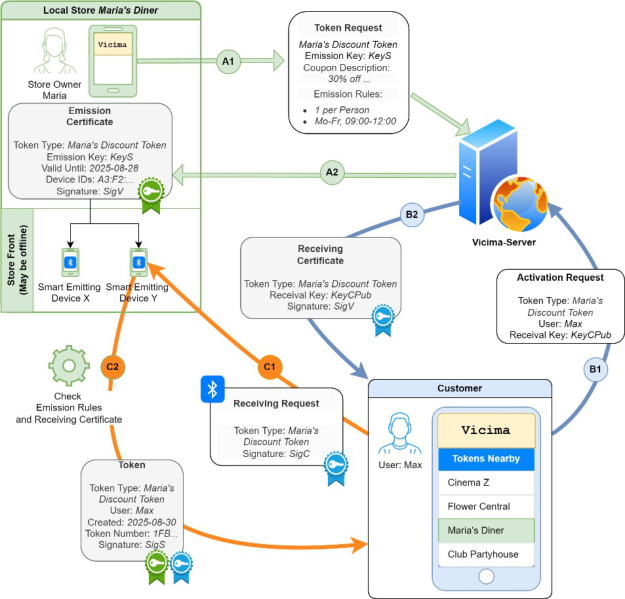
Facing the predominance of online market places like Amazon physical stores are increasingly losing valuable customers. This challenge is particularly acute for smaller business owners who face additional hurdles. Expanding their physical shops into the digital world not only causes labor and marketing costs but also needs to meet various legal requirements. Even then, small shops are easily overshadowed by the vast competition of digital offerings. Due to the pervasiveness of mobile phones and internet usage the pressure on local stores will likely become an increasing thread. In an attempt to counter these effects, concepts like Proximity Marketing have emerged, merging digital technology with locality. A prominent representative is Bluetooth Beacons. Those are typically small devices equipped with Bluetooth Low Energy (BLE) to send a specific data packet using a session-less connection. The data can be used to transmit very specific information related to an actual physical location. However, due to the nature of statically transmitted data, traditional Bluetooth Beacons offer limited variability and lack interactivity between sender and receiver. In particular, they cannot easily tailor information to specific users, as every user in proximity receives the same broadcast. Additionally, interpreting these messages typically requires specialized applications tailored to specific locations, which hinders the widespread adoption of this technology. With Vicima, we introduce a unified solution that consolidates the emission of tailored tokens into a single interactive app. This approach reduces entry barriers for both local businesses and users by leveraging symbiotic effects across different locations. Unlike traditional systems, our smart token system establishes a BLE connection with individual devices. This enables the enforcement of dynamic rules, such as issuing only one token per person within 24 hours or requiring proof of possession of specific previous tokens. By adding these capabilities, the system creates a secure, user-specific interaction layer, addressing key limitations of traditional proximity marketing solutions. Furthermore, the system is designed to support offline functionality for the token emitters. This allows for token emission without a constant network connection, reducing infrastructural requirements for shop owners. The workflow is outlined in Fig. 3, which is divided into three steps (A) Token Request; (B) Activation Request and (C) Receiving Request. The Receiving Request is initiated by a shop owner. It includes a user-defined coupon description, along with its emission locations and emission rules which define the conditions under a Emitting Device is allowed to generate tokens. The Token will then be listed as an for customers within the neighborhood, who can activate the tokens initiating an Activation Request. When the user is nearby a Emitting Device it can send a Receiving Request locally. Using the generated Receiving Certificate followed by the Activation Request, the user can prove to the Device that they interacted with the App and are allowed to receive a the specific token. The Emitting Device will then check the Emission Rules and create a unique Token tailored to the user. This Token is signed using the Key proven by the Emission Certificate issued by the Token Request.The described workflow allows for the emission of verifiable, unique tokens while enforcing customer-tailored rules in an offline scenario. This lowers the entry barrier for shop owners, providing them with a digital presence and increasing the visibility of small shops within a relevant group of nearby customers, all in a frictionless system.
Facing the predominance of online marketplaces like Amazon physical stores are increasingly losing valuable customers. This challenge is particularly acute for smaller business owners who face additional hurdles. Expanding their physical shops into the digital world not only causes labor, marketing costs1 and knowledge but also needs to meet various legal requirements like the Digital Services Act2. Even then, small shops are easily overshadowed by the vast competition of digital offerings (Coniq, 2021). This becomes an increasing threat due to the pervasiveness of mobile phones and internet usage.
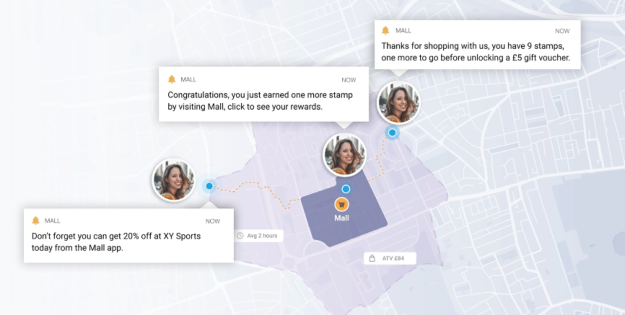
In an attempt to counter these effects, concepts like Proximity Marketing have emerged, merging digital technology with locality (Muddinagiri et al., 2020; Lin et al., 2022). With the use of short-range data transmission technologies, personalized messages, advertisements and even discounts can be delivered to nearby customers. This can motivate them to ignore offers from competitor brands (Coniq, 2021), repeat visits to the store or to take advantages of recently launched offers and discounts, as shown in Fig. 1. At the same time, the shops gather more information about the needs, wishes and preferences of their customers and thus offer them more specific and individualized products and services, which increases trust, loyalty 1https://luisazhou.com/blog/small-business-marketing-statistics/ 2https://eur-lex.europa.eu/eli/reg/2022/2065/oj
and income3. Thanks to the short distances, more precise advice, faster customization and repairs are also possible, as well as facilitating the placing of orders (Coniq, 2021; Shende et al., 2017).
Figure 1: Example of a mall offering local discounts and special offers to local customers (Coniq, 2021).
RESEARCH RESULTS ON PROXIMITY MARKETING Companies exist in a wide spectrum of sizes, from small, one-person stores to medium-sized, family-owned businesses with regional coverage up to large multinational enterprises. Although they all contribute to the economy and serve their customers, they operate in a variety of ways and face different challenges. Main differences relate to their organizational structure, their financial, personnel and technological resources, their decision-making processes and their market reach. Huge companies like Amazon, Alibaba or Tesco operate marketing and customer analytics departments with large budgets, a high number of employees and massive use of technology with a wide range to reach their often volatile consumer group. Smaller companies do not have such resources but are more flexible in adapting opportunities and in building more lasting personal and local relationships with their customers. Due to a lack of human, financial and technical resources, however, they cannot fully exploit these advantages. These small and medium-sized companies usually recruit their customers in their proximal environment through a mixture of direct communication, basic digital marketing and engagement in the local community (Lin et al., 2022). This includes phone calls, emails and face-to-face meetings as well as simple advertisements on billboards, Facebook or Instagram. Their presence, as sponsors of local sports clubs or cultural events, for example, is another way of raising awareness of the company and contact to potential customers. These direct connections and local presence also strengthen mutual trust. (Manthey et al., 2022). On the other hand, gaining visibility via channels
Smart Tokens for Proximity Marketing and Supply Chain Tracking - Vicima 59
such as social media is limited to a small customer group and is primarily aimed at customers who are already in active contact with the local business.
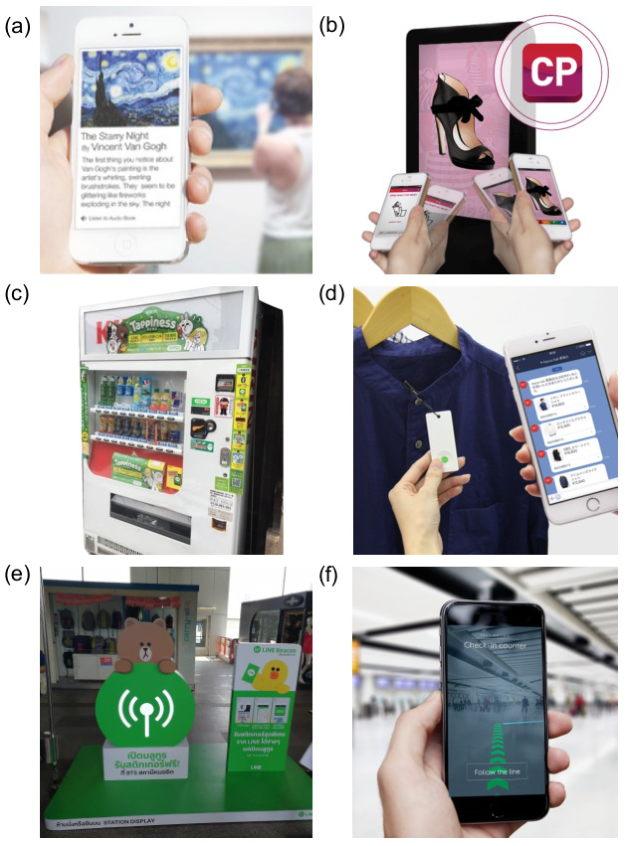
Technological advances in the field of wireless communication, such as WLAN, Bluetooth, ZigBee also provide new possibilities for services (Gomez and Paradells, 2010; Collotta and Pau, 2015), augmented reality systems (Lomas, 2017), indoor navigation (Gast, 2014), device-to-device communication4,5, establishing contacts (Jeon et al., 2018), advertising (Coniq, 2021) and payment (Zaim and Bellafkih, 2016). Examples of this are Bluetooth Beacons (Jeon et al., 2018) which are typically small devices equipped with Bluetooth Low Energy (BLE)6 to send a specific data packet using a session-less connection. The data can be used to transmit very specific information related to an actual physical location, as shown in Fig. 2.
In this way, potential customers in the vicinity can be advertised, navigated to the store and rewarded with a discount when they enter. The greater spatial accuracy of positioning using BLE beacons compared to other technologies such as GPS or WiFi also allows the customer to be tracked and guided along the various sections and shelves (Faragher and Harle, 2015; Pugaliya et al., 2017). One application therefore involves attaching beacons to objects such as billboards or signs. If customer approaches close enough to them, they are able to receive additional information and start active interactions. In contrast to technologies such as near-field communication (NFC), the distance between the beacon and the customer can be sufficiently large than 20 cm, so that the customer does not have to spend time searching for it. Printed QR codes, on the other hand, require a sufficient minimum size to be located and recognized by reading apps. In addition, they are not able to actively contact potential customers. Another application involves attaching the beacons to moving objects such as vehicles or packages. In these areas, the object often moves towards the reader, for example to pay the toll for road use, to pay at a petrol station, to serve as an admission ticket or as a key for the apartment door (Thompson, 2014).
Small and medium-sized companies supporting a local cultural event, for example, can place advertisements equip with beacons and provide visitors with specialized offers, recommendations and discounts for their store. They can send special offers to regular customers or reward them with exclusive offers if they visit regularly and use beacons to automatically track visits and purchases without customers having to scan a QR code or enter details manually.
However, control and personalization of these offers is either dependent on the beacon having a network connection, which loads customer-specific information from the company. Or an unconnected beacon only provides general information and the customer’s reader app must redirect to the company’s specific offers via its network connection, which is not always the case. Furthermore, the discount information from a smartphone can be transmitted to others and used without them having attended the cultural 4https://developers.google.com/nearby 5https://developer.apple.com/ibeacon 6https://www.bluetooth.com/specifications
event, for instance. Further manipulation of the data, the forwarding of customers to fraudulent offers or the capture of customer data are also possible and can only be prevented to a limited extent (Kolias et al., 2017; Pallavi and Narayanan, 2019).
Figure 2: Examples of BLE-based beacons providing services for (a) An exhibition at the Guggenheim Museum. (b) Augmented reality extension of products7. (c) Digital payment at drink vending machine8. (d&e) Advertisement and promotion with pull- notifications. (f) Augmented reality for indoor navigation and assistance services (Jeon et al., 2018).
Smart Tokens for Proximity Marketing and Supply Chain Tracking - Vicima 61
DESIGN & REALIZATION The characteristic of conventional beacons to transmit static data offers only limited variability and makes interaction between transmitter and receiver difficult. In particular, they are not easily able to tailor information to specific users, as every user in the vicinity receives the same transmission. Several services also require the interpretation of this information by specific applications, which are tied to specific manufacturers and functions, but also prevent the broad acceptance of this technology. With Vicima, we introduce a unified solution which combines the distribution of customized tokens into a single interactive app, reducing resource requirements as well as entry barriers for both local businesses and users, as shown in Fig. 3. Our smart token system doesn’t use broadcast to distribute information but establishes a BLE connection with individual devices. This enables the enforcement of dynamic rules, such as issuing only one token per person within 24 hours or requiring proof of possession of specific previous tokens. By adding these capabilities, the system creates a secure, user-specific interaction layer. Furthermore, the system is designed to support offline functionality allowing token emitters without a constant network connection, reducing infrastructural requirements for shop owners.
The workflow shown in Fig. 3 is divided into three sections. At first (A), a Token Request is carried out. Hereby, the store owner defines its offer, emission locations and certain rules for their fulfilment as well as a description for the customer. Transferred to the Vicima-Server, extended with metadata of the Vicima-service and digital signed, the final Emission Certificate can be distributed to different emitters afterwards, which grants them the permission to issue certain tokens. In section B, a customer encounters an interesting entry in the list of available tokens and submits an Activation Request for it. If it is set up accordingly, the customer automatically makes these requests for all tokens in a selected region. Again, extended with metadata and digital signed a Receiving Certificate is issued, which authorizes the receipt of tokens.
When the customer is in the vicinity of an Emitting Device, it can send a local Receiving Request. With the generated Receiving Certificate, the customer can prove to the device that it is in contact with an authorized customer allowed to receive a specific token. The emitting device verify the emission rules and creates a unique token tailored to the customer.
This Token is signed with the key that is documented by the emission certificate issued by the token request. The process and the signatures ensure compliance with the specified rules, so that a token presented in the store leads to the execution of the offer. This workflow allows the emission of verifiable, unique tokens while enforcing customer-tailored rules in an offline scenario where only the emitting device and the smartphone can communicate with each other. With this, store owners only require minimal technical resources in the form of emitting devices but can increase their digital presence and visibility within their local region and targeted audience.
The implementation is based on a client-server architecture. This involves using the Flutter framework9 with the Dart programming language10 for the frontend to provide a uniform user interface for various smartphone platforms. The backend on the server is implemented using the widely used and well-known open-source web framework Django11 with the Python programming language12 and the widely distributed, advanced and scalable relational database management system PostgreSQL13 for data storage and an empirical study was conducted on the effectiveness, user-friendliness, the boundary conditions of its practical applicability and its potential for improvement.
Figure 3: Workflow of token creation and emission with actors and corresponding processes store (Green), user (User) and Vicima (Orange) service.
CONCLUSION
The drawbacks of small and medium sized businesses were explained as well as the capabilities of proximity marketing that are beneficial to them. The presented solution address requirements like offline capability, 9https://flutter.dev/ 10https://dart.dev/ 11https://www.djangoproject.com/ 12https://www.python.org/ 13https://www.postgresql.org/
Smart Tokens for Proximity Marketing and Supply Chain Tracking - Vicima 63
resistance against manipulation and replays as well as cost efficiency. Further developments will focus on improvements of the user interface, the acceleration of data transfer between beacons and smartphones. Further extensive evaluation of the system and the app with more participants and additional realistic user processes will uncover potential for improvement.
REFERENCES
Collotta, M. and Pau, G. (2015). A novel energy management approach for smart homes using bluetooth low energy. IEEE Journal on Selected Areas in Communications, 33(12):2988–2996. Coniq (2021). Why proximity marketing is the future of customer engagement for
retail. Technical report. Faragher, R. and Harle, R. (2015). Location fingerprinting with Bluetooth low energy beacons. IEEE Journal on Selected Areas in Communications, 33(11):2418–2428. Gast, M. S. (2014). Building applications with IBeacon: Proximity and location
services with bluetooth low energy.” O’Reilly Media, Inc.”. Gomez, C. and Paradells, J. (2010). Wireless home automation networks: A survey of architectures and technologies. IEEE Communications Magazine, 48(6):92–101. Jeon, K. E., She, J., Soonsawad, P., and Ng, P. (2018). Ble beacons for internet of
things applications: Survey, challenges and opportunities. IEEE Internet of Things Journal, p. 1. Kolias, C., Copi, L., Zhang, F., and Stavrou, A. (2017). Breaking ble beacons for fun but mostly profit. In Proceedings of the 10th European Workshop on Systems Security, EuroSec’17, pages 1–6, New York, NY, USA. ACM. Lin, M. Y.-C., Nguyen, T. T., Cheng, E. Y.-L., Le, A. N. H., and Cheng, J. M.
S. (2022). Proximity marketing and bluetooth beacon technology: A dynamic mechanism leading to relationship program receptiveness. Journal of Business Research, 141:151–162. Lomas, N. (2017). Gatwick airport now has 2, 000 beacons for indoor navigation.
A: TechCrunch, 25. Manthey, R., Vogel, R., Schmidsberger, F., Baumgart, M., Roschke, C., Ritter, M., and Vodel, M. (2022). Blockchain based social commitment-secure & reliable web services. In International Workshop on Metrology for Living Environment (MetroLivEn), pages 101–104, New York, NY, USA. IEEE. Muddinagiri, R., Ambavane, S., Jadhav, V., and Tamboli, S. (2020). Implementation
of proximity marketing leveraging bluetooth low energy. In 2020 International Conference on Electronics and Sustainable Communication Systems (ICESC), pages 608–612. Pallavi, S. and Narayanan, V. A. (2019). An overview of practical attacks on ble based iot devices and their security. In 5th International Conference on Advanced Computing & Communication Systems (ICACCS), pages 694–698. IEEE. Pugaliya, R., Chabhadiya, J., Mistry, N., and Prajapati, A. (2017). Smart shoppe
using beacon. In 2017 IEEE International Conference on Smart Technologies and Management for Computing, Communication, Controls, Energy and Materials (ICSTM), pages 32–35.
Shende, P., Mehendarge, S., Chougule, S., Kulkarni, P., and Hatwar, U. (2017).
Innovative ideas to improve shopping mall experience over e-commerce websites using beacon technology and data mining algorithms. In 2017 International Conference on Circuit, Power and Computing Technologies (ICCPCT), pages 1–5. Thompson, D. (2014). ibeacon auto: Your car is a beacon. Zaim, D. and Bellafkih, M. (2016). Bluetooth low energy (ble) based geomarketing system. In 2016 11th International Conference on Intelligent Systems: Theories and Applications (SITA), pages 1–6.
LISTED IN THE AHFE DIGITAL BOOKSTORE CATALOGUE
Explore the complete digital volume
Human Factors, Business Management and Society
Read this individual research paper free through the original publisher, or explore the full digital proceedings book.
ISBN 978-1-964867-52-6
Explore this ISBN in the AHFE Bookstore ↗Listed in the July 2026 bookstore catalogue; search by ISBN to confirm current availability · Digital book purchase optional