Agnese Azzola, Venanzio Arquilla, Lucia Rampino (2026). User Experience Assessment for Smart Products in IoT Environments: A Systematic Review. In: Human Interaction and Emerging Technologies (IHIET 2026). AHFE Open Access, vol. 236, pp. 378–388. https://doi.org/10.54941/ahfe1008113
Smart products are increasingly embedded in everyday environments. Unlike traditional interactive systems, they operate across multiple touchpoints, involve multiple users simultaneously, and evolve over time through software updates, adaptive algorithms, and changing ecosystems. As a result, UX with smart products is shaped not only by task performance and usability but also by long-term processes of appropriation, agency calibration, and carry specific associated values and concerns. Despite this complexity, it remains unclear how current UX assessment methods account for these characteristics.This paper presents a systematic literature review investigating how UX has been evaluated in the context of smart and IoT products. Following PRISMA 2020 guidelines, 44 studies covering the last decade were selected from Scopus, ACM Digital Library, and Web of Science. The review identifies a persistent mismatch between the complexity of smart product experience and dominant evaluation practices. The contribution aims, on one side, at extracting methodological directions and, on the other, at conceptual reframing to shift evaluation practice: moving beyond the assessment of mere usability, and considering agency and control dynamics, as well as multi-user and multi-touchpoint dimensions.
The term “smart product” encompasses connected and intelligent products, ranging from smart home devices to wearables, voice/conversational assistants, and larger-scale smart product-service systems. As the term carries some definitional ambiguity and covers many categories, we refer here to products that can be connected, equipped with sensors and actuators that enhance their capabilities compared to their traditional counterparts (Porter & Heppelmann, 2014), powered by algorithms of varying sophistication (Raff et al., 2020) and featuring natural interaction modalities such as voice user interfaces (Mühlhäuser, 2008).
Despite the continuous growth of their market, framing user experience (UX) with these products remains a debated topic, due to the complexity they introduce in the interaction, both relative to their traditional counterparts
User Experience Assessment for Smart Products in IoT Environments 379 and to established human-computer interaction (HCI) paradigms, which historically developed around websites and apps designed for desktop and smartphones (de Souza et al, 2020; Hidalgo et al., 2022).
In terms of interaction, smart products and ecosystems are multi-touchpoint, multi-user, and multimodal: one can interact through different interfaces typologies such as touchscreens or vocal user interfaces (VUI), and multiple people can control products from different devices and locations (Capdevila et al., 2021; Kocaman et al., 2025; Oygur Ilhan et al., 2024; Weber & Ludwig, 2020). Taking the smart home as an example, interaction with products extends beyond the walls of the home at different moments of the day (remote control through apps being a clear example) and a voice assistant can be a mediator for home control.
The pattern of usage is not linear: smart products change over time. They evolve through software updates, and in some cases through AI-driven adaptive learning, and the ecosystem in which they are embedded also evolves (Arquilla & Vitali, 2016).
Finally, in terms of associated values, these paradigm shifts also affect the reasons for purchase, which may be driven by curiosity toward novelty, optimization goals such as energy efficiency or resource saving, or lifestyle. They can also raise concerns around privacy, data transparency, and trust in technological efficacy (Melo et al., 2022; Woźniak et al., 2023).
And yet the methods and frameworks used to evaluate them have long been called to adapt, with several proposals emerging but without reaching real consolidation or widespread application (Ntoa, 2024). As early as 2015, Väänänen-Vainio-Mattila et al. noted that UX research in ubiquitous computing had been “investigated in rather lightweight ways”, dominated by basic usability evaluations, ratings collected through simple predetermined scales, and general experience summaries. Ten years later, it is worth asking: what has changed, and in which direction?
This study aims to answer this question through a systematic literature review that maps how UX assessment of these products has been approached over the last decade. The review provides a systematic mapping of the methods, frameworks, and UX dimensions used to evaluate smart products and identifies the methodological and conceptual gaps specific to this product category. Finally, extracting shared directions from the literature, we propose a systematisation of gaps and practical recommendations for shifting the evaluative paradigm, articulated across two levels: methodological considerations and conceptual reframing.
The research questions guiding the literature review are: RQ1: Which methods, tools, and frameworks are used to assess UX in smart products and systems?
RQ2: Which UX dimensions, constructs are specifically evaluated? RQ3: What gaps and limitations exist in applying current UX assessment methods to smart products and systems?
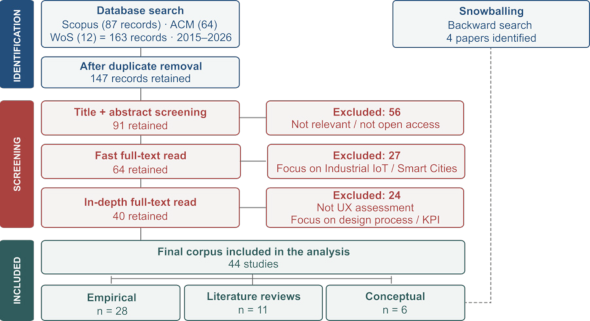
ANALYSIS This review follows the PRISMA 2020 guidelines for systematic literature reviews. The search was conducted across Scopus, ACM Digital Library, and Web of Science, considering publications from 2015 to 2026. The query combined terms related with smart products and IoT ecosystems with keywords as “ux evaluation” OR “ux assessment”.
Figure 1: Screen process using prisma model.
The corpus comprises three study types: empirical studies, systematic literature reviews, and theoretical or conceptual contributions.
Data extraction was structured around the following schema: Study Type, Product Category, Assessment Method(s), Study Setting, Temporal Frame, UX Dimensions assessed, Key Contribution, and Limitations or Gaps Identified.
The corpus covers four product categories. Smart home systems represent the largest group (n = 20), followed by cross-category or generic IoT ecosystems (n = 14). Conversational and voice assistants form a methodologically distinct cluster, characterised by specific interaction paradigms and UX dimensions (n = 6). Wearables constitute the smallest group (n = 4).
Methods
The first part of the analysis answers the first research question, analysing only the part of the corpus that represent empirical studies (n = 28). Assessment methods are understood as the tools and procedures through which researchers collect empirical evidence about users’ experience. In particular, how, where and in which time frame the data per collected.
Figure 2: Assessment methods, settings and temporal frames of the selected corpus.
User Experience Assessment for Smart Products in IoT Environments 381 Method combination is frequent across the corpus and reflects a deliberate strategy to capture the nuanced complexity of smart product experience. Despite the recurrently noted need for constructs tailored to IoT and AI products, standardised questionnaires remain the most common assessment instrument (Choma & Zaina, 2024). Interviews are widely used alongside them, providing qualitative depth that scales alone cannot offer. A growing approach is the analysis of user-generated content (as online reviews, forum discussions, social media posts) which allows access to large volumes of naturalistic user opinions without recruiting participants (Du et al., 2022). There are also early attempts to adapt heuristics specifically to IoT products (Almeida et al., 2018; Orehovački et al., 2018 Sciannamè & Spallazzo, 2023). A widely highlighted but still underexplored opportunity is the use of connected product usage data: studies show that many companies collect interaction logs but lack the methodological infrastructure to leverage them for UX evaluation (Bergman et al., 2018; Choma & Zaina, 2024; Mechant et al, 2018), and where data-driven approaches are adopted, researchers consistently recommend combining them with qualitative methods to recover the why behind the numbers (Khanshan et al., 2023).
Laboratory settings remain the most common study context, encompassing both simulated environments and controlled spaces where participants interact with devices outside their natural use context. The literature is consistent, however, in highlighting this as a significant limitation for ecological validity: in situ evaluation allows researchers to observe how a system is used in its real environment, capturing contextual factors (e.g. social dynamics, competing tasks, domestic routines) that controlled settings structurally exclude (Ntoa, 2024; Jakobi et al., 2017). This concern is particularly acute for smart home appliances, where the home itself is both the use context and a key variable (Chamunorwa et al., 2025; He et al., 2026).
Regarding temporal frames, the most common approach is retrospective: studies recruit existing users and ask about their cumulative experience through interviews, surveys, or user-generated content analysis such as review mining. Many studies also capture momentary experience, typically through in-session testing or immediate post-use feedback. A growing trend is mixed temporal design, combining multiple frames within a single study, which several contributions explicitly recommend as more adequate for smart products. Longitudinal studies, covering multiple weeks or months of real use, remain a minority, yet their relevance for this domain is widely acknowledged: key aspects of smart product experience such as appropriation, trust calibration, and adaptation to domestic routines cannot be captured at a single point in time (Melo et al., 2022). Anticipated studies, focused on pre-use expectations, represent a smaller share and are predominantly qualitative in nature.
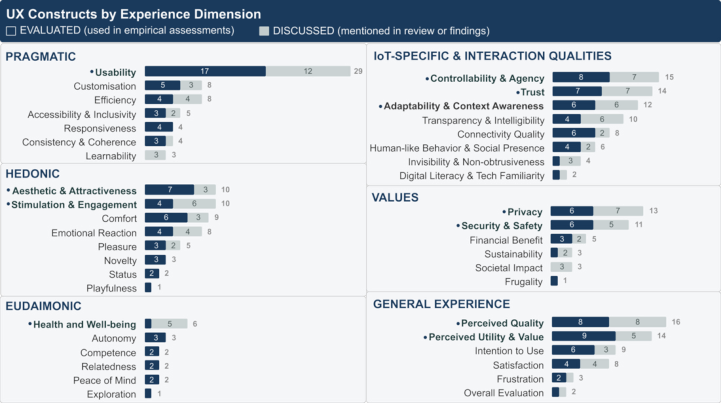
Dimensions and Constructs Addressing the second research question, the analysis examined which UX dimensions are evaluated across the corpus, distinguishing between dimensions directly used in studies (evaluated) and those identified as relevant in gap statements, theoretical frameworks, or recommendations (discussed).
The constructs identified in the literature were organised into macro- dimensions of user experience. Most studies focused on the pragmatic qualities of products, with usability being by far the most frequently assessed construct across the corpus.
Interestingly, hedonic and eudaimonic qualities were also considered, though to a lesser extent. Studies addressed the stimulation and aesthetic value provided by technology, and a growing interest in users sense of autonomy, health and psychological wellbeing was observed in more recent work.
A separate cluster of constructs served a more general evaluative function, assessing whether the overall experience was positive or negative, including satisfaction, intention to use, and focusing on the perceived value, with perceived quality and perceived utility.
Some studies also attempted to capture IoT-specific dimensions: among these, controllability and sense of agency were strongly predominant, trust and transparency were also emerging, and a series of constructs related to social presence or the quality of human-like behaviour reflected the relational nature of smart product interactions.
Finally, a growing attention to user values was observed, with privacy standing out as one of the most discussed topics across the corpus, followed by safety.
Figure 3. UX Dimensions, divided in clusters of constructs that were either evaluated in empirical studies or discussed in theoretical contributions.
DISCUSSION
The literature reveals evident patterns, presented here as: 1) methodological considerations for UX assessment with smart products; 2) indications for reframing the conceptualisation of UX with smart products.
User Experience Assessment for Smart Products in IoT Environments 383 Methodological Considerations
A recurring theme across the corpus is the inadequacy of existing UX assessment tools for the specificity of smart and IoT products. A set of shared and concrete methodological directions emerged.
Ecological validity: setting and time frame. The predominant study context remains the laboratory for studies concerning users observation. The literature is consistent in flagging this as a structural limitation, particularly acute for smart home products. Chamunorwa et al. (2025) note how a laboratory setting reduces ecological validity as “it does not accurately reflect the complexity of a real home environment, where users often engage in multiple activities, and social and contextual factors impact their interactions,” and identify a longitudinal in-home study as the necessary next step. Woźniak et al. (2023) observed how a contextual inquiry with long-term observation surfaces the emergence of differentiated user roles (e.g, SH-Administrator, Active User, Passive User) that only crystallise over extended use and shape the entire social ecology of the household’s interaction with the system.
The dominant temporal approach in the corpus is retrospective or episodic: existing users are recruited and asked about their cumulative experience through interviews and surveys, or they are provided such questionnaires after a single interaction. These approaches capture UX at a single point in time, but not its evolution. Melo et al. (2022) identify long-term UX evaluation as one of the three main open challenges in IoT research, arguing that the constructs most relevant to smart product experience shift in ways that single-point measurements cannot capture. A temporally extended study covering at least the phases of initial appropriation, routinisation, and reconfiguration appears necessary. Studies could cover anticipated UX by capturing expectations before use, episodic UX by checking in with users periodically, momentary UX by collecting in-situ feedback during interaction, and cumulative UX by reflecting on the overall experience at the end (Hidalgo et al., 2022).
Source triangulation: quantitative data and qualitative depth. A second direction concerns the data sources themselves. Literature increasingly signals the opportunity of integrating the usage data that connected products generate automatically. Nevertheless, companies producing such products still often lack the capability to effectively use the usage logs generated by them, suggesting the need not only for tools but first for an interpretative lens and methodological framework. IoT-developing companies, often collect large volumes of interaction logs but use them almost exclusively as anomaly indicators, “as either confirmatory or as a warning that something is wrong” (Bergman et al., 2018).
The use of product data alone, however, is consistently described as insufficient. Different method surface different UX factors, and that the full spectrum of smart product experience only becomes visible when multiple approaches are combined (Jang et al., 2016). A direction for further investigation should be designing studies in which quantitative and qualitative data are structured to be mutually informative.
Combining sensor and log data with qualitative methods such as interviews or walkthroughs produces a more accurate understanding than either source
alone (Khanshan et al., 2023; Mechant et al., 2018): logs reveal objective behavioural patterns that participants do not spontaneously report, while interviews explain the reasoning behind the numbers, reconstructing the functional meaning users assign to that usage.
A growing body of work proposes user-generated online reviews from platforms such as Amazon, app stores, and Reddit as a methodologically distinct and complementary data source. Its key advantage is access to large volumes of naturalistic user opinions expressed during real, sustained use, without recruiting participants or setting up study conditions. The limitation is that review mining captures primarily post-adoption, often negative experiences, and directs toward extreme opinions, reinforcing that it is most powerful as a complement to, not a replacement for, other methods.
Conceptual Reframing The analytical patterns across the corpus suggest that a more adequate conceptualisation of UX for smart and connected products requires moving beyond the individual-user, temporally static, and primarily pragmatic framing that still dominates assessment practice. Four interconnected conceptual directions emerge from the literature.
Beyond usability: hedonic, eudaimonic dimensions. The predominance of usability in IoT UX assessment is both well-documented and consistently questioned across the corpus. Väänänen-Vainio-Mattila et al. (2015) note that hedonic, emotional, and relational dimensions as pleasure, self-expression, social connectedness, and stimulation are largely absent from ubicomp evaluations, despite being recognised as central to UX. Jang et al. (2016) explored in a mixed-method study how usability-related factors dominate anticipated and first-contact UX, but perceived playfulness, relative salience, and content diversity are the primary predictors of long-term satisfaction. Schenkluhn et al. (2024) add a further layer: in a smart home setup the majority of participants opted for a semi-automatic condition over a fully automatic one, despite the latter being faster and less cognitively demanding, because it preserved a sense of autonomy, competence, and active involvement. Efficiency alone, they conclude, does not determine preference. Not only pleasure and the hedonic dimension, but also eudaimonic dimensions as autonomy, competence and long-term wellbeing need to be explicitly incorporated into evaluation frameworks alongside pragmatic ones (Lin et al., 2022).
Agency and Control as UX dimensions. A dimension that emerges with clarity in smart product research is the quality of the relationship between users and the system’s autonomous behaviour. Users tend not to want a fixed automation level but a dynamic negotiation: they willingly cede full autonomy to devices for routine, low-stakes tasks, but want to be able to re-adjust and override for tasks with emotional consequences (Garg & Cui, 2022).
Furthermore, in smart environment’s crises are not primarily technical failures but conflicts between users’ sense of what is appropriate and what the system does instead (Van Beek et al., 2025). These conflicts may lead users to actively reconfigure the technology, reprogramming, changing material arrangements. The implication for UX assessment is that controllability and intelligibility should be treated not as usability sub-dimensions but as
User Experience Assessment for Smart Products in IoT Environments 385 distinct, IoT-specific constructs: the perceived ability to negotiate, override, and understand the system’s reasoning is a primary driver of long-term experience.
Multi-user dynamics and multi-touchpoint coherence. Smart home research consistently reveals that treating the individual as the unit of analysis is structurally inadequate. Garg and Cui (2022) observe that domestic spaces are “dynamic environments inhabited by multiple people who may share complex relationships and assign different meanings to different spaces,” and that activity, value, and preference conflicts among household members are an expected feature of smart home life rather than an exception. Smart product- service systems involve not only networks of artefacts but also networks of users, in which different users interact with different touchpoints and may simultaneously occupy multiple, shifting roles – e.g., mediator, end-user, service provider – that single-user UX frameworks cannot accommodate (Oygur Ilhan et al., 2024). UX assessment methods need to be designed to capture shared, negotiated, and conflictual dimensions of experience that only emerge when all the actors are taken as the object of inquiry (He et al., 2026).
Finally, literature draws repeated attention to the fragmented nature of smart product interaction across devices, interfaces, and locations. Moving beyond evaluation methods that remain designed for single-interface scenarios is crucial (Capdevila et al., 2021). The conceptual implication is that UX assessment for smart products requires a system-level perspective: experience is not located in a single interaction moment or a single device, but distributed across the ecosystem, over time, and among multiple actors (Choma & Zaina, 2024).
CONCLUSION
This review mapped a decade of UX assessment practice for smart and connected consumer products, synthesising findings from 44 studies across empirical, review, and conceptual contributions. The analysis was structured around two levels: methodological gaps in smart product UX assessment, and gaps in the conceptualisation of smart product UX – meaning constructs and dimensions needed to adequately capture the interaction experience with such products.
The picture that emerges is one of persistent mismatch. The dominant approach to UX assessment has not substantially evolved to reflect the specificities of products that operate continuously, autonomously, and in multi-modal ways. Usability remains the primary assessed dimension, while constructs more specific to the IoT context (agency, transparency, multi-user negotiation, trust, appropriation) are rarely operationalised.
Three interrelated gaps organise the convergent critique in the literature. First, a problem of ecological validity: lab-based evaluation structurally excludes the social, contextual, and temporal factors that shape smart product experience in real homes. Second, a problem of temporal coverage: episodic and retrospective designs cannot capture how experience evolves across appropriation, routinisation, and reconfiguration. Third, a conceptual
bias toward pragmatic dimensions that leaves hedonic, eudaimonic, and IoT- specific constructs underrepresented in evaluation practice.
Addressing these gaps does not require abandoning existing methods but extending and combining them: leveraging the usage data that connected products already generate, integrating longitudinal field designs alongside controlled studies, and treating the household rather than the individual as the unit of analysis where appropriate.
The literature is aligned in highlighting these gaps but is still lacking in developing specific protocols and tools applicable in industry practice (Ntoa, 2024). The directions proposed here is intended as a basis for developing assessment protocols and tools that are more adequate to the complexity of smart product experience.
ACKNOWLEDGMENT
The authors would like to acknowledge the use of LLMs for grammar, syntax, and spelling revision.
REFERENCES
Almeida, R.L.A., Darin, T.G.R., Andrade, R.M.C. and De Araújo, I.L. (2018).
Towards Developing a Practical Tool to Assist UX Evaluation in the IoT Scenario. Anais do XXIV Simpósio Brasileiro de Sistemas Multimídia e Web: Workshops e Pôsteres. Porto Alegre: SBC. Arquilla, V. and Vitali, I. (2016). Designing in the IoT Era: role and perspectives in design practices. In: Proceedings of the 10th International Forum on Design as a Process (IFDP 2016). doi:10.4995/IFDP.2016.3311. Bergman, J., Olsson, T., Johansson, I. and Rassmus-Gröhn, K. (2018). An Exploratory
Study on How Internet of Things Developing Companies Handle User Experience Requirements. In: Mandrioli, D. et al. (eds.) Requirements Engineering: Foundation for Software Quality (REFSQ 2018), LNCS 10753. Cham: Springer. Capdevila, M.G., Saltiveri, T.G., Garrido, J.E., Müller, O.H. and Ruas, L.C. (2021). Do current user testing practices meet the needs of the new interactive paradigms? In: Proceedings of the XXI International Conference on Human Computer Interaction (Interacción ‘21), Article 22. New York: ACM. doi:10.1145/3471391.3471416. Chamunorwa, M., Müller, H. and Boll, S. (2025). Enhancing Smart Home User
Experience: A Study of Everyday Objects for Smart Home Control. Proceedings of the ACM on Human-Computer Interaction, Vol. 9, No. 5, Article pn2917. Choma, J. and Zaina, L. (2024). UX evaluation of IoT-based applications for Smart Cities: a rapid systematic review. Proceedings of the 2024 International Conference on Advanced Visual Interfaces (AVI ‘24). New York: ACM. de Souza, J.C., Brito, M.R.F. and Sampaio, A.L. (2020). Comparing Heuristic
Evaluation and MALTU Model in Interaction Evaluation of Ubiquitous Systems. IHC ‘20: Proceedings of the XIX Brazilian Symposium on Human Factors in Computing Systems, October 26–30, 2020, Diamantina, Brazil. New York: ACM. Du, Y., Liu, D., Morente-Molinera, J.A. and Herrera-Viedma, E. (2022). A data-driven method for user satisfaction evaluation of smart and connected products. Expert Systems with Applications, 210, 118392. doi:10.1016/j.eswa.2022.118392. Garg, R. and Cui, H. (2022). Social Contexts, Agency, and Conflicts: Exploring Critical
Aspects of Design for Future Smart Home Technologies. ACM Transactions on Computer-Human Interaction, 29(2), Article 13.
User Experience Assessment for Smart Products in IoT Environments 387 He, S., Liu, Y., Wang, Z., Xue, X., Zhang, X., Shi, L. and Fu, X. (2026). Designing
with Tensions: Reframing Smart Home Ecosystem UX through In-the-Wild Evidence. Extended Abstracts of the 2026 CHI Conference on Human Factors in Computing Systems (CHI EA ‘26). New York: ACM. Hidalgo, A., Serif, T., Groenli, T.-M. and Ghinea, G. (2022). On User Experience in The Internet of Things. 2022 IEEE International Conference on Internet of Things and Intelligence Systems (IoTaIS). IEEE. Jakobi, T., Ogonowski, C., Castelli, N., Stevens, G. and Wulf, V. (2017). The Catch(es)
with Smart Home: Experiences of a Living Lab Field Study. Proceedings of the 2017 CHI Conference on Human Factors in Computing Systems. New York: ACM. Jang, J., Zhao, D., Hong, W., Park, Y. and Yi, M.Y. (2016). Uncovering the Underlying Factors of Smart TV UX over Time: A Multi-study, Mixed-method Approach. TVX 2016: Proceedings of the ACM International Conference on Interactive Experiences for TV and Online Video, June 22–24, 2016, Chicago, IL. New York: ACM. Khanshan, A., Giling, L., Markopoulos, P. and Van Gorp, P. (2023). A Case Study of
Data-Enabled Design for Cardiac Telemonitoring. Proceedings of the European Conference on Cognitive Ergonomics 2023 (ECCE ‘23), September 19–22, 2023, Swansea, United Kingdom. New York: ACM. Kocaman, Y., Doğrul, F. and Aydoğan, E. (2025). Heuristics Based User Experience Evaluation for Identifying Challenges in IoT Enabled Conversational Agent Design. HAI ‘25: 13th International Conference on Human-Agent Interaction. New York: ACM. Lin, Z., Hall, A. and Sommer, B. (2022). Designing experiences for IoT products: A
case study testing existing UX frameworks. In: Lockton, D. et al. (eds.) DRS2022: Bilbao, 25 June–3 July, Bilbao, Spain. London: Design Research Society. Mechant, P., All, A. and De Marez, L. (2018). Evaluating User Experience in Smart Home Contexts: A Methodological Framework. In: Streitz, N. and Konomi, S. (eds.) Distributed, Ambient and Pervasive Interactions (DAPI 2018), LNCS 10921. Cham: Springer, pp. 91–102. Melo, B., Andrade, R. and Darin, T. (2022). Longitudinal User Experience Studies
in the IoT Domain: a Brief Panorama and Challenges to Overcome. IHC ‘22: Proceedings of the 21st Brazilian Symposium on Human Factors in Computing Systems, October 17–21, 2022, Diamantina, Brazil. New York: ACM. Mühlhäuser, M. (2008). Smart Products: An Introduction. In: Mühlhäuser, M., Ferscha, A. and Aitenbichler, E. (eds.) Constructing Ambient Intelligence. AmI 2007, Communications in Computer and Information Science, vol. 11. Berlin: Springer, pp. 158–169. doi:10.1007/978-3-540-85379-4_20. Ntoa, S. (2024). Usability and User Experience Evaluation in Intelligent Environments:
A Review and Reappraisal. International Journal of Human–Computer Interaction, 41(4). Orehovački, T., Plantak Vukovac, D., Džeko, M. and Stapić, Z. (2018). Evaluating Relevant UX Dimensions with Respect to IoT Ecosystem Intended for Students’ Activities Tracking and Success Prediction. In: Zaphiris, P. and Ioannou, A. (eds.) Learning and Collaboration Technologies (LCT 2018), LNCS 10924. Cham: Springer, pp. 279–293. Oygur Ilhan, I., Chen, Y. and Epstein, D.A. (2024). Analyzing user experience with a
smart product-service system: Children-owned wearables. In: Gray, C. et al. (eds.) DRS2024: Boston, 23–28 June, Boston, USA. London: Design Research Society. Porter, M.E. and Heppelmann, J.E. (2014). How Smart, Connected Products Are Transforming Competition. Harvard Business Review, 92(11), pp. 64–88.
Raff, S., Wentzel, D. and Obwegeser, N. (2020). Smart Products: Conceptual Review, Synthesis, and Research Directions. Journal of Product Innovation Management, 37(5), pp. 422–447. doi:10.1111/jpim.12544. Schenkluhn, M., Knierim, M.T., Kiss, F. and Weinhardt, C. (2024). Connecting Home:
Human-Centric Setup Automation in the Augmented Smart Home. Proceedings of the 2024 CHI Conference on Human Factors in Computing Systems (CHI ‘24), May 11–16, 2024, Honolulu, HI. New York: ACM. Sciannamè, M. and Spallazzo, D. (2023). AIXE. Building a scale to evaluate the UX of AI-infused products. IASDR 2023: Proceedings of the International Association of Societies of Design Research, 9–13 October 2023, Milan. doi:10.21606/ iasdr.2023.355. van Beek, E., Giaccardi, E., Boess, S. and Bozzon, A. (2025). The everyday enactment
of interfaces: a study of crises and conflicts in the more-than-human home. Human–Computer Interaction, 40(1–4), pp. 221–248. Väänänen-Vainio-Mattila, K., Olsson, T. and Häkkilä, J. (2015). Towards Deeper Understanding of User Experience with Ubiquitous Computing Systems: Systematic Literature Review and Design Framework. In: Abascal, J. et al. (eds.) INTERACT 2015, LNCS 9298. Cham: Springer, pp. 384–401. Weber, P. and Ludwig, T. (2020). (Non-)Interacting with Conversational Agents:
Perceptions and Motivations of Using Chatbots and Voice Assistants. Proceedings of Mensch und Computer 2020 (MuC ‘20), September 6–9, 2020, Magdeburg, Germany. New York: ACM. Woźniak, M.P., Vöge, S., Krüger, R., Koelle, M., Müller, H. and Boll, S. (2023). Inhabiting Interconnected Spaces: How Users Shape and Appropriate Their Smart Home Ecosystems. CHI ‘23: Proceedings of the 2023 CHI Conference on Human Factors in Computing Systems, April 23–28, 2023, Hamburg, Germany. New York: ACM.
SEARCH THE AHFE DIGITAL BOOKSTORE BY ISBN
Explore the complete digital volume
Human Interaction and Emerging Technologies (IHIET 2026)
Read this individual research paper free through the original publisher, or explore the full digital proceedings book.