Rafael De Pinho Andre, Almir Fonseca, Lucas Westfal, Matheus De Carvalho, Gustavo Dos Santos, Henrique Beltrão (2025). Rethinking Assessment: The Body as a Compass for Understanding. In: Training, Education, and Learning Sciences. AHFE Open Access, vol. 193, pp. 152–159. https://doi.org/10.54941/ahfe1006656
This research investigates the potential of utilizing sitting posture as a novel indicator of engagement and focus in different activities. Recognizing that even subtle shifts in how we sit can reflect our cognitive and emotional states, this study employs a sensor fusion IoT platform embedded within a chair to capture detailed postural data. By employing both quantitative and qualitative analysis, this research aims to determine if specific sitting postures can reliably correlate to a user's level of focus and attention, and present an alternative approach to assess and understand engagement by providing a non-intrusive, real-time window into an individual's cognitive state.We conducted an experiment to observe participants over a moderate period, between one and two hours, while engaging in either focused studying or passive streaming content consumption. The sensor array continuously monitors and records nuanced changes in sitting posture, including leaning, slouching, shifting, and micro-movements. This high-resolution data is analyzed to identify patterns and variations that correlate with different levels of engagement. To analyze the vast amount of postural data collected, we employed machine learning techniques. This allowed us to classify different sitting postures and identify patterns associated with varying levels of engagement during both studying and streaming activities.Furthermore, the sensor fusion IoT platform employs the collected data to generate a comprehensive report for each participant's sitting period. This report provided a detailed visualization of posture changes over time, highlighting key moments of engagement and disengagement, and offering insights into individual patterns of behavior. These personalized reports have the potential to be valuable tools for self-reflection and behavioral modification, allowing individuals to gain a deeper understanding of their own focus and attention patterns.
In educational and cognitive performance contexts, attention and engagement are critical determinants of learning outcomes and task success. The ability to maintain focus not only influences short-term productivity but also has long-term implications for knowledge retention, skill acquisition, and overall academic achievement. Particularly in tasks that span medium to long durations — such as studying, reading, or content consumption
Rethinking Assessment: The Body as a Compass for Understanding 153
— sustained engagement can be the differentiating factor between surface- level performance and deep cognitive processing. As modern educational environments evolve to become more hybrid and self-regulated, the demand for accurate, real-time engagement assessment tools continues to grow.
Traditional methods for assessing engagement, such as self-reports, behavioral observations, and performance metrics, often fall short in capturing the dynamic and subtle fluctuations in attention that occur during prolonged activities. These methods are either retrospective, intrusive, or lack the granularity needed to inform timely interventions. This limitation has opened new avenues for research that seek non-intrusive, continuous, and personalized approaches to understanding cognitive states.
Recent developments in sensor technology, particularly in the realms of wearable and ambient sensing, have made it possible to passively monitor physiological and behavioral signals that correlate with cognitive and emotional engagement. Among these signals, sitting posture has emerged as a promising yet underexplored indicator. Subtle shifts in how individuals sit — leaning, slouching, fidgeting, or readjusting — may reflect underlying fluctuations in mental states. When captured and analyzed through a combination of pressure, distance, and motion sensors embedded in a smart chair, these postural variations can offer valuable insights into engagement levels.
Sensor fusion plays a pivotal role in this process, allowing multiple data streams to be integrated and interpreted within a cohesive framework. By combining inputs from pressure mats, infrared distance sensors, and inertial measurement units, a richer and more accurate representation of posture and movement is achieved. When paired with machine learning algorithms capable of classifying posture patterns and predicting engagement levels, these systems can transition from passive data collectors to intelligent tools for behavioral assessment and intervention.
The present research explores the potential of using sitting posture as an indicator of attention and engagement. Through an IoT-enabled smart chair platform and advanced analytical methods, this ongoing study investigates whether specific postural configurations and transitions can reliably correlate with focus during cognitively demanding versus passive tasks. While the initial experiment focuses on short-term monitoring over sessions of one to two hours, the long-term vision of this research lies in developing a longitudinal understanding of students’ engagement patterns.
Such a longitudinal approach — monitoring posture-based engagement over weeks or months — holds immense potential. It could reveal consistent behavioral trends, identify at-risk students before performance drops occur, and support the creation of personalized learning strategies grounded in embodied cognition. By treating the body as a compass, this research not only reimagines how we assess engagement but also contributes to a growing interdisciplinary effort to align physical behavior with cognitive and emotional states in educational and workplace environments.
LITERATURE REVIEW
Understanding the relationship between sitting posture and cognitive engagement has been the focus of numerous studies, particularly with the advancement of sensor technology. Researchers have sought to develop non-intrusive systems that can effectively classify postures, provide insights into user behaviour, and offer real-time feedback to enhance engagement and ergonomic health. This review highlights key research contributions in sitting posture monitoring, sensor fusion technologies, and the application of machine learning in engagement assessment.
Sitting Posture Monitoring Technologies The development of smart seating systems has significantly improved posture recognition and classification accuracy. Mota and Picard (2003) introduced an early approach using pressure sensor matrices to classify nine different postures and infer engagement levels in a learning environment. The study demonstrated that dynamic posture transitions provide valuable insights into cognitive states, achieving an accuracy of 82.3% for engagement classification using Hidden Markov Models (HMMs). Their findings underscored the importance of movement patterns rather than static posture alone, laying the foundation for future adaptive learning systems. Similarly, Meyer et al. (2010) developed a textile-based capacitive pressure sensor that reduced measurement error and achieved an 82% classification accuracy, making it a feasible solution for ergonomic and health-monitoring applications.
Further advancements in sensor integration have led to improved posture classification performance. Jeong and Park (2021) introduced a mixed- sensor smart chair system that combined force-sensitive resistors (FSRs) and infrared distance sensors, significantly enhancing classification accuracy to 92% compared to 59% for pressure-only systems. Their study reinforced the potential of multimodal sensing approaches to detect a broader range of postures with greater precision. Tan et al. (2001) proposed a similar system leveraging pressure distribution sensors and principal component analysis (PCA), achieving 96% accuracy for familiar users. The ability to classify both static and dynamic postures in real time has contributed to the growing adoption of such technologies in office environments, healthcare settings, and learning institutions.
Machine Learning Approaches for Posture Recognition Machine learning techniques have played a crucial role in improving posture classification accuracy. Liu et al. (2019) developed a convolutional neural network (CNN)-based model that classified sitting postures with 95.6% accuracy, outperforming traditional methods such as backpropagation neural networks. This approach demonstrated the advantages of deep learning in recognizing subtle postural variations. Moreover, CNN models provide scalability and adaptability, allowing them to be trained on diverse datasets to enhance generalization across different user populations. Similarly, Ran et al. (2021) employed machine learning techniques in a portable posture monitoring system that classified seven distinct postures to provide real-time user feedback and prevent musculoskeletal disorders.
Rethinking Assessment: The Body as a Compass for Understanding 155
Incorporating machine learning with multimodal data sources has further improved classification robustness. Zhang et al. (2022) introduced a privacy- preserving system that combined infrared array (IRA) and pressure sensors to classify postures without relying on vision-based methods. This method provides an effective and unobtrusive alternative for long-term monitoring, addressing privacy concerns in office environments. The ability to maintain continuous tracking without infringing on user privacy is a critical advantage, particularly in professional and educational settings where surveillance-based approaches may be met with resistance.
Smart Chairs for Posture Correction and Engagement Assessment Beyond classification, several studies have explored the application of smart chairs for posture correction and engagement monitoring. Roossien et al. (2017) examined the effectiveness of a smart office chair equipped with tactile feedback mechanisms, encouraging users to adjust their posture through vibration alerts when sitting duration exceeded a predefined threshold. Their findings suggest that real-time interventions can promote healthier sitting behaviors, reducing the risk of prolonged static postures linked to musculoskeletal discomfort. Huang, Gibson, and Yang (2017) developed a similar system that classified eight standardized postures with 92.2% accuracy, demonstrating its potential in healthcare and human- computer interaction applications. Smart chairs designed for proactive posture correction could serve as vital tools for reducing sedentary-related health risks.
Posture monitoring systems have also been used to assess engagement levels in different activities. Mota and Picard (2003) established that posture dynamics could be linked to engagement levels, providing a foundation for future research in adaptive learning systems. By leveraging posture-tracking technology, instructors and employers can gain deeper insights into user engagement patterns and intervene when signs of disengagement are detected. The integration of pressure sensors and engagement analysis was further expanded by Anwary et al. (2021), who developed a real-time monitoring system that recognizes sitting patterns and alerts users to maintain healthier postures. This approach highlights the potential of posture-based engagement tracking beyond traditional educational applications, extending to workplace productivity and cognitive load assessment.
Future Directions Ongoing research in posture recognition and engagement assessment aims to integrate sensor fusion techniques with adaptive machine learning models to enhance real-time monitoring and feedback mechanisms. Authors suggest that future work will explore predictive modeling of engagement levels based on postural shifts, allowing for more personalized and proactive interventions. Additionally, privacy-preserving sensing methods, such as those proposed by Zhang et al. (2022), are drawing interest from researchers of workplace and educational ergonomics, highlighting the relevance of continuous monitoring without compromising user privacy. Literature suggests that advancements in multimodal sensor fusion and artificial intelligence are driving the development of more intelligent and responsive
seating systems, tailored to improving both ergonomic health and cognitive engagement.
Expanding research efforts focus on refining posture classification algorithms to accommodate individual variations and context-specific behaviors. Additionally, the integration of real-time feedback mechanisms with gamification elements — to enhance user engagement in posture correction strategies — is being explored. Future smart seating systems may incorporate biometric and physiological data, such as heart rate variability and respiration patterns, to offer a more holistic view of user well-being. With continued advancements in wearable technology and IoT-enabled furniture, the next generation of smart chairs could evolve beyond posture monitoring to support broader applications in cognitive performance assessment and personalized work environment optimization.
IoT-Enabled Smart Chair Platform We chose the ErgoPro Office Chair to build our IoT platform, due to its ergonomic features to provide comfort and support. Designed for personalized adjustability, it offers customizable seat height, backrest tilt, and armrest positioning, ensuring an optimal seating posture tailored to each user’s needs. The chair’s breathable mesh fabric not only enhances airflow for long-term comfort but also facilitates seamless integration of multiple sensor types for advanced posture monitoring. This model meets BIFMA, SGS, and NR17 certifications, ensuring durability, safety, and compliance with ergonomic regulations.
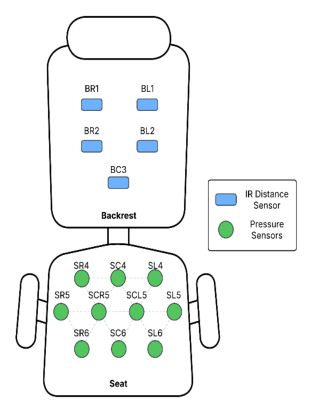
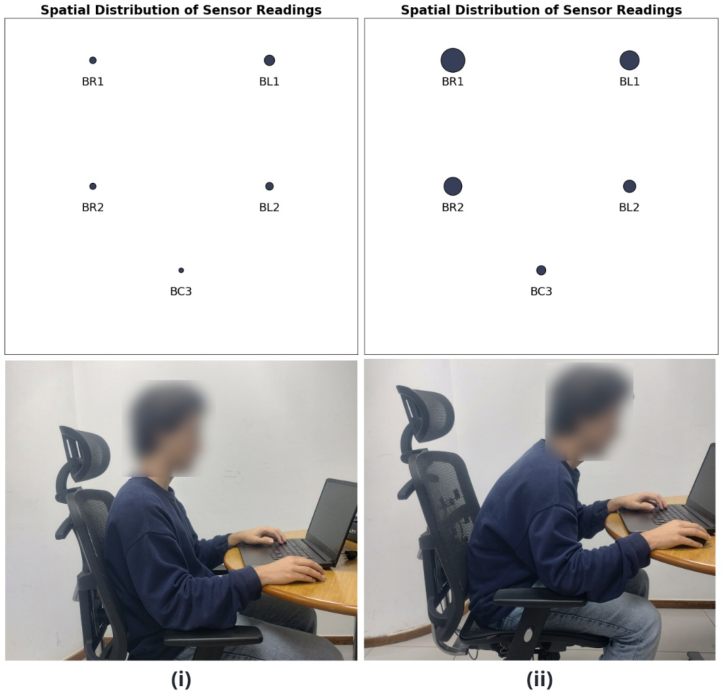
Equipped with infrared (IR) laser sensors and pressure sensors embedded within the mesh backrest and seat, the chair continuously monitors sitting posture. Figure 1 shows the distribution of the back and seat sensors. Figure 2 shows the sensor readings of two user postures.
Figure 1: Sensor distribution in the experimental setup, highlighting the triangular arrangement of the FSRs for pressure mapping, which enhances readings and interpolation.
Rethinking Assessment: The Body as a Compass for Understanding 157
Figure 2: The top row presents two samples of sensor data, where the size of the circles represents the measured distance between the user’s back and the sensors. The bottom row shows the corresponding postures: (i) an upright sitting posture and (ii) a slouched posture.
CONCLUSION AND FUTURE WORK The development and initial testing of the proposed posture monitoring platform have demonstrated its technical feasibility and reliability in capturing detailed sitting behavior. In the first phase of evaluation, the system was tested with six volunteers, each participating in a one-hour data collection session. During these sessions, researchers closely monitored and annotated participants’ actions and sitting positions in real time, allowing for a direct comparison between observed behavior and recorded sensor data.
The analysis of the collected datasets confirmed the correct functioning of the system, with all sensor inputs being consistently recorded and aligned with the manually observed postural changes. This validation step confirms that the sensor fusion infrastructure, data logging processes, and hardware integration are working as intended, providing a solid foundation for future analytical phases of the research.
With the initial technical validation complete, the next stage will involve a medium-term study with 25 participants. This expanded experiment aims to investigate correlations between sitting posture and engagement levels over longer periods and across a broader sample of individuals. The upcoming phase will allow for deeper insights into behavioral patterns, posture variability, and user-specific engagement profiles, contributing to the refinement of machine learning models and the development of personalized feedback systems.
This continued research will be critical for understanding how physical behavior can serve as a window into cognitive states, further supporting the central hypothesis that the body — through posture — can act as a compass for engagement and attention.
ACKNOWLEDGMENT
The authors would like to acknowledge the support provided by the Programa Institucional de Bolsas de Iniciação Científica (PIBIC). The research scholarships awarded through PIBIC have been fundamental in enabling the scientific development of undergraduate students and supporting the progress of this research project.
REFERENCES
Anwary, A. R., Cetinkaya, D., Vassallo, M. and Bouchachia, H., Smart-Cover: A realtime sitting posture monitoring system, in Sensors and Actuators A: Physical, 317, 112451, 2021. doi: 10.1016/j.sna.2020.112451. Huang, M., Gibson, I. and Yang, R., Smart Chair for Monitoring of Sitting Behavior,
in KnE Engineering, 2(1), pp. 274–280, 2017. doi: 10.18502/keg.v2i2.626. Jeong, H. and Park, W., “Developing and Evaluating a Mixed Sensor Smart Chair System for Real-Time Posture Classification: Combining Pressure and Distance Sensors,” in IEEE Journal of Biomedical and Health Informatics, vol. 25, no. 5, pp. 1805–1813, May 2021, doi: 10.1109/JBHI.2020.3030096. Meyer, B. J., Arnrich, J. Schumm and Troster, G., Design and Modeling of a Textile
Pressure Sensor for Sitting Posture Classification, in IEEE Sensors Journal, vol. 10, no. 8, pp. 1391–1398, Aug. 2010, doi: 10.1109/JSEN.2009.2037330. Mota, S. and Picard, R. W., Automated Posture Analysis for Detecting Learner’s Interest Level, in Conference on Computer Vision and Pattern Recognition Workshop, Madison, WI, USA, 2003, pp. 49–49, doi: 10.1109/ CVPRW.2003.10047. Ran, X., Wang, C., Xiao, Y., Gao, X., Zhu, Z. and Chen, B., A portable sitting posture monitoring system based on a pressure sensor array and machine learning, in Sensors and Actuators A: Physical, 331, 112900, 2021. doi: 10.1016/ j.sna.2021.112900. Roossien, C. C., Stegenga, J., Hodselmans, A. P., Spook, S. M., Koolhaas, W.,
Brouwer, S., Verkerke, G. J. and Reneman, M. F., Can a smart chair improve the sitting behavior of office workers?, in Applied Ergonomics, 65, pp. 355–361, 2017. doi: 10.1016/j.apergo.2017.07.012. Tan, H. Z., Slivovsky, L. A. and Pentland, A., A sensing chair using pressure distribution sensors, in IEEE/ASME Transactions on Mechatronics, vol. 6, no. 3, pp. 261–268, Sept. 2001, doi: 10.1109/3516.951364.
Rethinking Assessment: The Body as a Compass for Understanding 159
Wenjun, L., Guo, Y., Yang, J., Hu, Y. and Wei, D., Sitting posture recognition based on human body pressure and CNN, in AIPC Proceedings. 13 February 2019; 2073(1): 020093. doi: 10.1063/1.5090747. Wong, W. Y., Wong, M. S. and Lo, K. H., Clinical Applications of Sensors for
Human Posture and Movement Analysis: A Review, in Prosthetics and Orthotics International. 2007;31(1): 62–75. doi: 10.1080/03093640600983949. Zhang, X., Fan, J., Peng, T., Zheng, P., Lee, C. K. M. and Tang, R., A privacypreserving and unobtrusive sitting posture recognition system via pressure array sensor and infrared array sensor for office workers, in Advanced Engineering Informatics, 53, 101690, 2022. doi: 10.1016/j.aei.2022.101690.
LISTED IN THE AHFE DIGITAL BOOKSTORE CATALOGUE
Explore the complete digital volume
Training, Education, and Learning Sciences
Read this individual research paper free through the original publisher, or explore the full digital proceedings book.
ISBN 978-1-964867-69-4
Explore this ISBN in the AHFE Bookstore ↗Listed in the July 2026 bookstore catalogue; search by ISBN to confirm current availability · Digital book purchase optional