Waleed M Al-nuwaiser (2025). Bridging the Digital Divide: A Design Framework for Inclusive E-Government Interfaces for Low-Literacy Users. In: Human Factors in Design, Engineering, and Computing. AHFE Open Access, vol. 199, pp. 1922–1932. https://doi.org/10.54941/ahfe1007003
Computer Science Department, College of Computer and Information Sciences, Imam, Mohammad Ibn Saud Islamic University (IMSIU), Riyadh, 11623, Saudi Arabia ↗
This paper presents a framework for designing inclusive e-government interfaces tailored to the needs of low-literacy users. Underserved groups face challenges due to text-heavy interfaces, lack of multimodal properties, and poor navigability amid the growing digitalization of public services. Four key constructs were identified: simple navigation, multimodal input and output, error recovery, and cultural relevance. The peer review process and case study applications suggested potential improvements in accessibility and usability. The findings indicate clear expert agreement on aspects of clarity, task completion, and relevance; alongside constructive recommendations for enhancing multimodal properties. The proposed framework provides policymakers and designers with realistic guidelines to enhance digital inclusion and ensure alignment with the Sustainable Development Goals related to fair access to public services. Additionally, it serves as a foundation for future empirical studies aimed at enhancing inclusive e-government designs for varying literacy levels.
E-government is an initiative to improve the efficiency, transparency, and accessibility of government provision. Nevertheless, they tend to exclude low- literacy users, who struggle with interfaces that involve excessive reading, intricate menus, and the inability to access multimodal assistants (UNESCO, 2018). Such design gaps restrict civic engagement and access to essential services.
Although research on human-computer interaction (HCI) highlights the benefits of clear visual cues, audio prompts, and streamlined navigation (Zhu and Xu, 2024; Medhi, Thies, & Kumar, 2015), most traditional e-government platforms overlook these principles. When low-literacy users engage with e-government services, it is important to minimize unnecessary information to reduce mental effort, as highlighted by cognitive load theory (Sweller, 2019). The interaction can occur through multiple modalities, as universal design for learning promotes a multimodal approach—integrating
Bridging the Digital Divide: A Design Framework 1923
text, audio, visuals, and gestures—to meet a wide range of needs (Rose and Meyer, 2002). However, public digital services remain underutilized.
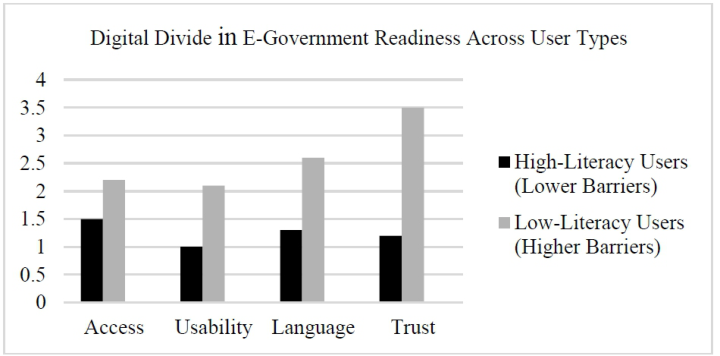
Figure 1: Barriers to E-government service utilization based on user literacy levels. Low-literacy users encounter much more difficulties than high-literacy users in terms of usability, access, and trust, which leads to their digital exclusion from public services (Srivastava et al., 2021; United Nations, 2022).
Recent studies have identified evident gaps in the literature. For instance, most European platforms do not have multilingual support, audio aids, or culturally relevant icons (Nadal and Navarro, 2025). In addition, many Indian applications omit speech guidance, which is crucial for low-literate communities (Srivastava et al., 2021). Figure 1 shows how users with lower and higher literacy levels experience differences in language, trust, usability, and accessibility. According to the United Nations (2022), the E-Government Development Index (EGDI) illustrates the difference in Table 1. It indicates that the average for high-income countries is 0.825, while the average for least-developed countries is 0.490. These findings provide an opportunity to propose frameworks that enhance accessibility for low-literacy populations.
Table 1: E-Government development index (EGDI) scores by country group.
Table available in the original PDF paper.
Country Group EGDI Score (2022) High-income countries 0.825 Upper-middle-income countries 0.677 Lower-middle-income countries 0.557 Least Developed Countries (LDCs, LLDCs, and SIDS) 0.490
Research Questions The following questions are investigated to address the aforementioned challenges:
1924 Al-Nuwaiser
1. What design constructs would most effectively improve the usability of e-government interfaces for low-literacy users? 2. How can these constructs be used to obtain a single and conceptually sound framework for inclusive interface design? 3. What forms of validation demonstrate the relevance, clarity, and applicability of this framework in real-world contexts?
Objectives and Contributions This study proposes a validated theoretical framework to address low literacy exclusion in e-government systems. Unlike previous studies that focused on separated usability aspects, the present study integrates four constructs— simplified navigation, multimodal input and output, error recovery, and cultural relevance—into a unified model informed by HCI, cognitive load and universal design for learning.
The framework was developed and validated by combining expert input and existing literature. The proposed model could explain the effect of cognitive, interactional, and socio-cultural constructs to improve the usability of e-government interfaces for low-literacy users. Bringing these elements together in one framework helps us to better understand the challenges of making digital platforms accessible while also contributing new insights to the field.
The framework was further refined through expert validation to ensure its practical relevance in real-world contexts, which makes it a useful resource for interface designers, policymakers, and digital inclusion advocates who aim to improve e-government services’ accessibility and usability.
Beyond design practice, the research highlights important policy implications, which offer guidance to embed accessibility standards in e-government platforms, thereby supporting Sustainable Development Goal (SDG) targets related to fair access to public services for all members of society.
METHODOLOGY
Framework Development A design science research (DSR) methodology was used to create a conceptual model to enhance the usability of e-government interfaces among low- literacy users. DSR is highly applicable in the development of artifacts with a theoretical background, but it is also practical to undergo iterations of development, refinement, and evaluation (Drechsler and Hevner, 2022; Goktas and Yumusak, 2024).
The initial step was the synthesis of more than 30 peer-reviewed articles published within the last decade that examined: HCI design (Zhu and Xu, 2024), cognitive load theory (Sweller, 2019), universal design for learning (Rose and Meyer, 2002), and digital inclusion in e-government systems (Srivastava et al., 2021; Morte Nadal and Esteban Navarro, 2025). Thematic coding revealed four common constructs essential to enhancing usability for low-literacy users: simplified navigation, multimodal input and output,
Bridging the Digital Divide: A Design Framework 1925
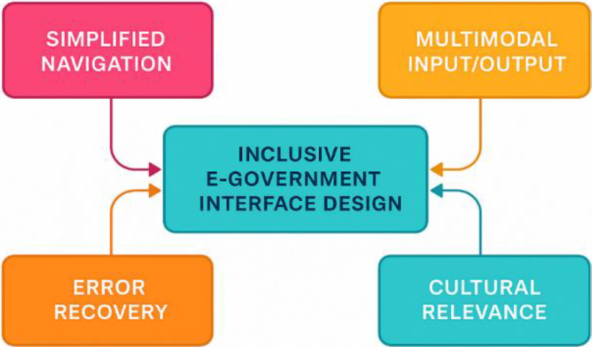
error recovery, and cultural relevance. Navigation simplification helps ease the thinking processes by reducing the number of operation schemes and unnecessary text. Multimodal input and output combine visual, audio, icon- based, and local language to increase understanding. Error recovery provides intuitive and real-time feedback to help users remove erroneous messages. Cultural relevance means that local norms, language, and symbolic referrals are adhered to, thus adding confidence and credibility to the user.
In the second phase, the framework was conceptually realized by visualizing the concept of the constructs’ interrelationship and the mutual effect on the users’ performance and satisfaction levels. The conceptual framework illustrated in Figure 2 proposes these four constructs as the fundamental design principles of inclusive e-government platforms to provide a potential design foundation to meet the needs of low-literacy users.
Figure 2: Conceptual framework for designing inclusive e-government interfaces. The four validated constructs incorporated into the model’s major design principles include simplified navigation, multimodal input and output, error recovery, and cultural relevance to enhance the accessibility of low-literacy users.
Expert Validation Using Delphi An expert validation process was conducted using the Delphi method to evaluate the proposed framework’s practical applicability and theoretical robustness. This validation approach is widely used in design science and HCI research to get consensus on artifacts that cannot yet be tested in real-world settings (Karlsson, Hedström, & Kolkowska, 2023; Goktas & Yumusak, 2024). The panel comprised eight specialists, including three academic researchers in HCI design and inclusive design, two industry practitioners involved in public-sector digital systems, and three policy advisors working on digital literacy and access in governmental and non-governmental contexts. Purposive and snowball sampling was used to recruit experts to the multidisciplinary representation of both theoretical and practical experts.
1926 Al-Nuwaiser
Table 2 shows that two validation rounds were conducted within 4 weeks. Round 1 involved the introduction of the framework and a structured questionnaire where each construct was evaluated on a five- point Likert scale based on its clarity, theoretical relevance, and practical applicability. Qualitative input was also obtained to identify potential areas for improvement.
The responses were analyzed, and a summary report was prepared. During Round 2, the experts reviewed this report and adjusted their scores accordingly. This definition of consensus adhered to the Delphi method, requiring a minimum of 75% agreement on the clarity, relevance, and applicability of each construct (Von der Gracht, 2012).
Table 2: Delphi validation process and consensus thresholds.
Table available in the original PDF paper.
Round Deliverable to Experts Evaluation Criteria Consensus Threshold ≥70% agreement
Clarity, Relevance, and Applicability
1 Conceptual framework questionnaire
≥75% agreement
2 Summary of the Round 1 feedback
Revised evaluation using the same criteria
Justification of the Sample Size The sample size of experts consulted in this study was narrowed down to eight to provide specific and distinct input, despite the broad variety of their experiences. The experts were chosen based on their academic or professional experience in HCI, e-government systems, digital inclusion, and interface design for low-literacy groups. This method is similar to known findings in Delphi research, where 8–15 participants seem adequate to induce valid consensus and maintain a manageable level (Okoli and Pawlowski, 2004; Linstone and Turoff, 2002). Other similar or smaller panels have been used in comparable studies, such as Goktas and Yumusak (2024), which used seven experts, and Karlsson, Hedström, and Kolkowska (2023), which used nine experts, meaning that the panel size is an adequate number allowing the traces of significant, multidisciplinary input.
Analysis and Interpretation of Data The responses of the Delphi rounds’ experts were examined using a mixed method. The quantitative data on the five-point Likert scale were summarized by showing descriptive statistics to obtain mean scores and standard deviation (SD) on each construct. The low variability among responses suggested a degree of consensus, while the high variability highlighted areas requiring refinement. Constructs that consistently showed strong alignment and high scores were kept without modification, whereas those exhibiting different fits were revised based on the recommendations of the experts.
Bridging the Digital Divide: A Design Framework 1927
Thematic analysis was employed to analyze the qualitative feedback in six steps, as discussed by Braun and Clarke (2006). This allowed the identification of common suggestions, such as changes to multimodal features and better definitions of cultural relevance indicators, and their inclusion in the framework. The proposed framework combines statistical indicators and qualitative observations, informed by theoretical insights, in addition to the practical insights that are supported by the evaluation of experts.
Validity Considerations The validity of the framework was evaluated following established principles of design science research (Larsen et al., 2025; Kroop, 2025). The criterion validity was facilitated with each construct based on previous empirical studies on e-government and low-literacy accessibility. Causal validity was engaged in the explicit expression of the logical relationships of the constructs, as shown in the framework model. The framework was also validated in context through its correspondence with the actual realities of e-government portals in underserved areas. The Delphi method was used to enhance the framework’s validity through cross-disciplinary expert involvement to ensure that it is theoretically sound and practically applicable and familiar to stakeholders representing academic, design, and policy settings.
Ethical Compliance The participation phase in the Delphi validation process was both voluntary and anonymous, and all experts provided informed consent. During the expert evaluation process, recognized ethical standards were followed, maintaining confidentiality and protecting participants’ rights.
RESULTS
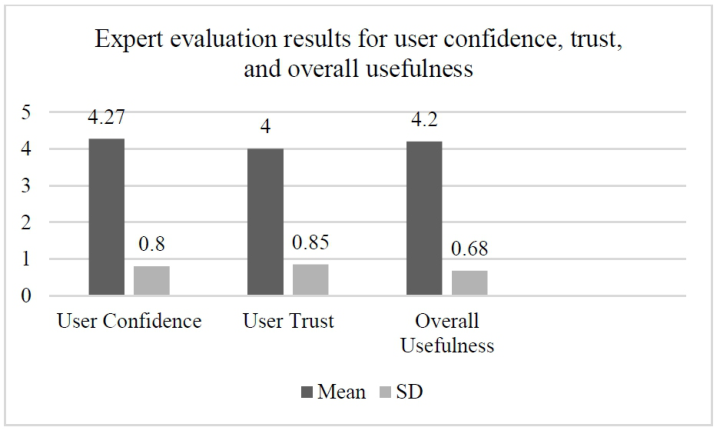
The expert evaluation of the proposed framework was conducted through the Delphi process by assessing nine criteria: clarity, task completion, conceptual relevance, accessibility, comprehension, user engagement, user confidence, user trust, and overall usefulness. Table 3 presents the mean scores and SDs for each criterion, organized into three groups to make the results clearer and prevent repetition.
Table 3: Expert evaluation of the framework constructs.
Table available in the original PDF paper.
Category Criterion Mean SDs 1 Impact on clarity 4.47 0.64 Impact on task completion 4.27 0.80 Conceptual Relevance (General) 4.40 0.74
2 Impact on accessibility 3.80 0.77 Impact on comprehension 3.80 0.86 Impact on user engagement 4.07 1.10 3 Impact on user confidence 4.27 0.80 Impact on user trust 4.00 0.85 General usefulness 4.20 0.68
1928 Al-Nuwaiser
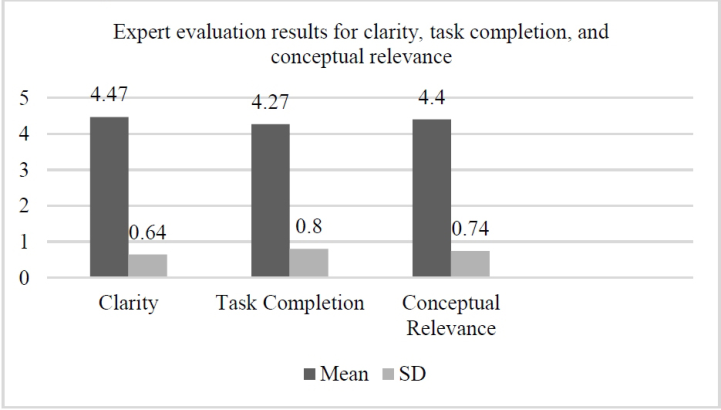
The first category—clarity, task completion, and conceptual relevance— received the highest ratings, with mean scores of 4.47, 4.27, and 4.40 (Figure 3). The relatively low SDs (0.64–0.80) show that experts agreed that the framework is clearly structured, helps users to complete tasks, and fits well with the needs of users with low literacy.
Figure 3: Mean scores and SD from the Delphi panel assessment of the framework’s clarity, task completion support, and conceptual relevance. Ratings are based on a five-point Likert scale (1 = very low, 5 = very high).
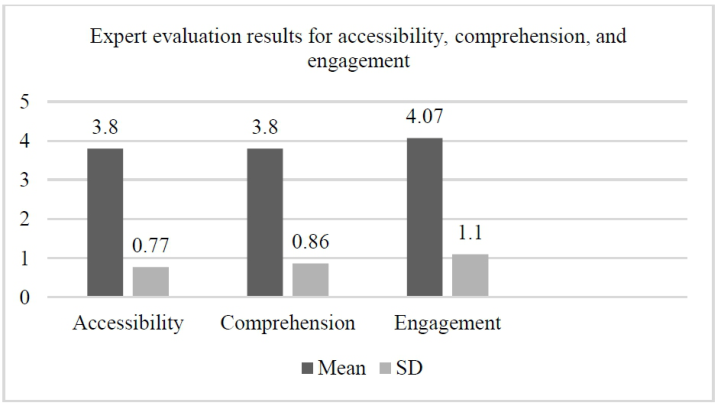
The second category—accessibility, comprehension, and engagement— recorded mean scores of 3.80, 3.80, and 4.07, respectively (Figure 4). These findings suggest that the framework has potential to improve access and understanding. However, the higher variability in scores (SD = 0.77–1.10) shows that experts had different views about how well it meets diverse multimodal needs and keeps users engaged.
User confidence, trust, and overall usefulness received positive ratings of 4.27, 4.00, and 4.20, respectively (Figure 5). The SD between 0.68 and 0.85 indicate that the framework can build trust and confidence among low-literacy users, supported by characteristics such as cultural relevance, simplified navigation, and robust error recovery.
Figures 3–5 present the grouped evaluation results in two-dimensional (2D) clustered column charts with consistent scales (0–5). This format groups related metrics, avoids redundancy, and maintains visual clarity while keeping all original data intact.
Bridging the Digital Divide: A Design Framework 1929
Figure 4: Mean scores and standard deviations from the Delphi panel assessment of the framework’s accessibility, comprehension, and user engagement. Ratings are based on a five-point Likert scale (1 = very low, 5 = very high).Figure 5: Mean scores and SD from the Delphi panel assessment of the framework’s ability to build user confidence and trust and its overall usefulness. Ratings are based on a five-point Likert scale (1 = very low, 5 = very high).
DISCUSSION
Evaluation of the Results The expert assessment indicates wide support for the framework, especially in terms of clarity, task completion, and conceptual relevance, where the level of agreement was high. These results correspond to the cognitive load
1930 Al-Nuwaiser
theory (Sweller, 2019), which proposes to reduce the unnecessary work of cognition, and with HCI design suggesting robust and intuitive navigation (Medhi, Thies, & Kumar, 2015).
Accessibility and comprehension have moderate scores and greater variability, indicating that the framework still needs to be refined to accommodate a wider range of individual needs, although it includes effective multimodal features. It is aligned with the previous research demonstrating that low-literacy users are better off with diversified communication channels, such as gestures and auditory directions (Srivastava et al., 2021).
User engagement was rated at a moderate level, suggesting that adding adaptive or interactive features could help to keep users engaged over time. Meanwhile, the high scores for user confidence, trust, and overall usefulness highlight how important culturally relevant design and effective error recovery are for creating a sense of safety and trust—something that many traditional e-government models still do not address enough. Similarly, this result aligns with the literature that highlights the importance of socio- cultural fit in the case of digital adoption in underserved groups (Morte Nadal and Esteban Navarro, 2025).
The findings verify that the framework has been effective in incorporating cognitive, interactional, and cultural dimensions. The feedback indicates obvious priorities for future versions, i.e., intensifying accessibility and engagement components and preserving clarity, relevance, and trust-building.
Comparison With the Existing Literature This study extends the existing research on e-government accessibility by introducing a unified model that synthesizes constructs from three related domains: HCI design, cognitive load, and universal design for learning. The proposed framework considers cognitive, interactional, and socio-cultural aspects of usability together, despite prior literature often addressing individual elements of usability such as interface structure, ease of language, or accessibility. This dimensionality addresses the need for more comprehensive models that can minimize digital exclusion among low-literate groups (Zhu and Xu, 2024; Srivastava et al., 2021).
The proposed framework focuses on cultural relevance and error recovery, unlike existing models that often prioritize technical accessibility or visual usability. This focus addresses the psychosocial barriers to e-government design that previous studies have inadequately operationalized (Morte Nadal and Esteban Navarro, 2025). The framework develops a validated and expert-refined model that integrates various dimensions, bridging the gap between concept and reality.
Limitations and Future Work Although the framework has remarkable potential, it has not yet been validated beyond expert review, and many aspects have not been explored in diverse cultural and geographic settings. The potential of future work lies in the empirical application of e-government systems to evaluate usability and adoption among low-literacy users. Enhanced multimodality, customizable
Bridging the Digital Divide: A Design Framework 1931
input interfaces (gesture-based interactions, etc.), and responsive user interface components can also be used to enhance accessibility and interest. There is also a possibility that longitudinal studies would assist in observing the user’s ongoing interaction and the lasting effects on digital inclusion.
CONCLUSION
This study introduces a validated design framework of inclusive e-government interfaces that accommodate low-literacy users based on the incorporation of HCI design, cognitive load, and universal design for learning. The expert review confirmed that the framework is transparent, conceptually sound, and able to build user confidence and trust. It also pointed out the opportunities to improve accessibility and interaction features. The framework provides a useful instrument for policymakers and designers aiming to reduce digital exclusion and aligns with global efforts to ensure fair access to public services. Future real-world testing will be essential for understanding the components of the framework and demonstrating its effectiveness.
REFERENCES
Braun, V. and Clarke, V., 2006. Using thematic analysis in psychology. Qualitative Research in Psychology, 3(2), pp. 77–101. https://doi.org/10.1191/ 1478088706qp063oa. Drechsler, A. and Hevner, A., 2022. Knowledge paths in design science research.
Foundations and Trends in Information Systems, 6(3), pp. 171–243. https:// doi.org/10.1561/2900000028. Goktas, H. O. and Yumusak, N., 2024. Applying the Delphi method to assess critical success factors of digitalization while sustaining lean. Sustainability, 16(19), p. 8424. https://doi.org/10.3390/su16198424. Karlsson, F., Hedström, K. and Kolkowska, E., 2023. Using the Delphi method to
elicit requirements for an international master’s program in information security management. In: L. F. Sikos and P. Haskell-Dowland, eds. Cybersecurity Teaching in Higher Education. Cham: Springer, https://doi.org/10.1007/978-3-031–24216- 8_2. Kroop, S., 2025. Artifact validity in design science research (DSR): A comparative analysis. DESsRIST 2025 Proceedings. https://doi.org/10.48550/ arXiv.2502.11199. Larsen, K., Lukyanenko, R., Müller, R., Storey, V., Parsons, J., Vandermeer, D. and Hovorka, D., 2025. Validity in design science. arXiv preprint. https://doi.org/ 10.48550/arXiv.2503.09466. Linstone, H. A. and Turoff, M., 2002. The Delphi Method: Techniques and
Applications. Boston: Addison-Wesley. https://doi.org/10.2307/3150755. Medhi, I., Thies, W. and Kumar, N., 2015. User interface design for low-literate and novice users. Washington University CSE Readings. Morte Nadal, T. and Esteban Navarro, M. Á., 2025. Recommendations for
digital inclusion in the use of European digital public services. Humanities and Social Sciences Communications, 12, p. 273. https://doi.org/10.1057/s41599- 025-04576-7.
1932 Al-Nuwaiser
Okoli, C. and Pawlowski, S. D., 2004. The Delphi method as a research tool: An example, design considerations and applications. Information & Management, 42(1), pp. 15–29. https://doi.org/10.1016/j.im.2003.11.002. Rose, D. H. and Meyer, A., 2002. Teaching Every Student in the Digital Age:
Universal Design for Learning. Alexandria, VA: ASCD. Srivastava, A., Kapania, S., Tuli, A. and Singh, P., 2021. Actionable UI design guidelines for smartphone applications inclusive of low-literate users. Proceedings of the ACM on Human-Computer Interaction, 5(CSCW1), Article 136, pp. 1–30. https://doi.org/10.1145/3449210. Sweller, J., 2019. Cognitive Load Theory and educational technology. Educational
Technology Research and Development, 68(1), pp. 1–16. https://doi.org/10.1007/ s11423-019-09701-3. UNESCO, 2018. A Landscape Review: Digital Inclusion for Low-Skilled and Low- Literate People. UNESCO–Pearson Initiative. https://unesdoc.unesco.org/ark:/ 48223/pf0000261791. United Nations, 2022. United Nations E-Government Survey 2022: The future
of digital government. New York: Department of Economic and Social Affairs. https://desapublications.un.org/publications/united-nations-e-government- survey-2022. Von der Gracht, H., 2012. Consensus measurement in Delphi studies: Review and implications for future quality assurance. Technological Forecasting and Social Change. https://doi.org/10.1016/j.techfore.2012.04.013. Zhu, T. and Xu, W., 2024. HCI in E-Government and E-Democracy. In C. Stephanidis
and G. Salvendy, eds. Human-Computer Interaction in Various Application Domains. Boca Raton: CRC Press, Chapter 12. doi: 10.1201/9781003490692-12
LISTED IN THE AHFE DIGITAL BOOKSTORE CATALOGUE
Explore the complete digital volume
Human Factors in Design, Engineering, and Computing
Read this individual research paper free through the original publisher, or explore the full digital proceedings book.
ISBN 978-1-964867-75-5
Explore this ISBN in the AHFE Bookstore ↗Listed in the July 2026 bookstore catalogue; search by ISBN to confirm current availability · Digital book purchase optional