Yingxi Xu, Yinying Tao, Chaohong Ding, Luqian Zheng, Chenge Wang (2025). Interactive Digital Narrative for Cultural Heritage: Game Design Taking Night Revels of Han Xizai as a Case Study. In: Human Factors in Design, Engineering, and Computing. AHFE Open Access, vol. 199, pp. 210–220. https://doi.org/10.54941/ahfe1006833
In the context of global digital transformation, traditional cultural dissemination is shifting from one-way linear transmission to interactive communication. Video games, with immersion, interactivity, and multi-dimensional storytelling, are emerging as innovative carriers for cultural heritage. However, digitizing traditional painting-based heritage still faces two key challenges: reliance on linear, pre-scripted narratives that limit exploration, and one-way knowledge transfer that results in fragmented historical understanding.To address this, the study transforms The Night Banquet of Han Xizai into a narrative-driven strategy puzzle game. Drawing on Ryan’s three-layer model of interactive narrative and Chatman’s narrative structure theory, it analyzes the painting’s narrative elements and proposes a game design framework aimed at reducing players’cognitive load and encouraging active cultural inquiry. A System Usability Scale (SUS) evaluation with 12 participants showed that combining interactive narrative with card-based strategy improved both usability and learnability.
Classical Chinese paintings are vital records of traditional culture, preserving social customs and symbolic meanings. Yet, current digital dissemination often fails to reconstruct historical contexts, making political metaphors and cultural meanings harder to grasp (Wei Y, 2024). While digital technologies enhance aesthetic and immersive qualities (Cao C, 2023), formats like digital scrolls and AR reconstructions remain largely linear, increasing cognitive load (Wang N, 2018) and limiting audience engagement, especially among younger users.
As a key medium empowered by technology and capable of bridging generational gaps, interactive narrative games offer promising solutions to the challenges discussed above. While traditional cultural education often struggles with low student engagement, narrative and virtual games have been shown to overcome this barrier—and even increase interest in visiting physical museums (Yu S, 2021). However, classical paintings, as fragmented remnants of the past, are difficult to interpret unless placed
Interactive Digital Narrative for Cultural Heritage: Game Design Taking Night 211
within interpretive contexts that fill in historical gaps. Games can facilitate this process by enabling experiential encounters with cultural heritage (Malegiannaki et al., 2020). In the field of digital heritage preservation, games not only help archive cultural content digitally (Laamarti et al., 2014) but also enhance public understanding of cultural memory and artifact value (Champion, 2016). To support this, researchers have developed diverse game design paradigms that promote interaction and engagement (Malegiannaki & Daradoumis, 2017; Mortara et al., 2014). Among these, narrative techniques have proven particularly effective in deepening player engagement with cultural material. In educational contexts, narrative structures significantly influence both learning motivation and outcomes (Maksimenkova & Lebedev, 2023). Naul (2020) further demonstrates that well-crafted narratives enhance motivation, immersion, and user engagement in serious games, contributing to improved learning experiences. Thus, as a strategy for disseminating and promoting classical paintings, narrative games can not only enrich users’ cultural experience but also strengthen their drive for active learning.
This study applies interactive narrative game strategies to The Night Banquet of Han Xizai, aiming to:
1. Increase users’ willingness to explore classical paintings; 2. Enable understanding of the painting’s historical narratives and cultural values; 3. Assess the usability and learnability of a design integrating storytelling with card-based strategy.
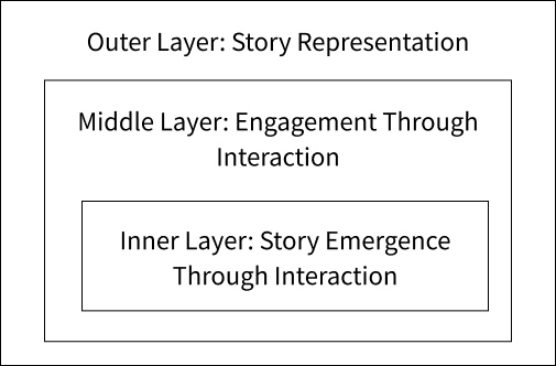
THEORY OF INTERACTIVE NARRATIVE In Avatars of Story, transmedia narrative theorist Marie-Laure Ryan proposed a comprehensive framework for interactive storytelling, known as the three-layer model. According to this model, effective interactive narrative design must consider three levels—surface, middle, and inner layers (see Figure 1). Specifically, the surface layer involves delivering a vivid and comprehensible narrative to the user; the middle layer emphasizes enabling user participation through interactive operations; and the inner layer concerns the generation of narrative content through direct interaction between the user and the product (Ryan M. L., 2006).
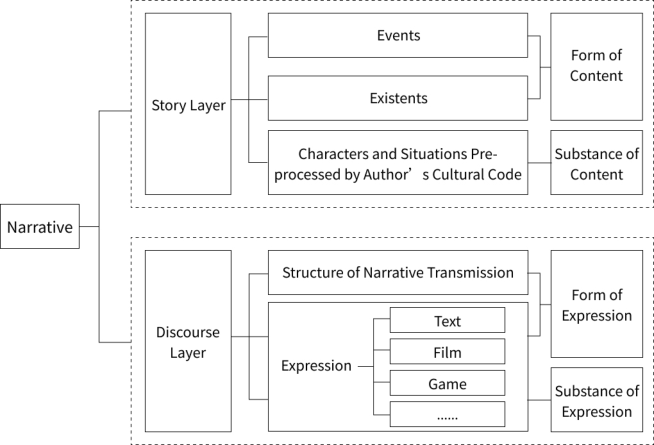
Building on structuralist theory, narratologist Seymour Chatman (2006) proposed in Story and Discourse that narrative is composed of two primary dimensions: story (the content of what is narrated) and discourse (the manner of its presentation). He further refined this framework by expanding the constituent elements of narrative into a more elaborate schema. Specifically, he conceptualized narrative structure through a dual-axis model comprising: (1) the form and substance of expression, and (2) the form and substance of content. These axes enable a systematic breakdown of narrative into key components such as events, existents, culturally coded agents and actions, and the structure and medium of narrative transmission (see Figure 2).
Figure 1: Ryan’s three-layer model of interactive narrative (self-drawn).Figure 2: Structural elements of narrative: story and discourse (self-drawn).
This study integrates Ryan’s three-layer theory of interactive narrative with Chatman’s structural model of narrative elements, using the classical painting The Night Banquet of Han Xizai as the core subject of analysis. By systematically unpacking the painting’s narrative components, we establish a design framework in the following sections. This theoretical integration offers a dual advantage: on one hand,Chatman’s model provides a comprehensive lens through which to reveal the internal relationships among narrative components in the painting; on the other, Ryan’s framework
Interactive Digital Narrative for Cultural Heritage: Game Design Taking Night 213
offers methodological guidance for enhancing user engagement and deepening narrative comprehension. The synergy of these two perspectives enables a transition from static to interactive storytelling, thereby enriching users’ interpretive depth and experiential understanding of the artwork.
DESIGN FRAMEWORK The Night Banquet of Han Xizai, painted by Gu Hongzhong in the Southern Tang period, depicts five continuous banquet scenes—“Listening to Music,” “Watching the Dance,” “Intermission,” “Informal Performance,” and “Dispersal”—vividly portraying the social atmosphere of the time (McCausland, 2013).
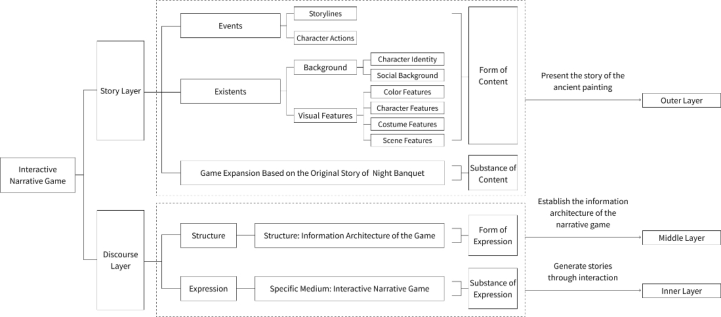
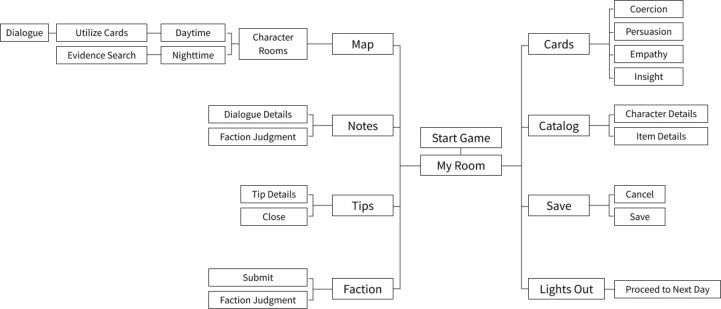
Based on the painting’s narrative and context, this study proposes Night Banquet, a narrative puzzle game framework integrating Ryan’s three-layer model with Chatman’s story–discourse structure. The framework converts a static artwork into an interactive narrative space: (1) Surface layer: Visual translation of “story” elements. The game follows the five-scene structure, extracting costumes, artifacts, and color palettes into interactive assets. Character identities and social background provide immersion. (2) Middle layer: Structuring “discourse” pathways. Information architecture includes map navigation, clue discovery, card interactions, and archives. Non-linear exploration reduces cognitive load. (3) Inner layer: Generating narrative through “medium of discourse.” Dialogue, item use, and card strategies (empathy, coercion, persuasion, insight) produce branching outcomes. (4) Based on Chatman’s theory, the game’s narrative components are further structured into “story” and “discourse” elements. The story includes: (a) events—key plot actions and character behaviors; (b) existents— static components such as social setting, character identity, and visual motifs; (c) extensions—supplementary elements like character dossiers, subplots, and historical clues. The discourse includes: (a) transmission structure—the hierarchical organization of pages and system logic; (b) medium of expression—the interactive mechanics of narrative puzzles,incorporating visual, auditory, and textual feedback to deliver the narrative.
Through this framework, the classical painting is reimagined not merely as a visual artifact but as an interactive narrative space. The design enhances user motivation for cultural understanding and offers a structured method for the gamified reinterpretation of Chinese visual heritage. The proposed framework is illustrated in Figure 3.
Figure 3: Design framework (self-drawn).
DESIGN IMPLEMENTATION This section outlines the development process of the Night Banquet game, detailing how the narrative and interaction layers were implemented based on the previously established design framework to enhance user immersion and cultural engagement.
(1) Story Layer Design:In the design framework, the story layer corresponds to two core elements: events and existents.
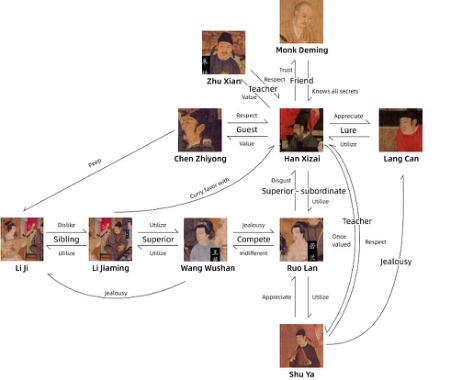
Regarding events, the game emphasizes narrative progression and character interaction. Players take on the role of Gu Hongzhong and enter the painting’s world to engage with ten key characters. These characters and their storylines are adapted from the historical context of The Night Banquet of Han Xizai, with modifications based on historical sources. The character relationship network is shown in Figure 4. The script organizes character motivations and narrative content using both plot summaries and narrative overviews (Gutiérrez F. L., 2024); for example, Li Jiaming’s storyline is detailed in Table 1.
Figure 4: Character relationship.
Interactive Digital Narrative for Cultural Heritage: Game Design Taking Night 215
Table 1: Storyline of Li Jiaming, a game character.
Table available in the original PDF paper.
Prop Story Card
Character Story Room Props
Coercion
“The Song of Breaking the Array”
Li Jiaming wants to present “The Song of Breaking the Array” to Han Xizai at the banquet.
Persuasion
It is the hairpin of Li Ji’s mother
Hairpin Stained with Blood
Persuasion
Li Jiaming is a music official of the Jiaofangsi in the Southern Tang Dynasty. On the surface, he is the half - brother of Li Ji, a qin master in the Shu palace. In fact, he manipulates the inheritance of qin skills through family relations. In the turmoil of the Five Dynasties and Ten Kingdoms, he seeks power ascent through music.
Music Score of the Southern Tang Dynasty
The words “Southern Tang” are scratched out, and the rhythm on the score is not common in the Southern Tang Dynasty either
Coercion
Invitation to the Han Mansion
The invitation to the Han Mansion is carefully kept by Li Jiaming
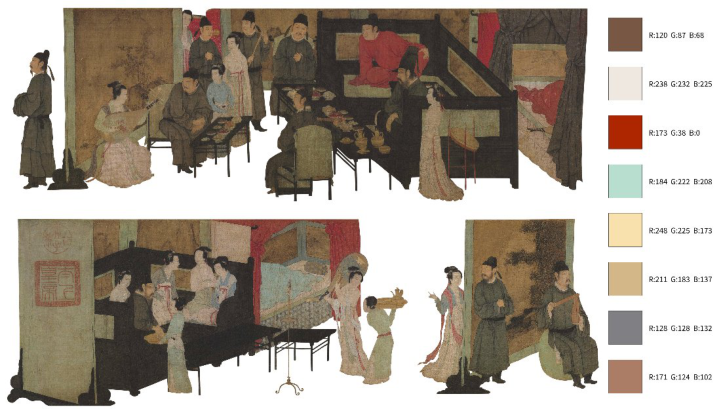
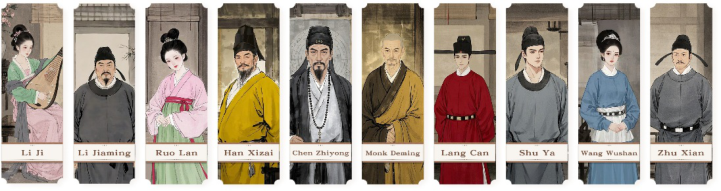
Regarding existents, the game’s visual and thematic elements are grounded in the original painting. To capture users’ initial attention, the color palette of The Night Banquet of Han Xizai was extracted and applied to the game’s visual system (Figure 5). Key visual elements such as costumes, artifacts, and decorations were reinterpreted as in-game icons and interactive assets (Figure 6). Additionally, characters were given distinct facial features aligned with their roles and emotional arcs, enhancing narrative clarity and visual immersion (Figure 7).
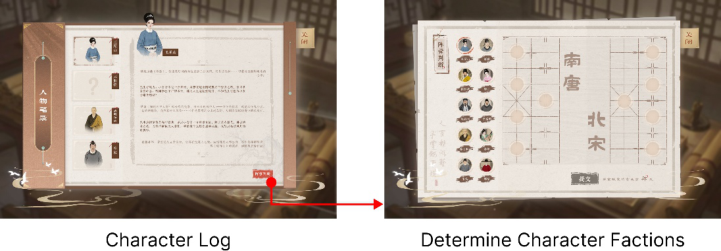
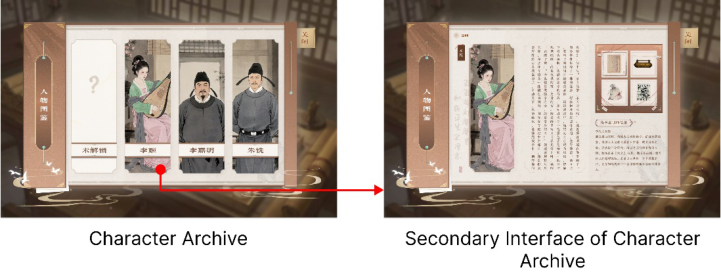
To support player comprehension, the game includes two key interface modules: the Character Log and the Character Archive. The Character Log
Figure 5: The design process begins with the extraction of visual elements from historical paintings.Figure 6: Game icons.Figure 7: The game’s character design closely reflects the painting’s historical context.
records all dialogue interactions between the player and each character, while the Archive offers dossier-style views of character backgrounds, social roles, and item-related clues (see Figures 8 and 9).
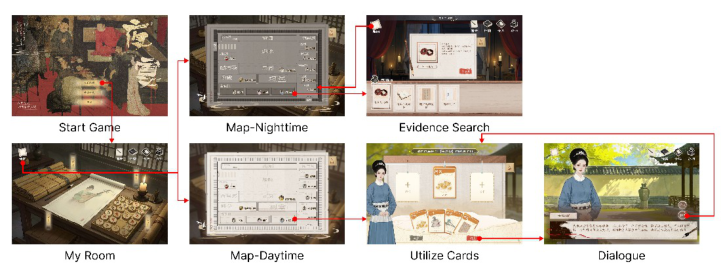
(2) The discourse layer defines the multi-level UI: Map, Logs, Tips, Cards, Save, Lights Out, Faction (primary); dialogues and deductions (secondary). Players move between scenes, trigger investigations, and freely switch interfaces (Figures 10–11).
Interactive Digital Narrative for Cultural Heritage: Game Design Taking Night 217
Figure 8: The Character Dialogue Record interface displays all player-character conversations. After reviewing, players can jump to the faction interface with one click.Figure 9: This is the Character Encyclopedia and its secondary interface, where players can view archives of unlocked characters.Figure 10: The structuring of the game’s information architecture.
Through this layered structure, players not only collect clues and trigger events, but also gradually construct an understanding of the painting’s underlying political metaphors and social hierarchies. Static figures and
scenes from The Night Banquet of Han Xizai are transformed into interactive narrative units. Players engage in a “detect—analyze—influence” cycle that forms a logic-driven narrative progression.
Figure 11: Interaction flowchart.
DESIGN EVALUATION To evaluate the effectiveness of the game design, participants were invited to play the completed version of Night Banquet and complete a post-experience questionnaire. The evaluation employed the System Usability Scale (SUS), which consists of 10 items measuring perceived usability. The odd-numbered items are positively phrased, while the even-numbered ones are negatively phrased. Each item uses a five-point Likert scale ranging from “Strongly disagree” to “Strongly agree.”
A total of 14 questionnaires were distributed, with 12 valid responses collected (4 male, 8 female participants). Scoring was calculated as follows: for each participant, scores for odd-numbered items (K2i1) and even- numbered items (K2i) were processed according to the SUS standard scoring method. The average overall usability score across all participants was 73.66 out of 100, as shown in Table 2.According to the SUS grading scale, the design falls within a higher usability level.
Table 2. SUS scores of participants.
Table available in the original PDF paper.
Participants A B C D E F G H I J K L Average SUS Scores 64 78 73.3 73.8 70.3 70.3 76.1 80.3 72.3 71.3 72.32 82 73.66
In addition to the overall SUS score, the questionnaire results were divided into two subscales: Learnability (items 4 and 10) and Usability (the remaining 8 items). Using weighted calculations (12.5 for Learnability; 3.125 for Usability), the average Learnability score was 75.12, and the average Usability score was 73.18. These results indicate that the design demonstrates strong usability and ease of learning, confirming the game’s potential value in interactive cultural heritage communication.
Interactive Digital Narrative for Cultural Heritage: Game Design Taking Night 219
CONCLUSION
This study applies Ryan’s three-layer narrative theory and Chatman’s narrative model to transform The Night Banquet of Han Xizai into an interactive narrative game, enhancing engagement and deepening cultural dissemination. The framework integrates plot, characters, social context, and visual symbols, showing adaptability to other paintings, intangible heritage, and historical architecture.
Limitations include a small, homogeneous sample, leaving differences across age, gender, and cultural background unexplored. Literature suggests variation in pacing preferences (González-González et al., 2022), gendered engagement with narrative (Rehbein et al., 2016), and cross-cultural interpretation (Al-Batineh and Alawneh, 2022). Future work should include stratified testing and cultural adaptation to broaden applicability.
ACKNOWLEDGMENT
The authors thank the School of Art and Fashion Design, Zhejiang University of Science and Technology, for support. This work was funded by the 2024 Graduate Student Scientific Research Innovation Fund (No. 2024yjskc17) and the Youth Science Fund (No. 2025QN098).
REFERENCES
Al-Batineh, M. and Alawneh, R., 2022. Current trends in localizing video games into Arabic: Localization levels and gamers’ preferences. Perspectives, 30(2), pp. 323–342. Cao, C., Yang, L. and Shen, X., 2023. Immersive experience of Chinese poems
and paintings. Proceedings of the ACM on Computer Graphics and Interactive Techniques, 6(2), pp. 1–6. Champion, E., 2016. Entertaining the similarities and distinctions between serious games and virtual heritage projects. Entertainment Computing, 14, pp. 67–74. Chatman, S., 2006. Story and discourse: Narrative structure in fiction and film. In:
D. J. Hale, ed. The Novel: An Anthology of Criticism and Theory 1900–2000. Oxford: Blackwell, pp. 219–246. González-González, C. S., Toledo-Delgado, P. A., Muñoz-Cruz, V., et al., 2022.
Gender and age differences in preferences on game elements and platforms. Sensors, 22(9), pp.3567. Gutiérrez, F. L., Medina-Medina, N., Gallardo, J., et al., 2024. Supporting narrative design in video games: Proposal and case study with an educational video game. International Journal of Human–Computer Interaction, [online ahead of print]. Laamarti, F., Eid, M. and El Saddik, A., 2014. An overview of serious games.
International Journal of Computer Games Technology, 2014, pp. 1–7. Maksimenkova, O. and Lebedev, S., 2023. How can narrative game design methods improve educational experience? In: International Conference on Interactive Collaborative Learning. Cham: Springer, pp. 464–473. Malegiannaki, I. A., Daradoumis, T. and Retalis, S., 2020. Teaching cultural heritage
through a narrative-based game. Journal on Computing and Cultural Heritage, 13(4), pp. 1–28.
Malegiannaki, I. and Daradoumis, T., 2017. Analyzing the educational design, use and effect of spatial games for cultural heritage: A literature review. Computers & Education, 108, pp. 1–10. McCausland, S., 2013. The Night Banquet: A Chinese scroll through time by De-Nin
D. Lee. Journal of Song-Yuan Studies, 42, pp. 486–492. Mortara, M., Catalano, C. E., Bellotti, F., et al., 2014. Learning cultural heritage by serious games. Journal of Cultural Heritage, 15(3), pp. 318–325. Naul, E. and Liu, M., 2020. Why story matters: A review of narrative in serious
games. Journal of Educational Computing Research, 58(3), pp. 687–707. Rehbein, F., Staudt, A., Hanslmaier, M. and Kliem, S., 2016. Video game playing in the general adult population of Germany: Can higher gaming time of males be explained by gender-specific genre preferences? Computers in Human Behavior, 55, pp. 729–735. Ryan, M. L., 2006. Avatars of Story. Minneapolis: University of Minnesota Press. Wang, N., Li, J. and Shi, Q., 2018. Encourage self-exploration through an interactive
Chinese scroll painting design. In: Proceedings of the 2018 ACM Companion International Conference on Interactive Surfaces and Spaces. New York: ACM, pp. 53–56. Wei, Y., Shan, W. and Zhang, Q., 2024. Real-time interaction with animated human figures in Chinese ancient paintings. In: 2024 IEEE International Conference on Multimedia and Expo Workshops (ICMEW). IEEE, pp. 1–6. Yu, S. and Lee, M., 2021. Audience participation behavior model of museum
digital narrative. In: International Conference on Applied Human Factors and Ergonomics. Cham: Springer, pp. 379–387.
LISTED IN THE AHFE DIGITAL BOOKSTORE CATALOGUE
Explore the complete digital volume
Human Factors in Design, Engineering, and Computing
Read this individual research paper free through the original publisher, or explore the full digital proceedings book.
ISBN 978-1-964867-75-5
Explore this ISBN in the AHFE Bookstore ↗Listed in the July 2026 bookstore catalogue; search by ISBN to confirm current availability · Digital book purchase optional