Shinichi Fukuzumi (2025). The issues related to agreement of software usage rules and its solution by UX approach. In: Human Factors in Design, Engineering, and Computing. AHFE Open Access, vol. 199, pp. 2206–2211. https://doi.org/10.54941/ahfe1007032
Before using the software, users are required to read and agree to the terms of use and the agreement regarding the handling of personal information. It is said that only about 5% of users read the consent form in its entirety. The most common reasons for this include: (1) It's pain, (2) The pros and cons are unclear, and (3) They all have the same content, so I've never had a problem not reading them.However, these terms and conditions are mainly agreements between the provider and the user, and include items to clarify where responsibility lies, so there are many problems caused by agreeing to the terms without fully understanding them. In order to avoid such troubles, according to a study, users need to understand the following four rules in these regulations. 1) Standards for account suspension, 2) Rules regarding money (payment methods, late fees, etc.), 3) Rules for withdrawal and cancellation, 4) Copyright rules.This time, we classified the contents of the terms of use for software and web applications and analyzed which of the four roots mentioned above they belong to. The subjects are: - General software - Online shopping sites - Auction sites The purpose of online shopping and auctions is to buy and sell things, so the focus is on operational aspects such as user qualifications, transactions, and exemptions rather than on terms for using regular software. In addition, the former is characterized by the fact that the operator and seller are almost the same, while the latter provides a place and the operator and seller are different. From this, we found that there are 3-4 items in terms that require special attention. The main purpose of the terms is an agreement between the provider and the user, and for this purpose, measures from the perspective of UX are necessary. Specifically, it is important to clearly show the "pre-use experience" in the UX concept. The aim is to create a UI that allows users to intuitively understand the four points mentioned above according to the principles of HCI. That is, -Display only the titles of items that require attention and the relevant items (items that have an impact) from the four rules according to the principles of 9241-112 (about 1-2 lines) and at the same time display an icon indicating the degree of danger -Hover the pointer over the icon to display a pop-up displaying the dangerous contentBy showing the concrete impact, such as conveying the image of an account being unusable in the case of an account suspension or conveying the actual damage that will occur in the case of financial matters, it is possible to make users understand the minimum terms and conditions.
Software terms of service and privacy policy agreements are required to be read and agreed to before use. The content of these agreements covers a wide range of topics, including “description of services,” “rules for use,” “fees and payment methods,” “prohibited actions,” “disclaimers,” and “matters concerning the suspension, modification, or termination of services,” all of which are important. However, it is said that only about 4–6% of users actually read these agreements in their entirety (Kanamori et al., 2017).
So why aren’t these terms and conditions read? The reasons often include: 1) They are long and it’s pain (McDonald et al. 2008), 2) The advantages and disadvantages are unclear (Reidenberg et al. 2014) and 3) They all contain the same content, and people haven’t encountered any problems from not reading them (they have become a mere formality) (Cate, 2010). However, these terms and conditions are primarily agreements between the service provider and the user, and they include clauses to clarify the allocation of responsibility, so there are many troubles that arise from agreeing to them without fully understanding them.
To prevent such problems, it has been reported that users need to understand the following four rules outlined in these terms and conditions (Fukuzumi, 2024).
1) Criteria for account suspension 2) Rules regarding finances (payment methods, late payment fees, etc.)
The Issues Related to Agreement of Software Usage Rules 2207
3) Rules for withdrawal and cancellation 4) Copyright rules.
A common measure to ensure users read the consent form is to have them check a box confirming they have read it. However, in many cases, users are likely to check the box without actually reading the form. Therefore, recently, some UIs have emerged where the checkbox only becomes active after the user scrolls to the end of the consent form. However, this is only a superficial solution and fails to fulfill the original purpose of achieving mutual agreement between the service provider and the user.
Previous research includes applications of Nudge theory (Acquisti et al, 2017), the use of icons (Cranor et al., 2006), and the Privacy Nutrition Label inspired by food nutrition labels (Kelley, 2009), but these are not sufficient (Sakurai et al, 2018). Therefore, measures from a User Experience (UX) perspective are necessary. Specifically, this involves the “anticipated experience” which is one of important elements of UX, and creating a UI that allows users to intuitively understand the four points mentioned above, in accordance with HCI principles (UX white paper, 2011). For example, if it concerns account suspension, the UI should convey the image of the account becoming unusable; if it concerns financial matters, it should convey that actual damage will occur.
Through such measures, it is necessary to maximize the user’s understanding of the consent form.
ANALYSIS OF TERMS OF USE This time, we classified the contents of the terms of use for software and web applications and analyzed which of the four roles mentioned above they belong to. The subjects are:
- General software - Online shopping sites - Auction sites The purpose of online shopping and auctions is to buy and sell things, so the focus is on operational aspects such as user qualifications, transactions, and exemptions rather than on terms for using regular software. In addition, the former is characterized by the fact that the operator and seller are almost the same, while the latter provides a place and the operator and seller are different. Table 1 shows the terms of use items written for each of the three target products with a circle, and among them, the items that seem to be related to the four rules mentioned above are highlighted in a bold frame.
From this, we found that there are 3–4 items in terms that require special attention.
2208 Fukuzumi
Table 1: The terms of use items written in products.
Table available in the original PDF paper.
The Issues Related to Agreement of Software Usage Rules 2209
PROPOSAL OF TERMS OF USE Policy
The main purpose of the terms is an agreement between the provider and the user, and for this purpose, measures from the perspective of UX are necessary. Specifically, it is important to clearly show the “pre-use experience”in the UX concept. The aim is to create a UI that allows users to intuitively understand the four points mentioned above according to the principles of HCI. That is,
Display only the titles of items (about 1–2 lines) that require attention and the relevant items (items that have an impact) from the four rules according to the principles of 9241–112 (ISO 9241–112, 2017) and at the same time display an icon indicating the degree of danger.
Hover the pointer over the icon to display a pop-up displaying the dangerous content.
By showing the concrete impact, such as conveying the image of an account being unusable in the case of an account suspension or conveying the actual damage that will occur in the case of financial matters, it is possible to make users understand the minimum terms and conditions.
The principles of ISO 9241–112 are as follows:
detectability,
freedom from distraction,
discriminability,
unambiguous interpretability,
conciseness, and
consistency (internal and external).
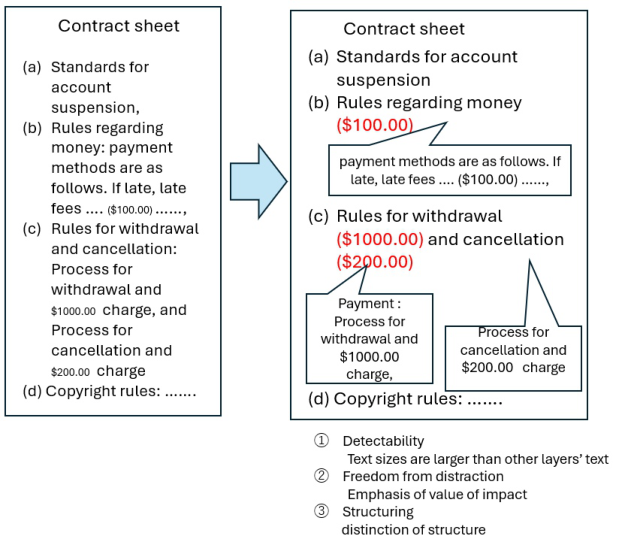
An example using these principles is shown in Figure 1.
Proposal Example
Figure 1(a) is a representation of a typical consent form, where various contents with different levels of detail are uniformly described. Figure 1(b) is a rewritten version of the conventional consent form, following the principles of information presentation described above.
In Figure 1(b), first, by displaying only the specific amount of concrete loss using visual effects such as color, size, blinking., it is possible to convey to the user that there will be negative consequences for them before they even read the content, thus realizing a pre-use experience of the user experience (UX). Next, in accordance with the principles of information presentation in ISO 9241–112, it achieves the following: changing the font size (detectability), using color to draw attention to specific areas (freedom from distraction), and structuring the information using pop-ups, etc., allowing users to directly access the necessary information (discriminability).
As can be seen by comparing Figure 1(a) and Figure 1(b), Figure 1(b) is not simply a collection of text, but incorporates variations in display to enable interaction.
2210 Fukuzumi
Figure 1: Example of proposed contract sheet.
CONCLUSION
This time, regarding the consent form, we proposed improvements to the presentation method using a UX perspective and an ergonomic perspective. While user evaluation of these results is yet to be conducted, we believe that the improvements will be effective even now, as the presentation is based on the international standard ISO 9241–12. On the other hand, the most common reason for not reading the consent form, as described at the beginning, is “xit’s pain,” and we have not yet implemented any countermeasures for this. Since it is undeniable that it is troublesome (time- consuming), we will consider how to be guiding users to the relevant information or further utilizing the principles of information presentation to address this issue. Furthermore, as part of our accessibility efforts, we will consider countermeasures using not only visual information (ISO9241–125 2017) but also auditory information (ISO/TS 9241–126 2019) and haptic information (ISO9241–920 2024), in conjunction with user evaluation.
REFERENCES
Acquisti, A., Adjerid, I., Balebako, R., Cranor, L. F., Komanduri, S., Leon, R. G., Sadeh, N., Schaub, F., Sleeper, M., Wang, Y. and Wilson, S. (2017). Nudges for Privacy and Security: Understanding and Assisting Users’ Chnoices Online, ACM Computing Surveys, Vol. 50, No. 3, Article 44, August 2017. Cate, L. F. (2010). The Limits of Notice and Choice, IEEE Security & Privacy,
8(2):59–62, March, 2010.
The Issues Related to Agreement of Software Usage Rules 2211
Cranor, L. F., Guduru, P. and Arjula, M. (2006). User Interfaces for Privacy Agents, ACM Transaction on Computer-Human Ineraction, Vol. 13, No. 2, June, pp. 135–178. Fukuzumi, S. (2024). UX approach related to agreement of software usage rules,
AHFE 2024 Hawaii edition. ISO 9241–112 (2025). Ergonomics of human-system interaction-Part 112: Principles for the presentation of information. ISO 9241–125 (2017). Ergonomics of human-system interaction-Part 125: Guidance
on visual presentation of information. ISO/TS 9241–126 (2019). Ergonomics of human-system interaction-Part 126: Guidance on the presentation of auditory information. ISO9241–920 (2024). Ergonomics of human-system interaction-Part 920: Guidance
on tactile and haptic interactions. Kanamori, S., Nojima, R., Iwai, A., Kawaguchi, K. Sato, H., Siwa, H. and Tabata, N. (2017). A study for reasons why users do not read privacy policies, Computer Security Symposium 2017, pp. 847–881 (In Japanese). Kelley, P. G, Breasee, J., Cranor, L. F. and Reeder R. W. (2009). A nutrition label
for privacy, In Proceedings of the 5th Symposium on Usable Privacy and Security, Article No. 4, ACM, 2009. McDonald, A. M. and Cranor, L. F. (2008). The Cost of Reading Privacy Policies, A Journal of Law and Policy for the Information Society. Reidenberg, J. R., Breaux, T. and Cranor, L. F. (2014). Disagreeable Privacy Policies:
Mismatches Between Meaning and Users’ Understanding, TPRC2014, September, 2014. Sakurai, H., Takagi, H. and Yamana, H. (2010). A survey on usage of P3P compact policy in WWW, DEIM Forum 2010 D8–5. UX white paper, (2011). User Experience White Paper Bringing clarity to the concept
of user experience, Result from Dagstuhl Seminar (September 15–18, 2010) on Demarcating User Experience, February 11, 2011.
LISTED IN THE AHFE DIGITAL BOOKSTORE CATALOGUE
Explore the complete digital volume
Human Factors in Design, Engineering, and Computing
Read this individual research paper free through the original publisher, or explore the full digital proceedings book.
ISBN 978-1-964867-75-5
Explore this ISBN in the AHFE Bookstore ↗Listed in the July 2026 bookstore catalogue; search by ISBN to confirm current availability · Digital book purchase optional