Thomas Angeli, Georgios Aronis, Sebastian Marth (2025). Ergonomic Impact of Backpacks on Bicycle Couriers. In: Human Factors in Design, Engineering, and Computing. AHFE Open Access, vol. 199, pp. 357–367. https://doi.org/10.54941/ahfe1006848
Online supermarkets have experienced rapid growth, especially during the COVID-19 pandemic. According to one forecast, the global online food delivery market will generate annual sales of US $1.38 trillion by 2025. The penetration rate in the meal delivery market is expected to be 28.2% in 2025, resulting in steady growth in the bicycle courier profession. Experiments are to be conducted to determine how the load carried is distributed on the back, how the load affects pressure on the buttocks, and how much of the load is absorbed by the shoulders.The measurements were carried out using an ergometer 8008 TRS 3 from the manufacturer Daum Electronic. The wattage range can be changed in 5-watt increments, which meets the requirements of the tests. The backpacks used for the tests are from the companies Flink and Mjam. Pressure sensors from Tekscan are used to measure the forces acting on the back and buttocks.Pressure and force measurements were used to show the forces acting on a cyclist’s body when carrying additional weight. As expected, a slight difference in the measured force between an upright and a forward-leaning sitting position (as on a racing bike) exists, explaining that a forward-leaning posture means that less force has to be borne by the straps and thus by the back. It was possible to show how the pressure is distributed across the cyclist’s back and buttocks and how great this pressure is. Backpacks from two delivery services were compared. It was found that with a load of 15 kg, the maximum pressure on the back caused by the Mjam backpack was higher overall giving a maximum value of 10 kPa, but was more evenly distributed than the pressure caused by the Flink backpack which gave a maximum value of 9.2 kPa. The Flink model showed that the maximum load carried by the back was 184.2 N, greater than that of Mjam, which was 166.5 N. By testing two different saddles, it was possible to show how pressure is distributed between them. The racing saddle showed pressure peaks up to 59.1 kPa on the sit bones. In contrast, the softer and wider touring saddle showed a more even pressure distribution across the sit bones and perineum, with pressure peaks reaching 50.7 kPa. As expected, measurements of the forces in the shoulder straps of the backpacks showed a decrease with a less upright posture, thus shifting the weight to the back. These results also corresponded with those from the pressure measurement on the back.Several series of measurements should be carried out in the future, with more test subjects to improve the results further. To assess the physiological strain on bicycle couriers more accurately, forces exerted on the handlebars have to be also measured. A relief device explicitly developed for this application has significantly reduced the forces exerted. Nevertheless, the ergonomics of bicycle courier backpacks need to be improved considerably, for example, through more comfortable padding. Comparisons with padding used in mountaineering backpacks showed a significant reduction in maximum forces and pressure exerted on the back of the users.
According to one forecast, there will be 2.5 billion users of online food delivery services by 2030, representing a percentage increase of approximately 154 % since 2024. In Germany alone, annual sales of up to € 9.9 billion are expected by 2025. This will result in steady growth in the bicycle courier profession (Statista, 2021). The Covid pandemic in particular has led to rapid growth in online supermarkets. In 2020, spending on food and beverages at online retailers in Austria rose by 46 % compared to 2019. The number of people ordering groceries online has increased by 26 %.
From an occupational health perspective, the risks that bicycle couriers expose themselves to on a daily basis are not yet being considered, or hardly at all. Risk assessment for physical strain in the workplace is an effective tool for preventing health hazards.
The common method for identifying and breaking down hazards in the workplace is to use forms such as MEGAPHYS (multi-level hazard analysis of physical strain in the workplace). Although MEGAPHYS offers ways of assessing cyclists, there is currently no way of considering the risk posed by additional weight on the back. This is therefore necessary to be able to assess the stresses on the body when heavy loads are transported in backpacks.
Experiments are to be conducted to determine how the load carried is distributed on the back, what effects the load has on pressure in the buttocks, and how much of the load is absorbed by the shoulders.
BASICS This chapter explains the basics of physical exertion resulting from cycling. It discusses the measurement methods used and explains how they work.
Physical Strain Physical strain describes stress on the body during leisure or work. Short- or long-term overstrain can harm physical health. This work focuses on physical strain affecting the musculoskeletal system, which includes bones, joints, muscles, tendons, fasciae, and their blood vessels and nerves. This system enables movement, stability, interaction with our surroundings, and exertion of force.
Physical stress is part of daily life and essential for maintaining health. The musculoskeletal and cardiovascular systems must be regularly stressed to preserve or enhance function. When physical stress occurs during paid work, it becomes a workload. There are six basic forms of physical stress.
The resulting strain depends on factors such as weight, duration, and handling conditions (Liebers and Schust, 2021). Excessive strain can cause musculoskeletal disorders (MSDs), often triggered by long sitting, heavy lifting, or frequent arm and hand movements. Common symptoms include neck, shoulder, arm, and back pain.
Contributing factors include organizational aspects (long hours, inadequate breaks, monotony), physical factors (age, fitness, prior conditions), and psychosocial stress. MSDs account for 21.3% of sick days in Austria, with an average of 15.5 days per case.
Five types of MSDs are recognized occupational diseases by AUVA:
BK 20: Vibration-induced circulatory or joint disorders from tools or machines.
BK 22: Nerve pressure injuries from repeated mechanical stress or anatomical constriction.
BK 23: Chronic bursitis or tendon disorders caused by constant pressure or vibration.
BK 24: Avulsion fractures of vertebral spinous processes during lifting or shoveling.
BK 25: Meniscus damage after long-term kneeling or squatting work.
MEGAPHYS To prevent such disorders, risks must be assessed. The MEGAPHYS project, by BAuA and DGUV (also used by AUVA), developed multi-level tools for
Ergonomic Impact of Backpacks on Bicycle Couriers 359
analyzing workplace physical stress. “MEGAPHYS” stands for multi-level risk analysis of physical stress in the workplace and involves four levels:
Key indicator screening
Expert screening
Metrological analysis
Laboratory simulation Each stress type is rated by key indicators such as duration and load. Sub- activities of the same stress type are grouped and scored with gender and time weightings to classify risk into four categories. However, MEGAPHYS assumes added weight is supported (e.g., mounted on a bike), not carried on the body—thus, it cannot accurately estimate strain for bicycle couriers who carry loads in backpacks.
Stress on Cyclists When cycling, various forces act on the body, which can cause overload if certain thresholds are exceeded. Even prolonged exposure to low forces can result in overload on the body. Costes et al. (2015) uses inverse kinematics to create a model that shows the forces acting on the body while cycling. Weiss (1985) records the type, frequency, and severity of non-traumatic injuries in 132 participants in an eight-day, 500-mile (approx. 805 km) road cycling race.
Most problems affect the buttocks (32.8%). Most of the participants who suffer from buttock problems report pain and pain-sensitive skin over the sitting bones (72%). 22% of participants complain of sore chafed areas on the buttocks and 10% of the formation of pressure ulcers. Riders who use a padded saddle report problems with the buttocks more often than riders who use a hard, unpadded saddle. Knee pain is reported by 35.4% of participants. The most common location for pain is the patella (Weiss, 1985).
The shape of the saddle is crucial for reducing pressure on the buttocks and achieving a stable and comfortable riding position. Bressel et al. (2009) describes how three different saddle designs affect pressure on the buttocks and hands as well as the stability of the rider. The use of a saddle without a nose minimizes pressure on the front perineal region, thereby counteracting conditions such as erectile dysfunction. However, the use of a short saddle nose leads to a loss in the perceived stability of the rider. (Bressel et al., 2009) Munoz et al. (2021) investigated the effects of weight carried on the back and backpack design on cyclists. The motion analysis shows that the additional weight leads to a reduction in the craniovertebral angle. In addition, the shoulders are pulled back, which leads to a shift in the centre of gravity. This results in increased strain on the lumbar spine. An additional weight of more than 20% of body weight can cause irreversible damage to the neck and lumbar spine(Munoz, 2021).
EXPERIMENT Test Subject and Test Equipment
The measurements were taken on a test subject who was 178 cm tall and weighed 69 kg. The test subject stated that he cycled several times a week.
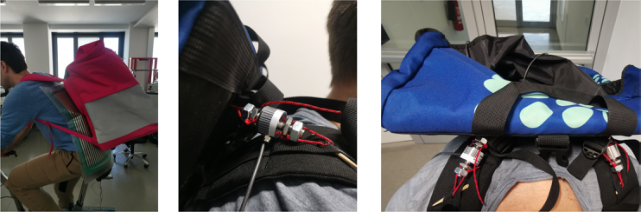
The tests were carried out on an ergometer manufactured by Daum Electronic (Daum Electronic GmbH, Fürth, Bavaria, Germany). This is the 8008 TRS 3 model. The wattage range can be changed in 5-watt increments, which meets the requirements of the experiments. The backpacks used for the tests are from the companies Flink (Flink SE, Berlin, Germany) and Mjam (Mjam GmbH, Vienna, Austria). Pressure sensors from the manufacturer Tekscan (Tekscan, Inc., Norwood, Massachusetts, USA) are used to measure the forces acting on the back and buttocks. Figure 1a shows the pressure sensor under the backpack. The sensors must be calibrated before the measurements. In order to obtain accurate results, the sensors are calibrated in contact between the back and the backpack and a three-point calibration is also performed. The same was done for the calibration on the buttocks.
The associated I-Scan software is used to record and process the sensor signals. For the test series, the pressure sensors are placed between the backpack and the back and between the subject’s buttocks and the saddle. To measure the forces in the shoulder straps, two U9B force sensors (measuring range 0–5 kN) from the manufacturer HBM are used. The shoulder straps of the backpack were cut and replaced with the force sensors. The setup can be seen in Figure 1b and 1c.
Figure 1: a) Pressure sensor between the back and the backpack; b and c) tension sensors for measuring the strap forces.
Measurement Protocol The seat height and the distance between the saddle tip and the upper link are adjusted by the test person themselves in order to achieve a comfortable riding position. The seat height is set to 73.5 cm and the distance between the saddle tip and the upper link is set to 56.5 cm.
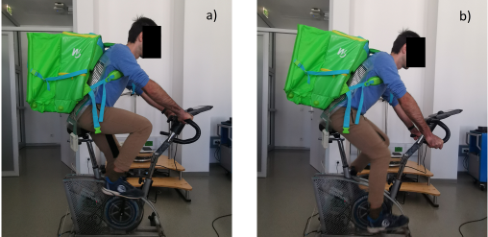
The hand position on the handlebars is specified, as different loads on the back and buttocks are expected depending on the hand position. The two handlebar positions used for the measurement series are a wide, straight grip, as found on city bikes and mountain bikes, and a low hand position, as used on racing bikes. In the measurement series, these are referred to as hands up (Figure 2a) and hands down (Figure 2b).
The additional weight loaded into the backpack corresponds to the usual loads carried by bicycle couriers (information from industry insiders). Measurements are taken with additional weights of 3 kg, 4 kg, 5 kg, 7.5 kg, 10 kg, and 15 kg. Standard steel weight plates and printed paper packages
Ergonomic Impact of Backpacks on Bicycle Couriers 361
are used as weights. When loading, care is taken to ensure that the weights are placed in the center of the backpack and cannot slip during riding. The backpacks from Mjam and Flink each have an additional dead weight of 3 kg, while the JOKR backpack has an additional dead weight of 1.5 kg.
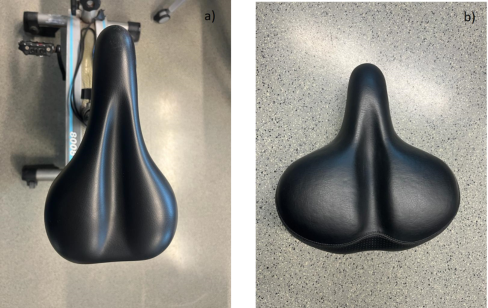
Figure 2: Handlebar positions: a) straight grip (hands up) b) low grip (hands down).Figure 3: a) Racing saddle b) Touring saddle.
The load on the buttocks is measured on two different saddles. The first saddle (Figure 3a) is a hard, narrow racing saddle, the second a wide, well- padded touring saddle (Figure 3b). For the measurements, the test person is instructed to maintain a speed as close to 20 km/h as possible. The measurements are performed at 100 W and 150 W respectively. This results in 48 measurements with the two hand positions for measuring the back load and the buttocks load. The force measurement in the shoulder straps was only performed with a backpack, but additionally in an upright sitting position, resulting in a total of 18 different datasets. Since the pressure sensors exhibit a logarithmic drift (Ferguson-Pell, 1993), which restarts when the load is removed and then reapplied.
RESULTS
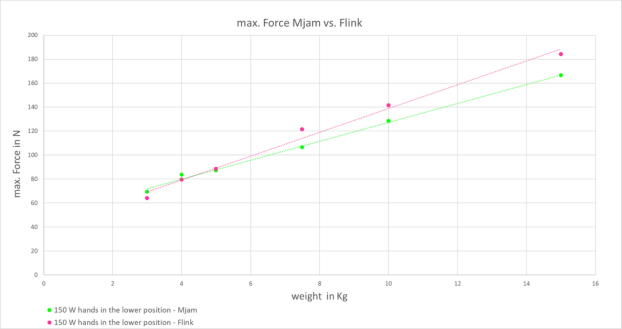
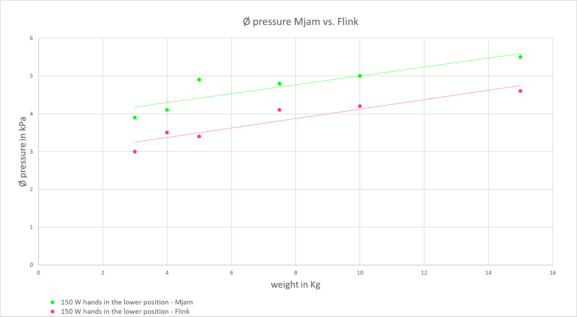
Load on the Back A part of the values obtained from the measurements are presented graphically in Figure 4 and 5. More specifically Figure 4 indicates the difference in max. force between the two backpacks for the 150 W case while the hands are in the down position. Figure 5 indicates the difference in average pressure for the 150 W and down position. As expected, there is a small difference in the measured force between the hand positions (hands down/up). This can be explained by the fact that, in a forward-leaning posture, a smaller proportion of the force is carried by the straps and must therefore be carried by the back. This can also be seen from the measurement of the strap force in Figure 10. In contrast, the pressure measurement does not show any clear difference between the hand positions. This is due to the changing contact surface of the backpack. The maximum force measured is 166.5 N for the Mjam backpack model and 184.2 N for the Flink model. The maximum pressure measured for the Mjam model is 10 kPa. For the Flink model, there is an outlier in the pressure measurement at 15 kg with hands at the top, which is due to a sensor error. Thus, the maximum pressure measured is 9.2 kPa.
Figure 4: Maximum force measured for both backpacks with the hands in the lower position.
There are clear differences between the backpacks from the two suppliers in terms of both force and pressure measurement. As can be seen in Figure 4, the Flink backpack shows that a greater proportion of the force is carried by the back at higher loads. The backpack from Mjam exerts greater pressure (Figure 5) because the contact surface is 55 cm2 smaller on average. On average, the pressure exerted by the Mjam model is 1.23 kPa greater than that exerted by the Flink model.
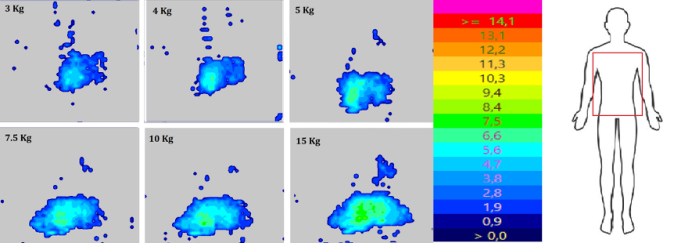
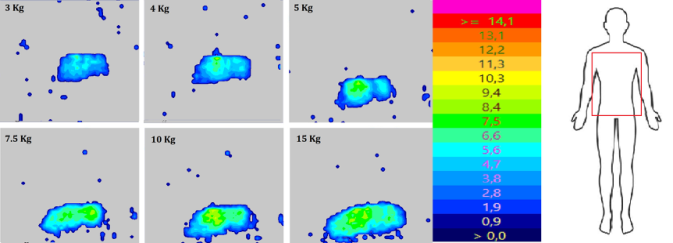
These measurement results also correspond to the perceived wearing comfort. The backpack from Mjam has a narrow edge, which causes uncomfortable pressure in the lumbar spine area. Figures 6 and 7 show how the pressure (average recording) is distributed across the back with both models. It should also be noted that the Mjam model (Figure 7) has individual
Ergonomic Impact of Backpacks on Bicycle Couriers 363
pressure peaks. These pressure peaks further reduce carrying comfort. With the Flink model, the pressure distribution is more even and, in addition, a small part of the load is also carried by the middle of the back.
Figure 5: Measured average pressure for both backpacks and hands in the lower position.Figure 6: Pressure distribution of the backpack from the manufacturer Flink with different loads, legend in kPA, measurement region marked in red.
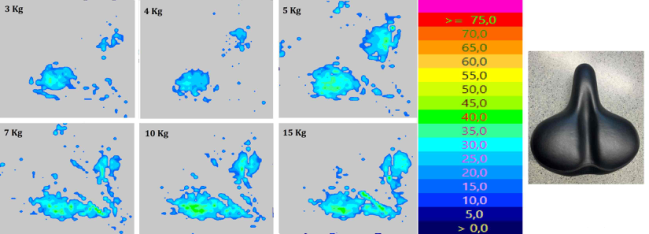
Load on the Buttocks The values increased deviations from the expected linear progression in the force measurement data. The force is calculated from the pressure using these sensors, which means that the surface area changes significantly due to movement, leading to deviations. In addition, shearing between the saddle and the sensor is likely to lead to deviations. The maximum force measured is 302 N for the wide saddle N (hands up, 100 W) and 401 N (hands up, 100 W) for the narrow saddle. However, a linear progression can be observed in the pressure measurement. As expected, the pressure on the buttocks decreases as power increases. Since the pedal force must be increased as power increases, the load on the buttocks decreases. The load also decreases with a low hand
position, as a larger part of the load is transferred from the hands to the bike. The maximum pressure with the wide saddle is 50.7 kPa (hands up, 100 W) and with the narrow saddle 59.1 kPa (hands up, 100 W).
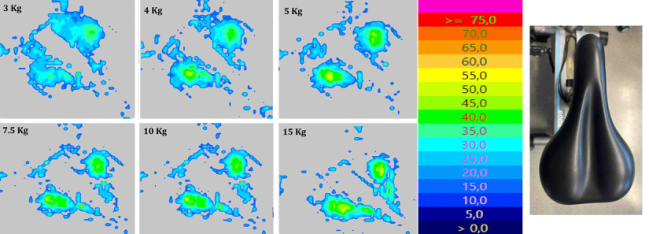
Figure 7: Pressure distribution of the backpack from the manufacturer Mjam with different loads, legend in kPA, measurement region marked in red.Figure 8: Measurement results from the pressure sensors on the wide saddle at 100 W and hands up, legend in kPa.Figure 9: Measurement results of the pressure sensors on the narrow saddle at 100 W and hands up, legend in kPa.
Ergonomic Impact of Backpacks on Bicycle Couriers 365
Figure 8 shows that the test person shifted his weight more to the right side on the wide saddle. On the narrow saddle, the pressure is distributed evenly across the sit bones and the perineum, especially with heavier loads.
It can be seen that the pressure is less evenly distributed on the narrow saddle and that there are significant peaks (Figure 9). The sit bones in particular are subjected to significantly more stress on the narrow racing saddle than on the wide saddle.
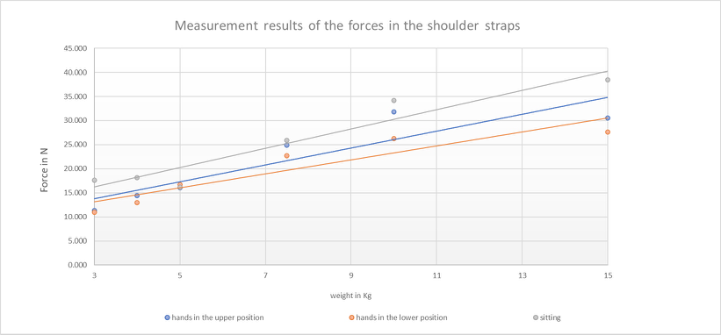
Forces on the Shoulder Straps The results of the measurements of the tensile forces in the shoulder straps can be seen in Figure 10. The results presented are the average values measured by the two sensors shown in Figure 1b and c. The forces shown therefore correspond to the forces acting on one shoulder. The results are as expected. The highest values are seen in the upright sitting position, which shows on average 10 % higher values than the forward leaning sitting position as the backpack can provide less support for the back in the upright position. In the upright position almost, the entire weight is carried by the shoulders. If the body is tilted further forward, the force acting on the shoulders also decreases. As expected, the values also increase linearly with increasing additional weight.
Figure 10: Measurement results of the forces in the shoulder straps.
SUMMARY AND OUTLOOK Pressure and force measurements were used to show the forces acting on the body of a cyclist when they are carrying additional weight. It was possible to show how the pressure is distributed across the cyclist’s back and the magnitude of this pressure. The backpacks used by the delivery services Mjam and Flink were compared. It was found that the pressure exerted on the back by the Mjam backpack was higher than that exerted by the Flink backpack. This finding coincides with the lower level of carrying comfort experienced
with this model. The Fink model showed that the total load carried by the back was greater than that carried by the Mjam model.
By testing two different saddles, it was possible to show how the pressure is distributed between them. The soft touring saddle showed an even distribution of pressure across the sit bones and perineum. In contrast, the racing saddle showed pressure peaks at the sit bones.
As expected, measurements of the forces in the shoulder straps of the backpacks showed that they decrease with a less upright posture, thus shifting the weight to the back. These results also correspond with those from the pressure measurement on the back.
To further improve the results, several series of measurements should be carried out with several test subjects. In order to assess the strain on bicycle couriers more accurately, it would be interesting to measure the forces exerted on the handlebars. Additionally, a relief device was developed to reduce stress on the rider’s body. The device consists of a C-shaped beam mounted on frame of the bike or seat post at one end and connected to a support plate at the other. Functioning as a spring–damper system, it helps to offload weight from the rider’s back, buttocks, and shoulders during use. Preliminary tests indicate a noticeable reduction in forces acting on the body, although further testing is required to fully evaluate its effectiveness. The study was carried out in collaboration with the General Accident Insurance Institution and the Vienna Labor Inspectorate.
ACKNOWLEDGMENT
The authors would like to acknowledge to the General Accident Insurance Institution and the Vienna Labor Inspectorate.
REFERENCES
Allgemeine Unfallversicherungsanstalt (2021) Arbeitsbedingten Muskel-Skelett- Erkrankungen vorbeugen. Brandstädt, F. et al. (2019) Mehrstufige Gefährdungsanalyse physischer Belastungen
am Arbeitsplatz: Gemeinsamer Abschlussbericht der BAuA und der DGUV Band 1. Bressel, E., Bliss, T. B. and Cronin, J. (2009) ‘A field-based approach for examining bicycle seat design effects on seat pressure and perceived stability’, Applied Ergonomics, 40, pp. 472–476. doi: 10.1016/j.apergo.2008.10.001. Costes, F., Turpin, N., Villeger, D., Moretto, P. and Watier, B. (2015) ‘A reduction
of the saddle vertical force triggers the sit–stand transition in cycling’, Journal of Biomechanics, 48(12), pp. 2998–3003. doi: 10.1016/j.jbiomech.2015.07.035. Ferguson-Pell, M. and Cardi, M. D. (1993) ‘Prototype development and comparative evaluation of wheelchair pressure mapping system’, Assistive Technology, 5(2), pp. 78–91. doi: 10.1080/10400435.1993.10132213. Liebers, F. and Schust, M. (2021) Handbuch Gefährdungsbeurteilung - Teil 2: Gefährdungen durch physische Belastung. Available at: https://www.baua.de/DE/ Themen/Arbeitsgestaltung-im-Betrieb/Gefaehrdungsbeurteilung/Expertenwissen/ Physische-Belastung/Einfuehrung/Einfuehrung_dossier.html?view=pdfViewExt (Accessed: 8 October 2025).
Ergonomic Impact of Backpacks on Bicycle Couriers 367
Munoz, N. Y., Solorzano, B. D., Giraldo, K. A. and Cifuentes de la Portilla, C. J. (2021) ‘Biomechanical analysis of delivery cyclist posture’s’, in 2021 IEEE 2nd International Congress of Biomedical Engineering and Bioengineering (CI-IB&BI), Bogota D. C., Colombia, pp. 1–4. doi: 10.1109/ CI-IBBI54220.2021.9626112. Statista (2025) ‘Online food delivery worldwide’. Available at: https:// de.statista.com/outlook/dmo/online-food-delivery/weltweit (Accessed: 8 October 2025). Weiss, B. D. (1985) ‘Nontraumatic injuries in amateur long-distance bicyclists’, The American Journal of Sports Medicine, 13(3), pp. 187–192. doi: 10.1177/ 036354658501300308.
LISTED IN THE AHFE DIGITAL BOOKSTORE CATALOGUE
Explore the complete digital volume
Human Factors in Design, Engineering, and Computing
Read this individual research paper free through the original publisher, or explore the full digital proceedings book.
ISBN 978-1-964867-75-5
Explore this ISBN in the AHFE Bookstore ↗Listed in the July 2026 bookstore catalogue; search by ISBN to confirm current availability · Digital book purchase optional