Li-hui Yang (2025). Parental Behavioral Differences and Psychological Load in Arcade Gameplay: A Case Study on Racing Simulators. In: Human Factors in Design, Engineering, and Computing. AHFE Open Access, vol. 199, pp. 671–679. https://doi.org/10.54941/ahfe1006879
Arcade game centers are public leisure spaces where parents frequently accompany their children. Within such interactive environments, parents may act not only as companions but also as facilitators, strategic guides, or behavioral role models. Compared to solo play, intergenerational co-play involves more complex role negotiation and interactional adaptation, placing parents under dual psychological loads from gameplay challenges and social expectations. This study investigates the behavioral patterns and subjective experiences of parents during accompanied play in public arcade settings and identifies practical implications for human factors and interface design. Thirty parent-child dyads were observed interacting with a motorcycle-themed racing arcade game. Using structured naturalistic observation, six behavioral indicators were recorded: decision-making authority, intervention type, gaze behavior, gameplay duration, instructional behavior, and emotional expression. Post-observation interviews were conducted to assess psychological safety, instructional anxiety, and engagement. Results showed that parents during accompanied play most frequently displayed either positive (33.3%) or neutral (56.7%) facial expressions, with only 10% appearing serious. Gaze was predominantly sustained (80%), with intermittent or no gaze accounting for 10% each. In father-child groups, a recurring “parent-directs, child-plays” pattern was observed, indicating a shift toward instructional or performative roles under cognitive and social stress. Chi-square analysis revealed a significant association between gameplay leadership (parent-led, child-led, co-led) and intervention strategy (full physical, mixed, full verbal) (χ²(4, N = 30) = 15.54, p = .004), with a medium-to-large effect size (Cramer’s V = 0.51). When children led, interventions were exclusively full physical (100%), while parent-led play favored full verbal (52.4%) or mixed strategies (33.3%). No full verbal interventions were observed in co-led situations. The study recommends that arcade systems integrate intergenerational interaction needs through shared control interfaces, adaptive task calibration, and anonymous adult modes to reduce pressure, enhance engagement, and support more inclusive public digital play experiences.
pre-mobile phone era. Visiting arcades with friends was once a common social activity. Over time, those adolescents have grown into parents, now participating in arcade activities in new roles. In recent years, it has become increasingly common for parents to bring children under the age of 12 to arcades. Previous studies have indicated that commercial arcade machines can help reduce stress for both children and adults (Pallavicini et al., 2021). In parent–child co-play scenarios, parents not only act as companions but may also serve as operational assistants, strategic guides, or behavioral models when their children are unfamiliar with game controls or unable to understand game instructions.
Parents’ decisions on game selection often involve multiple factors, such as price affordability, game duration (Leung & Chu, 2023), game genre, and its potential psychosocial effects (Salguero et al., 2009). For example, games with excessive violence or gore may negatively influence children, leading parents to favor age-appropriate games that combine entertainment and interaction. Compared to home gaming, public arcades offer richer opportunities for socialization and interaction, functioning as spaces where technology and physical engagement promote community culture and participation (Gavin et al., 2014).
Among various arcade genres, simulation machines are particularly popular for their realism and immersive environments, allowing players to feel as though they are in real-world settings (Lin & Sun, 2011). In parent–child co-play situations, however, parents face dual challenges: the operational demands of the game and the social evaluation from bystanders. Game scenes and difficulty levels adapt to the player’s proficiency, meaning that players of different ages, reaction speeds, and familiarity levels require varying degrees of assistance. Despite the prevalence of digital gaming, studies show that children still prefer playing in arcades with friends (Aslan et al., 2019) because it forms an important part of their social lives. Age remains a major predictor of game preferences and perceptions (Malito, 2024), and gameplay can help maintain and improve cognitive functions, particularly in middle-aged parents (Kim & Nam, 2022). Gender is another factor, influencing participants’ interests and experiences with digital games (Sayago et al., 2020). Furthermore, arcade games often emphasize competition and cooperation, with solitary play being relatively rare (Braun & Giroux, 1989). As a result, parent–child co-play scenarios involve more intergenerational role negotiation and adaptive interaction.
In a typical arcade simulation game experience, players first choose a theme of interest (e.g., racing, motorcycle riding, flight simulation), often considering the number of tokens required and the attractiveness of the machine’s appearance. They then sit down to familiarize themselves with the controls and ergonomic comfort, follow the tutorial or guidance to begin playing, and review their performance at the end of the game. Decisions on whether to continue are usually based on factors such as time, enjoyment, and the cost of continuation.
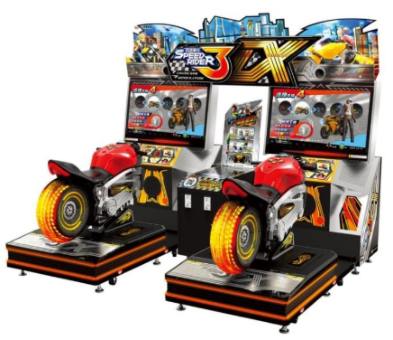
The present study focuses on Speed Raider 3DX, a motorcycle racing simulation arcade game released by Bao Hui Technology in 2020. The machine consists of two motorcycle units, enabling either solo play or
Parental Behavioral Differences and Psychological Load in Arcade Gameplay 673
competitive play against another rider on the same track. Equipped with a motion platform, the game delivers an enhanced sense of speed and immersion. Players can perform various stunts depending on the motorcycle and track selected, and the motion base simulates physical sensations such as wind resistance. Speed Raider 3DX offers single-player, multiplayer, and mid-game challenge modes, with online connectivity enhancing the thrill of competition. Given its widespread presence in major arcades and strong revenue performance in the racing simulation category, this machine was selected as the experimental platform for the current study.
While prior studies have focused primarily on parent–child interactions in home environments, there has been little quantitative analysis of the dual load parents face in public arcade settings—namely, the intrinsic load of game operation and the extrinsic load of meeting social expectations in public. This study aims to investigate these dual demands and quantify the psychological pressure experienced by parents in such settings, thereby addressing a gap in the literature.
METHODS
This study employed a structured naturalistic observation method, in which observers predetermined both the observation sample and the behavioral items, and developed behavioral recording indicators according to the research objectives. Without interfering with the natural interactions between parents and children, six behaviors were observed and recorded: (1) game operation dominance, (2) type of instructional intervention, (3) whether the parent maintained visual attention on the child, (4) game duration, (5) presence of teaching behavior, (6) emotional expressions.
Immediately after the observation, a brief interview was conducted to assess participants’ sense of psychological safety, teaching-related anxiety, and level of engagement during the interaction, thereby enhancing the validity of the study. Finally, the collected behavioral data were analyzed using the chi-square test, and results were normalized with Cramer’s V to examine the degree of association among variables. By exploring the interaction patterns between parental behaviors and psychological workload, this study aims to provide concrete and feasible recommendations for future arcade game machine design, covering aspects such as human factors engineering, interface design, and gameplay mechanics.
Participants A total of 30 parent–child dyads participated in this study. Eligibility criteria required that either both parents or at least one parent accompanied their child aged 6–12 to the arcade and voluntarily chose to play Speed Raider 3DX. Participants were recruited through random sampling at Tom’s World, a large-scale arcade chain in Taiwan. To minimize potential behavioral bias, participants were unaware of the study during both the pre-game and
674 Yang
gameplay phases. Interviews were conducted only after the gameplay session, when participants were preparing to leave. Data from individuals with prior experience playing Speed Raider 3DX were excluded from the analysis to ensure consistent gameplay familiarity across participants.
Materials
The experimental recording device used in this study was an iPad Pro. The arcade machine employed was Speed Raider 3DX (see Figure 1), developed by Baohui Technology in 2020. This motorcycle racing arcade simulator integrates a motion platform, with each unit comprising two motorcycles. Players can choose to play solo or compete against another player on the same track.
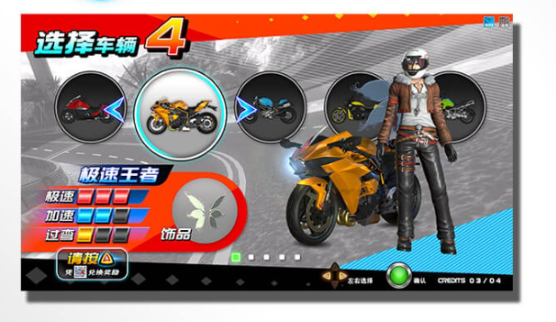
1. Insert coins to start the game, select a character, motorcycle model, and track before entering the race (see Figure 2).
Figure 2: Game menu screen (Baohui Technology, n.d.).
Parental Behavioral Differences and Psychological Load in Arcade Gameplay 675
2. Grip the handlebars, twist the right handle to accelerate, and lean forward to activate the infrared sensor for additional speed. Leaning left or right steers the motorcycle. The right brake handle slows the vehicle, while the left brake handle allows drifting through corners with acceleration. Once the nitro meter is filled, pressing the designated button triggers a transformation boost. The first player to cross the finish line wins. 3. The game features a motion platform mode that simulates vibrations and tilts according to track conditions, enhancing immersion and entertainment.
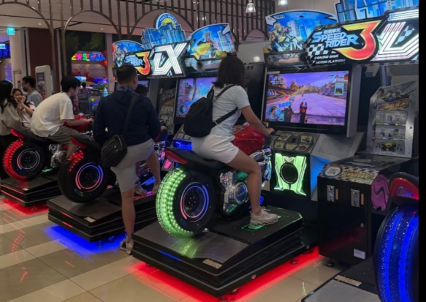
Procedure This study targeted parent–child pairs, or one parent accompanied by a child under the age of 12, visiting an arcade. The observation focused on motorcycle racing games within competitive simulation arcade machines, specifically using the Speed Raider 3DX. Each game session lasted approximately 5 to 15 minutes. A total of 30 families were observed, and the interactions between parents and children during gameplay were recorded (see Figure 3).
Figure 3: Parent-child gameplay on the arcade machine.
Step 1: Observation began when the child started operating the arcade machine and covered the entire process—from game instructions, through active gameplay, to the end of the session—capturing the full range of behavioral interactions between parent and child.
Step 2: The parental role during gameplay was analyzed using a structured naturalistic observation method. Six behavioral indicators were recorded: (1) Game operation dominance — parent-dominated, child-independent, turn-taking, or co-play.
(2) Intervention type — full participation, partial participation, or no participation.
(3) Visual attention to the child — continuous attention, occasional attention, or distracted/diverted attention.
(4) Game duration — one round, two rounds, or three rounds. (5) Teaching behavior — provided game rule instructions or no instruction. (6) Emotional expression — smiling, neutral, or serious.
676 Yang
Step 3: After the observation, a brief open-ended interview was conducted to assess the parent’s psychological experience and instructional approach. Questions included: “Would you guide your child in playing the game? Why or why not?” and “What aspects of the arcade machine do you think could be improved?”
RESULTS AND DISCUSSION
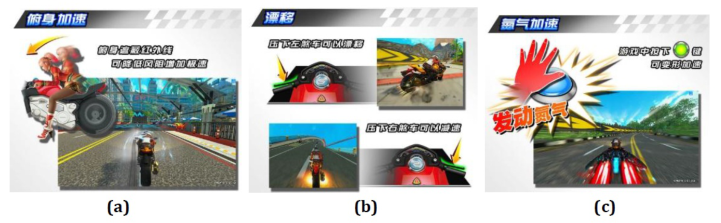
First, in the quantitative analysis, this study examined parental behavior patterns and their interrelationships during gameplay using chi-square tests and Cramer’s V. Observations indicated that children are generally unfamiliar with the operation of motorcycle arcade games, including basic functions (throttle acceleration and braking), game controls (leaning the body left or right to steer), special maneuvers (leaning forward for a speed boost, see Figure 4a; drifting, see Figure 4b), and item usage (photo capture, nitro boost, see Figure 4c). As a result, children often require parental guidance or assistance during gameplay, which became a key focus in both the observations and interviews. Accordingly, six behavioral indicators were recorded using structured naturalistic observation: control dominance, type of intervention, visual attention, game duration, instructional behavior, and emotional expression, to explore parental behavior patterns and psychological states during co-play.
Figure 4: Illustrations of arcade racing machines: (a) leaning forward for speed boost; (b) drifting maneuver; (c) nitro boost. (Baohui Technology, n.d.).
Within the Speed Raider 3DX, we observed three operational behaviors that differ from typical motorcycle driving and directly affect vehicle speed and game outcomes. These features are: (1) tapping the central large button to activate nitro boost, with three nitro charges available per game for strategic use; (2) pressing the left brake to execute a drift for faster cornering, which is a higher-skill maneuver; and (3) leaning forward (body leaning) close to the fuel tank to activate a patented high-speed mode, simulating reduced wind resistance to achieve higher speed. This feature is unique to this machine and uncommon in other similar games. These relatively subtle but critical features are challenging for players unfamiliar with the game, particularly children under 12, making parental guidance essential. The degree and type of parental involvement directly influence game performance.
Parental Behavioral Differences and Psychological Load in Arcade Gameplay 677
Observations further indicated that parents typically assume four roles while accompanying children: (1) Interveners: actively assist children in operating the game; (2) Instructors: provide verbal guidance while the child retains primary control; (3) Observers: monitor safety without direct intervention; and (4) Companions: allow children to play independently while giving minimal attention.
Quantitative results showed that parents mostly displayed positive (smiling, 33.3%) or neutral (56.7%) facial expressions during gameplay, with serious expressions accounting for only 10%, indicating a general willingness to engage and create a pleasant atmosphere. Visual attention was primarily continuous (80%), with intermittent or absent attention each accounting for 10%, reflecting high parental concern for child safety, which was corroborated by interviews. In families where fathers played with children, a “father-led play” pattern was common, in which parents adopted both educational and performative roles, experiencing substantial cognitive and social demands.
Further chi-square analysis revealed a significant association between game operation dominance (parent, child, shared) and type of intervention (full physical, mixed, verbal) (χ2(4, N = 30) = 15.54, p = .004, Cramer’s V = 0.51)(see Table 1), indicating that different control patterns influence parental intervention methods. When children dominated gameplay, parents predominantly engaged in full physical intervention (100%); when parents dominated, verbal guidance (52.4%) or mixed intervention (33.3%) was more common; in shared control scenarios, no full verbal intervention was observed.
Overall, parents tended to maintain positive facial expressions and continuous attention in public settings, which may reflect a phenomenon of “performative parenting,” deliberately displaying active engagement in public. Given that this study’s sample was limited to Asian families, future research could expand to cross-cultural comparisons or integrate physiological measurements to deepen the assessment of psychological load.
Table 1: Association between leadership and intervention strategies.
Table available in the original PDF paper.
Leadership Type Full Physical Mixed Full Verbal Parent-led 14.3% 33.3% 52.4% Child-led 100% 0% 0% Co-led 62.5% 37.5% 0%
CONCLUSION
This study found that when parents bring their children to arcades, they not only act as companions but also teach gameplay skills and directly intervene when their children struggle to operate the game. Such interactions significantly affect parents’ behaviors and psychological states. Therefore, the design of arcade game machines should consider the psychological and behavioral challenges posed by cross-generational interactions. For example, machines should feature shared control interfaces that allow parents and
678 Yang
children to operate together, and dynamically adapt game modes and difficulty levels according to the number of players, accommodating diverse player combinations.
Furthermore, since direct parental participation might affect race rankings and the sense of accomplishment for children under 12, it is recommended to incorporate an anonymous adult operation mode. This can reduce parental stress, improve parent-child interaction quality, and foster a more inclusive public digital gaming experience.
This study is pioneering in analyzing parent-child interactions in arcades from a human factors engineering perspective, with empirical evidence supporting: (1) parents’ behaviors are driven by a “dual load” that requires balancing game guidance and social expectations; (2) game machine design should integrate cross-generational needs, such as dynamic difficulty adjustment and anonymity features. This research provides an important empirical foundation for inclusive design in entertainment technology, with potential future applications extending to immersive platforms like VR.
ACKNOWLEDGMENT
I sincerely thank Tom Bear Amusement Park for providing the venue for this study, and we are grateful to the 30 parent-child families who participated in the experiment, enabling the successful completion of this research. Additionally, all images of the Speed Raider 3DX used in this study were sourced from the official website of Baohui Technology, for which we also express our appreciation.
REFERENCES
Aslan, A., Turgut, Y. E., & Yılmaz, T. K. (2019). Game, environment and peer effect on children on the digital gaming habits in game arcades. Journal of Computer and Education Research, 7(14), 480–495. Baohui Technology. (n.d.). Official website of Baohui Technology. Retrieved August
11, 2025, from https://gtichinaamuse.com/qy/productdetails?id=5324&ref=prod uct. Braun, C. M., & Giroux, J. (1989). Arcade video games: Proxemic, cognitive and content analyses. Journal of Leisure Research, 21(2), 92–105. Gavin, J., Kenobi, B., & Connor, A. M. (2014, December). Social play spaces
for active community engagement. In Proceedings of the 2014 conference on interactive entertainment (pp. 1–5). Kim, S., Koo, M., & Nam, K. (2022). Game experience leads to improvement in cognitive functioning of the early middle-aged adults in contrast with the young- aged adults. Computers in Human Behavior, 129, 107153. Leung, K. M., & Chu, W. (2023). Designing an eSports intervention for middle-
aged and older adults in Hong Kong: Social marketing approach. Plos One, 18(4), e0284504. Lin, H., & Sun, C. T. (2011). The role of onlookers in arcade gaming: Frame analysis of public behaviours. Convergence, 17(2), 125–137. Malito, N. (2024). The Relationship Between Cognitive Reserve, Video Game
Playing, and Cognition in Older Adults (Doctoral dissertation, Keiser University).
Parental Behavioral Differences and Psychological Load in Arcade Gameplay 679
Pallavicini, F., Pepe, A., & Mantovani, F. (2021). Commercial off-the-shelf video games for reducing stress and anxiety: Systematic review. JMIR mental health, 8(8), e28150. Salguero, R. T., del Río, M. P., & Vallecillo, J. L. G. (2009). Efectos psicosociales
de los videojuegos. Comunicación. Revista Internacional de Comunicación Audiovisual, Publicidad y Estudios Culturales, 1(7), 235–250. Sayago, S., Blat, J., & Barbosa Neves, B. (2020, November). At the Intersection of Digital Games, Gender, and Age: A Participant Observational Study with Active Older Women. In Extended Abstracts of the 2020 Annual Symposium on Computer-Human Interaction in Play (pp. 360–364).
LISTED IN THE AHFE DIGITAL BOOKSTORE CATALOGUE
Explore the complete digital volume
Human Factors in Design, Engineering, and Computing
Read this individual research paper free through the original publisher, or explore the full digital proceedings book.
ISBN 978-1-964867-75-5
Explore this ISBN in the AHFE Bookstore ↗Listed in the July 2026 bookstore catalogue; search by ISBN to confirm current availability · Digital book purchase optional