Smart materials have been widely studied for interactive physicalization, yet novice designers lack support in integrating them effectively. This study introduces Lumora Cards, a tangible interface combining physical material samples with annotated portfolio guidance to facilitate heuristic exploration. The cards map 180 design elements across five stages, enabling context-appropriate material selection. In a 12-day workshop with 32 novices, quantitative results showed that Lumora Cards significantly enhanced creativity, confidence, and perceived usefulness. Qualitative findings provided actionable methods for workflow integration. This work offers both a theoretical framework and practical tools for applying smart materials in interactive physicalization design.
Physicalization involves representing and interacting with abstract data through physical entities (Bae et al., 2022). As the field shifts from static mapping to dynamic systems, Interactive Physicalization (IP) has attracted increasing interest in domains such as personal health and public communication. In IP, Smart Materials (SMs) serve as dynamic mediators between data and user perception (Ding et al., 2024), transforming abstract information into tangible, changeable forms (Ding et al., 2024) and supporting real-time bidirectional interaction (Hogan & Hornecker, 2013). Composed of environment-responsive units, SMs encode data directly through their dynamic properties, enabling real-time expression and enriched interaction (Ke et al., 2023). Although prior work(Boem & Iwata, 2018) Received February 4, 2026; Revised March 28, 2026; Accepted April 13, 2026; Available online July 20, 2026
Lumora Cards: An Annotated Portfolios-Based Design Tool 97 (Minuto & Pittarello, 2015) has employed SMs as tangible interfaces for data visualization, few studies have focused on bridging theory and practice for novice designers or on systematically integrating multidisciplinary knowledge through hands-on material exploration.
Despite their potential, applying SMs in IP heavily depends on designers’ intuitive grasp of material-data relationships (Hurtienne et al., 2020) , which poses a significant challenge for novices (Lin & Lu, 2024). Existing research often prioritizes technical implementation over systematizing two key issues: lowering the learning barrier via design tools, and operationalizing embodied SM experiences (e.g., haptics (Sauvé et al., 2024) , shape-change (Ding et al., 2024) ) for data-expression goals. To address this gap, we propose Lumora framework and card tools based on the annotated portfolio methodology hh(APM) (Gaver & Boucher, 2024). The reason we use APM is that moving beyond literature reviews often limited to abstract theories (Bae et al., 2022) (Ranasinghe & Degbelo, 2023). In our study, we reconcile abstract principles (e.g., material responsiveness (Delany et al., 2012) ) with concrete design cases (Boem & Iwata, 2018) (Minuto & Pittarello, 2015) through a process of theory→case validation→pattern extraction. This forms the basis of our first research question: RQ1: How to systematize SMs integration into IP design using APM? Building on APM, we developed Lumora Cards to guide SMs application in IP. Unlike conventional card-based tools (Halskov & Dalsgård, 2006) (Hsieh et al., 2023), Lumora Cards integrate a hierarchical theoretical framework with embedded physical SM samples, encoding meta-rules as actionable design elements while providing tangible references for multimodal interaction. This leads to our second question:
RQ2: Whether and how does the Lumora Cards support novice designers in leveraging SMs to achieve IP?
We conducted a between-group workshop experiment. Results from eight novel design concepts, supported by quantitative and qualitative data, confirmed that the APM-based tool enhanced novices’ understanding of IP principles, improved SM application skills, and fostered creative material integration.
Our contributions are: (1) exploring the effectiveness of APM-based card tools for IP design; (2) proposing a novel tool that integrates SM samples with cards to guide novices; (3) empirically validating Lumora’s guidance through a card-based design process, contributing to the development of SM-enabled IP design tools.
METHODOLOGY
Four guiding principles underpinned the framework’s development using APM: (1) Indexicality: Design knowledge is derived from concrete cases and shared
accessibly, using visual formats and tangible material samples. (2) Process Support: The tool provides a coherent framework guiding participants through all workshop phases.
(3) Open-Endedness: Prompts are problem-oriented, incorporating blank areas and multiple-choice options to stimulate divergent thinking. (4) Layered Annotation: A three-tier structure (foundational workflow,
explanatory knowledge with materials, and extended guidance) offers structured yet flexible scaffolding.
Our framework development followed three key steps: (1) Case Collection & Categorization: We collected and analyzed 30 peer-
reviewed cases on smart material-data integration, tagging recurring patterns. (2) Hierarchical Annotation: Cross-case strategies were identified, innovative approaches distilled, and actionable workflows formalized into a tiered framework. (3) Pilot Validation: Experts evaluated the framework’s practicality by
applying it to a “natural interaction” theme, leading to iterative refinements.
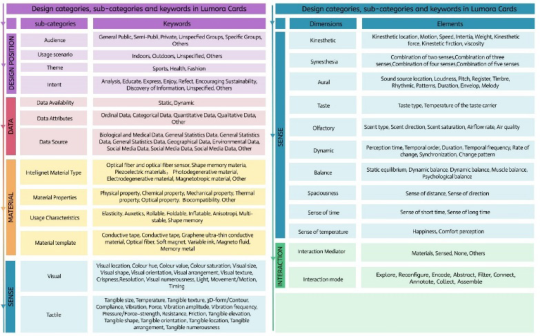
Through APM analysis, we categorized the framework into five dimensions: Design Position, Data, Material, Sense, and Interaction (Figure 1). This structure is non-linear, allowing users to move fluidly between categories to refine their design approach. When using it, users can also flexibly move between, combine, and iteratively adjust the above five dimensions to refine their approach.
Figure 1: The overview of the design framework.
THE WORKSHOP To evaluate the framework’s efficacy, we implemented it through Lumora card-based design tool, which integrates tangible SMs samples. A between- subjects experiment was conducted to examine the impact of the tool and address RQ1 and RQ2. This led to two research hypotheses:
H1: The APM framework fosters significant creativity in IP utilizing SMs.
H2: Incorporating hands-on SMs samples as experiential TEI cards results is effective in IP design.
The Tools of the Workshop The Lumora Cards
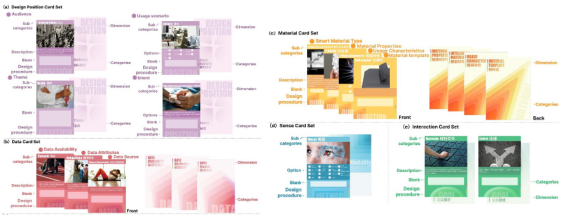
The framework is presented to users through Lumora Cards (Figure 4), designed for clarity and ease of use. The cards are organized into five color- coded categories: DESIGN POSITION (purple), DATA (pink), MATERIAL (yellow), SENSE (blue), and INTERACTION (green).
(1) Description Cards include visual references, textual explanations, and reflection areas. (2) Sticky Cards incorporate a section for attaching physical SM samples,
allowing tactile exploration of material properties (Figure 2). Materials that were difficult to source, fabricate, or posed safety risks were excluded. (3) Tick-Box Cards offer quick selection options for categorical elements.
All cards feature a front-side image corresponding to the card name, with uniform dimension information on the back. DESIGN POSITION cards include blank areas for user notes. DATA cards focus on data characteristics. MATERIAL cards comprise both Description and Sticky types, supplemented with a blank template card and introductory case studies to encourage creative exploration without constraint. SENSE cards cover 13 sub-categories, many with tick-box options for sensory aspects. INTERACTION cards guide consideration of product-user interaction. Each category also provides an “other” card for users to note additional ideas not included in the set.
Figure 2: The types of the Lumora cards. (a) Description Card. (b) Sticky Card. (c) Tick Box Card.
3.1.2 The Lumora Canvas
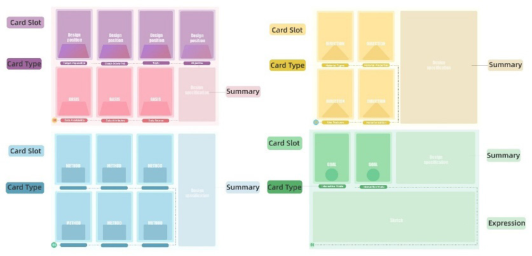
To standardize card use, we developed a structured canvas that scaffolds the design process. The canvas organizes the five card categories and includes a dedicated area for articulating design thinking (Figure 3). Designed to be used sequentially with the playbook, it allows participants to place selected
cards in “The card placement area” and subsequently describe their design concepts in “The design specification area.”
Figure 3: The overview of the canvases.
Participants We recruited 32 design students (8 males, 24 females; age M = 22.63, SD = 2.11) through online outreach. All participants had at least one year of design experience and basic knowledge of design methods. Using a 5-point Likert scale (1 = inexperienced, 5 = experienced), their self-reported expertise was confirmed novice status in both smart materials (M = 1.5, SD = 0.5) and interactive physicalization design (M = 1.47, SD = 0.34). Informed consent was obtained prior to the experiment, with participants allowed to withdraw at any time. No monetary compensation was provided, though they could keep their prototypes. Participants self-organized into 8 groups (G1–G8) of at least two members each, with G1–G4 assigned to the experimental group (EP1–EP16) and G5–G8 to the control group (CP17–CP32).
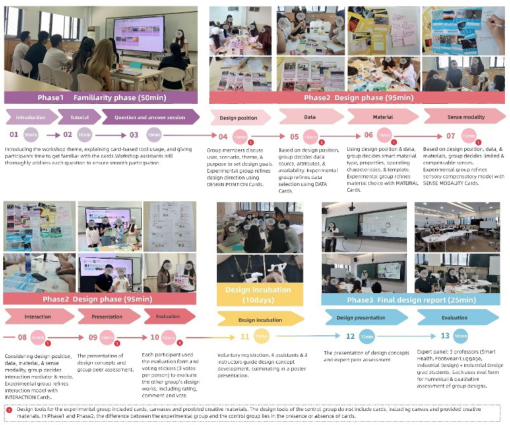
Figure 4: Workshop procedure.
Lumora Cards: An Annotated Portfolios-Based Design Tool 101 Workshop Procedure
As shown in Figure 4, the workshop comprised three phases, each with identical steps for the experimental group (with Lumora cards) and the control group (without cards).
Phase 1: Familiarity A 40-minute pre-workshop orientation introduced the theme “Fashion Design of Sports Products in the Context of General Health,” structured as a 20minute introduction, 10minute tutorial, and 10minute Q&A.
Phase 2: Design This 3-hour session began with tool distribution. The experimental group used Lumora cards with a canvas and materials, while the control group worked with only the canvas and materials. Groups then conducted 15-minute ideation for each of the five categories, followed by presentations, peer evaluation, and prototype creation, where interested groups further refined their prototypes and posters with researcher guidance within a 10-day incubation period.
Phase 3: Final Design Report Each group gave a 15-minute presentation of their design concepts in dedicated spaces. Three professors from School of Fashion Accessory, Beijing Institute of Fashion Technology evaluated via expert forms, scoring material selection appropriateness, multisensory data mapping effectiveness and interaction novelty, and providing written feedback.
Data Collection and Analysis Quantitative data were collected through pre- and post-workshop surveys. We adapted Bandura’s self-efficacy framework (Bandura, 2022) with nine items (scale 0–100) measuring confidence in building IP prototypes with SMs. Perceived usefulness and ease of use were assessed via a seven-point Likert scale (He et al., 2018) (Zhang et al., 2023). Post-workshop creativity was evaluated using the Creativity Support Index (CSI) (Carroll & Latulipe, 2009) . As data violated normality (Shapiro–Wilk, p < .05), nonparametric tests were applied in SPSS.
Qualitative data included semistructured interviews conducted after Phase 2, focusing on participants’ views of the framework, tools, workshop experience, and SM application in IP. All interviews were recorded and transcribed. We also collected conceptual outputs from Phase 2, final presentations from Phase 3, and observational notes. Thematic analysis was performed by eight researchers who independently coded the material, then discussed and synthesized the findings into four main themes.
RESULTS
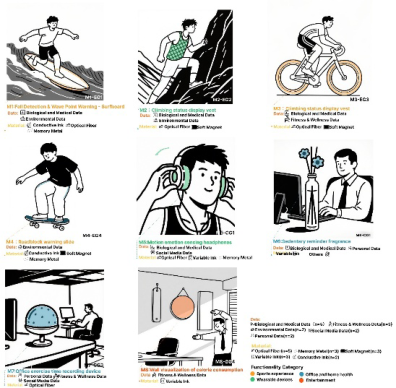
Mockups Following the workshop, eight initial IP concepts were generated, five of which were developed into complete design boards. These outcomes,
centered on the theme of “sports, fashion, and health,” illustrate applications of SMs across visible and tangible product areas, enabling personalized data interaction(Figure 5).
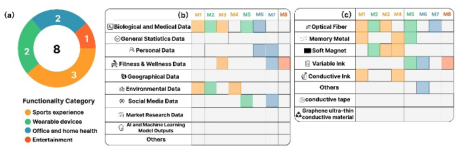
Functional analysis (Figure 6(a)) classified the designs into sports experience (3), office/home health (2), wearable devices (2), and entertainment (1). The predominance of sportsrelated concepts highlights participants’ focus on enhancing activity through realtime data perception. Designs also reflect growing attention to health in daily environments, indicating SMbased IP can address practical wellbeing needs.
Figure 5: Visualization of 8 concepts from the workshop. M# - the index of each concept.
Data selection (Figure 6(b)) shows that all concepts incorporated dynamic data aligned with product attributes and user interaction goals, underscoring the role of contextrelevant data in effective IP design.
SMs usage (Figure 6(c)) reveals shapechanging and lightemitting/ colorchanging materials as the most frequently employed. In sports equipment, SMs were integrated to enhance product functionality; in wearables, material comfort and optical properties were prioritized. These patterns suggest a preference for accessible, operable materials that support creative expression in IP.
Figure 6: Classification of concept design outcomes by (a) functionality, (b) data classification, (c) smart material utilization.
Lumora Cards: An Annotated Portfolios-Based Design Tool 103 Expert Evaluation
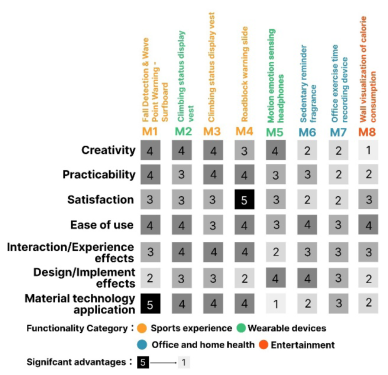
Five design experts evaluated the final concepts across seven criteria using a 5-point Likert scale. As shown in Figure 7, the experimental group (M1–M4) scored significantly higher than the control group (M5–M8) in Creativity, Interaction/Experience effects, and Material technology application, confirming that the APM-based Lumora framework and hands-on material cards effectively fostered creative and interaction-driven outcomes. While experts acknowledged the concepts’ creativity and experiential quality, they also noted concerns about practical implementation and industrial scalability, underscoring the need for further technical and design refinement to advance SM-based IP toward real-world productization.
Figure 7: The rating results of the concepts from professional design team.
Quantitative Results Framework Enhances Creativity and Self-Efficacy (H1)
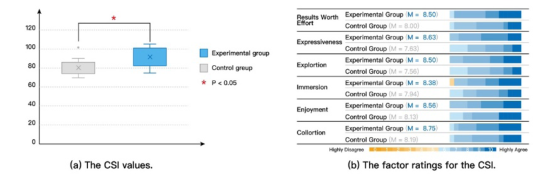
CSI scores show that the experimental group rated creativity support significantly higher (M = 83.67) than the control group (M = 75.33) (Wilcoxon Z = 2.138, p < 0.05), with higher scores across all CSI factors (Figure 8). Self-efficacy (Cronbach’s α = 0.97) improved significantly in both groups after the workshop (experimental: Z = 4.826, p < 0.001; control: Z = 4.636, p < 0.001), with the experimental group showing greater improvement (Z = 4.825, p < 0.001).
Figure 8: Results of CSI.Table 1: Median (lower quartile, upper quartile), and Wilcoxon tests for self-efficacy.
Table available in the original PDF paper.
Self-efficacy Questionnaire
Groups M (P25, P75)
Pre Post Z, p Improv. * Experimental Group 32.50 91.33 4.826 58.17
(29.11, 34.7) (89.22, 92.64) .000*** (54.81, 61.36) Control Group 40.28 58.39 4.636 15.11
(35.4, 45.67) (54.39, 60.53) .000*** (13.25, 23.08) Z, p 4.825
.000***
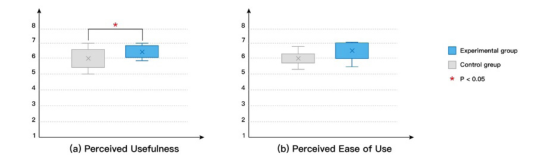
Hands-on SM Samples Improve Usability (H2) The experimental group rated tool usability significantly higher (M = 6.33) than the control group (M = 5.91) (Z = 2.087, p < 0.05) (Figure 9). Perceived ease of use did not differ significantly between groups (experimental: M = 6.33; control: M = 6.08).
Figure 9: Results of the usability and ease of use scale. (a) perceived usability (b) perceived ease of use.
Summary The results support H1, as APM-based tools significantly improved perceived creativity support and self-efficacy. They also support H2, as hands-on SM samples significantly enhanced perceived usability, though not ease of use.
Qualitative Results APM Provides Comprehensive Guidance for IP Design
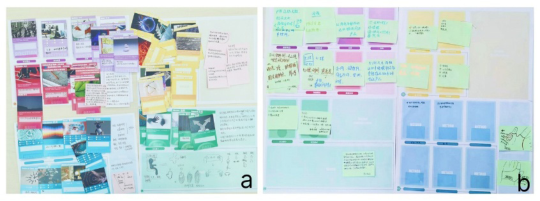
The APM-based card system supported structured yet flexible ideation, with participants reporting that the categorized design elements broadened their perspectives on sensory experience, data representation, and material selection. For instance, EP10 noted that concepts like “balance” prompted deeper consideration of sensory duration, while EP07 valued the material taxonomy for enabling property-based choices. The framework also improved design communication, allowing rapid grasp of material characteristics (EP2) and use of precise terminology (EP11), and helped translate inspiration into actionable plans while early identifying unfeasible elements (EP15) (see Figure 10 (a)). In contrast, control group participants cited knowledge gaps that
Lumora Cards: An Annotated Portfolios-Based Design Tool 105 limited divergent thinking (CP22) and led to less coherent goals (CP27) (see Figure 10 (b)). Although the cards standardized process organization (EP3) and incremental development (EP6), users adapted them flexibly, often iterating non-linearly across categories to tailor the sequence to their group’s needs.
Figure 10: Tool usage. (a) experimental group. (b) control group.
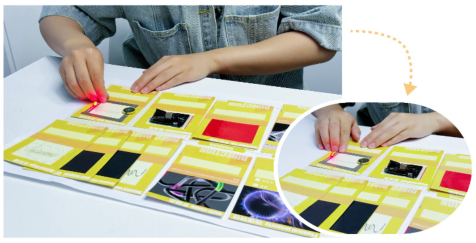
Handson SM Integration Enhanced Novice Designers’ SelfEfficacy The integration of handson SM samples with cardbased tools enabled rapid design learning and sensorydriven exploration(see Figure 11). Direct interaction with materials such as thermochromic yarn provided tangible understanding of SM properties and supported concrete idea generation. Participants noted that material tactility and dynamic behaviors enriched data experiences and expanded design possibilities, while the framework encouraged the use of both primary and compensatory senses, for example, by augmenting motion data with visual or olfactory stimuli. This approach offered alternative design strategies and deepened attention to embodied, emotioncentered interaction.
Figure 11: The overview of the MATERIAL cards.
Design Opportunities Participants proposed material and format improvements, including magnetic attachments (CP22, EP11) for easy reuse and thicker cardstock (CP20) for durability. Card layout could be enhanced by printing secondary terms on the front for quicker reference, and a digital tool version was suggested to autogenerate design logic. To improve information accessibility, a concise
handbook with SM examples (EP15) was recommended to clarify technical terms like “anisotropy.” Further ideas included embedding QR codes for extended content (EP15) and enlarging card display areas for multicard viewing (EP16).
DISCUSSION
This paper presents an APMderived framework and cardbased workshop that integrates handson SM samples to guide novice designers in IP. We validated its effectiveness in enhancing creativity and usability (RQ1) and in supporting novices through tangible SM experience (RQ2).
Integrating Practical Knowledge for IP Guidance The framework synthesizes interdisciplinary knowledge into a structured system that helps novices initiate and develop SMinformed IP designs. Participants reported that SM characteristics, material classifications, and case examples expanded their knowledge and aided material selection, reducing conceptual complexity. Unlike prior studies (Aarts et al., 2020) (Zhang et al., 2023), we observed users iteratively adjusting designs by moving between MATERIAL, DESIGN POSITION, and DATA cards, demonstrating flexible, nonlinear engagement. While crossdisciplinary frameworks are known to foster innovation (Sauvé et al., 2022), future work should continue bridging theory and practice (Halskov & Dalsgård, 2006) (Xue et al., 2024).
Handson Design Through SMEmbedded Cards Existing card tools often represent theoretical structures (Wang et al., 2024) (Zhang et al., 2023); ours extend this by embedding physical SM samples. On MATERIAL cards, participants could interact directly with samples, such as attracting ferrofluid with magnets or lighting bulbs with conductive ink, gaining tangible understanding beyond text and images. Combined with provided DIY tools including clay and cardstock, this enabled rapid prototyping and realtime concept refinement. Feedback confirmed improved material comprehension and deeper engagement, aligning with prior findings on tangible cards’ role in sparking creativity and collaboration (Messerschmidt et al., 2022) . Future designs could explore more modular SM integration (Liu et al., 2023) to enrich handson, sensorydriven exploration.
Practical Considerations for SM- Enabled Rapid Prototyping Openended SM exploration effectively stimulated IP creativity. Embedding SM knowledge and samples as tangible TEI cards clarified design options and expanded the creative space. During the workshop, SMs were embedded in two ways: (1) in ideation, via sticky cards with physical samples and explanatory text; (2) in prototyping, through diverse SM materials that allowed realtime, tangible concept iteration. Participants noted strengthened material understanding and application. Future work may investigate more modular, scalable approaches to embedding SMs in design tools (Liu et al., 2023).
LIMITATIONS AND FUTURE WORK This study is limited by the relatively narrow diversity of participants’ design backgrounds, which may restrict the generalizability of the findings. Future work should expand recruitment and systematically categorize participants by their prior expertise in smart materials and interactive physicalization to better understand how background shapes design outcomes.
CONCLUSION
This paper introduces an APM-derived framework for IP design, materialized through card-based tools that integrate hands-on SM samples as tangible embedded interfaces. The Lumora framework, structured across five categories and 180 design elements, was evaluated in a controlled workshop with 32 novice designers. Results demonstrate that the framework and embedded SM samples effectively support novices in approaching IP design, enhancing creativity, confidence, perceived usefulness, and facilitating rapid knowledge application. This work offers a practical, sensorydriven approach to integrating smart materials into IP design and highlights the value of embodied experience in technologymediated creative processes.
ACKNOWLEDGMENT
This work is supported by the Beijing Social Science Foundation Project (23YTC045). We also extend our gratitude to Qian Nie, Yaohua Wang, Yiming Cui, and Yan Yan from the Beijing Institute of Fashion Technology for providing the workshop venue and contributing expert evaluations. Furthermore, we sincerely thank every participant and all individuals who contributed to this study.
REFERENCES
Aarts, T., Gabrielaitis, L. K., De Jong, L. C., Noortman, R., Van Zoelen, E. M., Kotea, S., Cazacu, S., Lock, L. L., & Markopoulos, P. (2020). Design Card Sets: Systematic Literature Survey and Card Sorting Study. Proceedings of the 2020 ACM Designing Interactive Systems Conference, 419–428. https://doi. org/10.1145/3357236.3395516 Bae, S. S., Zheng, C., West, M. E., Do, E. Y.-L., Huron, S., & Szafir, D. A. (2022).
Making Data Tangible: A Cross-disciplinary Design Space for Data Physicalization. CHI Conference on Human Factors in Computing Systems, 1–18. https://doi. org/10.1145/3491102.3501939 Bandura, A. (2022). Self-efficacy: Toward a unifying theory of behavioral change.
Psicoterapia Cognitiva e Comportamentale, 28(1), 81–104. Scopus. Boem, A., & Iwata, H. (2018). “It’s like holding a human heart”: The design of Vital + Morph, a shape-changing interface for remote monitoring. AI & SOCIETY, 33(4), 599–619. https://doi.org/10.1007/s00146-017-0752-1 Carroll, E. A., & Latulipe, C. (2009). The creativity support index. CHI ’09 Extended
Abstracts on Human Factors in Computing Systems, 4009–4014. https://doi. org/10.1145/1520340.1520609
Delany, S. J., Buckley, M., & Greene, D. (2012). SMS spam filtering: Methods and data. Expert Systems with Applications, 39(10), 9899–9908. https://doi. org/10.1016/j.eswa.2012.02.053 Ding, Y., Sabnis, N., & Strohmeier, P. (2024). Motionless Movement: Towards
Vibrotactile Kinesthetic Displays. Proceedings of the CHI Conference on Human Factors in Computing Systems, 1–16. https://doi.org/10.1145/3613904.3642499 Gaver, W., & Boucher, A. (2024). Designing with Data: An Annotated Portfolio.
ACM Transactions on Computer-Human Interaction, 3685272. https://doi. org/10.1145/3685272 Halskov, K., & Dalsgård, P. (2006). Inspiration card workshops. Proceedings of the 6th Conference on Designing Interactive Systems, 2–11. https://doi. org/10.1145/1142405.1142409 He, Y., Chen, Q., & Kitkuakul, S. (2018). Regulatory focus and technology
acceptance: Perceived ease of use and usefulness as efficacy. Cogent Business & Management, 5(1), 1459006. https://doi.org/10.1080/23311975.2018.1459 006 Hogan, T., & Hornecker, E. (2013). In touch with space: Embodying live data for tangible interaction. Proceedings of the 7th International Conference on Tangible, Embedded and Embodied Interaction, 275–278. https://doi. org/10.1145/2460625.2460671 Hsieh, G., Halperin, B. A., Schmitz, E., Chew, Y. N., & Tseng, Y.-C. (2023). What is
in the Cards: Exploring Uses, Patterns, and Trends in Design Cards. Proceedings of the 2023 CHI Conference on Human Factors in Computing Systems, 1–18. https://doi.org/10.1145/3544548.3580712 Hurtienne, J., Maas, F., Carolus, A., Reinhardt, D., Baur, C., & Wienrich, C.
(2020). Move&Find: The Value of Kinaesthetic Experience in a Casual Data Representation. IEEE Computer Graphics and Applications, 40(6), 61–75. https:// doi.org/10.1109/MCG.2020.3025385 Ke, P., Yang, X., & Zhu, K. (2023). SoftVibe: Enhancing On-Body Haptic Feedback in VR using Rapid-Prototyping Toolkit with Modularized Flexible Vibrotactile Device. SIGGRAPH Asia 2023 Emerging Technologies, 1–2. https://doi. org/10.1145/3610541.3614575 Liu, S., Gu, W., Guo, Z., & Tang, N. (2023). A data-based architecture of smart
workshop based on multi-intelligent units. 2023 35th Chinese Control and Decision Conference (CCDC), 5111–5115. https://doi.org/10.1109/ CCDC58219.2023.10326721 Messerschmidt, M. A., Muthukumarana, S., Hamdan, N. A.-H., Wagner, A., Zhang, H., Borchers, J., & Nanayakkara, S. C. (2022). ANISMA: A Prototyping Toolkit to Explore Haptic Skin Deformation Applications Using Shape-Memory Alloys. ACM Transactions on Computer-Human Interaction, 29(3), 1–34. https://doi. org/10.1145/3490497 Minuto, A., & Pittarello, F. (2015). Smart Materials: When Art Meets Technology.
Income A. Nijholt (ed.), More Playful User Interfaces: Interfaces that Invite Social and Physical Interaction (Page 177–196). Springer Singapore. https://doi. org/10.1007/978-981-287-546-4_8 Ranasinghe, C., & Degbelo, A. (2023). Encoding Variables, Evaluation Criteria, and Evaluation Methods for Data Physicalisations: A Review. Sauvé, K., Brombacher, H., Van Koningsbruggen, R., Veldhuis, A., Houben, S.,
& Alexander, J. (2024). Physicalization from Theory to Practice: Exploring Contemporary Challenges for Physicalization Design. Designing Interactive Systems Conference, 368–371. https://doi.org/10.1145/3656156.3658381
Lumora Cards: An Annotated Portfolios-Based Design Tool 109 Sauvé, K., Sturdee, M., & Houben, S. (2022). Physecology: A Conceptual Framework
to Describe Data Physicalizations in their Real-World Context. ACM Transactions on Computer-Human Interaction, 29(3), 1–33. https://doi.org/10.1145/3505590 Wang, Z., Hao, S., & Carpendale, S. (2024). Card-Based Approach to Engage Exploring Ethics in AI for Data Visualization. Extended Abstracts of the CHI Conference on Human Factors in Computing Systems, 1–7. https://doi. org/10.1145/3613905.3650972 Xue, X., Li, X., Jia, B., Du, J., & Fu, X. (2024). Who Should Hold Control? Rethinking
Empowerment in Home Automation among Cohabitants through the Lens of Co-Design. Proceedings of the CHI Conference on Human Factors in Computing Systems, 1–19. https://doi.org/10.1145/3613904.3642866 Zhang, X., Han, D., Dong, Y., & Ren, X. (2023). DataVisage: A Card-Based Design Workshop to Support Design Ideation on Data Physicalization. Entertainment Computing – ICEC 2023: 22nd IFIP TC 14 International Conference, ICEC 2023, Bologna, Italy, November 15–17, 2023, Proceedings, 471–483. https://doi. org/10.1007/978-981-99-8248-6_45
LISTED IN THE AHFE DIGITAL BOOKSTORE CATALOGUE
Explore the complete digital volume
Creativity, Innovation and Entrepreneurship
Read this individual research paper free through the original publisher, or explore the full digital proceedings book.
ISBN 978-1-964867-82-3
Explore this ISBN in the AHFE Bookstore ↗Listed in the July 2026 bookstore catalogue; search by ISBN to confirm current availability · Digital book purchase optional