Hanna Koskinen, Nina Flink, Bastian Tammentie (2026). Operator information needs in underground hydrogen storage monitoring. In: Human Error, Reliability, Resilience, and Performance. AHFE Open Access, vol. 213, pp. 183–191. https://doi.org/10.54941/ahfe1007567
Underground Hydrogen Storage is gaining prominence as a solution for balancing energy grids in the transition to renewable energy, particularly as hydrogen offers flexibility amid the intermittency of renewables. However, deploying underground hydrogen storage within the Finnish energy system and bedrock conditions introduces complex technical, human, and organizational challenges. This research, conducted as part of the HUG Hydrogen Underground project, explores critical human factors in underground hydrogen storage development, focusing on operator roles, essential human tasks, and competency requirements to ensure safe operation. Using Work Domain Analysis —the first phase of Cognitive Work Analysis—the study characterizes the functional structure and operator support needs of storage system, considering constraints, purposes, processes, and physical components. An abstraction hierarchy model was created to define system purposes, values, and functions, facilitating the identification of critical operational dependencies and areas demanding operator understanding. Ten functional monitoring themes were developed to guide a participatory exercise involving HUG project experts in geology, engineering, safety, and operations, using Microsoft Whiteboard for collaborative input. The analysis of participant responses led to an initial monitoring concept, highlighting operator-critical information flows, interface design considerations for system-level oversight, and situational awareness requirements specific to underground hydrogen storages. In addition, visual mock-ups were prepared to illustrate potential displays for storage system (e.g., storage integrity, hydrogen inventory, and injection–withdrawal dynamics). The findings underscore the importance of integrating human factors early in system design to e.g., align monitoring concepts with operator information needs, laying a foundation for safe and effective storage operations.
The global energy system is undergoing a profound transition driven by the urgent need to reduce greenhouse gas emissions and to accelerate the deployment of sustainable, carbonneutral energy solutions. This shift is characterized by a rapidly increasing entering and integration of renewable energy sources—most notably wind and solar power—into our energy portfolios. Although these renewable technologies offer clear environmental Received February 20, 2026; Revised April 7, 2026; Accepted April 27, 2026; Available online July 20, 2026
advantages, their dependence on weather and seasonal variability introduces also substantial challenges, for example, maintaining the stability and reliability of the energy system across.
Hydrogen has emerged as one promising candidate capable of addressing these challenges by enabling balancing function in operations in energy systems including variable renewable generation. To realize this potential, robust and efficient hydrogen storage solutions are required. Among the options currently under exploration, underground hydrogen storage (UHS) in lined rock caverns (LRCs) is considered a promising candidate for northern European conditions. However, largescale underground storage introduces a range of technical, organizational, and human-related challenges that must be thoroughly understood to ensure safe and efficient operation. In particular, to mention some, significant uncertainties remain regarding suitable liner solutions for LRCs, appropriate maintenance practices over the storages’ lifetime, and the types of operational phenomena and conditions that should be monitored reliably during storage operations.
Hydrogen’s natural physical properties, including its high flammability and susceptibility to ignition, place rigorous demands on monitoring and control of storage processes as well as the safety management or the operations. Historical evidence shows that hydrogen-related incidents frequently involve organizational shortcomings, design flaws, or human errors during operation and maintenance work of hydrogen systems (e.g., Alfasfos et al., 2024; Wen et al., 2022). This underscores the importance of developing comprehensive sociotechnical system understanding that integrate not only technical measurements but also human and operational considerations that influence system safety.
This study is conducted within the Business Finland funded Hydrogen UnderGround (HUG) research project, which aims to establish a foundation for a largescale UHS concept tailored to Finnish conditions. Our research specifically addresses the human and social factors associated with UHS operations. In this paper, we focus on the development of a monitoring concept capable of supporting the safe and effective, situationally aware, operation of such storage facilities.
To create a foundation for the development work, we applied Work Domain Analysis (WDA), a method within the Cognitive Work Analysis framework that enables the examination of a sociotechnical system in terms of its functional purposes, constraints, and interdependencies (Naikar, 2013). WDA was used to model the general functional structure of an UHS system and to identify thematic areas relevant to operators’ monitoring needs. These high-level thematic areas served as the basis for generating an exploratory set of monitoring-related questions. To support knowledge elicitation and collective sensemaking, these thematic areas enriched with detailing questions were distributed to HUG project participants using the Microsoft Teams Whiteboard tool. Participant contributions were subsequently analyzed to synthesize shared perspectives and to outline the initial shape of a monitoring concept for UHS.
Operator Information Needs in Underground Hydrogen Storage Monitoring 185 The remainder of this paper is organized as follows. First, we present related work on UHS, human factors and monitoring in socio-technical systems. Then, we introduce the methodological approach including the participatory data collection process. Following the results, detailing the monitoring theme and human-system interface considerations that emerged from the analysis. Finally, we discuss the implications of these findings and outlines directions for further development of UHS monitoring concept.
RELATED WORK
Here we briefly review existing literature and industry learnings related to UHS from a human factors and human–system interface (HSI) perspective. Rather than providing exhaustive summaries of individual publications, the focus is on aspects relevant to storage operation, monitoring, and operator work tasks. Overall, the review reveals that human-centred perspectives on UHS operation remain sparsely addressed, highlighting a clear research gap.
Hydrogen’s physical and chemical properties introduce specific challenges for human operators. Its high flammability, wide ignition range, small molecular size, and high diffusivity increase the likelihood and potential consequences of leaks, particularly in confined environments (Lamari et al., 2024). These characteristics place demands on monitoring systems, leak detection, and operational vigilance. In underground storage contexts, additional challenges arise from long storage durations, cyclic injection and withdrawal, pressure variations, and possible chemical or biological reactions in the subsurface, all of which require continuous monitoring and informed operator intervention (Tarkowski & UliaszMisiak, 2022).
Despite the growing interest in UHS as a largescale energy storage solution, limited research exists on hydrogen behaviour in geological formations and its implications for operation and maintenance. Pressure cycling and stress changes may affect storage integrity and create potential migration pathways, requiring monitoring concepts that can support early detection and interpretation by operators. While lessons can be drawn from underground natural gas storage, hydrogen’s distinct properties limit the direct transferability of existing practices.
Evidence from hydrogen incident and accident databases further underlines the importance of human factors. Reviews of hydrogen safety events show that human and organisational factors contribute to a significant proportion of incidents, alongside technical failures (Alfasfos et al., 2024; Wen et al., 2022). Contributing factors include inadequate procedures, insufficient monitoring, unclear instructions, poor interface design, training deficiencies, and reduced situational awareness. These findings emphasise that safe hydrogen operation depends not only on technical safeguards but also on how information is presented, interpreted, and acted upon by human operators.
Recent reviews of hydrogen safety across production, storage, and utilisation phases similarly identify human error as a dominant contributor to accidents, highlighting the need for improved safetyoriented design, monitoring, and training (Guo et al., 2024). Schultz et al. (2022) further stress the importance
of risk analysis, comprehensive monitoring programmes, and human-centred approaches throughout the lifecycle of large-scale underground energy storage facilities. They argue that human factors play a critical role during site characterisation, construction, and operation, and call for systematic learning from operational experience and near-misses.
While these studies acknowledge the role of human factors, explicit treatment of operator information needs, monitoring concepts, and HSI design for UHS remains largely absent. Existing work rarely addresses how complex, uncertain, and safety-critical information should be structured and visualised to support operator situation awareness and decision-making. This paper contributes to the field by focusing specifically on operator information requirements for UHS operation and by exploring how these requirements can be supported through conceptual monitoring displays and HSI mock-ups.
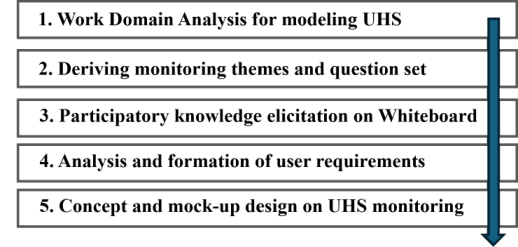
METHODS AND MATERIALS The development of the UHS monitoring concept followed a multi-stage process combining system modelling, participatory knowledge elicitation, and concept design work. The overall aim was to build an initial understanding of what aspects of UHS operations should be monitored and what could be the specific storage operators’ information needs. The methodological process consisted of five main steps (see Figure 1).
Figure 1: Monitoring concept development process.
The first step was to establish a foundational understanding of the sociotechnical system characteristics of an UHS facility. To achieve this, WDA was applied to model the potential functional structure of an LRC-based UHS system. WDA enabled the identification of system purposes, constraints, physical processes, and high-level functions that shape UHS operations. This modelling work was followed the approach described in Koskinen et al. (2025) and served as the analytical basis for subsequent monitoring-focused activities in the HUG project.
Using the WDA model as an analytical framework, in second phase, a set of monitoring themes (ten thematic areas) was derived to describe the types of system functions that operators should be able to observe or track during storage operation. For each theme, more specific, operationally grounded
Operator Information Needs in Underground Hydrogen Storage Monitoring 187 questions were formulated to explore what kinds of parameters, indicators, or conditions may require monitoring. For example, one thematic area was named “Structural integrity”. This thema included eight more specific questions, to give an example, which one of them was enquiring “what kind of mechanism/ phenomena can risk the structural integrity?”. These questions were designed to elicit expert knowledge regarding technical, operational, environmental, and human-related aspects of UHS monitoring.
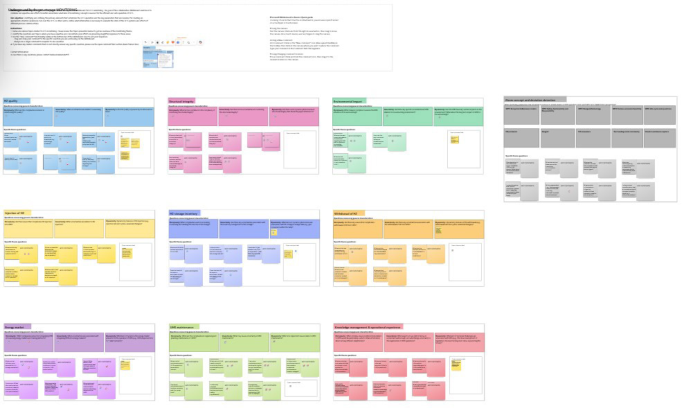
The monitoring themes and their associated specific questions (see Figure 2) were distributed to the HUG project partners using the Microsoft Teams Whiteboard tool made available on the project’s shared Teams platform. Participants were invited to respond to the themes and questions that aligned with their expertise, thereby enabling broad engagement across the multidisciplinary HUG project consortium. This participatory approach allowed collecting diverse viewpoints and supported the co-creation of early insights relevant to monitoring concept development.
Figure 2: Whiteboard view for the collaborative monitoring concept exercise.
The responses collected from the Whiteboard were then reviewed and further analyzed by human factors experts in operations and lifecycle work package. The analysis aimed at synthesizing the contributions into preliminary monitoring requirements. The process involved clustering responses under the functional categories identified through the WDA, identifying recurring concerns, and highlighting cross-cutting information needs relevant to safe and efficient UHS operation.
Finally, the emerging monitoring requirements were further refined and discussed through concept development workshops. These sessions enabled the iterative elaboration of a monitoring concept and supported the creation of mock-ups and visualizations representing potential monitoring displays for storage system. The workshops served both to validate the earlier analysis and to explore how monitoring information could be organized and presented to support operator decision-making.
RESULTS
The responses collected through the Whiteboard exercise were systematically reviewed, and the content of the thematic areas was analysed in detail. Based on this analysis, key aspects relevant to monitoring UHS were identified. In particular, the responses were used to derive critical parameters requiring monitoring, as well as potential operational situations and the associated information needs for their detection and management. These findings were subsequently synthesised into a set of general information requirements from the perspective of a UHS operator (see Table 1).
Table 1: Thematic areas and their associated information requirements.
Table available in the original PDF paper.
Thematic Area Information Requirements H2 purity Operators require timely and reliable information on target H2 purity levels, defined impurity thresholds, and quality measurements at all storage process stages (injection and withdrawal), together with clearly specified emergency measures and decision criteria to safely respond to quality deviations.
Structural integrity
Operators require continuous and reliable information on pressure and temperature variations and cycling and their effects on concrete and steel components, clearly defined technical limits for allowable pressure and temperature changes, and quantified acceptable leakage levels with early indicators of loss of gas tightness and predefined escalation thresholds for intervention.
Environmental impact
Operators require timely information on H2 leakage pathways, rates, and quantities, early detection of H2 in surrounding formations, groundwater composition and its interaction with storage structures, and indicators distinguishing sudden leakage events from long-term cumulative environmental impacts.
Injection of H2 Operators require real-time information on H2 injection rate, pressure, gas temperature, and injected volume, together with verified H2 quality compliance and clearly defined maximum and acceptable operating limits to ensure safe injection into UHS.
H2 storage inventory
Operators require accurate information on stored H2 amount and pressure, defined minimum and maximum inventory limits, awareness of thermal gradients and gas behavior, and linkage between storage pressure, end-use pressure needs, and electricity price conditions to ensure safe, contamination-free, and energy-efficient inventory management.
Withdrawal of H2
Operators require advance information on expected H2 demand and defined withdrawal capacity limits and rules to manage injection– withdrawal cycle frequency and operational parameter and to prevent overconsumption under varying market conditions.
Energy market Operators require timely information on electricity price levels and volatility, H2 demand trends, and coordinated information exchange across the value chain to optimize storage utilization, capacity sales, and balancing actions to avoid network imbalances.
UHS maintenance
Operators require up-to-date information on the inspectability and condition of critical UHS structures, including clear distinction between elements that can be inspected during normal operation and those requiring shutdown.
Operator Information Needs in Underground Hydrogen Storage Monitoring 189 Furthermore, the identified information requirements were iteratively refined in the concept design workshops, with the explicit aim of producing HSI visualisations and mock-ups. The purpose of this design activity was not to develop a complete or implementation-ready control system, but rather to explore how the information requirements could be meaningfully supported through interface design.
The resulting visualisations and mock-ups were generic in nature and were not tailored to any specific UHS site or development project. Instead, they served as illustrative examples of how the identified information requirements for UHS operation could be represented and communicated to operators.
In one of the workshops, the focus was on overall storage supervision and situation awareness. A high-level overview display was conceptualised to support the operator’s ability to form a rapid and comprehensive understanding of the UHS state. The design sought to ensure that the key information requirements listed in Table 1, such as critical process parameters and storage status indicators, were clearly visible in a single view to support continuous monitoring and early detection of deviations.
One session concentrated on disturbance and abnormal situation management. Human-system interface concepts for alarm detection and alarm visualisation were developed to support the operator in identifying process deviations and responding effectively to situations that may threaten UHS safety. Particular emphasis was placed on supporting efficient operator actions, clear prioritisation of alarms, and rapid comprehension of the underlying causes of abnormal conditions.
In addition, the concept design workshops explored alternative visualisation approaches to better support the operators’ comprehension of critical parameters and the question of storage optimization. These solutions aimed to make complex or abstract information—such as trends, limits, and operational trade-offs—more understandable and easier to interpret, thereby improving the operator’s ability to assess system state and make informed decisions.
In addition to supporting the design of UHS monitoring concept, the Whiteboard material produced was also analysed to identify open questions that require further investigation through research. Several unresolved issues were identified across the material. Some of these questions relate primarily to optimal process operation, such as defining efficient operating ranges and trade-offs under varying conditions. Others are more closely linked to safety-critical situations, including the likelihood of their occurrence, early indicators of their development, and the operator actions required to detect, manage, and mitigate such situations. These open questions highlight areas where additional modelling, simulation, or empirical studies on UHS are needed to complement the proposed monitoring concepts and information requirements.
DISCUSSION AND CONCLUSION This study approached UHS as a safety-critical sociotechnical system, in which safe operation emerges from the interaction of technical components, human operators, organisational practices, and regulatory frameworks. From this perspective, the results highlight the importance of integrating human and
social understanding into the system engineering process from the earliest design stages, rather than treating operator interaction as a latestage add-on.
In the Finnish context, UHS remains at an early conceptual stage, and its feasibility and implementation depend on a wide range of interrelated factors. These include legislative and regulatory requirements, geological suitability of potential storage sites, and the selection of appropriate technical solutions. While these aspects are critical, the findings of this study emphasise that, from an operational viewpoint, the HSI—through which the sociotechnical system is ultimately perceived, monitored, and controlled—plays a decisive role in ensuring safe and effective operation. The HSI serves as the point where complex technical, environmental, and market-related information is integrated into actionable operator understanding.
The participatory Whiteboard-based process proved to be an effective and productive method for eliciting expert knowledge. Responses were obtained for nearly all predefined questions, and in several cases the sessions triggered active discussion and exchange of perspectives among the participants. This interaction not only enriched the collected data but also helped to surface implicit assumptions, uncertainties, and differing viewpoints that may not have emerged through more structured methods alone.
At the same time, the results revealed a number of open questions related both to optimal operation and to the emergence and management of safety- critical situations. These unresolved issues underline the need for continued research. The work presented here therefore represents an initial step rather than a final solution.
Future research is planned to be continue in a follow-up project, focusing on the systematic elaboration of the identified open questions. One key objective is the development of a scenario catalogue covering a wide range of plausible operational, abnormal, and emergency situations relevant to UHS. In parallel, the user interface work will be extended toward a more comprehensive operator and user requirements specification, supporting the development of HSIs that are better aligned with the needs of safe, efficient, and resilient UHS operation.
ACKNOWLEDGMENT
The authors want to thank all the HUG project consortium members, researchers and experts sharing their valuable insights to better understand the operation of the UHSs. The project is funded by Business Finland (grant numbers VTT 6004/31/2023, GTK 7174/31/2023).
REFERENCES
Alfasfos, R., Sillman, J., and Soukka, R. (2024). Lessons learned and recommendations from analysis of hydrogen incidents and accidents to support risk assessment for the hydrogen economy. International Journal of Hydrogen Energy, 60, pp.1203–1214. Guo, L., Su, J., Wang, Z., Shi, J., Guan, X., Cao, W., and Ou, Z. (2024). Hydrogen
safety: An obstacle that must be overcome on the road towards future hydrogen economy. International Journal of Hydrogen Energy, 51, 1055–1078.
Operator Information Needs in Underground Hydrogen Storage Monitoring 191 Lamari, F., Weinberger, B., Langlois, P., and Fruchart, D. (2024). Instances of Safety-
Related Advances on Hydrogen as Regards Its Gaseous Transport and Buffer Storage and Its Solid-State Storage. Hydrogen, 5(3), pp. 387–402. Naikar, N. (2013). Work domain analysis: Concepts, guidelines, and cases. CRC press. Schultz, R.A., Williams-Stroud, S., Horváth, B., Wickens, J., Bernhardt, H., Cao,
W., Capuano, P., Dewers, T.A., Goswick, R.A., Lei, Q., McClure, M., Prasad, U., Schwartz, B.A., Yu, H., Voegeli, S. and Zhao, Q. (2023) ‘Underground energy- related product storage and sequestration: Site characterization, risk analysis, and monitoring’, Geological Society, London, Special Publications, 528. Tarkowski, R., and Uliasz-Misiak, B. (2022). Towards underground hydrogen storage: A review of barriers. Renewable and Sustainable Energy Reviews, 162, p. 112451. Wen, J. X., Marono, M., Moretto, P., Reinecke, E. A., Sathiah, P., Studer, E., Wyazmina,
E., and Melideo, D. (2022). Statistics, lessons learned and recommendations from analysis of HIAD 2.0 database. International journal of hydrogen energy, 47(38), 17082–17096.
LISTED IN THE AHFE DIGITAL BOOKSTORE CATALOGUE
Explore the complete digital volume
Human Error, Reliability, Resilience, and Performance
Read this individual research paper free through the original publisher, or explore the full digital proceedings book.
ISBN 978-1-964867-89-2
Explore this ISBN in the AHFE Bookstore ↗Listed in the July 2026 bookstore catalogue; search by ISBN to confirm current availability · Digital book purchase optional