Jari Laarni, Hanna Koskinen, Marja Liinasuo, Tuisku-Tuuli Salonen, Satu Pakarinen, Kristian Lukander, Tomi Passi (2022). Understanding Procedure Development in Nuclear Domain with Practice Theory. In: Human Factors in Energy: Oil, Gas, Nuclear and Electric Power. AHFE Open Access, vol. 54, pp. 16–22. https://doi.org/10.54941/ahfe1002216
According to some estimates, a majority of the accidents in the nuclear domain have been associated with failures in the use of procedures. A traditional model of procedure design and usage is based on the idea that because procedures represent the best understanding people have of the way their work has to be conducted, safety results from operator following procedures in a conscientiousness manner. However, procedure guidance and operator competencies are not conflicting views, but something that are aligned in safe and efficient operator practices. According to these views, even though procedures are resources for action, they cannot guarantee safety as such, and people need skills to apply procedures successfully. Our aim is to build a better understanding of the procedure design practices in one Finnish nuclear power plant, and outline a Human Factors Engineering (HFE) framework for procedure design based on theoretical work and on ethnographic case study approach. Procedures are designed through a series of steps (i.e., task analysis, format selection, draft preparation, verification and validation, and approval for release). These steps are similar to the phases of the Human Factors Engineering Program Review Model (O’Hara et al., 2012), but procedure design is not always described in terms of HFE. The paper describes the development of a method for the analysis of procedure design practice and some examples of the application of the method. We monitor and follow up the procedure development from the kick-off meeting to verification and validation (V&V) and approval for release through an ethnographic approach. The procedure design process includes familiarizing ourselves with the company’s procedure design guidance, participating in design meetings, interviewing procedure writers, reviewing the draft versions of the procedure, and observing procedure V&V activities at the simulator. A toolkit to study practice at work is used (Nicholini, 2013), which is based on a palette of sensitizing research questions, the answers to which are sought by the above-mentioned methods of data collection.The research work is still in the beginning stages, with procedure writer interviews conducted. According to these interviews, procedure design process can be seen as a social practice which itself is under constant development. For example, even though procedure writing has mainly been deskwork, simulators and simulation models play an increasing role in procedure development. It is very difficult to imagine all possible sequences of events while working at desk; when you test the procedure in the simulator, it is possible to see how the events unfold in real world. Also, co-creation is nowadays a key concept in process development. In co-creation workshops, experts from different domains are involved and can participate in the design activities. Also, engagement of end-users was seen as very important, and feedback from end-users is nowadays increasingly collected and reviewed several times during the development process. ReferencesNicholini, D. (2013). Practice Theory, Work, & Organization. An Introduction. Oxford: Oxford University Press.O’ Hara, J. M. et al. (2012). Human Factors Engineering Program Review Model. NUREG-0711, rev. 3. Washington, D. C.: Office of Nuclear Regulatory Research.
According to some estimates, a majority of the accidents in the nuclear domain have been associated with failures in the use of procedures. A tra- ditional model of procedure development and usage is based on the idea that because procedures represent the best understanding people have of the way their work has to be conducted, safety results from operator following pro- cedures in a conscientiousness manner. However, procedure guidance and operator competencies are not conflicting views, but something that are ali- gned in safe and efficient operator practices. According to this viewpoint, even though procedures are resources for action, they cannot guarantee safety as such, and people need skills to apply procedures successfully.
The latter view has apparently also implications for procedure develo- pment process. Our aim is to build a better understanding of the proce- dure development practices in one Finnish nuclear power plant (NPP), and outline a Human Factors Engineering (HFE) framework for procedure deve- lopment based on theoretical work and on ethnographic case study approach. Procedures are developed through a series of steps (i.e., task analysis, for- mat selection, draft preparation, verification and validation, and approval for release). These steps are similar to the phases of the Human Factors
Understanding Procedure Development in Nuclear Domain with Practice Theory 17
Engineering Program Review Model (NUREG-0711; O’Hara et al., 2012), but procedure design is not always described in terms of HFE.
The paper describes the development of a method for the analysis of procedure development practice, and some examples of the application of the method. We monitor and follow up the procedure development from the kick-off meeting to verification and validation (V&V) and approval for release through an ethnographic approach. The procedure development pro- cess includes familiarizing ourselves with the company’s procedure design guidance, participating in design meetings, interviewing procedure writers, reviewing the draft versions of the procedure, and observing procedure V&V activities at the simulator.
Rationale Behind Our Work Our aim is to develop a plant-specific HFE framework for procedure deve- lopment taking into consideration on the one hand existing national and international standards and guidelines, and on the other hand practical pro- cedure development practices in a Finnish NPP. This paper will focus on the investigation of procedure development practices in this specific NPP.
PROCEDURE DEVELOPMENT IN THE NUCLEAR DOMAIN Methods in Procedure Development
Methods can be defined as systematic ways for achieving a particular object. Practices instantiate methods, but methods are never applied as originally intended, but always adopted and adapted to the characteristics of an ongoing situation (Dittrich, 2016). For example, it has been found that experts in different domains typically do not rigorously adhere to methods, but they try to find a balance between the recommendations of the method and the specific circumstances of the task. This means that in order to affect procedure development, the methods (e.g., guidelines) need to be integrated into the practices of the design team.
Methods used in procedure development in the nuclear domain reflect and are based on relevant standards and guidelines. Guidance comes in many forms, and some of it is plant-specific, some of it is national or inter- national. IAEA’s reports (e.g., Safety Reports Series No. 48) and NRC’s reports in NUREG series (e.g., NUREG-0711, NUREG-0899) are examples of international nuclear guidelines.
NRC’s NUREG-0711 guideline states that procedures in the nuclear domain shall be developed and implemented in adherence to HFE guidelines, and they shall be supported by the analyses used to develop other interfaces (O’Hara et al., 2012). In fact, NUREG-0711 states that in order to ensure complete integration and consistency, the same HFE principles should be applied to procedures and other HSIs (O’Hara et al., 2012). According to NUREG-0711, the licensee shall develop a writer’s guide to establish a sound and effective procedure development process (O’Hara et al., 2012). Verifica- tion and validation of procedures is necessary to complete the development process. The licensee shall verify that the procedures are correct, and can
be carried out by operators, and validate the use of procedures in a simula- tor environment (O’Hara et al., 2012). When a procedure is modified, the licensee shall also verify the adequacy of its content, format, and its integra- tion with other procedures and HSIs, and revalidate it, when a modification changes operator tasks significantly (O’Hara et al., 2012). Consistency with other procedures is especially emphasized by IAEA Safety Report Series No. 48 (2006) in the development of emergency operating procedures.
Procedure Development Process The procedure development process in safety-critical domains includes a par- ticular set of steps that follow each other. The following steps have been identified in the procedure development process (e.g., Novatsis & Skilling, 2016):
Task and error analysis: to understand and analyze the task;
Format selection: to determine and select a suitable format for the procedure;
Drafting: to prepare a draft of the procedure;
Validation and quality assurance: to validate and assure the quality of the procedure;
Approval: to approve the procedure;
Reviewing and updating: to monitor and review of the effectiveness of the procedure and update it, if necessary.
Ahmed et al. (2020) recently presented a procedure system lifecycle based on System development Life Cycle, in which procedure planning, design and development are subdivided into the following subsections:
Goal definition refers to the purpose, applicability, and scope of the procedure.
Prerequisite specification identifies “the conditions needed to satisfy the objective of the procedure” (Ahmed et al., 2020; p. 5), and it includes items such as definition, safety, environmental and social responsibility, level of detail, level of use, and equipment identification.
Action and reactions specification consists of tasks aiding in achieving the main goal of the procedure, such as use of conditional and logic terms, error reduction guidelines and problem solving information.
Challenge specification provides guidelines on how to tackle barriers to successful execution of a procedure, including components such as safety statement, writing styles, format, punctuation and grammar, readability, and referencing and branching.
Procedure administration addresses management of procedure execution, including components such as approval, training, identifying information sources and processing, instructions about document storage and archival, deployment, stakeholder engagement, references, appendices, procedure administration and data collection methodology.
Procedure review and maintenance includes items such as procedure audit, checklist and sign off, management of change and calculation of procedure error rate.
Understanding Procedure Development in Nuclear Domain with Practice Theory 19
PRACTICE THEORY APPROACH Practice can be considered as arrays of routinized human activity. In practice- based approach people’s sayings and doings are interpreted and understood against the background of a particular practice and the shared goals and mea- nings of the practice (Schatzki, 1996). Works of Schatzki play an important role in the development of practice-based approach. According to Schatzki, there are three kinds of constitutive ordering elements in practices, practi- cal understandings of the actors, explicit rules, regulations, and procedures, and teleoaffective structures of practices (Schatzki, 1996). ‘Teleoaffective’ is a combination of teleology and affectivity, in which teleology refers to the orientation of particular ends, and affectivity refers to how things are expe- rienced (Dittrich, 2016). Reich and Hager (2014) have identified a couple of features in professional practice:
Knowing is something that is taken place during the execution of work practices so that practices themselves are the locus of learning and knowledge construction (Ahmed et al., 2020).
Practices are socio-material, indicating that in addition to human actors also material objects, tools and artefacts are included. These tools and artefacts are the embodiment of knowledge, and they provide orientation and direction to practices.
Practices as embodied, which means that they are performed between other humans and material things, and co-created in dialogue with other people.
Practices are relational, and they always have to be understood in a particular social and historical context.
Practices are emergent and dynamical phenomena that evolve and change over time. They cannot be completely predicted in advanced, since they are based on dynamics of human interactions in a particular physical context.
Procedure Development as Social Practice Following the ideas of Schatzki et al., our aim is to understand procedure development as a social practice consisting of interrelated activities that are connected through shared teleoaffective structures and shared understan- dings of what it means to develop a procedure in the nuclear domain. To understand procedure development as a practice we have to specify tools and equipment that are used, and settings in which the practices are actualized (Dittrich, 2016). In addition, we have to take into account that procedure development practices are flexible so that they can change and develop, and adapt to characteristics of an ongoing situation. Therefore, the acti- vity to develop a procedure is itself an object of design and can evolve (Dittrich, 2016).
METHODOLOGY
We will investigate procedure development practices by ethnographic meth- ods providing an insider’s perspective to understand designers’ behaviors, perspectives and experiences. This in turn provides a solid starting point
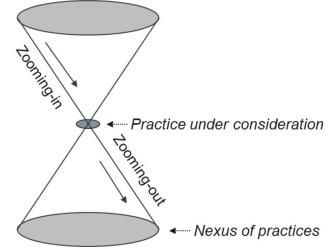
Figure 1: Zooming in and out on practice (Nicolini, 2012).
for developing improvements and the plant-specific HFE framework for procedure development.
The main features of the ethnographic approach we apply are (e.g., Jorgensen, 1989):
Special interest in procedure developers’ point of view;
Focus on everyday situations and settings;
Interpretation, analysis and theorizing of what has been observed in meetings and workshops;
Iterative and flexible process of inquiry requiring constant redefinition of the research questions.
The application of the ethnographic approach results in comprehensive, detailed and contextual interpretation of the research data.
Toolbox Approach An approach to study practice at work is used (Nicolini, 2012), which is based on a set of stimulating research questions, the answers to which are sought by ethnographic methods of data collection. Research will start by first zooming in on the details of the procedure development practice; this is followed by a zooming out maneuver through which the scope of the study is enlarged (Nicolini, 2012; Figure 1). In the latter phase our aim is to focus on connections between practices and their results (Nicolini, 2012). The iterative zooming in and out will continue alternatively until we can provide a feasible account of the practice and its effects on other practices.
Some examples of zooming in research questions are the following (Nicolini, 2012):
What are procedure developers doing and saying in interviews, and why?
What positions and perspective are they taken?
What is the timing and schedule of the procedure development practice?
What tools and artefacts are used in the practice?
What are the procedure developers’ main concerns and worries?
What are the main constraints of the procedure development practices?
How is the procedure development practice kept on track?
How and why may the things go wrong?
Understanding Procedure Development in Nuclear Domain with Practice Theory 21
Some examples of zooming out research questions are the following (Nicolini, 2012):
What are the connection between the procedure development practice under consideration and other engineering practices in the NPP?
Which other engineering practices affect, constrain, interfere or even conflict with the procedure development practice?
What is the history of the practice of procedure development? What practices, engineering activities etc. have led to the current state of affairs? How could things be otherwise?
Data Collection We will participate in virtual meetings to which the procedure developers take part. Ethnographic observation of these meetings provides insight into how a procedure is drafted, how decisions are made, what drives and guides decision making and how it is implemented (Burger et al, 2019). During observations, we will take detailed notes, and if possible, we will also record the meetings. Before observation of meetings, we will conduct a couple of semi-structured interviews.
We will be particularly sensitive to the issues mentioned by Ahmed et al. (2020), such as:
the objective the procedure should met;
the scope of the procedure;
the organizational units involved in the development process;
the main terms used in the procedure;
minimum level of information needed by the operator to perform proce- duralized actions;
issues related to style and format, readability and referencing and branching;
issues including in procedure administration such as approval, trai- ning, procedure review, change management and document storage and archival.
Data Analysis Afterwards audio recordings of the meetings and semi-structured interviews are transcribed. The meeting and interview transcripts are coded to track main themes and identify important concepts. Some main parts of the tran- scriptions of the conversations are analyzed in more detailed fashion. Meeting observations are triangulated with semi-structured interviews (e.g., Dittrich, 2016). If possible, the themes are further discussed with procedure developers to check the evolving interpretations with them (e.g., Dittrich, 2016).
Data analysis is based on a dialectical strategy, according to which data is disassembled into elements and components, and they are investigated to identify patterns and relationships (Nicolini, 2012). When an idea has been identified, the data is reassembled, providing an interpretation of a que- stion of a particular problem. The synthesis is then evaluated and critically examined. This process can be iterated several times. Finally, the results of the fieldwork are carefully documented.
We will be sensitive to hidden meanings, that is, the aim is to identify moments in which procedure developers articulate implicit meanings. The aim is to zoom into micro-episodes, that is, interactions and changes in and expansions of interaction standing out as intense and compelling, as suggested by Emerson (2004).
CONCLUSION
We have described the development of a plant-specific HFE framework for procedure development taking into consideration on the one hand existing national and international standards and guidelines, and on the other hand practical procedure development practices in a Finnish nuclear power plant. We monitor and follow up the procedure development from the kick-off mee- ting to verification and validation (V&V) and approval for release through an ethnographic approach. The procedure design process includes familiari- zing ourselves with the company’s procedure design guidance, participating in design meetings, interviewing procedure writers, reviewing the draft versions of the procedure, and observing procedure V&V activities at the simulator.
REFERENCES
Ahmed, L. Quddus, N. Kannan, Peres, P.S.C., Mannan, S.M. (2020). Development of a Procedure Writers’ Guide Framework: Integrating the Procedure Life Cycle and Reflecting on Current Industry Practices. International Journal of Industrial Ergonomics, Volume 76. Burger, K. White, L. Yearworth, M. (2019). Understanding Front-End Project Work-
shops with Social Practice Theory. International Journal of Project Management, Volume 37, pp. 161–175. Dittrich, Y. (2016). What Does it Mean to Use a Method? Towards a Practice Theory for Software Engineering. Information and Software Technology, Volume 70, pp. 220–231. Emerson, R.M. (2004). “Working with ‘Key Incidents”’, in: Qualitative Research
Practice, Searle, C. et al. (eds.), pp. 427–442. London: SAGE. INTERNATIONAL ATOMIC ENERGY AGENCY (2006). Development and Review of Plant Specific Emergency Operating Procedures, Safety Reports Series No. 48. Vienna: IAEA. Jorgensen, D.L. (1989). Participant Observation – A Methodology for Human Studies. Newbury Park: SAGE. Nicolini, D. (2012). Practice Theory, Work, & Organization. An Introduction,
Oxford: Oxford University Press. Novatsis, E. Skilling, E.J. (2016). “Human factors in the design of procedures, in: Human Factors in the Chemical and Process Industries: Making it Work in Practice, Edmonds, J. (Ed.), pp. 291–307. Amsterdam: Elsevier. O’Hara, J., Higgins, J., Fleger, S., Pieringer, P. (2012). Human Factors Engineering
Program Review Model (NUREG-0711, Rev. 3). Washington, D.C.: U.S. Nuclear Regulatory Commission. Reich, A. Hager, P. (2014). Problematising Practice, Learning and Change: Practice- Theory Perspectives on Professional Learning. Journal of Workplace Learning, Volume 26, pp. 418–431. Schatzki, T.R. (1996). Social Practices: A Wittgensteinian Approach to Human
Activity and the Social. Cambridge: Cambridge University Press.
LISTED IN THE AHFE DIGITAL BOOKSTORE CATALOGUE
Explore the complete digital volume
Human Factors in Energy: Oil, Gas, Nuclear and Electric Power
Read this individual research paper free through the original publisher, or explore the full digital proceedings book.
ISBN 978-1-958651-30-8
Explore this ISBN in the AHFE Bookstore ↗Listed in the July 2026 bookstore catalogue; search by ISBN to confirm current availability · Digital book purchase optional