Hanna Koskinen, Tuisku-Tuuli Salonen, Jari Laarni, Marja Liinasuo, Satu Pakarinen, Kristian Lukander, Tomi Passi (2022). Foreseeing the Potential of Virtual Reality in Nuclear Power Plant Field Operator Training. In: Human Factors in Energy: Oil, Gas, Nuclear and Electric Power. AHFE Open Access, vol. 54, pp. 33–39. https://doi.org/10.54941/ahfe1002218
In the 21st century, advanced technologies such as virtual reality (VR) and augmented reality (AR) solutions have found their way to a variety of industrial applications and settings. The nuclear domain does not make an exception, and thus there has been an increasing interest to investigate how these technologies could be of use in different operative activities in nuclear field. Radiation visualization provides one good example of the use of VR that may facilitate planning of maintenance activities and thus enable to minimize the personnel’s time spent in contaminated spaces. One potential application area for VR in the nuclear domain is operator training. Nowadays the operator training is organized most often as classroom and simulator training. New advanced technologies may enable to enrich the conventional training facilities so that, for example, more hands-on training of teamwork and collaboration between the control room and the field operators becomes possible.In this paper, we concentrate on the training of field operators and especially, how VR-based solutions could facilitate and advance this process. We have conducted an interview study about the training of field operators in two Finnish nuclear power plants. Altogether 12 interviews were carried out with personnel responsible of field operations and the training of field operators. The interview study aimed to improve understanding on how the field operator training is currently arranged, and what expectations there are for the development of field operators’ training programme. Based on the results of the interview study, a summary is made on how the field operator training is organized in the two Finnish nuclear power plants and what are the benefits and limitations of the current training practices. We also report how the field operators foresee the potential of VR technologies in their training. Furthermore, suggestions are provided on concrete VR applications that may benefit the training and work of field operators. Finally, we will present some practical design implications for developing such training systems.
New advanced technologies such as virtual reality (VR) and augmented reality (AR) have made their way into variety fields of industries. These tech- nologies promise to augment and enhance the industry operations in many ways, for example, by helping to gain better understanding of the product/sy- stem under development (Hjelseth et al, 2015) or enabling online guidance and decision support on specific work situations. The possibilities of VR&AR have also been studied in nuclear power plant (NPP) context. For instance, VR has been applied successfully in ergonomic studies in designing control room spaces and facilities (Gatto et al, 2012; Meunier et al, 2018; Zamberlan et al, 2012). Furthermore, VR use in visualization of radiation have been stu- died with the aim to facilitate planning of maintenance activities, and thus enable to minimize the personnel’s time spent in contaminated spaces (Mol et al, 2008; Nystad et al, 2011). The results of these studies have already indicated that with the use of VR it is possible to positively influence on the
Plant Number of interviewees Work experience (years) Loviisa NPP 5 (2-30) Olkiluoto NPP 6 (3-30)
reduction of dose measures when compared to activities without VR sup- port. Furthermore, VR simulations has also been developed in the context of control room verification and validation activities (Bergroth et al, 2017; Dos Santos et al, 2009).
One potential application area for VR in safety-critical system operation and in the nuclear domain is operator training (Andres et al, 2016; Koskinen et al, 2021; Louka et al, 2001; Yue et al, 2016). Nowadays the operator trai- ning is organized most often as classroom and simulator training in physical training simulator environments. New advanced technologies may enable to enrich the conventional training facilities so that, for example, more hands- on training of teamwork and collaboration between the control room and the field operators becomes possible (Koskinen et al, 2021). The benefits of VR in training of operators and maintenance personnel in nuclear context can be great as in VR the work tasks can be trained in a safe environment without real-life time restrictions and repeatedly as many times as needed.
We have conducted an interview study about the training of field operators (FOPs) in two Finnish NPPs. Altogether 11 interviews were carried out with personnel responsible of field operations and the training of field operators. We also report how the FOPs foresee the potential of VR in their training. Furthermore, suggestions are provided on concrete VR applications that may benefit the training and work of FOPs and present some practical design implications for developing VR-based training.
DATA COLLECTION The interview study was conducted in two Finnish nuclear power plants, that is, Loviisa NPP and Olkiluoto NPP. Altogether, 11 (five from Loviisa NPP and six from Olkiluoto NPP) field operators were interviewed (Table 1).
The form of the interview was structured and, questions were made under four specific themes: 1) Field operator work, 2) Collaboration, 3) Training, and 4) Possibilities of VR.
Due to the Covid19 pandemic situation the interviews were conducted remotely through a Microsoft Teams application and the duration of the inte- rviews were approximately one hour. The interviews were audio recorded and transcribed for further analysis.
RESULTS
Field Operator Work The work of the field operator consists of process control and monitoring, routine field inspections and periodical testing. FOPs work mainly in pairs,
Foreseeing the Potential of Virtual Reality 35
however, some of the work is done alone, for example, field-inspection responsibility areas are shared between the partners. In addition to rou- tine inspections, the field operations include process separations and returns, periodical testing of emergency systems and valve operations.
FOPs work in close collaboration with the control room operators in a daily manner. All the tasks are distributed by the control room operators, and mutual situation awareness is maintained by reporting significant phases of any operation to the control room.
The work of the FOPs includes challenges related to complexity, uncertain- ties, and dynamicity. Extensive job description, variety of tasks and vast field of operations increase complexity of the work. For example, in Olkiluoto NPP, certain external facilities at the NPP area are included in the responsibi- lities of the FOPs. The extensiveness of the field also sets uncertainties, as it is sometimes a challenge to navigate to the right component in narrow places. Hot temperatures and steam are one of the hazards of the work which add uncertainty. During revision, the working pace is more hectic compared to the normal operation, adding dynamicity. Distances in the facility area can be long, and thus it is time-consuming to travel between various locations.
Training In both NPPs, it was typical that the backgrounds regarding the professional training of FOPs varied a lot. Thus, there was no individual line of education or school that would have directly prepare for FOP’s profession and tasks. Of course, it was recognized by the interviewed FOPs that a certain extent having a technical background (e.g., electrician or assembly worker) may be helpful in acquiring the tasks and knowledge required in FOP’s work.
Both NPPs have their own basic training programs for FOPs (Table 2). There are many similarities between the training programs but also some plant-specific differences. In both NPPs, the training starts with an intro- ductory training in which issues such as important plant information and organizational guidance and occupational safety is gone through. This is followed by a more theoretical training of plant systems and equipment in Loviisa NPP that takes altogether approximately two months. In Olkiluoto NPP, there is a short on-the-shift training period for FOPs before they engage technical training of plant systems and equipment. After the training of the plant systems and equipment in both NPPs, the FOPs are going through a lon- ger period of time on-the-shift training. In Loviisa NPP, a specific study plan is drafted for each FOP individually that acknowledges the vacancy-specific responsibilities and learning goals, that is, the primary and secondary side FOP tasks. In the end of the basic training, a test is organized for the FOPs. In Loviisa NPP, the final exam is realized as a written exam whereas in the Olkiluoto NPP, the final exam includes a field inspection round together with the division manager and the shift supervisor.
In both NPPs, the FOPs also participate in yearly refresher training. The content of this training may vary depending on the identified training needs in each plant. In practice, it may be training related to some new plant systems or equipment or procedures and safety guidance that have been updated.
Table 2. A general overview of the FOP training programs and practices.
Table available in the original PDF paper.
Loviisa NPP Olkiluoto NPP Form of training
Basic training
Entrance training (e.g., plant intro- duction and occupational safety) A short on-the-shift training period Technical training on plant systems and equipment On-the-shift training period A final exam in which field inspe- ction round is executed with a divi- sion manager and a shift supervisor Methods/materials: group lectures, design documentation and procedures
Introductory and theoretical training on electricity production and plant systems and equipment (duration approx. 2 mo.) Decision on the coming vacancy (primary or secondary FOP based on demand) On-the-shift training on guidance of experienced FOP and based on individual study plan (approx. half a year) A final exam (written format) Methods/materials: group lectures, design documentation and procedures, individual study plan Refresher training
6 d/year, from which 6 d lectures (not established practice yet) d simulator Methods/materials: Navis-system, procedures
6 d/year, from which 4 d lectures 2-4 d simulator Methods/materials: Process models, equipment manuals, procedures, simulator etc.
The FOPs also participate in simulator training together with the control room operators. In Loviisa NPP, this form of training for FOPs (i.e., simula- tor training) has already been well established practice many years whereas in Olkiluoto NPP, the FOPs have just in the resent years took part in the simu- lator training. In addition to the official yearly training days, in both NPPs, FOPs have self-study materials that they can independently access and study according to their own preferences.
Benefits and Limitations of the Current Training Practices The interviewed FOPs were inquired what the benefits and limitations are they experience in their current training practices.
In Loviisa NPP, the FOPs generally thought that learning by doing was effective way of learning their work tasks. Being involved in the simulator training with control room operators were conceived a good practice so that also those FOPs that were not usually spending much time in the main control room had a possibility to see that side too. However, into the way how the simulator training was organized now, that is, the FOPs mainly followed the simulator run from a side and went through the related procedures was hoped improvements. Particularly, the FOPs wished that they could be more actively involved in the simulator run (i.e., carry out the tasks assigned to them). Another issue related to the training and knowledge management was that the FOPs thought that some specific information and knowledge was hold by
Foreseeing the Potential of Virtual Reality 37
too few people and, for example, in a situation in which this kind of person was retiring important information from the organization may have been lost. The FOPs also thought that improvements could be done in training to use the new equipment and systems, and, for example, it would be beneficial to be able to follow the installation work and testing of the new systems.
In Olkiluoto NPP, the FOPs wished that the refreshing training program would include more material and content that would be specially tailored for the needs of the FOPs. In addition, they hoped more hands-on training in the field as there is always the possibility that while independently going through the documents and written instructions some things may be misun- derstood. Moreover, training of new equipment and systems was hoped to be more even-handed meaning that also making sure the other FOPs that were not in the shift at the time of the installation and commissioning of the equipment can get the training for the use of the system. According to the FOPs now it was relied too much on that the colleagues were passing the rele- vant information about the new equipment to the others. In Olkiluoto NPP, they had a new system called Navis in use that included photos from the plant’s room spaces and equipment that the FOPs could use independently to study and rehearse. The Navis system was experienced as a good additional source of information by the FOPs and they used the system to, for exam- ple, review spaces that were not accessible during normal operation due to radiation.
Possibilities of Virtual Reality in Field Operator Training In both NPPs, early attempts to add virtual reality to the field operator trai- ning are already under development. In the more advanced example from Loviisa, FOPs participate control room operators’ simulator training using a VR environment created with a 360-footage from the facility. The VR envi- ronment is connected to the simulator, and the FOP performs determined operations in an adjacent room. There is no means to communicate with the control room operators through the VR application, and thus in these simulator training sessions, the instructor was needed to deliver messages. The application includes VR-glasses, that are lacking in the other, less deve- loped VR environment, that is used in the other NPP. In the latter case, the VR environment is merely an open database of 360-pictures for self-learning purposes. In both NPPs, the future objective is to use VR environment to improve FOPs active participation in the simulator training.
The interviewed FOPs saw potential in applying VR in their training and identified several opportunities of VR for training purposes related to pra- cticing certain tasks and rehearsing premises. Tasks that could be practiced in VR environment included demanding tasks as well as tasks that were not possible to practice during normal operation. The VR was seen useful in presenting the facility premises to new field operators during their training. Experienced operators could also use the application to rehearse locations of valves in rooms with high radiation levels. The VR could also be used in route planning to certain rooms. Altogether, VR training was believed to reduce radiation exposure and increase the usefulness of simulator training.
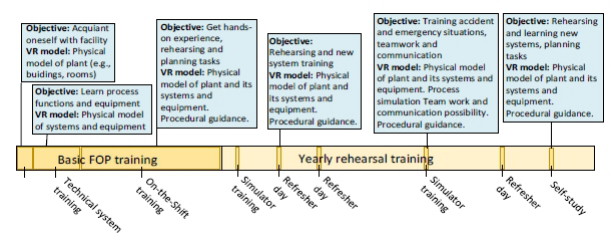
Figure 1: Mapping of VR-based solutions with FOPs training program.
The interviewed field operators identified several elements necessary for the design of the VR environment. Realistic modelling of room spaces with relevant details, pathways with possible obstacles such as fire or steam and system identification codes was considered important.
DISCUSSION AND CONCLUSIONS An interview study in two Finnish NPPs was made about the FOPs training and how VR could enhance the process of acquiring the skills and knowledge needed at their work. Generally, in both NPPs, the FOPs thought that their training program had developed to a favorable direction during the years. The training had become more systematic, and FOP specific content had been developed for the training.
VR-based solutions were seen to provide new possibilities in training. The characteristics of the VR training solutions that may appropriately support learning may change over the course of the training program and specific learning objectives set in each point of the program (Figure 1).
As already discussed in the previous section, both NPPs already have some VR-based solutions in use and the FOPs has got their first experiences on the benefits of these technologies in the training. However, future work on deve- loping VR-based training systems in NPP context would include, for example, extending the scope of the VR-models, adding new functionalities (e.g., pro- cedures or step-by-step guidance) and collaborative qualities. In addition, it would be necessary to conduct comparative studies in which the traditional training methods and their effectiveness compared to the VR&AR -based training would be explored as only few studies have focused on this in safety- critical operations. However, in the end, it might be that the most suitable setup for training would be a combination of these two training mediums. Finally, based on our interview study the FOPs generally had positive atti- tudes towards the VR in their training that suggest that these systems are worthwhile to continue develop.
Foreseeing the Potential of Virtual Reality 39
ACKNOWLEDGMENT
We want to acknowledge all the operators that participated in the interviews and that shared their experiences on their work and professional training.
REFERENCES
Andres, G., Israel, B., Gustavo, F., Miguel, R., Javier, R. (2016) “Virtual Reality Training System for Maintenance and Operation of High-voltage Overhead Power Lines”, J. Virtual Reality Volume 20 Issue 1. Bergroth, J., Koskinen, H., Laarni, J. (2017) ”Use of Immersive 3-D Virtual Reality
Environments”, NUCLEAR TECHNOLOGY 202, 2–3. Dos Santos, I.J.A.L., Carvalho, P.V.R.D., Mol, P.V.A., Carvalho, R. (2009) “The Use of Questionnaire and Virtual Reality in the Verification of the Human Factors Issues in the Design of Nuclear Control Desk”, International Journal of Industrial Ergonomics Volume 39, Issue 1. Gatto, L.B.S., Mol, A.C.A., Dos Santos, I.J.A.L., Jorge, C.A.F., Legey, A.P. (2012)
“Virtual simulation of a Nuclear Power Plant’s Control Room as a Tool for Ergonomic Evaluation”, PROGRESS IN NUCLEAR ENERGY Volume 64. Hjelseth, S., Morrison, A., Nordby, K. (2015) “Design and Computer Simulated User Scenarios: Exploring Real-Time 3D Game Engines and Simulation in the Maritime Sector”, International Journal of DESIGN Volume 9, No. 3. Koskinen, H., Laarni, J., Liinasuo, M., Salonen, T., Pakarinen, S. Lukander, K.
Passi, T. (2021) “Augmenting Field Operator Training Through Virtual Reality”, proceedings of the 12th Nuclear Plant Instrumentation, Control and Human- Machine Interface Technologies (NPIC&HMIT), pp. 79–88 (2021). Louka, M.N., Balducelli, C. (2001) “Virtual Reality Tools for Emergency Operation Support and Training”, proceedings of the international Emergency Management Society (TIEMS). Meunier, L., Keller, D., Guedon, P. (2018) “Virtual Reality: Lessons Learned From
WEST Design and Perspectives for Nuclear Environment” FUSION ENGINEE- RING AND DESIGN Volume 136. Mol, A.C.A., Aghina, M.A.C., Jorge, C.A.F., Couto, P.M. (2008) Virtual Simulations of Nuclear Plants for Dose Assessment wit On-line Measurements Collected by Network Radiation Monitors”, proceedings of CSEW. Nystad, E., Papin, B., Bye, A., Skjerve, A.B., Louka, M., Øwre, F., Berg, Ø., Heimdal,
J.O., Braarud, Ø. (2011) Simulator-based Human Factors Studies Across 25 Years. Springer. Yue, K., Wang, D., Yang, X., Hu, H., Liu, Y., Zhu, X. (2016) “Evaluation of the User Experience of Astronaut Training Device: An Immersive, VR-based, Motion- training system” OPTICAL Measurement Technology And Instrumention 10155. Zamberlan, M., Santos, V., Streit, P., Oliveira, J., Cury, R., Negri, T., Pastura, F.,
Guimaraes, C., Cid, G. (2015) “DHM Simulation in Virtual Environments: A Case-study on Control Room Design”, Work Volume 41.
LISTED IN THE AHFE DIGITAL BOOKSTORE CATALOGUE
Explore the complete digital volume
Human Factors in Energy: Oil, Gas, Nuclear and Electric Power
Read this individual research paper free through the original publisher, or explore the full digital proceedings book.
ISBN 978-1-958651-30-8
Explore this ISBN in the AHFE Bookstore ↗Listed in the July 2026 bookstore catalogue; search by ISBN to confirm current availability · Digital book purchase optional