Julia Yumi Ito (2026). From Lean Agile maturity to AI Readiness: A theoretical management analysis in the digital age. In: Human Factors, Business Management and Society. AHFE Open Access, vol. 215, pp. 153–161. https://doi.org/10.54941/ahfe1007596
Challenged by the rapid evolution of digital transformation and the emergence of Artificial Intelligence (AI), the joint approach of Lean Management and the Agile Mindset has been recognized as a potential model for organizational resilience in the digital age. However, there is a lack of evidence in the literature regarding management frameworks specifically designed for AI strategy and adoption, as most studies address these methodologies separately or within traditional management contexts. This paper serves as an introductory analysis to bridge this gap, proposing a primary correlation between Lean Agile (Leagile) principles and the strategic demands of AI. Based on the premise that Leagile is directly applicable to the digital context, this study aims to present a framework derived from six Leagile maturity dimensions: Strategy, Culture, People, Processes, Products and Governance. To achieve this, a mixed-methods exploratory study was conducted using bibliometric and deductive content analysis. Preliminary results indicate that high maturity in Strategy and Culture is a prerequisite for mitigating risks in AI adoption, while operational agility sustains technological scaling. Ultimately, Leagile maturity serves as a strategic roadmap, demonstrating that business readiness must precede the technical implementation of AI. Therefore, this exploratory analysis contributes to the field of management by positioning Leagile management as a strategic foundation to navigate the complexities of AI and the digital age.
In the Digital Age, organizational readiness for Artificial Intelligence (AI) is primarily an evolutionary capability rather than a mere technical challenge. Although AI represents a macroeconomic imperative, recent reports highlight organizations’ struggles to translate investments into tangible value, often confining initiatives to a “pilot purgatory” phase due to limitations in mechanistic management models (IBM, 2025; World Economic Forum, 2025).
Lean-Agile (Leagile) management emerges as a critical framework, providing organizational ambidexterity through operational efficiency (Lean) and market adaptability (Agile). This study posits that Leagile maturity, defined as consistent embedding of principles across six dimensions (Strategy, Culture, People, Processes, Products, Governance), establishes the structural preconditions for AI as a strategic lever. Advanced maturity levels Received February 7, 2026; Revised April 2, 2026; Accepted April 22, 2026; Available online July 20, 2026
154 Ito enable transitions from sporadic practices to transform states, supporting complex technological scaling (Womack & Jones, 1996; Naylor et al., 1999; Rigby et al., 2018).
Despite its importance, a theoretical gap persists academic literature typically treats Lean, Agile, and AI in silos. Most AI studies focus on technical algorithms or ethics, overlooking the integrated management models necessary for scalability (Ali and Khan, 2025). Consequently, there is a lack of frameworks explicitly connecting Leagile maturity to AI Readiness—the systemic capability to align infrastructure and human behavior for the future (MIT CISR, 2024).
This paper addresses this gap by demonstrating Leagile maturity as a strategic prerequisite for AI readiness. Through bibliometric analysis (1996-2026) and theoretical synthesis, it answers: How do Leagile dimensions build capabilities to mitigate AI adoption risks and enable scalable integration? The resulting framework maps this triad, showing how advanced maturity shifts organizations from isolated pilots to strategic AI ecosystems.
METHODOLOGY
This section details research design, data collection protocol, and analytical framework adopted to correlate Leagile maturity with AI Readiness.
This study employs a methodological triangulation approach, combining exploratory-descriptive qualitative design with bibliometric mapping (quantitative) and deductive content analysis (qualitative). The deductive method infers AI readiness from established Leagile premises of efficiency and adaptability (Lakatos, 2003).
Data collection integrated systematic bibliographic searches in Web of Science Core Collection (WoSCC) and Scopus with documentary analysis of industry reports (IBM, MIT CISR), ensuring convergence of academic and practitioner perspectives. This mixed-method validation connects recent digital maturity insights with theoretical literature.
Systematic Bibliographic Search The systematic search was performed in the Web of Science Core Collection (WoSCC) and Scopus databases, selected for their multidisciplinary relevance in engineering and management. The bibliographic search was conducted without restrictions on language or document type, aiming to capture the global evolution of the topic. The search strings were constructed to intersect the three core domains: Lean Management, Agile Mindset, and Artificial Intelligence. Boolean operators (AND, OR) were standardized for the two main multidisciplinary databases selected. Search strings:
WoSCC: (TS = (Artificial Intelligence) OR TS = (AI)) AND (TS = (leagil*) OR (TS = (lean) AND TS = (agil*))) AND TS = MANAG*
Scopus: (TITLE-ABS-KEY (“Artificial Intelligence”) OR TITLE-ABS-KEY (“AI”)) AND (TITLE-ABS-KEY (leagil*) OR (TITLE-ABS-KEY (lean) AND TITLE-ABS-KEY (agil*))) AND TITLE-ABS-KEY (manag*)
From Lean Agile Maturity to AI Readiness: A Theoretical Management Analysis 155 The initial search yielded a total of 130 records (23 from Web of Science and 107 from Scopus). Data treatment included the unification of databases and the elimination of repetitions. After deduplication (n = 13) and screening criteria, considering (i) inclusion of studies with explicit Leagile and AI intersection in management contexts and (ii) exclusion purely technical/algorithmic studies. The final corpus consisted of 117 unique publications (n = 117). This sample size is substantial for an emerging research topic and allows for both bibliometric mapping (quantitative) and deductive content analysis (qualitative).
The corpus includes a significant number of Conference Papers alongside Journal Articles. This composition reflects a research field currently emergent. As noted in bibliometric studies on Leagile management, conference proceedings often serve as the primary vehicle for disseminating frontier knowledge in digital transformation before consolidation into mature theoretical frameworks in journals. Consequently, to avoid excluding recent innovations, both journals and proceeding papers were considered for the qualitative synthesis (Ito, Silveira, Akkari, 2023).
Data Processing Analysis The raw data were exported in BibTeX and RIS formats and processed using Bibliometrix v.4.3.0, an open-source tool for quantitative research in scientometrics developed in the R statistical programming environment. The Biblioshiny interface was utilized to perform the descriptive analysis, network visualization, and conceptual mapping (Aria and Cuccurullo, 2017).
The time frame covers the period from 1996 to 2026. The year 1996 was selected as the starting point, marking the first indexed publication on the simultaneous use of Leagile management and Artificial Intelligence (Luo, Zhang, & Ren, 1996). They were pioneers in discussing a paradigm involving intelligent agents and infrastructural information networks within Lean and Agile-oriented software engineering. The upper limit (2026) captures recent and early access publications reflecting the state of the art of generative AI.
The analysis followed a structured workflow:
1. Bibliometric Mapping and Performance Analysis: Evaluation of publication growth and citation metrics, identifying core sources using Bradford’s Law (concentration of scientific output in core journals and authors), Zipf’s Law to analyze the frequency of keywords to identify the “basic vocabulary” and semantic evolution of the field (e.g., the shift from “manufacturing” terms to “decision making” and “intelligence”), and Lotka’s Law (scientific productivity of authors and scientific collaboration within the specific theme). 2. Deductive Content Analysis: The extracted information was deductively categorized within a pre-established maturity framework (Ito, 2024). Six organizational dimensions were used as analytical lenses to verify readiness for AI: Strategy, Culture, People, Processes, Products and Governance.
This procedure allowed correlating the critical factors of higher Leagile maturity with the AI Readiness requirements identified in the literature.
RESULTS AND DISCUSSION
The integrated analysis of bibliometric data and the systematic review reveal that the convergence between Lean Management, Agile Mindset, and Artificial Intelligence has reached an inflection point. The results indicate that Leagile management acts as the strategic and structural infrastructure necessary to sustain artificial intelligence, validating the hypothesis that technology alone is insufficient for organizational transformations.
The results are presented in two stages: the mapping of the scientific landscape, which validates the emergence and relevance of the topic, followed by the deductive content analysis, demonstrating how Leagile maturity dimensions meet the critical requirements for AI readiness.
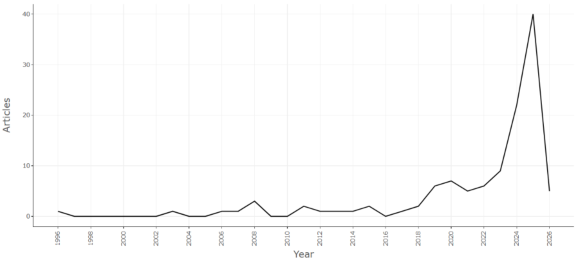
Bibliometric Mapping and Performance Analysis The bibliometric analysis, applying the main bibliometric laws to the corpus of 117 documents (1996–2026), allowed for the identification of the evolutionary behavior of this research field, validating it as an area in rapid expansion and conceptual transformation. The exponential growth of publications, from a maximum of 3 articles per year until 2018 to 40 in 2025 (see Figure 1), follows a steep saturation curve, indicating a transition from an exploratory phase to theoretical consolidation.
Figure 1: Annual scientific production on the convergence of Leagile Management and Artificial Intelligence during 1996 and 2026 (Author, 2026).
The temporal analysis reveals non-linear growth: Although the theoretical concept of integrating agile, lean, and intelligent systems has seminal roots in 1996 with Luo, Zhang, and Ren (1996), scientific production remained latent for two decades. The scenario has changed drastically in the last two years: a historical peak in 2025 (40 publications) and a strong presence in early access for 2026. More than 50% of all relevant scientific production on the topic has been published in the last 24 months. The hiatus between 1996 and 2024 suggests that management approaches and methodologies (Leagile) were ahead of technological capacity; now that the technology has matured, corporations need to accelerate and structure the management models required to support it (Womack & Jones, 1996; Stone, 2012).
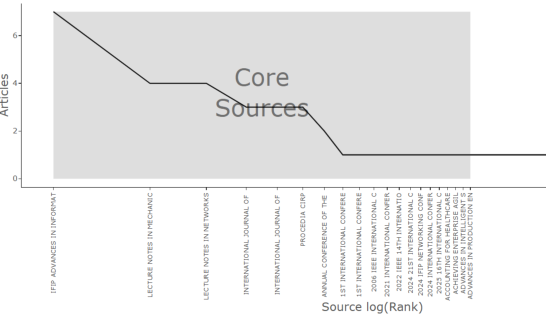
From Lean Agile Maturity to AI Readiness: A Theoretical Management Analysis 157 The distribution by publication type of the 117 documents, concentrated in conference papers (49.6%), journal articles (23.9%), proceeding papers (6.8%), and book chapters (6.8%). Also evidences the emerging nature of the topic, where conferences act as the primary vehicle for scientific dissemination. Confirmed by Bradford’s Law (see Figure 2), there is no single dominant journal, indicating only a nuclear zone of production engineering and information systems communities, composed of IFIP AICT (7 articles), Lecture Notes in Mechanical Engineering (4), Lecture Notes in Networks and Systems (4), and journals such as the International Journal of Lean Six Sigma, International Journal of Production Research, and Procedia CIRP (3 each).
Figure 2: Core sources distribution highlighting the main journals and conference proceedings according to Bradford’s Law (Author, 2026).
Lotka’s Law regarding author productivity was also not met, with a high proportion of the 385 mapped authors having only one publication (95.8%). Authors with 2–3 articles (e.g., NA N, ARIF J, LAURAS M) operate in specific niches (logistics, smart manufacturing) without dominant leadership. Again, this fragmentation reinforces the characteristics of new multidisciplinary themes, where researchers from various fields (IT, Engineering, Management) are beginning to explore the intersection without a consolidated group of specific researchers. Furthermore, the geographic distribution analysis highlights India (36 publications), focused on AI application in industrial and management processes; Australia (20), focused on Project Management; Morocco (18), with research in applied industrial engineering; and France and the USA (15 each) covering more varied themes. These countries together account for more than half of the corpus.
Table 1: Words most frequently used in abstracts, titles, and keywords (Author, 2026).
Table available in the original PDF paper.
Keyword Total Occurrences Lean Production 55
Artificial Intelligence 48 Agile Manufacturing Systems 47
Project Management 25 (Continued)
Table 1: Continued.
Table available in the original PDF paper.
Keyword Total Occurrences Industry 4.0 17
Decision Making 15 Digital Transformation 14
Information Management 14 Decision Support Systems 12
Lean Manufacturing 12 The application of Zipf’s Law for keyword frequency evidenced that the term “Artificial Intelligence” (48 occurrences) has assumed leadership among technologies, surpassing classic engineering terms in the evaluated studies. However, the operational base remains solid, with “Lean Production” (55 occurrences) and “Agile Manufacturing Systems” (47 occurrences) leading the lexicon. Nevertheless, cognitive and strategic terms such as “Project Management” (25), “Industry 4.0” (17), “Decision Making” (15), “Digital Transformation” (14), “Information Management” (14), and “Decision Support Systems” (12) appear shortly after (see Table 1). This demonstrates that AI is no longer treated merely as shop-floor automation but as a strategic management tool in the digital age, demanding leaner and more agile processes.
Deductive Content Analysis: Leagile Dimensions as AI Enablers The bibliometric findings were mapped onto the six dimensions of Leagile management maturity (Ito, 2024), correlating them with critical AI Readiness Factors identified in the literature. Each dimension reveals specific capabilities that transition from operational practices to strategic AI prerequisites (see Table 2).
The literature points out that the lack of a clear strategy and an innovation culture are primary barriers to AI, and the analysis above identifies Leagile maturity as a predictor of AI adoption success, with clear causal paths between organizational dimensions and technical readiness factors. The observed convergence results in the concept of Lean 4.0 or Digital Lean, where traditional tools like VSM (Value Stream Mapping) and Poka-Yoke are digitized. Lean provides the discipline for waste reduction, while Industry 4.0 technologies (Big Data, Cloud, IoT) provide the speed and connectivity required in the digital age (Womack & Jones, 1996; Rigby, Sutherland, Noble, 2018; Stone, 2012; Valamede, Akkari, 2020).
Therefore, the theoretical analysis indicates that “AI readiness” demands a strategic restructuring of the operational and managerial model that mirrors advanced stages of Leagile maturity (at least at the “Mature” level in each dimension). Lower levels remain trapped in isolated experiments, failing to achieve the minimum efficiency and adaptability necessary to scale and deliver consistent, sustainable business results.
Define Lean-AI OKRs;
Annual strategic Value
Stream Mapping; Dedicated
C-Level sponsor.
Weekly retrospectives with
AI insights; Multidisciplinary
“AI Office Hours”;
Upskilling gamification.
Leagile-AI LMS platform;
“AI buddy” rotation;
Human-AI engagement
metrics.
Value Stream Mapping for
AI pipelines; ML model takt
time; Lean ETL automation.
Leagile Product Discovery;
“AI as MVP” sprints;
Generative customer pull
features.
Lean Data Council
(governance Kanban); “AI
red teaming”; Visual data
quality dashboards.
Transformed: Continuous strategic
alignment via Lean-AI OKRs
ensures AI is a core capability, not
an isolated IT project.
Advanced: Culture of retrospectives
+ systematic experimentation
creates trust in AI decisions,
essential for agentic AI at scale.
Mature: Role rotation and iterative
learning loops enable scalable
human-AI collaboration, preparing
for future competencies.
Mature: Value stream mapping +
Lean standardization reduces Mura
(variability), generating clean data
for algorithms; Lean 4.0 proves
continuous physical flow is the base
for real-time digital flow.
Mature: MVP cycles + customer
pull incorporate AI as a
differentiator feature, not an
accessory, via continuous delivery.
Advanced: Lean Data Council +
governance Kanban establish real-
time data governance; Iterative “AI
red teaming” ensures transparency
and ethical compliance at scale.
C-Level support
and strategic
AI roadmap
(Ali and Khan,
2025).
Human-AI
trust,
experimental
culture (IBM,
2025).
Reskilling
68% digital competencies
(World
Economic
Forum, 2025).
Clean data
pipelines;
Agile Machine
Learning
Operation.
AI-embedded
products;
continuous
delivery.
Real-time data
governance;
Algorithm
auditing.
Project management (25
occurrences), Industry 4.0
(17), digital transf. (14);
Bradford Zone 1 (IFIP
AICT).
Personnel training (9),
engineering educ. (6);
Trend topics 2022+;
Thematic map “niche”.
Talent management
(3), HR management
(5); Lexical evolution
“personnel” → “talent”
post-2020.
Lean production (55),
agile systems (47), supply
chains (14); Generative
AI wave (2024–2025)”.
digital twin (5); Motor
themes “decision making”
(15).
(7), DSS (12), info
management (14); Lotka
dispersion reinforces need
for frameworks.
points (Lean upstream/ Agile
downstream), Industry 4.0
alignment (Rigby, Sutherland,
Noble, 2018)
loops, empowerment, human-
centricity (Womack & Jones,
1996)
multidisciplinary teams, human-
machine hybrid talent.
elimination (Muda), agile A3
problem-solving (Womack &
Jones, 1996).
products, smart features. Smart management (8),
risk management, pull metrics. Risk management
Table 2: Synthesis of the analysis correlating bibliometric evidence with Leagile capabilities and AI Readiness requirements (Author, 2026).
This systematic bibliometric analysis of 117 documents published between 1996 and 2026 confirms that Leagile maturity across the dimensions of Strategy, Culture, People, Processes, Products and Governance, constitutes a prerequisite for scalable and consistent organizational AI Readiness. Classical bibliometric laws validate the incipient level of this research field and assist in deepening this relationship: Bradford’s Law identified a specialized core of sources in production engineering (IFIP AICT with 7 articles, Lecture Notes with 8); Lotka’s Law revealed a 95.8% author dispersion among 385 researchers; and Zipf’s Law highlighted the dominant conceptual triad— lean production (55 occurrences), artificial intelligence (48), and agile manufacturing systems (47)—which represents more than 40% of the field’s basic vocabulary. This bibliometric analysis demonstrates through Bradford’s (identified cores), Lotka’s (quantified dispersion), and Zipf’s (mapped lexical triad) laws that AI Readiness is an evolutionary organizational capability, not an isolated technological state, demanding a solid, efficient, and adaptable structural preparation sufficient for investments to result in sustainable and strategic business returns.
The results demonstrate three main causal mechanisms. First, Transformed levels in Strategy and Advanced levels in Culture mitigate AI adoption risks through continuous strategic alignment and psychological safety for systematic experimentation. Second, Mature Processes maturity ensures data quality by eliminating waste and variability, creating stable physical flows that sustain real-time digital flows. Third, post-2023 Leagile ambidexterity has correlated the governance and human-AI orchestration capabilities necessary to transition from isolated pilots to strategic agentic systems.
For managers, the proposed framework offers a structured diagnosis by dimension, with empirically validated priorities: executive sponsorship and clarity of short- to long-term objectives in Strategy; value stream mapping in Processes; and data councils with visual governance in Governance. Organizations that achieve these minimum levels convert AI investments into sustainable business results.
The limitations of this article include the qualitative deductive scope restricted to Web of Science and Scopus databases, demanding future quantitative and empirical validation. Future research should include sector-specific case studies, statistical modelling of maturity dimensions and AI outcomes, and empirical validation of the proposed framework in real organizational transformations. This study positions Leagile management maturity as an essential strategic foundation for the effective implementation of Artificial Intelligence in the management of the digital age.
ACKNOWLEDGMENT
Statement on the use of AI in scientific writing: During the preparation of this paper, the author used Gemini (Google) to enhance the English grammar and improve the overall readability and flow of the text. Throughout the entire process of construction and writing, the author monitored and refined the content generated with the assistance of the AI tool and takes full responsibility for the final content of the publication.
REFERENCES
Ali, A., & Khan, N. (2025). Critical success factors for organizational AI readiness: A systematic literature review. Journal of Enterprise Information Management, 38(2), 123–147. Aria, M., & Cuccurullo, C. (2017). Bibliometrix: An R-tool for comprehensive
science mapping analysis. Journal of Informetrics, 11(4), 959–975. IBM. (2025). Agentic AI’s strategic ascent. IBM Institute for Business Value. Ito, J. Y. (2024). Proposal for a lean-agile management maturity model in the context of the digital age: Application in impact businesses in Brazil. Master’s Dissertation in Engineering and Innovation Management. Universidade Federal do ABC, Santo André, Brasil. Ito, J. Y., Silveira, F. F., and Akkari, A. C. S. (2023). International publication trends
in Lean-Agile Management research: A bibliometric analysis. Procedia Computer Science, 219, 666–673. Lakatos, E. M. (2003). Fundamentals of scientific methodology. São Paulo: Atlas. Luo, X., Zhang, C., & Ren, Y. (1996). A paradigm for engineering business process and its information system. IEEE International Conference on Systems, Man and Cybernetics. Information Intelligence and Systems, Beijing, China, 3, 2339–2344. MIT CISR. (2024). AI future-ready enterprises. MIT Center for Information Systems
Research. Naylor, J. B., Naim, M. M., and Berry, D. (1999). Leagility: Integrating the lean and agile manufacturing paradigms in the total supply chain. International Journal of Production Economics, 62(1–2), 107–118. Rigby, D., Sutherland, J., & Noble, A. (2018). Agile at scale. Harvard Business
Review, 96(3), 88–96. Stone, K. B. (2012). Four decades of lean: A systematic literature review. International Journal of Lean Six Sigma, 3(2), 112–132. Valamede, L. S., and Akkari, A. C. S. (2020). Lean 4.0: A new holistic approach for
the integration of lean manufacturing tools and digital technologies. International Journal of Mathematical, Engineering and Management Sciences, 5(5), 851–868. Womack, J., & Jones, D. (1996). Lean thinking: Banish waste and create wealth in your corporation. New York: Simon & Schuster. World Economic Forum. (2025). New Economy Skills: Building AI, Data and Digital
Capabilities for Growth.
LISTED IN THE AHFE DIGITAL BOOKSTORE CATALOGUE
Explore the complete digital volume
Human Factors, Business Management and Society
Read this individual research paper free through the original publisher, or explore the full digital proceedings book.
ISBN 978-1-964867-91-5
Explore this ISBN in the AHFE Bookstore ↗Listed in the July 2026 bookstore catalogue; search by ISBN to confirm current availability · Digital book purchase optional