Krystian Pawłowski (2020). The Market Conditions Based Taxonomy of Modern Manufacturing Practices. In: Advances in The Ergonomics in Manufacturing: Managing the Enterprise of the Future. AHFE Open Access, vol. 12. https://doi.org/10.54941/ahfe100435
The subject of research is the taxonomy of modern methods and techniques of management. Management methods and their classification have always been the subject of research in both theoretical aspect (defining logical relationships in an organized set of methods) and empirical aspect (verifying their practical application). Empirical studies have been conducted multiple times in various countries. The objective of research was most frequently: the goals (reasons) for implementation, and the actual extent and results of the implementation. The purpose of this article is to present the results of research on the taxonomy of modern management methods in the context of situational determinants of enterprises in the process of implementing these methods. Such formulated problem is a result of a belief that the selection of modern methods of management in companies is subjected to both internal and external situational determinants. In my research I intend to test the hypothesis that an important factor for the company situational determinants is that company’s market orientation. The research process is divided into two phases: 1. Phase of the literature study and preparation of methodology for empirical research, 2 Empirical research and development of results. This article summarizes the results of the literature study and the main assumptions of the model of empirical research, which will be carried out at the beginning of 2014. The scope of the research includes 39 methods and techniques of management.
Progress in the field of product and technology innovation can be quickly increased by, for instance, the acquisition of patents and licenses. On the other hand, the organizational progress and the progress in knowledge management require a deliberate and systematic management actions. In enterprises, theoretical and practical knowledge of managers regarding modern management methods and techniques is often superficial, limited to the level of general concepts and slogans. A competitive gap regarding organizational innovation and knowledge management associated with not using modern management methods and tools (or failure of their implementation) arises mainly for the following reasons:
Lack of proper knowledge regarding the structuring of modern management methods and answering the question when to implement and what methods? This problem is also related to the difficulty in defining separate groups of management methods, which results from a growing complementarity of modern concepts and methods of management.
Lack of situational selection of modern management methods conditioned by external and internal factors.
Lack of overriding philosophy of doing business, business development strategy in the area of modern management methods.
Attempts to copy complete solutions which do not work due to cultural differences compared the country in which they were developed (in most cases it is Japan).
Lack of knowledge of the possible, real effects of such implementations, which as a result blocks the initiative and motivation to implement such methods.
In own research, the author sets a hypothesizes that the selection of modern methods of management in companies is subject to internal and external situational determinants, and that an important factor defining situational determinants of companies is their market orientation. Market orientation affects:
the scope of adjustment of the product or service to the individual customer requirements (level of product’s customization)
the nature of the main business process (emphasis on individual elements of the main business process) and its components: o Processes of production preparation. o Production process (such as the ability to introduce a continuous flow and a suction system, the possibility of using the stimulation process). o Logistics processes (character and the storage place of major inventories, the position of the inventory distribution point, repeatability of semi-finished products, variability of usage of semi- finished products).
Company’s business objectives.
Organizational objectives in the area of company management systems.
In the literature of the subject there are many taxonomies of management concepts, among which one can find modern, universal organizational principles (criteria for the classification and selection of modern management methods). The most extensive of these is the work of Miller and Roth (Bolden et al., 1997), the taxonomy developed by White (White, 1996), and the work of Bolden, Waterson, Wall, Warr, and Clegg. (Bolden at al., 1997). The most comprehensive proposition of Bolden includes 87 management concepts divided according to two main criteria: emphasis placed by individual concepts in a strategic dimension, and the areas they deal with.
The above mentioned taxonomies, including the proposal of Bolden and White do not lead to defining the separate groups of management methods, nor do they help to eliminate the randomness of the selection of appropriate methods in specific situations. The presented taxonomies are general classifications which do not take into account the situational selection of appropriate methods and tools of management. Moreover, even the most comprehensive proposal of Bolden does not distinguish the management methods and tools. For example, one group contains Toyota Production System with SPC or SQC. SPC and SQC methods represent only a JIDOKI part of one of the two foundations of the Toyota Production System.
SITUATIONAL CONDITIONS OF SELECTION OF MODERN MANAGEMENT METHODS A model of situational selection of modern methods and tools of management
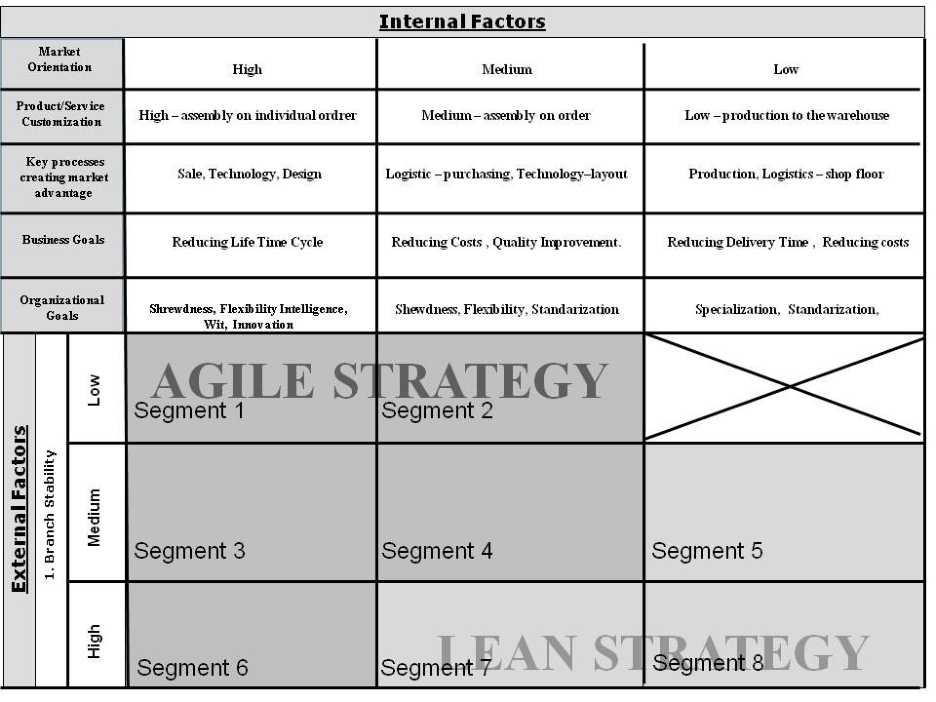
Figure 1 presents a model of situational selection of modern methods and tools of management. The model distinguishes two main groups of factors conditioning the situational selection of modern methods and tools of management: External factors shown on the vertical axis and internal shown on the horizontal axis. And so, the vertical axis contains a continuum in which we can distinguish three groups of companies based on the stability of the line of business. On the horizontal axis also three groups of companies are distinguished, based on five categories of factors: 1. strategy of market orientation, 2 the level of customization of products/services, 3 dominant processes (main components of a business process) building company’s market advantage, 4. main business objectives which create competitive advantage, and 5. organizational goals of the company.
Figure 1. A model of situational selection of modern methods and tools of management (Source: own research).
The resulting matrix creates nine potential associations such as: external (market) factors - internal conditions (business and organizational). After rejecting one illogical association (assuming that the primary goal of every organization - apart from non-profit organizations – is maximization of profit), eight situation segments were achieved. For each segment strategies for the implementation of modern methods and techniques of management were defined. The strategy is based on the following hypotheses:
1. Concepts of Lean Management (LM) and Agile Enterprise (AE) were considered as meta-concepts of management and at the same time as the development strategies of the organization. Meta concepts are materialized by many more detailed management concepts, methods and tools.
2. Implementation of modern management methods is effective when in the situation of a strong market orientation and high instability of a business sector we use Agile Organization strategy.
3. Implementation of modern management methods is effective when in the situation of a weak market orientation and high stability of a business sector we use Lean Management strategy.
External factors The key external factor having a substantial influence on situational selection of modern management methods and tools is the stability of the business sector. As mentioned above distinguishes three segments: segment with high stability, with average stability and with low stability of a business sector. The increasing instability of the business sector causes the growth of risk of substitutes from other sectors, the growth of spontaneity of demand, the increase of a number of small value contracts and the number of subcontractors. The decrease in the stability of the business
sector is also associated with the need to seek for market opportunities, and with the need to no longer only recognize and satisfy the requirements of individual clients but even to predict them. (Mazur, Rószkiewicz, Strzyżewska, 2008). The level of business sector stability has also a significant impact on the internal conditions, customization, business processes, logistics and manufacturing conditions. The greater the instability of the business sector, the stronger these effects are. The decrease in the stability of the business sector limits the possibility of automation of manufacturing processes, leads to a decrease of reliability of estimates of external and internal demand, increases the variability of the demand for semi-finished products, and this in turn reduces the ability to implement continuous flow and suction system, and the ability to use the stimulation process.
Internal factors The model assumes five groups of internal factors that have a significant impact on the situational selection of management methods and tools. A continuum resulting from these groups defines three segments of companies.
Level of market orientation Research hypothesis was assumed, that the most important factor for the company defining situational determinants is that company’s market orientation. Market orientation directly shapes other internal factors which define situational determinants of companies. It indicates at what level the company obtains information about customers' needs and satisfies them. (Mazur, Rószkiewicz, Strzyżewska, 2008),
Level of customization of products/services. Along with the increasing instability of the business sector, for effective satisfying of demand, a manner of preparing the product/service and adapting it to individual customer needs gains on importance. Initial support for this hypothesis can be found, among others, in previous studies conducted at Poznan University of Technology by the team of S. Trzcieliński (2013). In the research project called "Customizing enterprise management systems to the conditions of knowledge-based economy" 150 Polish companies were analyzed.
A survey conducted in 2012, distinguishing two points in time - 2007 and 2012, which coincided with the period of implementation of the Knowledge-Based Economy in Poland, but also with the period of the global economic crisis. In 2012 the variety of technologies used in the realization of contracts compared to 2007 increased in 27% of companies and decreased only in 3%. On the other hand, the number of small value contracts, compared to 2007, increased in 30% of companies and decreased in 13%. Similarly, in 19% of companies, the number of subcontractors/suppliers with whom the company cooperates increased as compared to 2007. Number of suppliers decreased in 7% of companies. Companies characterized by a high degree of products customization offer highly individualized products based on customers’ demand, in which the production preparation and marketing processes are definitely crucial. Enterprises characterized by a medium level of customization offer products which are partially tailored to customers’ needs. These are mainly catalog products manufactured on the basis of the ordered assembly. Customers choose the final product from a wide range of standards. Companies manufacturing products of a low degree of customization offer products that can’t be changed, produced to stock, very often with the PUSH strategy, most often quickly circulating products, distributed mainly through the wholesale network or from a central warehouse. (Pawłowski, 2013),
Predominant processes in the main business process - the level of customization of products/services influences the importance of the individual processes in the main business process. The increase in the level of customization leads to a decline in the importance of manufacturing processes in favor of preparatory processes. Many times, a high level of customization means not only the assembly on order but a complete preparation of technology and construction of the ordered product. Shortening product delivery cycles indicates that changes in specifications, and hence in the design and technology of the product, occur in the course of production leading to dozens of structural and technological changes and generates an even greater number of changes and problems in the logistic processes in the supply chain and manufacturing processes. These changes often lead to the growth of manufacturing defects and untimely delivery of the products. In such circumstances it is necessary to apply management methods and tools supporting the processes of development of products and technology, and leading to shortening cycles of the implementation of these processes.
Business objectives. Customization of products in the field of operating activity of companies determines the following conditions:
Logistics conditions: character and the storage place of major inventories, the position of the inventory distribution point, repeatability of semi-finished products, variability of usage of semi-finished products.
Production conditions: ability to introduce a continuous flow and a suction system, the possibility of using the stimulation process The above mentioned logistics and production conditions significantly influence in turn the business objectives of companies' operating activity. The developed model assumes three groups of business objectives for particular business segments (Figure 1).
High customization is associated with low repeatability of standard elements and a high volatility of elements usage. The costs and time spent on the technical preparation of production distributes over a small amount of product manufactured often in a shorter period of time. For each order, the processes of technical and construction preparation of the product are activated. Product specifications is defined for each order; can partially be based on previously defined variants, but there is a very large number of solutions dedicated for a particular client. The company's competitive position will mainly be affected by preparatory processes. Connected with the above-mentioned, observed in many markets, shortening of supply cycles, business objectives for the above group of companies: shortening cycles of realization of all business processes (mainly preparatory processes) (Figure 1). (Pawlowski, 2013)
The average level of customization is associated with high repeatability of standard components. The costs and time spent on the technical preparation of production distributes over a large number of product manufactured often in a longer time perspective. For subsequent orders, processes of technical and construction preparation of the product are limited to the development of lists of elements for particular production orders and to the current updating of offered variants of product. Product specification is defined for each order but is based on previously defined variants. Production processes are partially automated. With the average level of customization, both the time to deliver products to the market, the cost of providing them and the wide range of product variants offered are crucial. The company's competitive position will mainly be affected by preparatory and production- logistics processes. Business objectives for the above group of companies: shortening cycles of realization of all business processes, increasing the quality of products and services - increased product competitiveness, and reducing costs of operating activity - increased cost competitiveness (Figure 1). (Pawlowski, 2013).
Low level of customization is associated with high repeatability of products. The costs and time spent on the technical preparation of production distributes over a large number of product manufactured often in a longer time perspective. For subsequent orders, processes of technical and construction preparation of the product do not occur. Defined product specifications does not change either. Production processes are often automated. With a low customization, the most important are the time of delivering products to the market, the cost of providing them and their quality. Production and logistics processes will play a key role in the company competitive position. Business objectives for the above group of companies: reducing costs of operating activity - increased cost competitiveness, increasing the quality of products – increased product competitiveness (Figure 1). (Pawlowski, 2013).
Organizational objectives - are the fifth factor defining the situational conditions of enterprises that determine the selection of modern management methods and tools. Organizational objectives are related to the construction of enterprise’s management system and determine its characteristics. For high market orientation, the desirable features of a management system are: quickness, flexibility, intelligence, cleverness and innovation. For the average level of market orientation, the desirable features are quickness and flexibility. For low market orientation, the desirable features are specialization, standardization and organization of processes around the value stream.
THE MARKET CONDITIONS BASED TAXONOMY OF MODERN MANUFACTURING PRACTICES The scope of the taxonomy
The scope of the research includes 42 methods and techniques of management. Material scope of the study was limited to industrial companies. Legitimacy and manner of implementation of these methods were considered based on the two criteria presented in Figure 1.
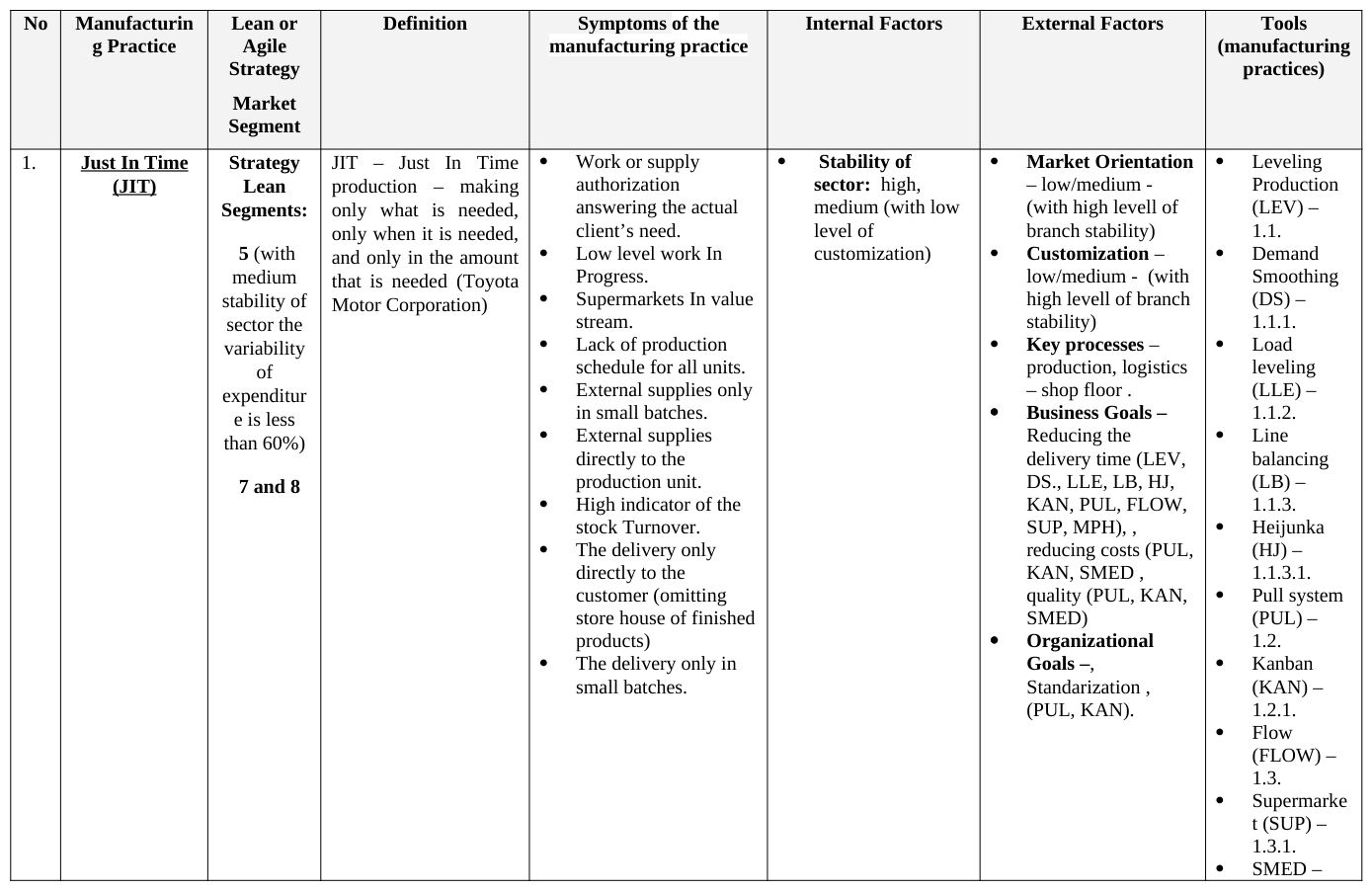
Table 1. shows a portion of the full taxonomy developed based on the literature study and includes such methods as the JIT (Just In Time) and LEV (Leveling). In the second stage of the research process (phase of empirical study) assumptions from the first phase will be verified. Table 1, from left to right, shows the ordinal number of the method, the definition of the method, the basic symptoms of using the method in the company, a strategy in which the method is applied, business segments in which the use of the method is the most effective, external and internal conditions for which the implementation of the method is the most effective, and in the last column the management tools (methods) that are used in the method.
Table available in the original PDF paper.
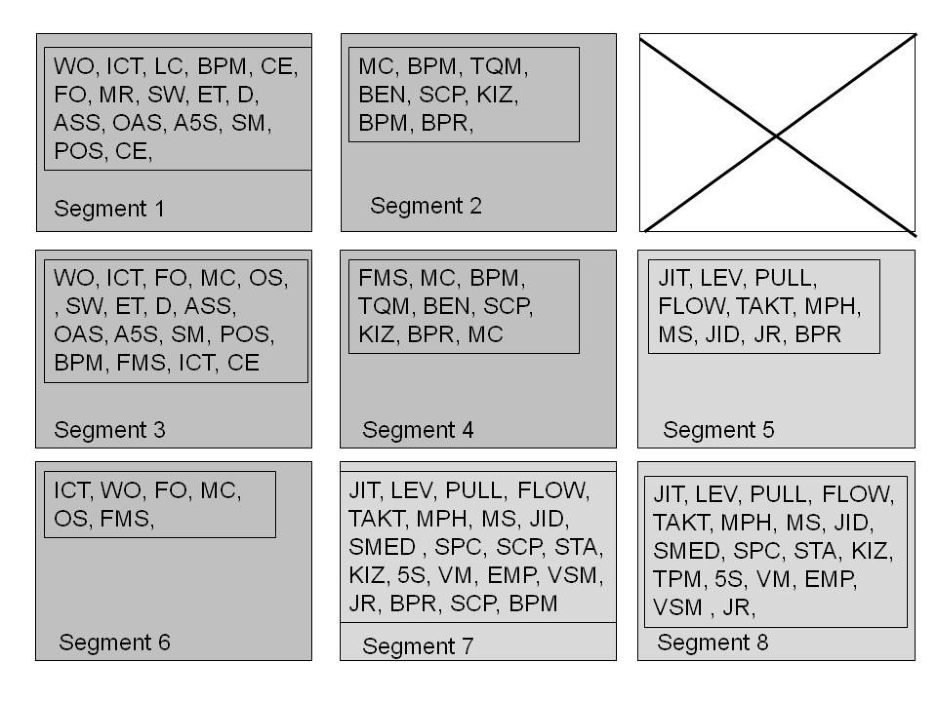
Figure 2. shows the overall summary of the full taxonomy covering all the 42 management methods included in the study.
Figure available in the original PDF paper.
PHASE OF EMPIRICAL STUDIES The research process is divided into two phases:
1. Phase of the literature study and the preparation of methodology for empirical study. 2. Empirical study and development of results. Phase of empirical studies will be conducted in March and April 2014. Results of empirical studies are to verify assumptions from the literature studies. The intention of the study is to test the hypothesis that the important factors defining situational determinants of companies is stability of the business sector and market orientation of the company, which affects: - the level of adjusting the product or service to the individual customer requirements (level of customization of the product), - the character of the main business process (emphasis on individual elements of the main business process) and its components, - processes of production preparation, - production processes (such as an ability to introduce a continuous flow and a suction system, the possibility to use the stimulation process), - logistics processes (such as the character and storage place of main inventories, the location of the point of stocks distribution, repeatability of semi-finished products, volatility of semi-finished products usage).
SUMMARY A progress in organization and knowledge management requires a deliberate and systematic management actions. A competitive gap associated with organizational innovation and knowledge management related to the lack of application of modern management methods and tools (or failure to implement them) can be efficiently and quickly reduced with the use of situational selection of modern management methods. The market conditions based taxonomy, after the end of empirical studies phase, can be a useful tool in the development and implementation of the development strategy of the organization.
Proceedings of the 5th International Conference on Applied Human Factors and Ergonomics AHFE 2014, Kraków, Poland 19-23 July 2014 Edited by T. Ahram, W. Karwowski and T. Marek
Table 1. A portion of the full taxonomy (Source: own research).
https://openaccess.cms-conferences.org/#/publications/book/978-1-4951-2103-6 Ergonomics in Manufacturing (2020)
Proceedings of the 5th International Conference on Applied Human Factors and Ergonomics AHFE 2014, Kraków, Poland 19-23 July 2014 Edited by T. Ahram, W. Karwowski and T. Marek
https://openaccess.cms-conferences.org/#/publications/book/978-1-4951-2103-6 Ergonomics in Manufacturing (2020)
Proceedings of the 5th International Conference on Applied Human Factors and Ergonomics AHFE 2014, Kraków, Poland 19-23 July 2014 Edited by T. Ahram, W. Karwowski and T. Marek
https://openaccess.cms-conferences.org/#/publications/book/978-1-4951-2103-6 Ergonomics in Manufacturing (2020)
Proceedings of the 5th International Conference on Applied Human Factors and Ergonomics AHFE 2014, Kraków, Poland 19-23 July 2014 Edited by T. Ahram, W. Karwowski and T. Marek
Figure 2. Overall summary of taxonomy. (source: own research).
Key: (JIT) - Just In Time, (Lev) Levelling, (Pull) Pull system, (Kan) Kanban, (Flow) Flow production, (Sup) Supermarket, (SMED) Single Minute Exchange of Dies, (Takt) Takt Time, (MPH) Multi Process Handling, (MS) Multi Skilling (JID) – JIDOKA, (TQM) – Total Quality Management, (BEN) – Benchmarking, (SPC) – Statistical Process Control, (SCP) – Supply Chain Partnering, (STA) – Standardization, (KIZ) – Kaizen, (TPM) – Total Productive Maintenance, (5S)- 5 S, (VM) – Visual Management, (EMP) – Empowerment, (VSM) – Value Stream Mapping, (WO) – Virtual Organization, (LC) – Learning Culture, (FO) – Fractal Organization, (MC) - Mas Customization (OS) – Outsourcing, (MR) – Marketing Research, (SW) – SWOT, (ET) – Extrapolation of trends, (D) – Delfi method, (OAS) - Market Attractiveness Analysis , (A5S) - Porter five forces analysis ( (JR) – Job Rotation (SM) – Skills Matrix (POS) – Process Oriented Structure, (BPM) – Business Process Management, (BPR) – Business Process Reengineering, (FMS) – Flexible Manufacturing Systems, (CE) – Concurrent Engineering, (ICT) – Integrated Computer Technologies, (MC) – Manufacturing Cells, (TBW) – Team Based Working, (EMP) – Empowerment
REFERENCES
Bruce M., Daly L., (2004). Lean or Agile. A solution for supply-chain management in the textile and clothing industry.
International Journal of Operation & Production Management Vol. 24 No. 2, 151-170. Carr P, Rainbird M., Walters D., (2004). Measuring the implications of virtual integration in the new economy. International Journal of Physical Distribution & Logistics Management Vol. 34, No. 3/4, 358-372. Bolden R., Waterson P., Warr P., Clegg Ch., Wall T., (1997). A new taxonomy of modern manufacturing practices. International
Journal of Operation & Management. Vol. 17 No. 11, 1112-1130.
Proceedings of the 5th International Conference on Applied Human Factors and Ergonomics AHFE 2014, Kraków, Poland 19-23 July 2014 Edited by T. Ahram, W. Karwowski and T. Marek
Mazur J., Rószkiewicz M., Strzyżewska M., Orientacja na wiedzę a wyniki ekonomiczne przedsiębiorstwa. Wyniki badań średnich przedsiębiorstw funkcjonujących w Polsce. Szkoła Główna Handlowa w Warszawie. Warszawa 2008. (pp. 19-20). Nadler G. (1967). Work system design. The ideals concept. Homewood: R.D. Irwin Inc. Pawłowski E., Pawłowski K., (2005). Enterprise of the future in relation to the modern manufacturing practices. [Modern
enterprise] S. Trzcieliński (Ed), Nowoczesne Przedsiębiorstwo (pp. 30–40). Poznań, Monografia wydana przez Instytut Inżynierii Zarządzania, Politechnika Poznańska. Pawłowski K., Trzcieliński S., (2006). Guidelines to classification and choice of the modern manufacturing practices. S.
Trzcieliński (Ed). Zarządzanie we współczesnym przedsiębiorstwie [Management in modern enterprise] (pp. 9–23). Poznań, Monografia wydana przez Instytut Inżynierii Zarządzania, Politechnika Poznańska. Trzcielinski S. (2013). Niektóre symptomy zmiany strategii przedsiębiorstw. Wstępne wyniki badań wpływu GOW. [in:] Moszkowicz M., Kamiński R. Wasowicz M. Budowa gospodarki opartej na wiedzy w Polsce – modele i doświadczenia. Research Papers of Wrocław University of Economics 298, Wrocław 2013 (pp. 170 – 178) Trzcieliński S. (2011). Przedsiębiorstwo zwinne. Wydawnictwo Politechniki Poznańskiej, Poznań, (pp. 11-23) Trzcieliński S. (2005). Models of company agility. [in:] S. Trzcieliński (ed.), Nowoczesne przedsiębiorstwo [Modern enterprise].
Momografia wydana przez Instytut Inżynierii Zarządzania , Politechnika Poznańska, Poznań 2005. Warnecke H. (1993). The Fractal Company. A Revolution in Corporate Culture. Berlin: Springer-Verlag. White P. G., (1996). A survey and taxonomy of strategy-related performance measures for manufacturing. International Journal of Operation & Management. Vol. 16, No. 3. Zang Z., Sharifi H., (2000). A methodology for achieving agility in manufacturing organizations. International Journal of
Operation & Production Management Vol. 20 No. 4, (pp. 496-512)
LISTED IN THE AHFE DIGITAL BOOKSTORE CATALOGUE
Explore the complete digital volume
Advances in The Ergonomics in Manufacturing: Managing the Enterprise of the Future
Read this individual research paper free through the original publisher, or explore the full digital proceedings book.
ISBN 978-1-4951-2103-6
Explore this ISBN in the AHFE Bookstore ↗Listed in the July 2026 bookstore catalogue; search by ISBN to confirm current availability · Digital book purchase optional