Mateusz Chróst (2023). Opportunity as a common factor of agility and entrepreneurship. In: Human Aspects of Advanced Manufacturing. AHFE Open Access, vol. 80, pp. 67–76. https://doi.org/10.54941/ahfe1003509
The article presents an analysis of the literature on the agility of an enterprise from the point of view of recognition of opportunities, entrepreneurship and chances in a turbulent environment. The different approaches to the concept of opportunity are described and the ideas of enterprise brightness, resource flexibility of enterprises, the concept of enterprise intelligence and shrewdness are presented. The link between the notion of entrepreneurship and innovation has been shown. The concept of innovation was defined and organized. Activities related to creating opportunities in a reactive and proactive manner were discussed. The article presents a case study involving the implementation of a new (innovative) technology. The innovation in the examined company was created as a result of reactive activities. The company research presents implementation the innovative technology and specifies the timeframe for implementation. The length of the opportunity streak was presented and the product and service life cycles were compared. It was shown that the company's reactivity enabled the implementation of the new technology and opened a new range of opportunities consisting in the commencement of training services in the field of the implemented innovation.
In uncertain times and a turbulent environment, entrepreneurship-related skills that create opportunities and resist market volatility are gaining impor- tance. The ability to use entrepreneurship-related traits is a significant factor in the long-term running of a business. In recent years, there have been many publications on entrepreneurship. There are many scientific studies that con- firm that entrepreneurship has a significant positive impact on economic development, including job creation. Entrepreneurship can contribute to job creation in various ways. First, entrepreneurs create new businesses that gene- rate jobs for other people. These new jobs often require new qualifications and skills, which in turn can lead to the development and improvement of education and training systems. Second, entrepreneurs often invest in their companies, which in turn leads to increased production and sales. As a result, entrepreneurs are more likely to need additional workers to meet the grow- ing demand for their products and services. Third, entrepreneurs innovate, which contributes to the development of new markets and sectors of the economy. These new markets often require new skills and specializations,
which in turn can lead to the creation of new jobs. It is worth noting, howe- ver, that the impact of entrepreneurship on job creation can vary depending on the context and conditions in which the entrepreneur operates. In some cases, entrepreneurship can lead to job losses, such as in sectors that are being automated or outsourced. Therefore, it is important to study the impact of entrepreneurship on job creation in the context of specific market and eco- nomic conditions. (Perlines et al., 2022). Joseph Schumpeter pioneered a new approach to the way business is conducted in a capitalist economy that relies on innovation and new solutions. Schumpeter believed that the key impetus for the development of capitalism is new products, technologies, forms of transportation and organizations, which are created through entrepreneur- ship. Entrepreneurship can take many forms, including individual, collective, or occur within large enterprises. For this reason, equating entrepreneurship only with small businesses is an unwarranted narrowing of the concept, as the entrepreneurial spirit can be present in a variety of business contexts. (Sudol, 2008).
OPPORTUNITY An opportunity is a situation in which there is the possibility of gaining an advantage or profit by taking action at a particular time and place. Oppor- tunities can arise from a variety of factors, such as changes in the market, customer needs, shortcomings in competitors’ offerings, technological adva- nces or changes in regulations. Entrepreneurs and managers who are able to identify and seize opportunities can achieve business success. Traditio- nal microeconomics assumes that companies operating in markets are fully informed about how to do business. Markets are treated as equilibrium situ- ations, and management and organizational research is undertaken to better understand market opportunities and possibilities. In this view, there is the possibility of creating new opportunities and possibilities that are not objecti- vely defined. In the face of market uncertainty, companies can make profits by expanding their production offerings. Due to the lack of a constant balance between supply and demand, markets are a field for the search for oppor- tunities and chances, which can arise from other entrepreneurs’ mistakes, shortages, surpluses or inadequate allocation of resources. Bold and vigilant entrepreneurs take advantage of other entrepreneurs’ mistakes and inadequ- ate resource allocations to buy goods where prices are “too low”and then sell them where prices are “too high.” This practice results in a gradual closing of price gaps and a reduction of surpluses and shortages. In a dynamic environ- ment with changing consumer tastes, resource availability and the emergence of new technologies, this process does not lead to rapid convergence to a state of equilibrium, but constantly creates new opportunities for enterprising market participants. Under conditions of market instability, there are oppor- tunities for entrepreneurs who are able to capitalize on the erroneous plans and decisions of others by quickly correcting their business actions. Such entrepreneurs are characterized by vigilance and imagination. In economics, as well as in the field of management and organization, research focuses on understanding and theoretically describing market processes and emerging
Opportunity as a Common Factor of Agility and Entrepreneurship 69
opportunities and possibilities. This approach makes it possible to identify new opportunities, which are called chances or opportunities that are not objectively defined. In a market where there is an imbalance between supply and demand, mistakes and shortcomings of other entrepreneurs or misalloca- tion of resources lead to the emergence of opportunities and opportunities for entrepreneurial market participants. Entrepreneurs taking advantage of such opportunities are characterized by vigilance, courage and creativity in taking business actions to make profits. In this way, they create new opportunities for themselves and other market participants, while reducing price differen- tials and reducing shortages and surpluses in the market (Sautet, n.d.). In a world of constantly changing tastes, resource availability and known techno- logical capabilities, this entrepreneurial process cannot guarantee rapid (or slow) convergence to a state of equilibrium. However, it does create a new band of opportunity at every moment. In a turbulent and changing market, an opportunity arises for entrepreneurial participants in the business process who are able to uncover flawed plans, those that are implemented based on flawed decision-making frameworks. These are the entrepreneurs who will have the ability to correct business plans and actions by reacting quickly and effectively, are characterized by vigilance and endowed with imagination. In this way, businesses recognize opportunities that have arisen as a result of initially erroneous plans. This attitude determines the tendency to discover and seize opportunities. These are companies that resist routine and stagna- tion, are open to the new and are not afraid of change. What creates the ability to spot favorable opportunities is a natural alertness to new opportu- nities or the danger of unfavorable developments. In a turbulent environment, natural alertness is expressed in boldness and imagination. Entrepreneurial vigilance refers to an attitude of openness to available (but hitherto overlo- oked) opportunities. The entrepreneurial nature of human action refers not only to the circumstance that action is taken in an open, uncertain world, but also to the circumstance that the human subject at all times spontane- ously searches for hitherto unnoticed features of the environment (present or future) that may inspire new actions on his part. Without knowing what to look for, without using any thoughtful search technique, the entrepreneur is scanning the horizon all the time (Kirzner, 1997). Huczek, in his article, beli- eves that entrepreneurial management requires the use of specific approaches and policies:
Organizations need to be made receptive to innovation and change so that they see it as a opportunity, not a threat. The organization should be organized in such a way that it can perform the difficult work of an entrepreneur. Care should be taken to ensure that appropriate policies are in place to create a climate conducive to seizing opportunities.
innovation and entrepreneurship should be systematically measured and evaluated in the organization, To ensure proper learning, success (Huczek Marian, 2009). Educatio- nal institutions operating in the educational market, in order to maintain a competitive advantage, use an entrepreneurial approach, looking for sou- rces of opportunity and ways to exploit them. These activities enable them
to adapt their educational offerings to market needs and improve the qua- lity of education. Educational institutions can also launch new majors and specializations, taking advantage of new remote or virtual learning oppor- tunities. Innovation is a key element of the entrepreneurial mindset, as it affects the emergence of new opportunities or their creation in a proactive manner (Zdun, 2021).
ENTREPRENEURSHIP Entrepreneurship is a complex process that consists of many elements and aims to create and develop an enterprise, with the main goal of generating profit and adding value for various stakeholder groups, such as customers, employees and society. To achieve successful entrepreneurship, a combination of different factors is required, such as:
ability to identify and seize business opportunities,
ability to take risks, skills to create and manage a team,
financial and resource management skills, negotiation and sales skills.
There are many theories and concepts about entrepreneurship that com- plement and complement each other. The main sources include:
economic literature, such as books and academic articles on entrepreneur- ship and business,
business practice and the experience of entrepreneurs,
market and industry research and analysis,
education and training programs on entrepreneurship and business. Rese- arch on entrepreneurship is carried out in many fields of knowledge: economics, management science, sociology and psychology. According to Frank Knight, an entrepreneur is a person who takes risks and is willing to engage in uncertain situations. Joseph Schumpeter, on the other hand, defi- nes an entrepreneur as a person who introduces new combinations, acts as a creator and innovator (Knight, 1921). Kirzner defines an entrepreneur as a person who is alert to favorable opportunities for change (Kirzner, 1997). Peter Drucker, on the other hand, emphasizes that the essence of entre- preneurship is entrepreneurial and innovative activities that seek success in the market. According to him, an entrepreneurial person always seeks change, responds to it and uses it as an opportunity to achieve his goals (Drucker, 1992). In the context of entrepreneurship, the question of the predispositions required of a business person is relevant. Many researchers believe that an entrepreneur should have many skills, such as the ability to deal with uncertainty, creativity, the ability to work under pressure, per- severance and alertness to opportunities. In addition, a business person should have good leadership skills, the ability to manage a team and the ability to make quick decisions. In addition, nowadays, it is also important for an entrepreneur to be able to adapt to changing market conditions and use information and communication technologies in running his business (Hirschi, 2010). Entrepreneurs must develop a number of competencies in order to succeed in their business activities. Among these competencies are
Opportunity as a Common Factor of Agility and Entrepreneurship 71
knowledge of legal and financial regulations, the ability to manage relati- onships with employees and customers, market analytical skills, and the ability to detect and seize business opportunities. In addition to this, it is important to have motivation and discipline in pursuit of set goals, as well as resilience to the stress of risk-taking. An entrepreneur must function in an environment of lack of clear instructions and control, with a lot of uncertainty, ambiguity and risks, which requires intense social interaction and flexibility in decision-making. Psychological literature indicates that a successful entrepreneur is characterized by, among other things, entre- preneurship, innovation, creativity, resourcefulness, analytical thinking, flexibility and self-discipline (Piskorz, 2009).
The right personality factors play a key role in the successful functioning of entrepreneurial people. Among these factors are a focus on problems and a willingness to solve them against internal and external obstacles that arise, the ability to handle difficult situations on one’s own, the ability to maintain a set direction and goal, and the ability to observe and analyze all economic elements in a holistic manner. Successful entrepreneurs are also characterized by a strong ego and a willingness to overcome anxiety. In addition, the value systems that shape the attitudes of entrepreneurs and influence their decision- making are also important (Strzałecki, 2007). The ability to innovate is a key factor in the success of a business. Nowadays, innovation plays an important role in civilization and economic development. Entrepreneurs who are able to innovate are able to set market trends and adapt to the changing needs of consumers. Innovation contributes to the transition from market equilibrium to a stage of dynamic development. The introduction of innovations makes it possible to create movement and change in the economic environment, which in turn is an important factor for adapting to changing consumer needs. It is also not insignificant that innovation allows for the development of new tech- nologies and processes, which in turn can contribute to increased efficiency and lower production costs. In this way, innovation is an important tool in the hands of entrepreneurs to compete and stay in the market. In conclusion, the ability to innovate is a key element that distinguishes agile entrepre- neurs and is an important factor for success and survival in the market (Zdun, 2021).
AGILE ENTERPRISE – THE ABILITY TO CREATE OPPORTUNITIES An agile enterprise is a business model based on agile management methods such as Agile and Lean Startup. The idea of an agile enterprise is to adapt quickly and continuously to changes in the business environment, and to implement and test new ideas and solutions quickly. In an agile enterprise, it is important to adapt to the needs of customers and the market, and focus on continuous improvement of processes and products. In such a business model, teams are customer-oriented and focus on rapid implementation of changes and improvements, which allows for better market alignment and penetration. Agility is the ability to change. Agility allows an organization to accomplish the projects it wants to accomplish when it deems it necessary
and economically reasonable. Agility is a foundation required for all organi- zations. Awareness of the need for flexibility and agility activities in the past was not implemented in a structured manner because the world and the mar- ket were not changing as rapidly as they are in today’s business environment. (Rick Dove, 2001). Researchers are trying to answer the question of how agile should be understood in enterprises, what factors limit the implementa- tion of agile, and what management expectations are for implementing agile. The biggest barriers to implementing an agile approach include a culture that is too deeply rooted in traditional methodologies and a lack of resources to implement change in companies. Business owners’ and executives’ expe- ctations of the effects of agile management are increased productivity and competitiveness, and reduced delivery times (Zakrzewska et al., 2022). In the literature, studies can be found on the creation of new business process management (BPM) models that include ERP systems as modeling variables. Studies show that BPM has a positive and significant impact on promoting agility in an organization, and ERP models this relationship (Alavi et al., 2022). According to Mundra, there are specific properties of agility in an agile enterprise: the concept of agility is not monolithic and abstract, it is analyzed holistically: it includes human resources, structure, processes, stra- tegic management and technology, intangibles such as organizational culture. Another characteristic is that being agile is not a destination, but a journey - it is like taking care of good health in which good hygienic practices should be applied and adapted to each enterprise case in a different context(Enterprise Agility: Being Agile in a Changing World - Sunil Mundra - Google Books, n.d.). An Agile Enterprise is a business that is able to respond quickly and effectively to changing market conditions, customer needs, and other external factors. It has the ability to adapt and innovate quickly, and to take advan- tage of new opportunities as they arise. There are four key characteristics of an Agile Enterprise:
Enterprise agility - the ability to seize market opportunities, through lean management. Agility consists of many dimensions such as opportunity- responsive enterprise, opportunity-creating enterprise in the environment, enterprise with virtual subsystems, agile virtual enterprise.
The essence of the concept of enterprise brightness - is the ability of an enterprise to quickly perceive market opportunities and threats from the environment. The biological metaphor for the enterprise is the eye of the chameleon, relying on a quick and decisive response to catch an insect in a precise way by the chameleon.
The essence of the concept of resource flexibility of the enterprise - the abi- lity in the enterprise to expand the universality of resources which requires the creation of external and internal network structures.
The essence of the concept of intelligence - the ability of an organization to continuously learn through the personal mastery of its members and the shared vision of action created by the company’s management, which can convince its members of it.
The essence of the concept of enterprise cleverness - is about practical and effective actions that lead to the exploitation of opportunities. It is about
Opportunity as a Common Factor of Agility and Entrepreneurship 73
the effectiveness of the implementation of goals and the action (Trzcielin- ski, 2011). Flexible technology is one that allows quick changeovers and changes in operating parameters, and gives a wide opportunity to produce a diverse range of products. Financial flexibility is related to the ability to seize opportunities through the use of capital and cash. A company characterized by financial flexibility provides an opportunity to expand the bandwidth of opportunities and finance additional projects that could not have been planned or anticipated in the planned budget. Social agility makes it possible to quickly change the competence needs of employees like the organization of their work. An important element that enhances social agility is the working relationship the employer has with the emplo- yee. Entrepreneurial agility is the knowledge and skills that a company has to realize product creation, operations or marketing. A company that is able to cooperate in the R&D sphere expands its bandwidth of opportu- nities and increases the possibility of creating new products (Trzcielinski, 2011).
CASE STUDY The enterprise has its own base with an area of 2700m2. Other areas include 5400m2 provided for development. Construction materials recovered from renovation work are stored on the base. These include old-use concrete sle- epers, wooden sleepers, various types of rails and turnout parts. All items are segregated according to their purpose and isolated from the ground. The company has specialized equipment that allows it to carry out independent work. It has backhoe loaders, excavators, including one that allows moving on railroad tracks, specialized equipment for carrying out track works, tru- cks, delivery trucks and barracks. The mission of REMTOR sp. z o.o. is to provide the best technical solutions in the railroad industry throughout Poland in the area of rail infrastructure construction. The vision of REMTOR sp. z o.o. is to create an organization which will cover the implementation of large railroad construction projects with the scope of its activities. The scope of activities is to meet European standards and create competition in Europe. The company wants to ensure the comprehensiveness of its activities by cre- ating a design unit and expanding its machinery park. The company has a vision of acquiring the best professionals with specialized licenses to carry out any task related to the construction of railroad infrastructure in the future. REMTOR Sp. z o.o. offers construction, repairs, ongoing maintenance and upkeep of stations, lines and sidings, construction and repairs of streetcar tra- cks and turnouts, construction of streets, roads and squares, construction of sanitary and rainwater drainage systems. At the request of investors, it deve- lops construction and detailed designs for ongoing investments, along with obtaining the relevant permits. The company performs periodic inspections of the technical condition of railroad sidings. The company offers services in the field of welding rails with thermite in tracks, turnouts and intersecti- ons using dry, prefabricated forms. Welding applies to railroad rails of type 60E1 (UIC60) and 49E1 (S49). Another service offered is the reconditioning of railroad superstructure components using electric arc surfacing.
The company, acting reactively, noticed that there was a shortage of com- panies on the market specializing in the regeneration of turnout components by means of rail arc surfacing. For the company under study, the introdu- ction of the technology for regenerating railroad turnouts was an innovative activity. The implementation of the technology required the training of per- sonnel, the purchase of appropriate equipment and the carrying out of a testing ground on the premises of PKP PLK S.A. After a positive evaluation of the approval procedure, the company could apply for a certificate of approval and appropriate certification.
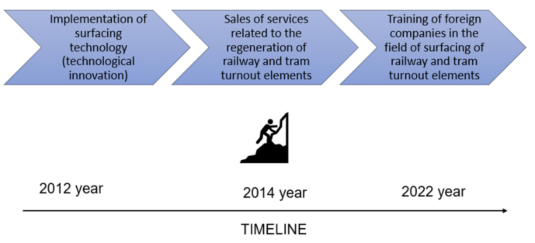
Figure 1 shows a diagram of the implementation of a technological inno- vation in a reactive manner (the company noticed a need in the market by observing requests for proposals and tender proceedings). Thanks to resource flexibility, an opportunity arose to equip the welding unit with the necessary equipment. Readiness to sell services related to the remanufacturing of tur- nout elements occurred after two years. This is a time-consuming and costly process. According to the timeline in Figure 1, the opportunity as a result of the innovation arose eight years after the service was sold. The techno- logical innovation resulted in the creation of a new service to train foreign companies in the field of surfacing turnout and streetcar components. Saudi Arabia’s 2022 investment to build six metro lines in Riyadh. Access to skilled labor is difficult, so there are many foreign workers in the country. In order to keep the Riyadh metro’s track infrastructure in proper working order, a need arose to train personnel in the technology of reconditioning metro turnout components.
Figure 1: Diagram of technological innovation implementation.
CONCLUSIONS
Innovation is the implementation of something new or significantly improved product or service. In the company under study, the implemented innova- tion expanded the company’s service offerings and enabled the creation of an opportunity related to a new service involving training in a previously implemented technology. Conclusions confirming the connection between innovation and opportunity are presented below:
Innovation supports the process of opportunity creation through the com- pany’s actions in a reactive and proactive manner. In the company under
Opportunity as a Common Factor of Agility and Entrepreneurship 75
study, management acted reactively by recognizing an opportunity to implement a new service to meet customer needs.
Innovation does not have to be groundbreaking - it does not have to create new customer needs or services. The key element is the implementation of a product or service innovation for an organization,
innovation can be implemented small-scale for the company enabling the long-term discovery of a previously unknown opportunity and its exploitation,
Creating opportunities by innovating in service companies can have a long life cycle, the surveyed company recognized and seized opportunities after eight years.
The innovation process is supported by the psychological abilities of the company’s executives and managers, who are open to new calls and make decisions related to a change about which they are uncertain and at a given moment are unable to predict its consequences (opportunities),
The process of creating opportunities through the implementation of innovations can increase enterprise agility and enhance the ability to reconfigure enterprise resources,
the company showed shrewdness, intelligence and shrewdness by recogni- zing and seizing the opportunity that arose
opportunity arose from an externally favorable situation: a shortage of qualified personnel in Saudi Arabia and the construction of six metro lines in Riyadh.
The findings confirm that innovation can be an important tool for crea- ting business opportunities. The implementation of an innovation not only expands the range of products and services, but can also provide the impe- tus for the creation of new business opportunities. It is worth noting that an innovation does not have to be groundbreaking, and its scale can be relatively small, yet when recognized and exploited, an opportunity can have a long life cycle. Management and the company’s board of directors play a key role in the innovation implementation process, and their psychological abilities and openness to new challenges are essential to discovering and exploiting the opportunity. Finally, it is worth noting that the innovation process can incre- ase the company’s agility and flexibility, as well as its ability to reconfigure resources. In the case studied, the opportunity related to the implementation of innovation arose as a result of an external enabling situation, such as a shortage of qualified personnel and the construction of a subway line.
REFERENCES
Alavi, S., Ramezanian, M., Bagheri, A., & Zeraati, V. (2022). Providing a model for achieving organisational agility with emphasis on business process management. International Journal of Process Management and Benchmarking. Enterprise Agility: Being Agile in a Changing World - Sunil Mundra - Google Books.
(n.d.). Retrieved November 12, 2022. Hirschi, A. (2010). The role of chance events in the school-to-work transition: The influence of demographic, personality and career development variables. Journal of Vocational Behavior.
Huczek Marian. (2009). Zarza˛dzanie jako czynnik rozwoju przedsie˛biorczo´sci. Kirzner, I. M. (1997). Entrepreneurial Discovery and the Competitive Market Process: An Austrian Approach. Journal of Economic Literature, XXXV, 60–85. Knight, F. (1921). Risk, Uncertainty and Profit. Houghton Mifflin Company. Perlines, F. H., Ariza-Montes, A., & Blanco-González-Tejero, C. (2022). Intra-
preneurship research: A comprehensive literature review. Journal of Business Research. Piskorz, Z. (2009). STUDIA Z NAUK SPOŁECZNYCH Psychologia przedsie˛biorczo´sci-sylwetka psychologiczna przedsie˛biorcy. Rick Dove. (2001). The Language, Structure, and Culture of the Agile Enterprise. Sautet, F. (n.d.). Opportunity Recognition The Entrepreneur and the Wonder of Human Creativity (book chapter) View project Local development and Jacobs externalities View project. Strzałecki Andrzej. (2007). Twórcza przedsie˛biorczo´s´c i zarza˛dzanie. Wyniki nowych
bada´n psychologicznych. Prakseologia, 147/2007. Sudoł, S. (2008). Przedsie˛biorczo´s´c - jej pojmowanie, typy i czynniki ja˛ kształtuja˛ce.
Problemy Zarza˛dzania, 6(nr 2 (20) Przedsie˛biorczo´s´c), 9–26. Trzcieli´nski Stefan. (2011). Przedsie˛biorstwo Zwinne. Zakrzewska, M., Jarosz, S., Piwowar-Sulej, K., & Sołtysik, M. (2022). Enterprise agility – its meaning, managerial expectations and barriers to implementation – a survey of three countries. Journal of Organizational Change Management. Zdun, M. M. (2021). Przedsie˛biorczo´s´c, innowacyjno´s´c, rozwój gospodarczy i insty-
tucja socjalizuja˛ca– jako ła´ncuch kategorii powia˛zanych. Rozprawy Społeczne, 15(1), 125–144.
LISTED IN THE AHFE DIGITAL BOOKSTORE CATALOGUE
Explore the complete digital volume
Human Aspects of Advanced Manufacturing
Read this individual research paper free through the original publisher, or explore the full digital proceedings book.
ISBN 978-1-958651-56-8
Explore this ISBN in the AHFE Bookstore ↗Listed in the July 2026 bookstore catalogue; search by ISBN to confirm current availability · Digital book purchase optional