Xinyuan Huang, Jingfang Wang (2026). Climate Science Popularization Packaging Experience Design Based on Transmedia Narrative Theory. In: Human Factors in Communication of Design. AHFE Open Access, vol. 216, pp. 182–194. https://doi.org/10.54941/ahfe1007636
Global warming has become a severe ecological challenge for humanity at present. However, climate science popularization for children is generally plagued by such problems as abstract content, single form and the disconnection between knowledge and practice. To address these pain points, this study, based on the transmedia narrative theory, proposes a climate science popularization packaging experience design integrating physical packaging with digital interaction. The effectiveness of the system is verified through user testing, and a trinity science popularization system featuring "physical packaging + digital interaction + practical transformation" is ultimately constructed. Taking a lamp-type degradable and reusable packaging as the physical carrier, the design is combined with an AR pet raising application designed based on the images of polar endangered animals, integrating climate knowledge, emotional connection and behavioral incentives into a whole. Through three core modules including knowledge infiltration, social linkage and practical transformation, children are guided to transform from passive recipients into active explorers and practitioners, which provides an innovative path for improving teenagers' climate literacy and behavioral willingness through integrated design.
Global warming, a severe ecological crisis driven by human activities, has triggered a series of chain effects that pose a fundamental threat to the global ecosystem and the development of human society. To reduce greenhouse gas emissions and address climate change, a broad consensus has been formed in global climate governance. In 2015, 197 countries and regions adopted the Paris Agreement, under the impetus of which economies around the world have successively taken proactive measures to cut carbon emissions (Wang et al., 2025). Subsequently, Morocco issued the National Strategy for Sustainable Development 2030 in 2017; in 2019, South Africa systematically promoted the green and low-carbon transition through a series of comprehensive policies, including the promotion of biofuels, the establishment of green funds, the formulation of low-emission development strategies, and the imposition of carbon taxes in various fields (Epule et al., Received February 7, 2026; Revised April 2, 2026; Accepted April 17, 2026; Available online July 20, 2026
Climate Science Popularization Packaging Experience Design Based 183 2021). China put forward the "Dual Carbon" goals in 2020, striving to peak carbon dioxide emissions before 2030 and achieve carbon neutrality before 2060 (Chen et al., 2025). The realization of these policy goals ultimately relies on the public, especially the younger generation, to form a profound understanding of climate issues and translate it into sustained actions. Therefore, effective climate science popularization for children has become a crucial basic social project.
At present, children’s cognition of climate change is often characterized by a disconnect between fragmented knowledge and weak behavioral intention, which reveals systemic design flaws in the current climate science popularization system. In terms of content narrative, science popularization is mostly confined to disciplinary abstract models and disaster narratives, lacking contextual narrative design that integrates climate mechanisms with children’s daily life experience. This leads to the psychological distance where children perceive climate knowledge as distant and irrelevant to themselves. In terms of communication methods, the traditional one-way indoctrination model remains dominant, failing to effectively apply interactive design forms such as immersive experience, visual narrative and social collaboration, which restricts children’s wholehearted engagement and cognitive assimilation. In terms of practical transformation, science popularization generally stops at risk warning, and fails to design step-by-step behaviors that transition cognition into specific low-carbon actions. These three design flaws together result in the low effectiveness of climate science popularization among children and restrict the development of their systematic climate literacy. Against this backdrop, digital interaction technology is regarded as a key path to solving the above predicaments due to its visualization and interactivity. Researchers have actively explored the application of digital interaction technology in climate science popularization. By intuitively presenting abstract climate knowledge, providing interactive experiences, stimulating learning interest and enhancing multi-sensory learning effects, such new technologies have improved children’s learning interest and the effectiveness of learning. However, the quality of digital interactive science popularization products on the market varies significantly at present. Some of these products fail to fully consider children’s cognitive characteristics and acceptance levels, inadvertently increasing their cognitive pressure; virtual display technology is only used as a gimmick for commodity marketing, making the integration of technology and educational content superficial. This undoubtedly exerts a negative impact on the overall quality and educational effectiveness of the integration of digital interaction and children’s science popularization products.
To overcome the shortcomings of current digital interactive science popularization products and systematically address the above design flaws, this study focuses on the following two core research questions: (1) How to design digital interactive science popularization content based
on children’s cognitive development to ensure the appropriateness and attractiveness of the content;
scenarios about global warming to enhance children’s interest in learning and participation in global warming-related topics.
Based on the transmedia narrative theory, this study conducts climate science popularization for children on global warming by combining physical packaging with an AR pet raising application to realize immersive learning of climate knowledge. In this way, it gives better play to the educational role of digital interaction technology in children’s climate science popularization and improves children’s learning motivation and behavioral engagement related to climate knowledge.
RELATED WORK
Research Status of Climate Science Popularization With the intensification of global warming, the design of natural science popularization products for children has attracted increasing attention from academic and practical circles around the world. Scholars hope to use innovative carriers to promote the cognitive internalization and practical transformation of the concept of low-carbon environmental protection. Catherine Lammert adopted the critical content analysis method to explore nine award-winning children’s picture books published from 2020 to 2023. Guided by the activism typology framework, she analyzed how picture books combine narrative and visual elements to present teenagers with a diverse landscape of environmental activism, ranging from daily actions to transformative actions(Lammert, 2025). Wang Yushan focused on the development of children’s science popularization applications and improved the communication effect of scientific knowledge by introducing gamification design. Starting from the player behavior driving mechanism, this study established a gamification driving model for children’s science popularization APPs, and carried out design practice and evaluation with a carbon neutrality-themed application as an example. It stimulated children’s interest in scientific exploration and cognitive understanding through gamification methods (Wang, 2023). Yang Xinran adopted the concept of multi-sensory experience design, took China’s provincial administrative divisions as the entry point, and developed climate science popularization educational products suitable for preschool children. By analyzing the correlation between children’s cognitive development and multi-sensory design and combining user research, she proposed a product design path integrating multi-sensory stimuli such as vision, hearing and touch, providing an innovative design scheme with both theoretical support and practical guidance for children’s climate science popularization education (Yang, 2024).
Presently, children’s natural science popularization products are becoming increasingly diverse in type, showing the development characteristics of technology empowerment and emphasis on experience. Nevertheless, the development of such products still faces key dilemmas. These dilemmas include, but are not limited to, the lack of a systematic natural education framework in the design of popular science content. Although existing
Climate Science Popularization Packaging Experience Design Based 185 products can arouse emotional resonance, the organization of scientific knowledge is often fragmented, failing to form a coherent and progressive learning path that conforms to children’s cognitive development. This restricts children’s comprehensive understanding and in-depth learning of natural knowledge. In terms of experience and interaction, many natural science popularization products, especially offline ones, have practical shortcomings, failing to provide sufficient interactivity and practicality. As a result, children have a poor experience, which makes it difficult to stimulate their interest and enthusiasm for natural exploration.
Application of Digital Interactive Design in Natural Science Popularization There have been abundant research cases at home and abroad on the application of digital interactive design in natural science popularization. Wang Kyra et al. developed a serious game named PEAR, which integrates geolocation and augmented reality (AR) elements. This game can effectively improve participants’ cognitive level of climate change-related knowledge and their attitudes towards it, providing empirical support for promoting public sustainable behaviors and climate education through serious games (Wang et al., 2021). Jung-Hua Lo, Yu-Fan Lai and Tzu-Lun Hsu proposed a teaching method that integrates AR technology into primary school natural science inquiry activities through mobile devices and AR applications, which can enhance students’ understanding of the natural environment and their awareness of ecological protection, so as to achieve the goal of promoting education for sustainable development. Aiming at the limitations of the one- way education model in current ecological science popularization (Lo et al., 2021). Xing Yuxi proposed a development framework for ecological science popularization serious games based on the experiential learning theory. The purpose of this framework is to improve users’ sense of participation, desire for exploration and ecological civilization literacy in natural and scientific education from the cognitive, emotional and behavioral levels by virtue of gamified dynamic interaction and experience design (Xing., 2024).
Currently, the application of digital interactive design in the field of children’s education has shown a positive trend. By virtue of immersive and interactive learning experiences, it has effectively improved children’s learning motivation and cognitive development. However, it should be pointed out that existing science popularization products are still insufficient in promoting children’s in-depth understanding of natural ecology and climate change, and fail to effectively guide children to translate relevant cognition into practical low-carbon and environmental protection practices. As a result, the phenomenon of the disconnect between knowledge and practice is still prominent in technology-enhanced learning environments.
DESIGN STRATEGY Theoretical Framework: Transmedia Storytelling Theory
Proposed by Henry Jenkins in 2003, the theory of Transmedia Storytelling has a core connotation that goes far beyond simply replicating content across
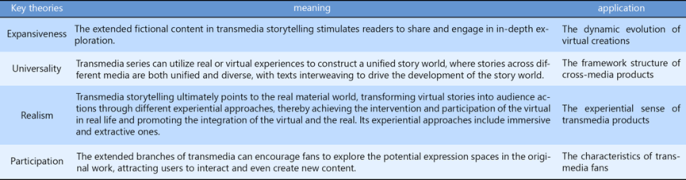
186 Huang and Wang different platforms. Instead, it distributes the core story elements, plot lines and worldview across various media through systematic design, enabling each medium to undertake unique and complementary narrative functions by virtue of its own characteristics (Li, 2025). With a unified story world as its core, the theory constructs a virtual world by piecing together story fragments from different media, and narrows the gap with real life through audience interaction, thus forming a distributed and explorable narrative ecosystem. The main tenets of transmedia storytelling include expandability, shared world, reality and participation (Song et al., 2023). Expandability is reflected in the expansion and extension of stories across different media; shared world emphasizes that stories in various media belong to one unified story world; reality focuses on the connection with real life; and participation highlights the interactive engagement of the audience (See Figure 1).
Figure 1: Main theories of transmedia storytelling.
The application of this theoretical framework to the field of climate science popularization for children demonstrates remarkable adaptability and innovative potential. The systemicity, interconnection and experiential nature inherent in natural knowledge are highly consistent with the advantages of transmedia storytelling in constructing an interconnected world and providing multi-dimensional perceptions. The principle of expandability allows climate-related stories to be extended across multiple media—such as from popular science packaging to mobile applications and games— enriching children’s cognitive channels. The principle of shared world ensures that stories in different media fall within a unified climate science story world, helping children build a complete knowledge system. The principle of reality closely links climate knowledge to real life, enabling children to better understand the impacts of climate change through simulating real- life scenarios. The principle of participation encourages children to take an active part in interactions, such as field exploration tasks, enhancing their experiential understanding of climate science. Integrating this theory, abstract concepts of climate change can be transformed into viewable animations, interactive simulations and explorable field tasks. This multimodal narrative experience not only aligns with children’s diverse cognitive styles, but also deeply integrates the cognition of the climate system, emotional resonance with the environment and low-carbon behavioral intention through a continuous narrative experience. It guides children to establish an internal transformation logic from knowledge to attitude, and then from attitude to practice on the basis of understanding climate science, thereby providing a
Climate Science Popularization Packaging Experience Design Based 187 powerful theoretical tool and a systematic design blueprint for addressing the common disconnect between cognition and practice in current climate science popularization.
System Design and Development Process Based on the transmedia storytelling theoretical framework, this study develops a science popularization system integrating physical packaging, digital interaction and practical transformation, aiming to establish a complete narrative closed loop from cognition to emotion and then to conation. Physical packaging and digital applications are not simply superimposed, but jointly narrate the same story centered on climate warming science popularization.
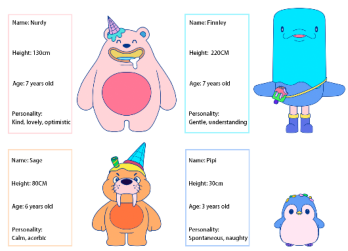
Within the transmedia storytelling framework, core characters with emotional resonance serve as the key link connecting cross-media content and sustaining continuous user engagement. Drawing on the prototypes of polar endangered animals such as polar bears and penguins, this study systematically develops a series of IP character clusters named the Carbon Pals Family, endowing them with anthropomorphic personalities and clear narrative missions. For example, Nurdy, a seven-year-old polar bear, takes ice cream as an emotional medium to build a connection with human food culture through the relaxed way of sharing delicacies. While conveying sweetness and joy, Nurdy guides children to recognize the severe threat of glacial melting to the foraging and living habitats of polar bears. Finnley, a seven-year-old polar giant whale like Nurdy, regards marine drift bottles as emotional carriers that hold the wishes and greetings of children around the world. These drift bottles not only convey warmth, but also lead children to understand the erosion of ocean acidification and plastic pollution on the polar ecosystem. Sage, a six-year-old walrus, forms an emotional bond through polar igloo games. In the process of leading children to explore the traditional survival wisdom of the polar regions, Sage reveals the profound impacts of permafrost thaw on polar indigenous peoples and ecosystems. Pipi, a three-year-old penguin, turns nest-building puzzle games into emotional touchpoints. With its naive and lovely interactive methods, Pipi provides children with an immersive experience of the survival challenges faced by penguin populations, helping them understand the severe threat of sea ice decline to penguin habitats. These characters are positioned as the emotional link for children throughout the entire transmedia experience, realizing the expansion of story content across different media. In terms of visual style, in accordance with the design strategy of scientific childlike modeling, this design retains the iconic features of the species and adopts moderately exaggerated geometric form processing. On the basis of ensuring the scientific accuracy of animal characteristics, it enhances visual affinity, and combines a high-saturation color system with a dynamic facial expression symbol system to form a cross-media visual language system that integrates scientific rigor with children’s aesthetic adaptability, laying a solid emotional anchor and narrative clue for the entire science popularization system (See Figure 2).
Figure 2: IP design.
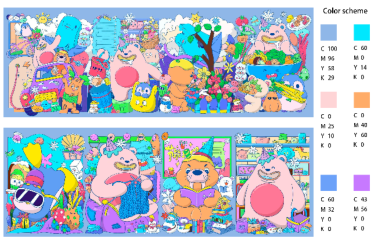
To integrate the IP characters into a credible and compelling story world, this study further embeds them within a complete narrative illustration and visual system. The illustration scenes revolve around the core theme of low- carbon and environmentally friendly behaviors, vividly depicting the IP characters practicing low-carbon actions in daily life scenarios. In this process, key low-carbon behaviors—such as the use of new energy vehicles, tree planting, and composting kitchen waste—are narratively bound to specific IP characters, transforming abstract environmental guidelines into emotionally resonant character stories. For the color language, a highly saturated blue is adopted as the base color, echoing the ecological backdrop of polar glaciers and oceans. It is paired with bright auxiliary colors including pink, orange and bright yellow to create a visual system that aligns with polar ecological imagery while brimming with childlike vitality. This high-saturation color scheme not only enhances the visual recognizability of the characters and the emotional tension of the scenes, but also makes the low-carbon action scenarios more appealing. It enables children to naturally develop emotional identification with and mnemonic associations to environmental behaviors through the perception of bright and vivid colors (See Figure 3).
Figure 3: Illustration display.
Centered on the theme of global warming, this packaging system creates a narrative visual language system. It adopts a contrasting color palette of light blue and dark blue as a whole: light blue symbolizes the healthy and beautiful glaciers and the state of pure nature, conveying the vision of environmental
Climate Science Popularization Packaging Experience Design Based 189 protection; dark blue metaphorically represents environmental pollution and climate crises caused by high carbon emissions, and intuitively constructs the story worldview through color tension. As a narrative carrier, the surface of each packaging box is printed with narrative illustrations of low-carbon behavior scenarios. Presented in a childlike style, these images are in line with children’s aesthetic cognition and convey environmental knowledge through concrete scenes.
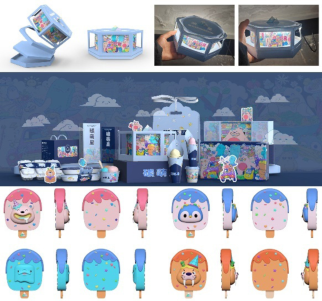
The packaging integrates physical structural innovation with digital technology to construct a multi-level interactive experience system. In terms of physical structure, the core packaging adopts a modular design: the three- dimensional snow mountain model on the top directly highlights the climate theme; the illustrated outer shell in the middle is designed as a rotatable structure, allowing children to observe low-carbon scenarios from different angles when rotating it, which enhances the fun; the hidden QR code at the bottom serves as a digital entrance to guide users to the supporting climate science popularization App. All packaging materials are made of recycled pulp molding, and the packaging is functionalized into a small desk lamp that can be reassembled. Children transform the packaging into a desk lamp by assembling the parts with their own hands, a process that metaphorizes the environmental concept of resource restructuring and regeneration. The warm light of the desk lamp in daily use continuously strengthens children’s cognition of a sustainable life. At the digital interaction level, the hidden AR visual markers on the surface of the packaging box can be recognized by the application. When children scan them with their devices, interactive animations of virtual IP characters can be triggered, extending the low- carbon scenarios in physical illustrations into dynamic stories. The QR code leads to the supporting climate science popularization App, realizing a seamless transition from offline observation and exploration to in-depth online learning. The special ice cream in the product extension design utilizes the physical characteristic of morphological disappearance to form a concrete metaphor for glacial melting, and at the same time transforms the environmental protection concept into perceptible behavioral guidance by virtue of the emotional connection of the IP images (See Figure 4).
Figure 4: Packaging and products.
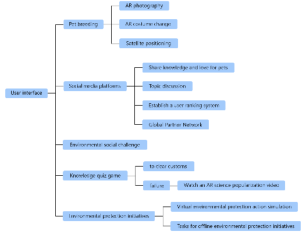
190 Huang and Wang With immersive environmental protection interactive experience as its core, the interface integrates AR technology, gamification mechanisms and social functions to create a comprehensive and multi-level unique experience for users. The adoption process is triggered by scanning the packaging, and the pet’s health status is linked to learning progress and practical tasks. The functional modules include AR photography, a social platform, user levels, friend connection, environmental challenges, AR Q&A, virtual tree planting, offline challenges, climate journals, online lectures, and more (See Figure 5).
Figure 5: Design framework.
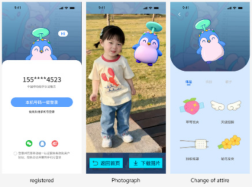
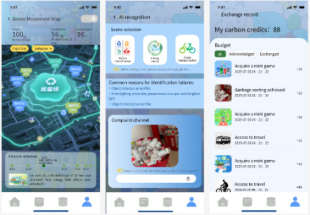
Pet Raising Interface, Scanning a specific package unlocks the adoption of an AR avatar of a polar animal. These adopted avatars are not isolated entities; each one is closely bound to real polar animals living in their natural habitats. The health status of the AR avatars and the environment of their virtual habitats are jointly influenced by children’s progress in climate knowledge learning and their completion of practical tasks.The interface modules related to pet raising consist of three sections: the AR photography zone supports the overlay of virtual pets onto real-world scenes; the IP costume zone allows the unlocking of limited-edition skins to strengthen emotional connections; the real-time positioning zone tracks the dynamic changes of real polar animal habitats and the animals’ current living status in real time (See Figure 6).
Figure 6: Pet raising interface.
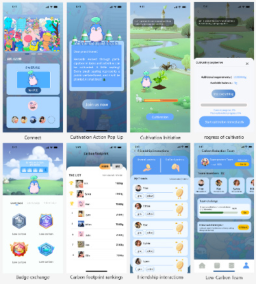
Social Function Interface, Children can share their insights into climate science popularization and growth records of virtual pets on this interface, and participate in the discussion and voting on topics such as the most
Climate Science Popularization Packaging Experience Design Based 191 effective daily emission reduction actions and the priority of polar species protection to stimulate their rational judgment and value discrimination. The user contribution value system quantifies interactive behaviors such as sharing and commenting to promote level upgrading, and unlocks advanced social permissions and virtual rewards accordingly, building a positive cycle of continuous participation. The friend connection function relies on real-time video technology to connect children from different regions, guiding them to communicate on local climate impacts and response strategies, which can broaden children’s international horizons and cultivate their environmental awareness. The environmental protection social challenge function regularly launches collaborative environmental protection challenges themed on plastic-free life or green commuting; these challenges not only strengthen achievement feedback by awarding honorary medals, limited digital assets and physical environmental protection prizes, but also visually present the team’s cumulative carbon emission reduction, aggregating abstract individual actions into concrete collective achievements, and turning social interaction directly into an internal driving force for promoting environmental protection practices while enhancing community cohesion (See Figure 7).
Figure 7: Social function interface.
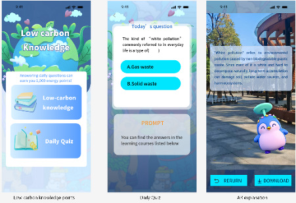
Gamified Learning Interface, AR knowledge Q&A adopts a contextual question-setting mode where IP characters pose questions to children; incorrect answers will trigger 3D science popularization animations to assist understanding, and to avoid tedious content, children are also guided to perform relevant actions to improve their attention and learning interest. Virtual currency can be obtained after completing the games, which can be exchanged for virtual rewards such as limited-edition costumes and honorary titles, as well as physical rewards including honorary medals, IP peripherals and environmental stationery in the mall. The virtual tree planting simulation in the virtual environmental action simulation scene realizes the whole process of digging, planting and watering through somatosensory interaction, and different tree species correspond to different carbon sequestration values, allowing children to intuitively perceive the effect of environmental protection actions on alleviating global warming (See Figure 8).
Figure 8: Gamified learning interface.
Practical Transformation Interface, Offline low-carbon action challenges release a series of offline environmental protection tasks with clear themes and strong operability on a weekly basis, such as “Family Zero-waste Record for a Day”, “Community Plant Adoption and Maintenance” and “Public Transport Travel Check-in”; the design of these tasks is closely integrated with daily life scenarios, transforming macro climate issues into perceivable and executable micro actions for children (See Figure 9).
Figure 9: Practical transformation interface.
Technical Implementation Solution The AR interaction module is built around Kivicube as the core, utilizing markerless image recognition and high-precision spatial positioning technology to set illustrations of low-carbon scenarios as trigger points (Han et al., 2025). Children can scan the packaging to activate 3D animations and interact with virtual characters, achieving a cross-platform immersive experience. Based on the Unity engine, the mobile application adopts the MVC architecture to separate the data, logic and presentation layers, and uses the Kivicube SDK to realize the accurate integration of virtual characters and the real environment. It optimizes the stability of spatial anchoring with sensor data, and creates a complete data chain with SQLite and MySQL databases to support the cloud synchronization of climate diary records and offline tasks. The system architecture emphasizes resource sharing and asynchronous communication, with the cloud uniformly managing digital assets such as 3D models. AR interacts with the mobile terminal through the RESTful API, and virtual medals and scene parameters are automatically updated after task
Climate Science Popularization Packaging Experience Design Based 193 completion. To adapt to mid-to-low-end devices, ECS architecture is applied in AR rendering to optimize memory usage, and LOD technology is used on the mobile terminal to dynamically adjust model precision, ensuring smooth operation at 30FPS. This solution deeply integrates physical packaging and digital content to form a complete closed loop from offline practice to online feedback, which can provide children with a gamified climate science popularization experience and offer data support for system iteration.
DISCUSSION AND LIMITATIONS This study has successfully applied the transmedia storytelling theory to the field of children’s climate science popularization and constructed a science popularization model with the synergy of physical packaging, digital interaction and practical transformation, effectively improving children’s climate cognition and behavioral intention. The combination of the degradable design of physical packaging and the AR pet raising application has realized the in-depth integration of knowledge, emotion and behavior. However, this study still has certain limitations. At this stage, the system is a functional prototype, and the economic feasibility of its large- scale production has not been fully verified, especially the material cost and production process need further optimization; in terms of technical stability, the performance of AR interaction varies across different devices and lighting conditions, and algorithm optimization is required to improve stability; in addition, the narrative acceptance across cultural backgrounds has not been fully evaluated, and adaptive adjustments should be made according to the cultural characteristics of children in different regions.
CONCLUSION
Based on the transmedia storytelling theory, this study has designed a science popularization system integrating physical packaging and digital interaction to address the problems of abstract content and single form in children’s climate science popularization. With degradable lamp-type packaging as the physical carrier and combined with the AR pet raising application featuring polar endangered animals, the study has constructed three core modules of “knowledge infiltration - social linkage - practical transformation”, which deeply integrate climate knowledge, emotional connection and behavioral incentives. Through the virtual-real integrated design of physical and digital elements, the study solves the pain point of the disconnect between knowledge and practice in children’s climate science popularization and guides children to transform from passive knowledge recipients into active explorers and practitioners. This design provides an innovative path for improving teenagers’ climate literacy, verifies the practical value of the transmedia storytelling theory in environmental education, and offers a replicable design paradigm for education for sustainable development. In the follow-up, long-term follow-up research will be carried out to quantify behavioral impacts, AI technology will be integrated to realize personalized
194 Huang and Wang narrative recommendation, and the model will be extended to fields such as biodiversity conservation to verify its universality.
REFERENCES
Chen, Y., & Shi, L. (2025). Prediction of regional differences in China’s achievement of the “Dual Carbon” goals and their influencing factors. Acta Ecologica Sinica, 45(10), 4789–4802. Epule, T. E., Chehbouni, A., Dhiba, D., Moto, M. W., & Peng, C. (2021). African
climate change policy performance index. Environmental Challenges, 5, 100163. Han, M., & Chong, F. X. (2025). Digital innovative application of Shangqiu Han Dynasty stone relief patterns based on the Kivicube platform. Shanghai Packaging, (05), 189–191. Lammert, C. (2025). How is climate activism represented in award-winning children’s
picturebooks? A critical content analysis. English Teaching: Practice & Critique. Advance online publication. Li, Y. M. (2025). Research on the targeted communication path of national defense education content for college students under the transmedia narrative theory. Journal of News Research, 16(03), 93–97. Lo, J.-H., Lai, Y.-F., & Hsu, T.-L. (2021). The Study of AR-Based Learning for Natural
Science Inquiry Activities in Taiwan’s Elementary School from the Perspective of Sustainable Development. Sustainability, 13(11), 6283. Song, J., & Wu, Z. M. (2023). Research on the design path of domestic game co-branded clothing based on transmedia narrative. Journal of Silk, 60(05), 97–103. Wang, K., Tekler, Z. D., Cheah, L., Herremans, D., & Blessing, L. (2021). Evaluating
the Effectiveness of an Augmented Reality Game Promoting Environmental Action. Sustainability, 13(24), 13912. Wang, X. S., Zhou, Y. D., & Tian, S. Y. (2025). Climate policy uncertainty and highquality trade development. China Industrial Economics, (12), 119–137. Wang, Y. (2023). Gamification Design of a Carbon Neutral Science App for Children
Based on the Octagon Behavior Analysis Model. In: Zaphiris, P., et al. (Eds.). HCI International 2023 – Late Breaking Papers. HCII 2023. Lecture Notes in Computer Science, vol 14060. Springer, Cham. Xing, Y. X. (2024). Research on the design of serious games for ecological science popularization based on experiential learning. Beauty & Times (Upper), (03), 108–112. Yang, X. R. (2024). Research on the design of children's climate science popularization
educational products based on multi-sensory experience (Master's thesis, Guangxi Normal University).
LISTED IN THE AHFE DIGITAL BOOKSTORE CATALOGUE
Explore the complete digital volume
Human Factors in Communication of Design
Read this individual research paper free through the original publisher, or explore the full digital proceedings book.
ISBN 978-1-964867-92-2
Explore this ISBN in the AHFE Bookstore ↗Listed in the July 2026 bookstore catalogue; search by ISBN to confirm current availability · Digital book purchase optional