Ali Mostafavi, Wenge Xu, Oliver Carsten, Foroogh Hajiseyedjavadi (2026). Learning from Drivers: A Case-Based Reasoning Framework for Takeover Control in Conditionally Automated Vehicles. In: Advances in Human Factors of Transportation. AHFE Open Access, vol. 224, pp. 331–340. https://doi.org/10.54941/ahfe1007861
The rapid evolution of intelligent transportation systems has positioned conditionally automated vehicles (CAVs, SAE Level 3) at the forefront of automotive innovation. These vehicles represent a critical transition between human-driven and fully autonomous systems, in which safety and reliability depend on effective management of takeover control (TOC) events. This paper introduces a Case-Based Reasoning (CBR) framework to model, evaluate, and improve decision-making during control transitions using empirical and contextual data from both human and vehicular agents. The framework follows the CBR cognitive cycle of retrieval, reuse, revision, and retention to compare new TOC scenarios with previously observed cases. Each case integrates multimodal information, including driver personal traits, non-driving-related tasks, traffic density, and takeover urgency, as well as temporal and spatial performance metrics such as takeover time and steering behaviour. The time budget to system limitation is used as the determining outcome variable. By capturing and reusing experiential knowledge, the proposed framework enables adaptive and interpretable decision-making for Level 3 automation. It supports bidirectional learning between drivers and automated systems and provides a foundation for future Levels 4 and 5 vehicles to incorporate human-like reasoning in safety-critical decisions.
The advent of automated vehicles promises to revolutionize transportation systems by enhancing safety, efficiency, and mobility. Among the various levels of driving automation defined by the Society of Automotive Engineers (SAE), Level 3 conditional automation represents a critical transitional stage that introduces unique challenges in human-machine interaction. Unlike lower automation levels that require continuous driver supervision or higher levels that eliminate the need for human intervention, Level 3 systems allow drivers to disengage from the driving task under specific operational design domain conditions while requiring them to be ready to resume control when Received February 5, 2026; Revised April 7, 2026; Accepted April 21, 2026; Available online July 20, 2026
prompted (Morales-Alvarez et al., 2020). This conditional nature creates a fundamental tension: drivers are permitted to engage in non-driving related tasks (NDRTs) yet must maintain sufficient readiness to safely take over vehicle control within a limited time budget (Tan and Zhang, 2022). As Level 3 systems transition from research prototypes to commercial deployment (e.g., Mercedes-Benz’s Drive Pilot and Honda’s Traffic Jam Pilot), understanding and predicting takeover performance has become paramount for ensuring safety in mixed-autonomy traffic environments (Alms and Wagner, 2024; Kim et al., 2025).
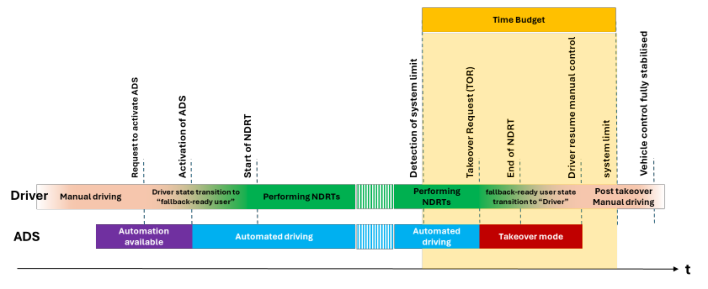
Figure 1: Illustration of the transition from manual to automated driving and the takeover process following automated driving in SAE level 3 vehicles.
TAKEOVER CONTROL AND TIME BUDGET Takeover control describes the process by which driving authority transitions from the automated system to the human driver following a takeover request (TOR). TORs are typically issued when system limitations are reached, operational design domain boundaries are violated, or potential hazards are detected (Miller et al., 2024). Prior work has shown that the modality and timing of TORs significantly affect driver response behaviour and takeover quality (DeGuzman et al., 2021).
The safety of this transition is highly governed by the available time budget (Figure 1), defined as the interval between TOR issuance and the moment at which driver intervention becomes necessary to maintain safe vehicle operation (Du et al., 2020). This time budget must be sufficient for drivers to disengage from NDRTs, reorient attention to the driving environment, rebuild situation awareness, and execute appropriate control actions. Experimental studies report substantial variability in required takeover times, ranging from approximately 2 to over 40 seconds depending on scenario conditions and driver state (Eriksson and Stanton, 2017). Gong et al. (2023) further demonstrate that traffic complexity and urgency substantially increase the time required for safe takeover execution.
Regulatory efforts have attempted to standardize minimum takeover time budgets. For example, UN Regulation No. 157 specifies a minimum transition
Learning From Drivers 333 time of four seconds for automated lane keeping systems (UNECER, 2021). However, Lu et al. (2025) show that fixed time budgets are insufficient to account for the dynamic and context-dependent nature of real-world takeover scenarios.
Multiple factors have been shown to influence takeover performance. Wan and Wu (2018) report that cognitively and visually demanding NDRTs significantly increase takeover time and degrade vehicle control quality. Gasne et al. (2022) demonstrate that age-related differences lead to longer reaction times and reduced post-takeover stability. Traffic density has been shown to directly affect takeover difficulty and maneuver execution complexity (Du et al., 2020). In addition, TOR design characteristics, including alert modality and lead time, significantly influence driver response latency and control performance (Yoon et al., 2019; Yang et al., 2023).
PREVIOUS MODELS FOR UNDERSTANDING TAKEOVER CONTROL To address the complexity of takeover control, prior research first attempted machine learning models to predict takeover time, intention, or quality based on driver, vehicle, and environmental data (McDonald et al., 2019). For instance, Du et al. (2021) employed machine learning techniques, including random forests and support vector machines, to classify driver takeover performance as good or poor using physiological signals and external scenario parameters. Their best-performing model achieved an accuracy of approximately 70%, indicating that driver physiological and environmental features provide a moderate yet reliable level of predictive capability for takeover performance under varying cognitive load conditions.
More recent studies have adopted deep learning architectures to better capture temporal dependencies and multimodal interactions. In particular, Pakdamanian et al. (2021) proposed the DeepTake framework, which integrates vehicle dynamics, driver biometrics, non-driving-related task information, and subjective measures to jointly predict takeover intention, takeover time, and takeover quality. Experimental results showed that DeepTake achieved accuracies of 96% for takeover intention, 93% for takeover time, and 83% for takeover quality. Chen et al. (2025) show that long short-term memory (LSTM) networks with attention mechanisms improve prediction accuracy by capturing temporal patterns in driver behaviour. Vision-based approaches using convolutional neural networks have also been shown to accurately predict takeover decisions from gaze and head-pose data (Deo and Trivedi, 2020; Gupta et al., 2023).
Despite these advances, existing approaches exhibit several fundamental limitations. Liu et al. (2024) demonstrate that data-driven models trained on specific experimental conditions often fail to generalize to unseen scenarios or driver populations. Liu et al. (2025) further highlight that model performance degrades significantly when applied outside the original training domain. In addition, Ayoub et al. (Ayoub et al., 2022) note that many deep learning models function as black boxes, limiting interpretability and raising concerns regarding trust and accountability in safety-critical applications. Most
importantly, existing models do not explicitly represent or reuse experiential knowledge, limiting their ability to adapt reasoning strategies across diverse and infrequent takeover scenarios.
DEVELOPING CBR FRAMEWORK TO IMPROVE TAKEOVER CONTROL Several characteristics of CBR make it particularly suitable for the takeover control analysis. First, CBR naturally handles the diversity and variability of takeover scenarios by storing and retrieving specific experiences rather than attempting to generalize across all possible situations. Second, CBR provides inherent interpretability, each recommendation is grounded in concrete past cases, enabling drivers and system designers to understand the reasoning behind predictions. Third, CBR supports personalization by maintaining individual driver case bases that capture personal driving styles, preferences, and capabilities. Fourth, CBR facilitates continuous learning through the retain phase, allowing the system to improve over time as new takeover experiences are accumulated. Finally, CBR can integrate with other computational approaches, including machine learning for case retrieval and adaptation, creating hybrid systems that leverage the strengths of multiple paradigms.
Despite these promising characteristics, CBR has not been systematically applied to the takeover control problem in Level 3 automated vehicles. Existing research has not explored how CBR can be structured to represent takeover cases, what similarity metrics are appropriate for matching current situations to past experiences, or how case adaptation can account for differences in driver state, vehicle dynamics, and environmental conditions. Furthermore, the integration of CBR with real-time sensor data and its validation in realistic takeover scenarios remain open questions.
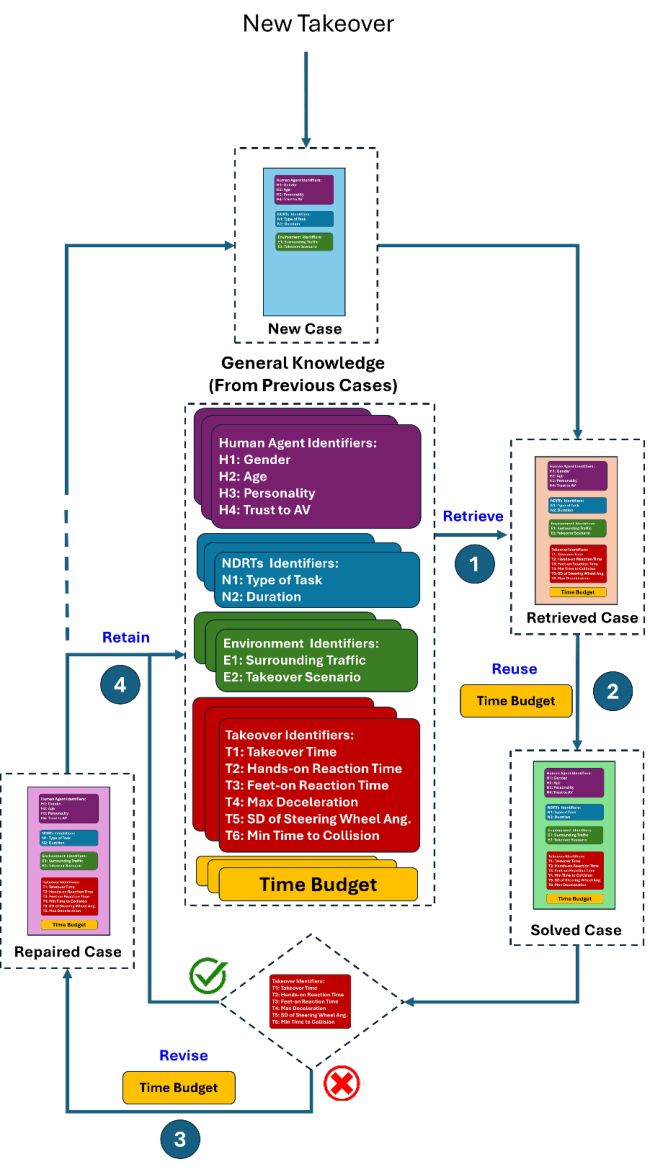
Figure 2 illustrates the purposed Case-Based Reasoning (CBR) framework designed to optimize takeover transitions in SAE Level 3 automated driving systems. In takeover scenarios, the system maintains a repository of previous takeover cases, each characterized by multiple dimensions of contextual information. When a new takeover request emerges, the system retrieves the most similar historical case and adapts its time budget accordingly, rather than applying a fixed value. Each case in the CBR system is represented as a multi-dimensional feature vector comprising four primary categories of identifiers (Table 1).
The framework implements a classical four-stage CBR cycle adapted for real-time automotive application.
Stage 1: Retrieve When a takeover request is initiated, the system constructs a new case using identifiers available, including human-related factors (H1–H4), NDRTs characteristics (N1–N2), and environmental conditions (E1–E2). These identifiers form the retrieval feature vector x = [x1, . . . , xp], where p denotes the total number of retrieval identifiers. At this stage, takeover identifiers (T1–T6) are not available for the new case, as the takeover has not yet been accomplished.
Learning From Drivers 335
Figure 2: Purposed CBR framework for takeover decision-making in SAE LEVEL 3.Table 1: CBR case representation parameters.
Table available in the original PDF paper.
Identifier Definition Human Agent Identifiers
H1: Gender H2: Age
H3: Personality H4: Trust in AV
Non-Driving Related Task (NDRT) Identifiers N1: Type of Task Activity (e.g., reading, smartphone use)
N2: Duration Time spent disengaged from driving Environment Identifiers
Takeover Identifiers T1: Takeover Time Total time required to resume control
T2: Hands-on Reaction Time Time until steering wheel contact T3: Feet-on Reaction Time Time until pedal engagement
T4: Maximum Deceleration Abruptness of speed adjustment T5: Steering Wheel Std. Dev. Control stability during takeover
T6: Minimum Time to Collision Safety-critical temporal margin Time Budget Available time window for safe takeover completion
Case retrieval follows a CBR paradigm, where similarity between the new case x and a previously stored case xi is computed using the Gower similarity distance (Gower, 1971), which supports mixed numerical and categorical features:
p ω δ =
1
d x x
, , (1)
( )
Equation available in the original PDF paper.
j ij j i p ω =
1
j j
Equation available in the original PDF paper.
where xi denotes the i-th case in the General Knowledge repository, is the importance weight associated with identifier j, and δij represents the per-identifier dissimilarity. For numerical identifiers, δij is defined as the normalized absolute difference, while for categorical identifiers it is a binary mismatch indicator.
The system retrieves the top-k most similar cases satisfying d(x, xi) ≤ τ , where τ is a predefined similarity threshold. Although takeover identifiers (T1–T6) are unavailable for the new case at this stage, they are retained as part of the retrieved cases and later used to evaluate historical takeover performance during the reuse stage. If no sufficiently similar case exists, a conservative default takeover time budget of 4 s is assigned, consistent with values suggested for automated lane keeping systems (UNECER, 2021).
Learning From Drivers 337 Stage 2: Reuse
Each retrieved case provides an associated takeover time budget and recorded takeover identifiers (T1–T6). When multiple similar cases are retrieved, the system selects the case that previously exhibited the best overall takeover performance. Historical takeover performance is assessed using takeover identifiers (T1–T6), where lower values of T1–T5 and higher values of T6 indicate better performance. Based on these criteria, a performance score Pi is assigned to each retrieved case i, such that higher values of Pi correspond to superior historical takeover performance.
The retrieved case used for reuse is selected as the one with the highest performance score: i* = arg max Pi, (2) i∈Nk
where denotes the set of retrieved similar cases. The time budget associated with the selected case is then reused directly and assigned to the new case: TBnew = TBrus = TBi*. (3)
Stage 3: Revise Once the takeover is accomplished, the new case becomes a solved case with observed takeover identifiers (T1–T6) and observed takeover time TTobs. The reused solution is considered valid if all observed takeover identifiers fall within predefined acceptable thresholds. If one or more thresholds are violated, the system intervenes to revise the time budget. Revision is performed by adjusting the reused time budget to better reflect the observed takeover demands. The revised time budget TBrev is computed as:
T Brev = T Bnew + (T Tobs − T Tret), (4) where TTret denotes the takeover time associated with the reused case. This formulation allows the time budget to be increased or reduced, depending on whether the observed takeover required more or less time than anticipated. If the revised value falls below a predefined lower bound, the time budget is constrained to be no less than 0.67 s, corresponding to the average driver perception–reaction time (Johansson and Rumar, 1971). Although reaching this bound is highly unlikely in practice, the constraint ensures that no cases with unrealistically small time budgets are retained in the General Knowledge repository.
Stage 4: Retain Following the revision, the solved case is retained in the General Knowledge repository. If the reused time budget is validated, the new solved case is stored alongside the original retrieved case. If revision is required, a repaired case is created with identical identifiers but an updated time budget and stored as a new entry in the repository. Before the next takeover request, the system updates internal weights and threshold values to reflect the expanded case base.
CONCLUSION
This paper presented a CBR-based framework to support takeover control in SAE Level 3 automated vehicles. Instead of relying on fixed time budgets, the framework learns from prior takeover experiences and adapts to different drivers, NDRTs, environmental conditions, and takeover performance. A key contribution of this work is its focus on learning from real driver behaviour. The framework does not assume that one takeover strategy fits all drivers or all situations. By checking whether reused time budgets meet predefined performance thresholds and revising them when necessary, the system can gradually improve its decisions while maintaining safety constraints. This highlights the importance of balancing adaptability with reliability in human- in-the-loop automated driving. At the same time, the proposed framework is still under development and is currently being validated through simulation- based and experimental studies.
Future work will focus on evaluating its performance in different driving simulations and real-world scenarios, with particular attention to takeover safety, driver workload, and system efficiency. The framework could also be extended by incorporating real-time physiological and behavioural measures, such as attention, stress, and workload, to better assess driver readiness and adjust takeover guidance dynamically.
REFERENCES
Alms, R. and Wagner, P. (2024), ‘Control transitions in level 3 automation: Safety implications in mixed-autonomy traffic’, Safety 10(1). URL: https://www. mdpi.com/2313-576X/10/1/1 Ayoub, J., Du, N., Yang, X. J. and Zhou, F. (2022), ‘Predicting driver takeover time in
conditionally automated driving’, IEEE Transactions on Intelligent Transportation Systems 23(7), 9580–9589. URL: https://ieeexplore.ieee.org/document/9733956 Chen, L., Li, D., Wang, T., Chen, J. and Yuan, Q. (2025), ‘Driver takeover performance prediction based on lstm-bilstm-attention model’, Systems 13(1). URL: https:// www.mdpi.com/2079-8954/13/1/46 DeGuzman, C. A., Kanaan, D., Hopkins, S. A. and Donmez, B. (2021), ‘Takeover
request (tor) effects during different automated vehicle failures’, Journal of Intelligent Transportation Systems 29(4), 335–347. URL: https://10.1080/1547 2450.2021.1891536 Deo, N. and Trivedi, M. M. (2020), ‘Looking at the driver/rider in autonomous vehicles to predict take-over readiness’, IEEE Transactions on Intelligent Vehicles 5(1), 41–52. URL: https://ieeexplore.ieee.org/document/8910371 Du, N., Kim, J., Zhou, F., Pulver, E., Tilbury, D. M., Robert, L. P., Pradhan, A. K.
and Yang, X. J. (2020), Evaluating effects of cognitive load, takeover request lead time, and traffic density on drivers’ takeover performance in conditionally automated driving, in ‘12th International Conference on Automotive User Interfaces and Interactive Vehicular Applications’, AutomotiveUI ’20, Association for Computing Machinery, New York, NY, USA, p. 66–73. URL: https://dl.acm. org/doi/10.1145/3409120.3410666 Du, N., Zhou, F., Pulver, E. M., Tilbury, D. M., Robert, L. P., Pradhan, A. K. and Yang, X. J. (2021), ‘Predicting driver takeover performance in conditionally automated driving’, Accident Analysis & Prevention 148, 105748. URL: https:// www.sciencedirect.com/science/article/pii/S0001457520315682
Learning From Drivers 339 Eriksson, A. and Stanton, N. A. (2017), ‘Takeover time in highly automated vehicles:
Noncritical transitions to and from manual control’, Human Factors 59(4), 689– 705. PMID: 28124573. URL: https://doi.org/10.1177/0018720816685832 Gasne, C., Paire-Ficout, L., Bordel, S., Lafont, S. and Ranchet, M. (2022), ‘Takeover performance of old er drivers in automated driving: A review’, Transportation Research Part F: Traffic Psychology and Behaviour 87, 347–364. URL: https://www.sciencedirect.com/science/article/pii/S1369847822000845 Gong, J., Guo, X., Qi, C., Liang, X. and Wang, Q. (2023), ‘Measuring takeover
performance in different driving scen arios: Considering the influence of non- driving-related tasks and takeover request lead time’, Transportation Research Part F: Traffic Psychology and Behaviour 97, 411–421. URL: https://www. sciencedirect.com/science/article/pii/S1369847823001699 Gower, J. C. (1971), ‘A general coefficient of similarity and some of its properties’, Biometrics 27(4), 857–871. URL: http://www.jstor.org/stable/2528823 Gupta, S., Tan, X. and Zhang, Y. (2023), ‘Predicting driver takeover decisions
in conditionally automated vehicles with a gaze-based deep learning model’, Proceedings of the Human Factors and Ergonomics Society Annual Meeting 67(1), 657–663. URL: https://doi.org/10.1177/21695067231192914 Johansson, G. and Rumar, K. (1971), ‘Drivers’ brake reaction times’, Human Factors 13(1), 23–27. PMID: 5542208. URL: https://doi. org/10.1177/001872087101300104 Kim, S., Novakazi, F. and Karlsson, I. M. (2025), ‘Is conditionally automated
driving a bad idea? observations from an on-road study in automated vehicles with multiple levels of driving automation’, Applied Ergonomics 129, 104617. URL: https://doi.org/10.1016/j.apergo.2025.104617 Liu, Q., Liu, J., Zhao, J., Cai, Y., Wang, H., Chen, L. and Lv, C. (2025), ‘Takeover time prediction for conditionally automated driving vehicles: Considering mixed traffic flow environment’, IEEE Transactions on Intelligent Transportation Systems 26(6), 7496–7508. URL: https://ieeexplore.ieee. org/document/11005682 Liu, W., Li, Q., Wang, W., Wang, Z., Zeng, C. and Cheng, B. (2024), ‘Deep
learning based take-over performance predictio n and its application on intelligent vehicles’, IEEE Transactions on Intelligent Vehicles pp. 1–15. URL: https://ieeexplore.ieee.org/document/10462514 Lu, X., Tan, H., Zhang, H., Wang, W., Xie, S., Yue, T., Chen, F. and et al. (2025), ‘Triboelectric sensor gloves for real-time behavior identification and takeover time adjustment in conditionally automated vehicles’, Nature Communications 16, 1080. URL: https://doi.org/10.1038/s41467-025-56169-2 McDonald, A. D., Alambeigi, H., Engstro¨m, J., Markkula, G., Vogelpohl, T., Dunne,
J. and Yuma, N. (2019), ‘Toward computational simulations of behavior during automated driving takeovers: A review of the empirical and modeling literatures’, Human Factors 61(4), 642–688. PMID: 30830804. URL: https://doi.org/10.1177/0018720819829572 Miller, J. A., Nikan, S. and Zaki, M. H. (2024), ‘Navigating the handover: Reviewing takeover requests in level 3 autonomous vehicles’, IEEE Open Journal of Vehicular Technology 5, 1073–1087. URL: https://10.1109/ OJVT.2024.3443630 Morales-Alvarez, W., Sipele, O., L´eberon, R., Tadjine, H. H. and Olaverri-Monreal,
C. (2020), ‘Automated driving: A literature review of the take over request in conditional automation’, Electronics 9(12). URL: https://www.mdpi.com/2079- 9292/9/12/2087
Pakdamanian, E., Sheng, S., Baee, S., Heo, S., Kraus, S. and Feng, L. (2021), Deeptake: Prediction of driver takeover behavior using multimodal data, in ‘Proceedings of the 2021 CHI Conference on Human Factors in Computing Systems’, CHI ’21, Association for Computing Machinery, New York, NY, USA. URL: https://doi.org/10.1145/3411764.3445563 Tan, X. and Zhang, Y. (2022), ‘The effects of takeover request lead time
on drivers’ situation awareness for manually exiting from freeways: A web- based study on level 3 automated vehicles’, Accident Analysis & Prevention 168, 106593. URL: https://doi.org/10.1016/j.aap.2022.106593 UNECER (2021), UN Regulation No. 157: Uniform provisions concerning the approval of vehicles with regard to Automated Lane Keeping Systems (ALKS), Technical Report E/ECE/TRANS/505/Rev.3/Add.156, UNECE. Revision 3, entered into force 22 January 2021. URL: https://unece.org/transport/ documents/2021/03/standards/un- regulation-no-157-automated-lane-keeping- systems-alks Wan, J. and Wu, C. (2018), ‘The effects of lead time of take-over request and
nondriving tasks on taking-over control of automated vehicles’, IEEE Transactions on Human-Machine Systems 48(6), 582–591. URL: https://ieeexplore.ieee.org/ document/8391722 Yang, W., Wu, Z., Tang, J. and Liang, Y. (2023), ‘Assessing the effects of modalities of takeover request, lead time of takeover request, and traffic conditions on takeover performance in conditionally automated driving’, Sustainability 15(9). URL: https://www.mdpi.com/2071-1050/15/9/7270 Yoon, S. H., Kim, Y. W. and Ji, Y. G. (2019), ‘The effects of takeover request
modalities on highly automated car control transitions’, Accident Analysis & Prevention 123, 150–158. URL: https://www.sciencedirect.com/science/ article/pii/S0001457518310285
LISTED IN THE AHFE DIGITAL BOOKSTORE CATALOGUE
Explore the complete digital volume
Advances in Human Factors of Transportation
Read this individual research paper free through the original publisher, or explore the full digital proceedings book.
ISBN 979-8-950676-00-0
Explore this ISBN in the AHFE Bookstore ↗Listed in the July 2026 bookstore catalogue; search by ISBN to confirm current availability · Digital book purchase optional