Massimo Maresca, Francesco Rea, Carlo Andreotti, Luca Gaggero (2026). Ship-to-Shore Interconnection for Yacht Passenger Safety. In: Advances in Human Factors of Transportation. AHFE Open Access, vol. 224, pp. 600–608. https://doi.org/10.54941/ahfe1007888
In this article, we present a ship-to-shore interconnection system aimed at supporting real-time monitoring of Yacht crew and passenger health. The system leverages broadband interconnection services provided by Low Earth Orbit (LEO) satellite systems and is composed of two software components. The first component is responsible for the acquisition of parameters describing both the health and safety conditions of passengers (e.g., blood pressure, heart rate, body temperature, movement, and disease-specific parameters for conditions such as diabetes) and the navigation conditions of the vessel (e.g., wind intensity, sea state, speed, response to wave motion, heel, and heading). The second component is a platform for tabular data synchronization. Rather than relying on a custom-designed software application, which would be inherently rigid or only limitedly configurable, the proposed solution exploits the ability of operators to develop application logic using spreadsheet-based tools. The synchronization platform ensures continuous consistency between onboard data and the spreadsheets used by the operators at the shore-based centers.
In this article, we present a ship-to-shore interconnection system aimed at supporting real-time monitoring of navigation conditions and passenger health on recreational vessels. This topic is of significant relevance, particularly in regions such as the Mediterranean Sea, where recreational boating is widespread due to the presence of major tourist destinations. Such activities typically involve small motor or sailing vessels carrying a limited number of passengers, who may include families with children and elderly people with health conditions requiring continuous monitoring.
The system leverages broadband interconnection services provided by Low Earth Orbit (LEO) satellite systems and is composed of two software components. The first component is responsible for the acquisition of parameters describing both the health and safety conditions of passengers (e.g., blood pressure, heart rate, body temperature, movement, and disease-specific parameters for conditions such as diabetes) (Latella, 2019, Tirupachuri, 2021, Rapetti, 2021, Latella, 2021, Darvish, 2022, Guo, 2023).
Ship-to-Shore Interconnection for Yacht Passenger Safety 601 These parameters are periodically collected through onboard sensors and wearable devices and transmitted to a shore-based control center, hosted by the Coast Guard or by yacht clubs, marinas, and/or local healthcare organizations. At the shore-based center, operators identify potentially hazardous or risky situations and coordinate the implementation of appropriate actions. The second component is a platform for tabular data synchronization. Rather than relying on a custom-designed software application, which would be inherently rigid or only limitedly configurable, the proposed solution exploits the ability of operators to develop application logic using spreadsheet-based tools. The synchronization platform ensures continuous consistency between onboard data and the spreadsheets used by the operators at the shore-based centers. Within this framework, the navigation and personal parameters received from recreational vessels are represented as dynamically evolving time series in the operator spreadsheets. Operators can define data visualization schemes, anomaly-detection formulas, alert-generation rules, and business intelligence procedures for the periodic analysis of collected data. The results of such analyses are presented through charts and dashboards that support both service evaluation and operational decision-making.
The tabular data synchronization platform is based on SpreadSheetSpace technology (Maresca, 2016, Maresca, 2017), extended with functionalities tailored to the specific application domain, particularly to support interaction with the data collection component. More specifically, a REST API and a Java/C# SDK were developed to enable onboard data acquisition systems to operate as clients of the SpreadSheetSpace platform. Through this integration, the system exploits the SpreadSheetSpace functionalities to support real-time ship-to-shore data synchronization as well as the storage of historical data versions, thereby enabling pattern and trend analysis.
In summary, the proposed system constitutes an instance of a classical Internet of Things (IoT) architecture characterized by two distinctive features, namely the use of Low Earth Orbit (LEO) satellite communication, which has recently reshaped maritime connectivity, and the adoption of SpreadSheetSpace technology, enabling operators to rapidly prototype data analyses and dashboards through spreadsheet-based tools.
The presentation is structured as follows. We first introduce the iFeel technology, which supports data collection from wearable sensors. We then introduce the SpreadSheetSpace technology, with specific reference to the Synchronization Overlay developed in the context of this project to maintain data synchronization between vessels and shore-based centers. Finally, we describe how the two components were integrated into the final system.
MONITORING HUMAN BODY CONDITIONS THROUGH WEARABLE TECHNOLOGIES The monitoring of the human body movements and ergonomics is pivotal to improve the quality of people’s life, by decreasing the risk of injuries during physical tasks. When not performed correctly, prolonged and repetitive movements are the most common reasons for the manifestation of chronic diseases such as low back pain and musculoskeletal disorders (MSDs).
A continuous evaluation and analysis of the human body’s articular stress is remarkably helpful for injuries risk prevention.
In this contest, the iFeel project aims to enhance the state-of-the-art in the field of human health monitoring and analysis by providing innovative measurement tools and AI technologies. The two key ingredients of the iFeel system are i) a set of artificial intelligence algorithms ii) a certified hardware integrated into wearable devices. These two ingredients enable the online assessment of quantitative metrics of human factors, such as human fatigue, motion, articular stresses, and payload.
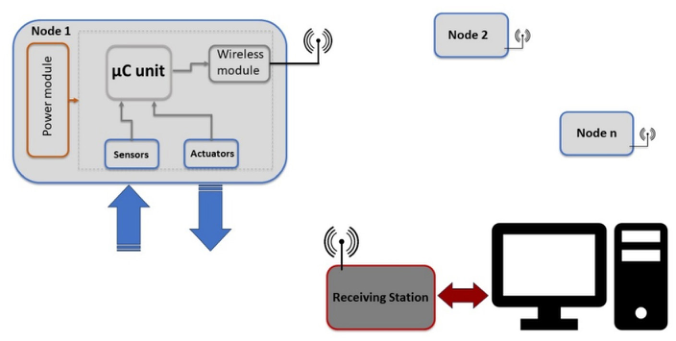
The iFeel framework, summarized in Figure 1, is composed of a set of iFeel-Nodes, implementing the required sensors and actuators, and a central processing unit, the iFeel-Station that, in turn, can communicate with a central processing unit (i.e. a micro-controlled board or a computer). The Nodes are the basic sensing and actuated unit of the iFeel system. The system operates both for motion tracking and Force/Torque (F/T) sensing via the Inertial- Node and F/T-Node. Moreover, vibrotactile feedback can be provided via the inertial node, or via a specialized node Multi-Haptic-Node capable of providing distributed feedback.
Figure 1: iFeel framework.
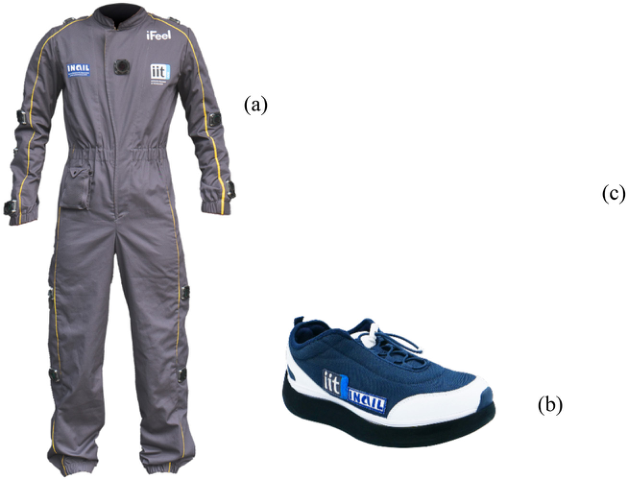
Currently, inertial and biometric sensors are embedded into a suit (Figure 2a), while external forces are gathered through sensors integrated into a pair of shoes (Figure 2b). While for normal activities (e.g., walking, running, lifting, etc.) this approach is adequate for human biomechanics analysis, other tasks might require a different acquisition system to retrieve external forces. As an example, the same technology used for the development of the sensorized insole visible in Figure 2c (i.e., capacitive pressure sensors on flexible or stretchable material) might be integrated into gloves. This would allow the acquisition of external forces when hands are used to move or support the human body.
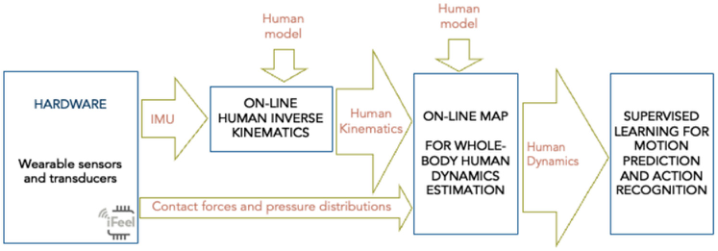
Acquired data are used to estimate human kinematics, i.e. the description of the motion, and human dynamics, i.e. the forces causing the motion, through a set of AI algorithms. With the application of a musculoskeletal human model, this biomechanics analysis framework (Figure 3) has the role of processing real-time raw data and estimating human body parameters such as articular stress, fatigue, and ergonomics aspects. Furthermore, the AI algorithms can predict future human motion and forces, thus evaluating possible future risks that can be used to alert the human beforehand.
Figure 3: Biomechanics analysis framework.
The integration of iFeel wearable technology lends itself to be applied in the maritime domain, especially for the monitoring of the health conditions of yacht crews and passengers.
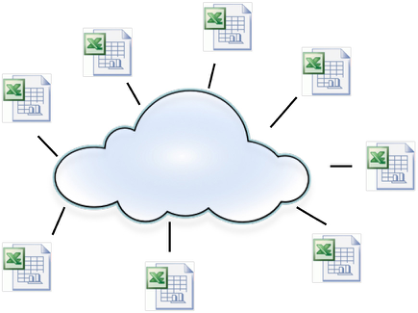
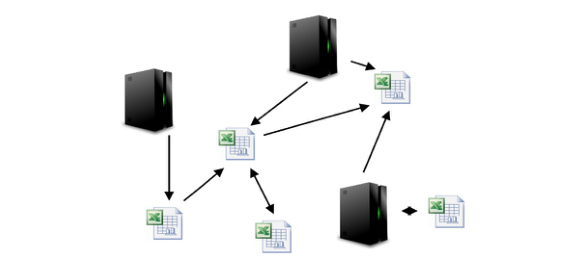
SPREADSHEET BASED INTERFACE FOR HEALTH MONITORING The SpreadSheetSpace is a virtual environment for the exchange and synchronization of tabular data over the Internet and private networks (Figure 4). Within this environment, spreadsheets share data through continuous synchronization.
Figure 4: The SpreadSheetSpace.
Spreadsheet Synchronization A spreadsheet may grant read access to a cell range or a table to a set of users, who can then display a synchronized copy of the shared data within their own spreadsheets. According to spreadsheet terminology, a cell range is a fixed-size array of cells, whereas a table is an extensible collection of records in which formulas automatically propagate to newly inserted records.
A shared cell range or table is defined as a View, while its synchronized replica displayed in another spreadsheet is referred to as an Image. A cloud- based platform is responsible for View persistence and for maintaining synchronization between Views and Images. The View abstraction is extended beyond spreadsheets to generic data sources, enabling external systems to expose data in a manner consistent with spreadsheet-based Views. This extension allows spreadsheets to remain synchronized not only with other spreadsheets but also with such data sources.
Spreadsheet synchronization requires the introduction of two functionalities, respectively called Expose and Import. Expose is the functionality through which a spreadsheet or a Software Platform creates a View, whereas Import is the functionality through which a spreadsheet creates an Image corresponding a View. Expose/Import create a permanent asymmetric connection from a source spreadsheet, i.e., the one that exposes the View, to the target spreadsheets, i.e., the ones that display Images of the exposed View. The “permanent” adjective denotes the fact that the
Ship-to-Shore Interconnection for Yacht Passenger Safety 605 View-Image relationship remains active until it is explicitly removed, whereas the “asymmetric” adjective denotes the fact that the two spreadsheets play different roles, namely the source spreadsheet owns the View whereas Images are just read-only copies of the View. Any update in an exposed View appears in the corresponding Images.
Synchronization Between Spreadsheets and External Data Sources Spreadsheet users often use spreadsheets to integrate and process data extracted from a variety of data sources, including ERPs and Information Systems as well as Sensors.
Personal Decision Support Systems is the most general use case of spreadsheet synchronization with Software Platforms. While company IT Platforms typically offer built-in Business Intelligence functionalities, managers and executives often prefer to develop customized analyses and graphical presentations in spreadsheets, an environment they know well and that provides them with a powerful set of tools. For example, they develop and share what-if analyses or rough statistical calculations on small subsets of the corporate data to support their strategy options.
Enterprise Application Integration is the second use case of interest. The presence of multiple autonomous IT Platforms forces Managers and Executives to integrate the corporate data exposed by the different IT Platforms on their desktops. Spreadsheets become powerful data mashup tools facilitating the integration of data from multiple origins.
Alignment with sensors and more in general external data sources is a third use case of interest, on which this paper focuses. Such external data sources provide live data views to customers to allow them to develop personalized analyses and graphical presentations. For example, a bank/broker/stock- exchange may give its customers real time views on stock quotes, bond quotes, currency exchange rates and other financial figures, in such a way to allow them to build live portfolio analyses and graphical presentations. In this project, the iFeel system acts as the external data source used by the SpreadSheetSpace platform to keep the spreadsheets at the shore-based centers synchronized with yacht crew and passenger data.
Synchronization Overlay Starting from the basic SpreadSheetSpace service, which maintains synchronization among tables located in spreadsheets, information systems, and external data sources, we developed a new concept, namely the Synchronization Overlay (SO), defined as a managed set of synchronized tables. Within a Synchronization Overlay, spreadsheets act as both data providers and consumers, while external data sources—such as information systems and sensors—primarily act as data providers (Figure 5).
Figure 5: Synchronization overlay.
DATA SYNCHRONIZATION IN THE MARITIME DOMAIN The monitoring of the health conditions of crews and passengers aboard vessels clearly relies on the availability of a constant, high-bandwidth, low- latency connection between the vessels and a ground station, where medical personnel perform the monitoring activities. Until recently, such connectivity was not feasible, as geostationary satellites covering maritime areas could not provide either sufficient bandwidth or sufficiently low latency to support this service. The advent of low-Earth-orbit (LEO) satellites, made possible by Starlink, now provides the necessary infrastructure.
From an application perspective, the system must therefore, on the one hand, collect and convey data generated by the network of sensors installed on individuals aboard the vessels and, on the other hand, provide a software application located at the ground station to support operators in data analysis.
The extreme variability of monitoring techniques, particularly in the current experimental phase, prevents convergence toward stable applications. Instead, it requires direct involvement of the operators themselves in defining data analysis and visualization techniques, as well as data historization for retrospective analysis. The received data are inherently heterogeneous.
Spreadsheets represent the tool that grants operators the freedom and flexibility to design customized analyses and visualizations, through dashboards of various types, while preserving direct access to and operability on raw data. The primary advantage of using spreadsheets therefore lies in the agility they offer in the development of application solutions.
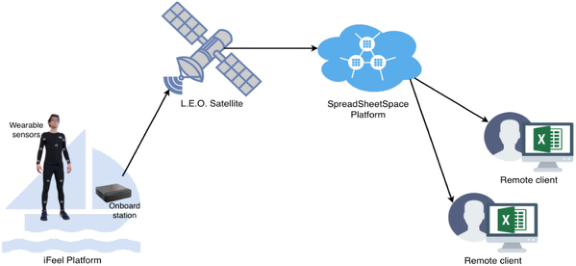
Figure 6: Integration of onboard sensors and operators’ spreadsheets.
Ship-to-Shore Interconnection for Yacht Passenger Safety 607 Consequently, the implemented system, shown in Figure 6, provides integration between onboard sensors and the operators’ spreadsheets. This integration is supported by a layered infrastructure composed of the following layers:
Network layer, based on standard TCP/IP protocols, with the physical layer implemented through low-Earth-orbit satellite connections;
Data distribution layer, provided by the SpreadSheetSpace platform, which delivers real-time data synchronization and secure data historization services through the use of end-to-end asymmetric encryption techniques;
Onboard application layer, implemented by the platform that coordinates and manages the sensors installed on the vessel and prepares the application payloads to be made available to ground operators;
Ground application layer, which is not implemented through the development of dedicated applications—typically rigid and difficult to customize—but instead relies on spreadsheets, enabling ground operators to directly develop their own applications.
The overall system also required the implementation of a management plane, i.e., a platform capable of supporting the deployment and management of service instances, including the activation and deactivation of onboard sensors and the configuration of synchronizations with the ground stations providing the monitoring service.
Particular attention was devoted to privacy support, given that the processed data are inherently sensitive, as they relate to individuals’ health conditions. Secure synchronization, based on end-to-end encryption and provided by the SpreadSheetSpace platform, natively ensures full data confidentiality. Data are encrypted at the source using a locally generated private key and decrypted at the destination using the corresponding public key. That ensures that only the destination users, i.e., the shore-based center operators, can read them. Of particular relevance is the fact that the private key never leaves the administrative domain of the data source, i.e., the vessel, thus making it impossible for any party, including the data distribution platform operators, to interpret the transmitted data. Data decryption is possible only at the destination, namely at appropriately configured ground stations.
CONCLUSION
In this paper, we presented the integration of two technologies. The first, called iFeel, collects data from wearable sensors, while the second, called SpreadSheetSpace, synchronizes the data produced by the sensors with the spreadsheets used by those responsible for monitoring the health conditions of the individuals wearing the sensors.
The application presented, aimed at monitoring the health conditions of yacht crews and passengers, significantly improves the usability of recreational boating by enabling even people affected by medical conditions requiring continuous monitoring to navigate safely. It is interesting to note that the application of the two integrated technologies to the maritime
domain is made possible by the introduction of low Earth orbit satellites, which provide the low latency required to support synchronization.
ACKNOWLEDGMENT
Funded by the European Union - NextGenerationEU and by the Ministry of University and Research (MUR), National Recovery and Resilience Plan (NRRP), Mission 4, Component 2, Investment 1.5, project “RAISE - Robotics and AI for Socio-economic Empowerment” (ECS00000035).
REFERENCES
Darvish et al. (2022).“Simultaneous Action Recognition and Human Whole-Body Motion and Dynamics Prediction from Wearable Sensors”, IEEE HUMANOIDS. Guo et al. (2023). “Online Action Recognition for Human Risk Prediction with
Anticipated Haptic Alert via Wearables”, IEEE HUMANOIDS. Latella et al. (2019). “Simultaneous Floating-Base Estimation of Human Kinematics and Joint Torques” Sensors. Latella et al. (2021).“Analysis of Human Whole-body Joint Torques during Overhead
Work with a Passive Exoskeleton”, IEEE Transactions on Human-Machine Systems, 2021 Maresca, M. (2016). The spreadsheet space: Eliminating the boundaries of data cross-referencing. Computer, 49(9), 78-85. Maresca, M. and Baglietto, P. (2017). Spreadsheet Synchronization for Workgroup
Collaboration and Software Platform Access. In ECISM 2017 11th European Conference on Information Systems Management (p. 179). Academic Conferences and publishing limited. Rapetti et al. (2021). “Model-based real-time motion tracking using dynamical inverse kinematics” Algorithms. Tirupachuri et al. (2021). “Online non-collocated estimation of payload and articular
stress for real-time human ergonomy”, IEEE Access.
LISTED IN THE AHFE DIGITAL BOOKSTORE CATALOGUE
Explore the complete digital volume
Advances in Human Factors of Transportation
Read this individual research paper free through the original publisher, or explore the full digital proceedings book.
ISBN 979-8-950676-00-0
Explore this ISBN in the AHFE Bookstore ↗Listed in the July 2026 bookstore catalogue; search by ISBN to confirm current availability · Digital book purchase optional