Xinyun Li, Anqi Tong (2026). Redefining Cultural Experiences: An AR Interaction Design Study of Chu Phoenix Patterns Based on the Three-Factor Theory of Culture. In: Usability and User Experience. AHFE Open Access, vol. 232, pp. 338–348. https://doi.org/10.54941/ahfe1008062
As a core totem of Jingchu culture originating from the Shang and Zhou dynasties, the Chu phoenix pattern stands as one of the most representative visual symbols within its ornamental system. However, against the backdrop of an era characterized by fragmented information, traditional culture faces the challenge of gradual erosion. This study, grounded in the “Three Factors of Culture” theory, constructs a design framework aimed at systematically enhancing the user experience of cultural products. First, an original digital design of the Chu phoenix pattern was completed. Based on the Unity platform, an AR interactive application was developed, transforming the pattern elements into science-popularization animations through information visualization. Users can interact with virtual elements through gestures to trigger educational animations that blend audio-visual effects, thereby enhancing cultural learning immersion through gamified interaction. To evaluate the AR system's effectiveness in improving user experience and cultural cognition, this project recruited 40 adolescent users for experimentation. Results indicate that the AR system delivers a positive user experience and effectively fosters cultural identity among users.
The Chu people originated in the Jianghan River basin. In ancient Chinese mythology, the phoenix is known as the “King of Birds,” and its status in Chinese culture is second only to that of the dragon; it is also a symbolic totem of Chu culture. Its stylized and formulaic visual representation—the Chu phoenix pattern—emerged as a core totem of Jingchu culture during the Shang and Zhou dynasties, standing as one of the most representative visual symbols within this pattern system. In today’s era where digital technology deeply permeates cultural dissemination, breaking through traditional static, one-way communication models and reshaping immersive, interactive cultural experiences has become a critical issue for achieving the living
Redefining Cultural Experiences: An AR Interaction Design Study of Chu Phoenix 339 transmission of intangible cultural heritage. Existing models predominantly rely on the superficial symbols of museums’ flat exhibition displays and cultural products. User experiences thus become static and shallow, making it difficult for the public to deeply grasp the underlying historical context and spiritual essence, resulting in diminished cultural dissemination effectiveness. Although new technologies like augmented reality have been applied to cultural heritage, existing research exhibits significant shortcomings: First, most practices focus on technical implementation without systematic cultural theory guidance, resulting in a disconnect between technology and cultural substance. Second, users have failed to establish a systematic path that leads from cultural awareness to emotional resonance. This exposes a critical research gap: how to construct an integrated framework that systematically bridges cultural translation, interaction design, and experience evaluation, thereby elevating traditional culture from the display of its “form” to the transmission of its “essence.
Therefore, based on the current demand for innovation in digital heritage experiences and the practical challenges in disseminating Chu phoenix patterns, the research questions of this study are as follows:
1. How can the Three-Factor Theory of Culture be integrated with the revitalization and dissemination of Chu phoenix-pattern culture? 2. How should AR interaction mechanisms be designed to effectively stimulate users’ immersive experiences and deep understanding of Chu phoenix-pattern culture? 3. What specific outcomes does this AR interaction system achieve in enhancing key user experience metrics, such as system usability, cultural awareness, and emotional resonance?
Based on the Cultural Three-Factor Theory, this study constructed an AR interactive experience framework for Chu phoenix patterns, followed by design implementation and effectiveness validation. The objective is to address the current issues of insufficient interactivity and superficial cognition in cultural experiences through systematic design guided by theory, thereby exploring a viable approach that effectively enhances user experience and cultural dissemination efficacy. Preliminary research indicates that this approach demonstrates positive potential in stimulating user interest and deepening cultural understanding.
RELATED WORD Against the backdrop of superficial cultural content making it difficult to achieve deep cultural transmission, scholars have embarked on explorations from various perspectives. Wei Rong and Gu Huimin proposed the specific application of the traditional Chinese phoenix motif in three domains: apparel, architecture, and handicrafts. With the advancement of new media technologies, it will also be applied in virtual reality technology displays (Wei and Gu, 2020). Ye Yuhong proposes expressive forms for patterns in cross-media communication scenarios, focusing on their digital translation
340 Li and Tong and visual design. By leveraging the technical characteristics of media to facilitate dissemination, he endows patterns with the narrative capacity of spatial dimensions (Ye, 2025). Jia Lu proposed that the Chu phoenix pattern represents the artistic crystallization of Chu culture. Based on social development and people’s pursuit of aesthetics, we must innovate and develop by integrating the essence of Chu culture into contemporary artistic expression (Jia, 2015).
Overall, existing research offers valuable insights into the modern application and formal transformation of patterns. However, most practices remain focused on visual-level adaptations, lacking a systematic theoretical framework to guide the holistic translation and experiential construction spanning cultural forms, behavioral rituals, and spiritual values. This research gap presents an opportunity for this study to employ the Cultural Tri-Factor Theory in constructing a systematic communication framework.
DESIGN STRATEGY Cultural Translation Design of Chu Phoenix Patterns Based on the Three-Factor Theory of Culture
Phoenix patterns represent one of the most distinctive highlights of Jingchu culture. The Three-Factor Theory of Culture, grounded in Chu culture as represented by phoenix patterns, constructs a cultural translation strategy through three dimensions: “material carriers, social organization, and spiritual core.”
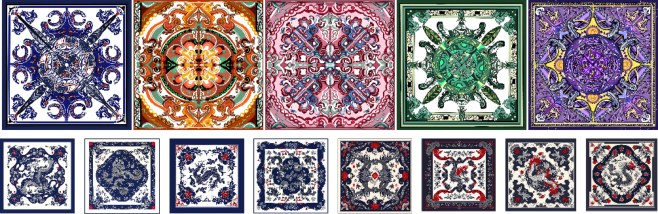
The material layer represents the most outwardly visible aspect of culture, corresponding to the visual form of the Chu phoenix pattern. The core strategy for translating this layer lies in extracting its essential elements through scholarly research while seeking balance in innovation. The primary focus is on addressing the challenge of creating a visually appealing modern interpretation of the Chu phoenix pattern’s aesthetic characteristics, tailored for the core viewing medium of scanned posters. When users scan the poster with their mobile devices, the system synchronously displays an animated presentation of the Chu phoenix pattern, effectively bringing it to life and conveying its cultural significance. This translation effort—a digital pattern library that combines cultural distinctiveness with visual impact—has laid a solid foundation for dynamic presentations in subsequent AR experiences.
Figure 1: Design of the chu phoenix pattern series.
Redefining Cultural Experiences: An AR Interaction Design Study of Chu Phoenix 341 Organizational layers pertain to the social interactions and ritual norms underlying culture. The Chu people revered the phoenix, and their collective rituals—including sacrifices, music, and dance—served as vital arenas for the living transmission of Chu phoenix motifs (Peng, 2020). This study conducted an in-depth analysis of the action sequences, collaborative relationships, and emotional appeals within Chu rituals such as “sacrificing to the phoenix” and “wearing phoenix ornaments.” Based on this analysis, a gamified AR interactive task system was designed. For instance, transforming solemn sacrificial rites into “virtual ceremonial” tasks that multiple users can collaborate on online, where users simulate actions like presenting jade offerings and pouring sacrificial wine through gesture recognition technology. It achieves a qualitative leap in cultural experience, transforming it from mere ‘observation’ to active “participation.”
The spiritual layer constitutes the core of culture, corresponding to the philosophical concepts and national spirit embodied by the Chu phoenix pattern, such as the life philosophy of “rebirth through reincarnation” and the cosmological view of “unity between heaven and humanity.” The translation at this level represents the ultimate goal of design, with its strategy centered on constructing a narrative-driven immersive context that fosters emotional resonance. Upon unlocking this storyline through interaction, users will find themselves immersed in a virtual realm blending historical elements with artistic imagination. They will witness the entire journey of the Chu Phoenix Pattern—from its birth and evolution to its ultimate transcendence— accompanied by majestic ancient music and a profound voice-over narration. This interpretation does not merely state the spirit explicitly, but rather constructs a perceptible, experiential emotional field.
This study employs user experience design based on the Cultural Three Theory, focusing on three dimensions: material carriers, social organization, and spiritual core. First, we excavate the linear forms of phoenix-bird patterns on the material surface, reconstructing the physical manifestation of the motifs. At the organizational level, AR interaction technology provides users with an immersive experience. Finally, at the spiritual level, we uphold core cultural values, promoting the dissemination of the spiritual essence of Jingchu culture among users.
Design of Cultural Interaction Mechanisms for the Chu Phoenix Pattern AR Experience Building upon cultural translation, this section constructs a three-stage interactive model based on a progressive experience logic of “guidance- exploration-resonance.” This model aims to systematically guide users from low-threshold interactions, through gamified exploration, to ultimately achieve deep emotional resonance and cultural understanding.
Phase One: Triggering and Launching the AR Experience The primary objective of this phase is to minimize the initial learning curve, guiding users seamlessly into the AR experience environment through intuitive and reliable methods. Users scan physical posters featuring specific
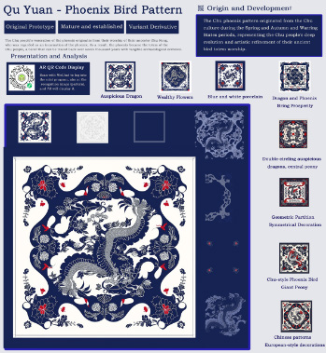
342 Li and Tong Chu Feng patterns using mobile devices in offline settings. The app’s camera interface then activates, providing real-time graphical focus assistance. Upon recognizing a successful moment, the system immediately provides multisensory, real-time feedback: the device emits a subtle vibration and, accompanied by an ethereal startup sound, launches an AR interactive game that tells the story behind the pattern. The core of this phase’s design lies in intuitive operation and definitive feedback.
Figure 2: Visualization poster design for chu phoenix pattern information.
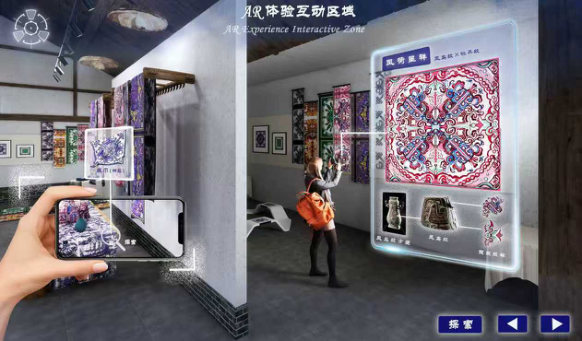
Phase Two: Exploration of Cultural Symbols and Gamified Cognition After successfully triggering the AR experience, this phase presents users with a non-linear, freely explorable interactive space designed to deepen their appreciation and understanding of the formal beauty of Chu phoenix patterns through gamified engagement. Virtual patterns float in midair, allowing users to rotate the model 360 degrees with a single-finger swipe gesture or zoom in to examine intricate carving details using a two-finger pinch gesture. A non- intrusive information overlay appears on one side of the interface, providing concise explanations of the pattern’s historical origins, artistic characteristics, and other relevant details. To deepen understanding, the system features a core deconstruction-reconstruction interactive game: When users click the “Deconstruct” button, the pattern dynamically breaks down into several core components; users then reassemble these components through drag- and-drop gestures to restore the original design. During assembly, magnetic attraction and visual highlighting occur when components approach the correct position. Successful assembly triggers an animation and motivational sound effect to indicate success.
This stage deeply integrates gamification design principles with constructivist learning theory. Free observation grants users autonomy to explore; “deconstruction-reassembly” interactive tasks transform cognitive processes into embodied challenges. This “learning by doing” approach significantly improves users’ retention and depth of understanding regarding the complex structural patterns of the Chu Phoenix motif.
Figure 3: AR scanning and interactive display of chu phoenix patterns.
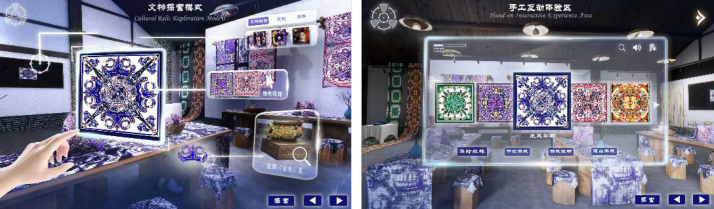
Phase Three: Narrative Immersion and Emotional Sublimation This stage marks the climax and culmination of the entire experience, designed to elevate the journey from behavioral interaction to emotional resonance—the very essence of conveying the spiritual core of the Chu phoenix motif. Upon successfully completing the puzzle task, the system automatically triggers a linear narrative animation titled “Phoenix Soaring to Heaven,” requiring no additional user input. The animation begins with the user’s hand-restored phoenix pattern, sequentially revealing the Chu phoenix motif’s origins in ritual ceremonies, its evolutionary forms across historical artifacts, and its innovative applications in contemporary design. Amidst the interplay of majestic ancient music and profound narration, the visuals create an intensely immersive experience.
Figure 4: Interactive Narrative Scene: “Phoenix Dance in the Heavens” with Chu-Style Phoenix Patterns.
The essence of this stage’s design lies in the concept that “action initiates the narrative.” Through an epic audiovisual narrative, the user’s prior understanding of the “form” is naturally guided toward grasping the “essence”—such as rebirth through nirvana and the pursuit of freedom. This effectively sparks deep emotional resonance and cultural identification, completing a full experiential loop from sensory stimulation to value recognition.
USER EXPERIRNCE AND SYSTEM EVALUATION Experimental Participants and Procedures
This study employs an embedded mixed-methods design to comprehensively evaluate the usability of the AR system and its effectiveness in cultural dissemination. This method was chosen to employ a 2 × 2 mixed-factorial design, measuring user experience in both quantitative and qualitative dimensions to assess shifts in cultural perception, differences in emotional experiences, and the degree of acceptance of design elements. The experiment was conducted in a controlled environment at a cultural exhibition hall in Jiangxi Province to ensure consistency in experimental conditions. Forty recruited adolescents were evenly divided into two age groups (12–15 years and 15–18 years), with equal representation of males and females. All participants expressed interest in traditional culture but possessed minimal prior knowledge of the Chu phoenix pattern, ensuring homogeneity in their cultural cognitive baseline.
The experimental procedure follows the sequence of “pre-test – experience – post-test – interview”: Pre-test: Participants first complete a pre-test questionnaire on cultural cognition designed based on the Three-Factor Theory of Culture. This questionnaire covers the visual characteristics, historical origins, and symbolic meanings of the phoenix pattern, aiming to assess their initial level of understanding.
System Experience: After researchers briefly outlined key operational points, participants independently completed a 15-minute system experience using tablets preloaded with the AR application. The experience fully encompassed three core interactive segments.
Post-test: Immediately following the experience, administer the System Usability Scale (SUS) test and a cultural cognition post-test to capture immediate user experience feedback and shifts in perception.
Semi-structured interviews: Finally, a random sample of participants (15 in total) from each group will be selected for one-on-one in-depth interviews to gather their subjective perceptions and suggestions for improvement.
The entire experimental procedure was conducted under uniform environmental conditions with the assistance of two trained research assistants to ensure standardized operations and consistent data collection.
MEASUREMENT TOOLS AND DATA ANALYSIS METHODS System Usability Scale (SUS)
SUS is a widely adopted standardized questionnaire in the industry for quickly assessing users’ subjective perceptions of system usability (Ge, Li, Wang et al., 2023). Mixed-methods research is governed by the balance between environmental and ecological validity; we employed participant recruitment and sampling methods. Therefore, this study selected SUS because it has been proven to offer high reliability even with small sample sizes and is capable of accurately capturing users’ immediate perceptions of interactive systems, which is crucial for evaluating novel AR experiences.
This scale comprises 10 items using a 5-point Likert scale (1 = Strongly Disagree, 5 = Strongly Agree), with odd-numbered items being positive
Redefining Cultural Experiences: An AR Interaction Design Study of Chu Phoenix 345 statements and even-numbered items being negative statements. In this experiment, participants completed the questionnaire immediately after the AR experience to capture their first impressions regarding the system’s learnability, usability, and interaction fluency. The total score was converted to a 0–100 scale using the standard formula, with scores above 68 typically considered “good” and scores above 80.3 deemed “excellent.”
Cultural Awareness Questionnaire To quantitatively assess users’ effectiveness in acquiring cultural knowledge, this study independently designed a cultural cognition questionnaire based on the three-factor theory of culture (material, behavioral, and spiritual) (Guo and Ai, 2018). The questionnaire employs a pre-test/post-test design. The pre- test assesses participants’ initial knowledge level, while the post-test measures cognitive improvement after experiencing the system. Each correct objective answer is worth 10 points. The open-ended question is scored on a scale of 0–10 points based on accuracy and depth according to predetermined criteria. The total possible score is 100 points. To assess improvements in cultural awareness, we used SPSS software to perform a paired-sample t-test on the total scores from the pre- and post-tests. The significance level was set at α = 0.05.
Semi-Structured Interviews To gain a deeper understanding of users’ subjective experiences, emotional responses, and potential improvement suggestions, this study developed a semi-structured interview outline. Interview questions centered on four core dimensions: “initial experience perception,” “evaluation of the interaction process,” “narrative immersion effects,” and “impact of cultural identity.” Interviews were conducted in a private, quiet space by one interviewer and one note-taker. All sessions were audio-recorded with simultaneous transcription, averaging 12 minutes in duration. An incremental questioning strategy was employed: when participants mentioned keywords like “interesting” or “confusing,” prompt follow-up inquiries were made to elicit specific details (e.g., “Which design elements did you find interesting?”) to ensure data depth and richness.
RESULTS AND ANALYSIS System Usability Scale (SUS)
Analysis of 40 valid SUS scale data points indicates that the average score for this AR interactive system is 78 points, placing it in the “Good” category. This score reflects positive user evaluations across both perceived usefulness and perceived ease of use dimensions. Further analysis revealed differences in user experience across age groups: the 15–18 age group scored slightly higher (79.5 points) than the 12–15 age group (76.5 points).This finding may indicate that slightly older adolescents demonstrate greater adaptability and proficiency with mobile AR interfaces. Nevertheless, both groups scored above the “Good” benchmark of 68 points. This empirically validates the effectiveness of the system’s core design approach.
To quantitatively evaluate the system’s effectiveness in cultural dissemination, this study conducted a paired-sample t-test on pre- and post-test data from the cultural cognition questionnaire. Analysis revealed that the post-test total score for cultural cognition (M = 82.5, SD = 4.1) was significantly higher than the pre-test total score (M = 45.3, SD = 5.7), with a statistical result of t(39) = 12.45, p < 0.001.This data indicates that the AR experience produced an extremely significant positive effect in enhancing users’ cultural cognition of the Chu phoenix pattern. At the level of the three cultural factors, the greatest score increase occurred in the “spiritual connotation” dimension (pre-test M = 2.5, post-test M = 4.8). This strongly confirms the critical role of narrative immersion modules in the system design (e.g., the “Phoenix Dance in the Heavens” animation) in conveying deep cultural values and evoking emotional resonance.
Semi-Structured Interviews This study conducted thematic analysis on interview transcripts from 15 participants, identifying three progressive core themes: “Immersive Triggers and Initial Impressions,” “Gamified Interaction and Cognitive Construction,” and “Emotional Resonance and Cultural Identity.” Most users expressed amazement at the “magical” moments of virtual-reality fusion during AR triggers, establishing initial trust and sparking curiosity. Over half noted that gamified interactions like “deconstruction-reconstruction” significantly deepened memory and understanding of pattern structures through embodied actions and instant feedback, aligning with constructivist learning principles. Crucially, nearly two-thirds of users mentioned that narrative experiences like “Phoenix Dance in the Heavens” evoked emotional resonance with the spiritual connotations of Chu phoenix patterns, such as “rebirth from ashes.” This indicates that multimodal storytelling successfully created an emotional field, facilitating the internalization of cultural values.
DISCUSSION AND LIMITATIONS This study systematically evaluated the Chu Fengwen AR interaction system, which is based on the Three-Factor Theory of Culture, through a series of experiments. The results consistently indicate that the system achieved positive outcomes across three dimensions: usability, enhancement of cultural awareness, and emotional experience. Specifically, the average score on the System Usability Scale (SUS) (78 points) fell within the “good” range, confirming that the “Guide-Explore-Resonate” interaction process reduced users’ cognitive load and embodied user-centered design principles. The highly significant improvement in cultural understanding (p < 0.001), particularly the marked progress in the “spiritual significance” dimension, directly validates the effectiveness of gamified interaction and narrative immersion as core design strategies, indicating that the system has successfully facilitated the transmission of cultural symbols from superficial forms to deeper values.
Redefining Cultural Experiences: An AR Interaction Design Study of Chu Phoenix 347 The core theoretical contribution of this study lies in transforming the Three-Factor Theory of Culture from an analytical framework into a practical paradigm for AR experience design, thereby providing a methodological approach to bridging the gap between “technology” and “substance” in the digitization of cultural heritage. In practice, this study provides a concrete case study for the revitalization of Chu Fengwen, and its systematic design evaluation framework offers valuable insights that can be applied to other contexts. Of course, this study also has its limitations. First, the sample is limited to adolescents and is relatively small in size. Second, the controlled experimental setting differs from real-world, open cultural consumption environments. Finally, the study focused on assessing immediate effects and did not track the long-term retention of cultural knowledge. These limitations point to directions for future research, such as conducting long-term tracking studies with broader populations and in real-world settings, as well as exploring the integration of technologies like AIGC and WebXR with this framework.
CONCLUSIONS AND FUTURE WORK This study focuses on the digital and living transmission of Chu Fengwen, completing a comprehensive exploration that spans theoretical development, design practice, and validation of results.
This study confirms that through precise visual translation at the material/ symbolic level, gamified interactive reconstruction at the behavioral/ritual level, and narrative immersion design at the spiritual/value level, it can systematically guide users through a deep experiential journey that progresses from cultural awareness and cognitive understanding to emotional resonance.
Therefore, the core contribution of this study lies not only in providing a concrete and successful case study of digital innovation in Chu Phoenix patterns, but also in proposing and validating a transferable methodological framework comprising “cultural translation, experience design, and empirical evaluation.” This framework emphasizes theoretical guidance rooted in cultural essence, ultimately returning to design validation centered on user cognition and emotional experience, thereby offering a practical solution to the common dilemma in current cultural heritage digitization projects of “prioritizing form over substance.”
Based on the findings and limitations of this study, future work can be deepened in three directions: First, expanding the breadth and depth of the evaluation by increasing sample sizes and incorporating long-term field tracking studies. Second, exploring the integration and innovation of emerging technologies, including investigating personalized narratives driven by AIGC or lightweight technological pathways such as WebXR. Third, validating the transferability of the design framework by applying it to more types of cultural heritage, such as Dunhuang caisson ceilings and architectural polychrome paintings. Thereby paving the way for broader sustainable digital dissemination of cultural heritage.
REFERENCES
Ge, Ying., Li, Si., & Wang, Wu. (2023).” Applicability Testing of User Experience Evaluation for Online Platforms Based on the Xiaohongshu App.” Journalism and Communication, (11), 102–108. Guo, Ting.& Ai, Xiaoqun.(2018).” A Study on Sensory Quality and Behavioral
Patterns of AR Museum Guide Users from a Cognitive Load Perspective.” Zhuangshi, (10), 94–97.DOI: 10.16272/j.cnki.cn11-1392/j.2018.10.017. Jia Lu.(2015). The Inheritance and Development of Chu Fengwen in Contemporary Art.Art Appreciation, (9), 102–102. Peng, Yang. (2020). Research on the Chu Phoenix Bird Pattern and its Spirit.
(Doctoral dissertation). Hunan Normal University. DOI: 10.27137/d.cnki. ghusu.2020.000178. Tong, C., & Hee-Gyun, K.(2022).Intangible cultural heritage based on AR technology.
Journal of Applied Data Sciences, 3(3), 118–127. Wei Rong, & Gu Huimin.(2020). Research on traditional Chinese patterns: A case study of “phoenix pattern”. Drama House (6), 3. Ye, Yuhong.(2025).” Digital Translation and Visual Communication Design of
Intangible Cultural Heritage Handicraft Patterns.” Footwear Technology and Design, 5(24), 51–53.
LISTED IN THE AHFE DIGITAL BOOKSTORE CATALOGUE
Explore the complete digital volume
Usability and User Experience
Read this individual research paper free through the original publisher, or explore the full digital proceedings book.
ISBN 979-8-950676-08-6
Explore this ISBN in the AHFE Bookstore ↗Listed in the July 2026 bookstore catalogue; search by ISBN to confirm current availability · Digital book purchase optional