Abiodun Afolayan Ogunyemi (2026). Mapping Knowledge Creation in Digital and Workplace Environments: A Data-Driven Scoping Review of Trialogical Learning. In: Human Interaction and Emerging Technologies (IHIET-FS 2026): Future Systems and Design Applications. AHFE Open Access, vol. 235, pp. 345–355. https://doi.org/10.54941/ahfe1007288
This study presents a data-driven scoping review of trialogical learning within the knowledge creation and collaborative learning literature, with particular attention to workplace and digitally mediated contexts. Although collaborative knowledge creation has been widely studied, the relationship between its theoretical foundations and its application in organisational and digital environments remains insufficiently integrated. The study examines the evolution, structure, and applications of the literature using a dataset of 6,525 publications that cite key foundational works. Bibliometric analysis and text mining were used to identify publication trends, thematic clusters, and the distribution of workplace and digital dimensions. The results show sustained growth in the literature and a diverse thematic structure dominated by educational and theory-driven research. Digital mediation is highly prevalent (approximately 89% of studies), while workplace-related research is also widely represented (approximately 65%) but remains secondary in the thematic structure. Approximately 59% of studies include both workplace and digital elements. The findings indicate that research is distributed across multiple domains but lacks systematic integration. The study highlights the need for approaches that connect theoretical frameworks with workplace practices and digital environments.
Over the past two decades, trialogical learning has been proposed as an integrative framework for understanding knowledge creation as a collaborative, artefact-mediated process (Paavola & Hakkarainen, 2005). It synthesises key traditions, including activity theory (Engeström, 2001), knowledge building (Bereiter, 2002; Scardamalia & Bereiter, 2006), and organisational knowledge creation (Nonaka & Takeuchi, 1995). However, the extent to which this integration has been realised across workplace and digitally mediated contexts remains unclear.
At the same time, knowledge creation is increasingly situated within digital, distributed, and knowledge-intensive work environments. These developments, associated with the evolving nature of work, require continuous Received April 30, 2026; Revised May 16, 2026; Accepted May 30, 2026; Available online June 22, 2026
346 Ogunyemi learning across organisational boundaries (Tynjälä, 2008). Despite growing research on collaborative learning and digital environments (Stahl et al., 2006), these areas have largely developed within separate disciplinary traditions.
As a result, the literature is not systematically integrated, leaving the educational, organisational, and technological perspectives coexisting without clear connections. Workplace learning is often informal and embedded in practice (Eraut, 2004), while digital mediation is frequently treated as a separate domain rather than part of a unified framework.
This study addresses this gap through a data-driven scoping review that examines how the literature is structured, how it has evolved, and how workplace and digital dimensions are represented and connected.
THEORETICAL FOUNDATIONS AND BACKGROUND The trialogical learning approach conceptualises learning as a collaborative process of knowledge creation centred on the development of shared artefacts (Paavola & Hakkarainen, 2005). Moving beyond models of individual acquisition and social participation, it proposes a third perspective in which learning involves the deliberate advancement of knowledge through collective activity. Knowledge is externalised, negotiated, and progressively refined through shared ideas, models, and practices.
This perspective builds on the knowledge-creation metaphor by integrating acquisition and participation while emphasising iterative refinement of shared objects. A key feature is mediation, which links individual and social dimensions by explaining how artefacts support collective processes. Despite this integrative aim, applications in workplace and digitally mediated contexts remain limited.
A central foundation is knowledge building, which frames learning as the collective advancement of ideas (Bereiter, 2002; Scardamalia & Bereiter, 2006). Knowledge develops through sustained discourse within a shared domain, with progress reflected in improved collective understanding. However, this approach has been applied mainly in educational settings.
Activity theory offers a complementary lens, viewing learning as the transformation of collective practices within socio-cultural systems (Engeström, 2001). It highlights object-oriented activity and contradictions as drivers of change, with expansive learning producing new forms of practice. While it extends to workplace contexts, it gives less attention to the systematic development of shared conceptual artefacts.
Organisational knowledge creation provides another perspective, focusing on how knowledge emerges and evolves within organisations through interactions between tacit and explicit forms (Nonaka & Takeuchi, 1995). Although it offers a strong account of workplace knowledge processes, it prioritises organisational outcomes over shared knowledge objects.
Workplace learning research bridges these perspectives by emphasising that learning is embedded in everyday activity and often occurs informally through participation and experience (Billett, 2001; Eraut, 2004). However, it rarely
Mapping Knowledge Creation in Digital and Workplace Environments 347 explains how collaborative knowledge creation is systematically structured. Similarly, digital advances have enabled computer-supported collaborative learning, where knowledge is co-created through interaction and tools (Stahl et al., 2006), but these developments remain largely educational.
Overall, these perspectives provide complementary yet only partially integrated accounts. They have largely evolved in parallel, leaving workplace and digitally mediated contexts insufficiently theorised within a coherent framework.
Research Questions The study is guided by the following research questions:
RQ1: How has research on trialogical learning and knowledge creation evolved as a research domain?
RQ2: What theoretical and thematic clusters structure the literature on trialogical learning and knowledge creation?
RQ3: How is trialogical learning applied in workplace and organisational contexts?
RQ4: How are digital tools and mediation conceptualised?
RQ5: What gaps exist in the operationalisation of trialogical learning and related knowledge creation approaches?
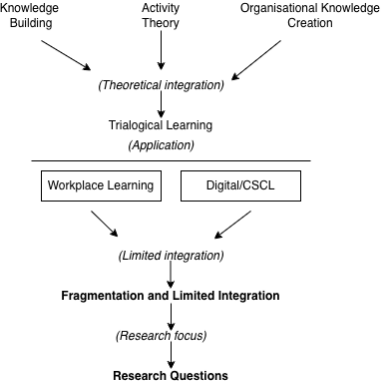
Figure 1: Conceptual framework linking theoretical foundations, application domains, and research questions.
Figure 1 illustrates how the trialogical learning framework integrates foundational traditions and is applied across workplace and digital contexts, highlighting fragmentation and motivating the research questions.
METHODOLOGY
This study employed a scoping review design guided by the PRISMA-ScR framework (Page et al., 2021) to map the structure, evolution, and thematic composition of research on knowledge creation and collaborative learning, with particular attention to trialogical learning. The review followed a structured process of identification, screening, eligibility, and inclusion, consistent with established scoping review methodology. This approach was suitable given the exploratory aim and the need to capture a broad, interdisciplinary field.
Relevant literature was identified using the Scopus database, selected for its comprehensive coverage of peer-reviewed publications. A citation- based retrieval strategy was employed to ensure conceptual alignment with the theoretical foundations of knowledge creation research, consistent with established approaches in bibliometric analysis (Donthu et al., 2021). Publications were retrieved based on citations of six foundational works: Paavola and Hakkarainen (2005), Paavola et al. (2004), Bereiter (2002), Scardamalia and Bereiter (2006), Engeström (2001), and Nonaka and Takeuchi (1995). This approach enabled the construction of a corpus that reflects the literature’s intellectual lineage.
The search was limited to journal articles and conference papers published in English. Records without abstracts or complete bibliographic information were excluded. After data cleaning and deduplication, the final dataset comprised 6,525 publications. Data extraction included metadata and textual content such as titles, abstracts, author keywords, publication year, and cited references. Preprocessing involved standardising formats and combining textual fields into a unified corpus for analysis.
The analysis integrated bibliometric methods with natural language processing. Bibliometric techniques were used to examine publication trends and citation patterns, while text mining—incorporating keyword analysis, term-frequency measures, and topic modelling via Latent Dirichlet Allocation (Blei et al., 2003)—identified thematic structures. Topics were labelled through interpretive examination of high-frequency terms within each cluster.
To address workplace learning, digital mediation, and operationalisation, a rule-based classification approach was applied. Publications were tagged using predefined keyword sets to detect these dimensions. This combined methodology enabled triangulation and revealed structural patterns and gaps across the literature.
RESULTS
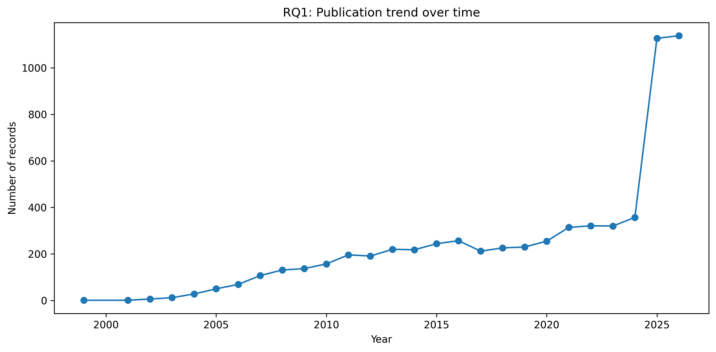
Evolution of the Research Domain (RQ1) The temporal distribution of publications indicates sustained growth in the literature on knowledge creation and collaborative learning. As shown in Figure 2, publications were relatively limited in the early years, followed by steady growth and a marked increase after 2024.
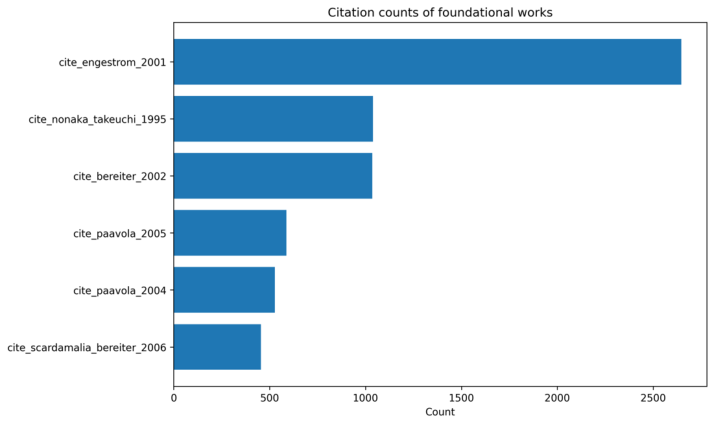
Figure 2: Publication trends over time show the growth of the literature on knowledge creation and collaborative learning.Figure 3: Citation frequency of foundational works highlights the dominance of activity theory relative to other theoretical traditions.
The distribution of document types showed that the literature was dominated by journal articles (n = 5,627, 86.2%), followed by conference papers (n = 898, 13.8%).
Theoretical Foundations and Structural Composition (RQ2) The influence of foundational theories varies significantly across the dataset. As illustrated in Figure 3, activity theory (Engeström, 2001) is the dominant perspective, whereas contributions to trialogical learning are less central.
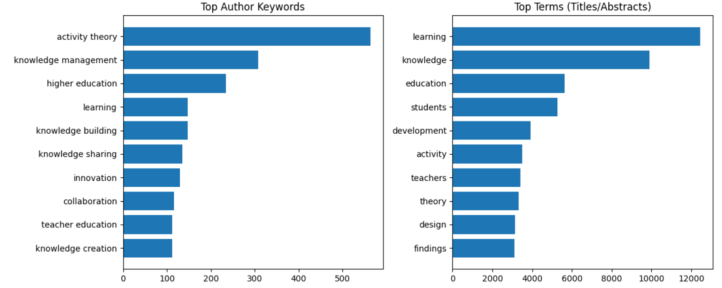
350 Ogunyemi The combined analysis of author keywords and term frequencies (Figure 4) showed frequent occurrence of terms related to activity theory, knowledge management, learning, and education.
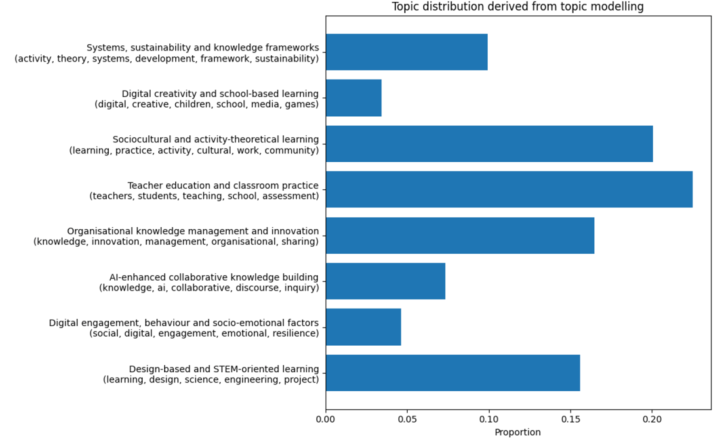
Figure 4: Top author keywords and term frequencies (titles and abstracts) showing dominant thematic emphasis across the literature.Figure 5: Topic distribution with interpretive labels derived from the most frequent terms in each cluster.
Topic modelling identified eight thematic clusters, each labelled based on its most frequent terms (Figure 5). The largest clusters were centred on teacher education and classroom practice (approximately 22%), followed by sociocultural and activity-theoretical learning (approximately 20%). Organisational knowledge management, representing the primary workplace- related cluster, accounted for approximately 16% of the literature. Emerging domains such as AI-enhanced collaborative learning represented a smaller proportion (approximately 7%).
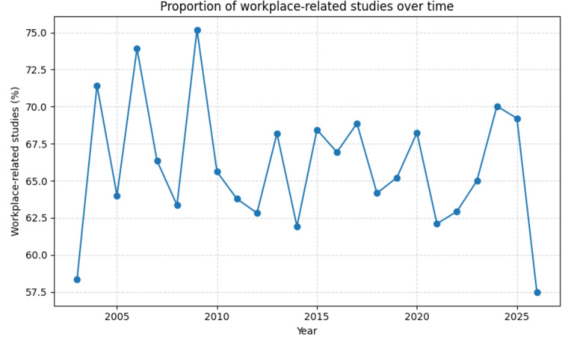
Figure 6: Proportion of workplace-related studies over time, showing relatively stable representation across the literature.
Workplace Relevance (RQ3) The proportion of workplace-related studies over time (Figure 6) ranged between 60% and 70% of publications. The topic distribution (Figure 5) showed that approximately 16% of studies formed a distinct workplace- oriented thematic cluster.
Digital Mediation (RQ4) Digital mediation was highly prevalent across the dataset, with approximately 89% of studies referencing digital technologies. The distribution of domain labels (Table 1) showed that a majority of studies combined workplace and digital elements (58.6%), while 30.6% focused exclusively on digital contexts and 6.5% were primarily workplace-focused.
Table 1: Distribution of domain labels.
Table available in the original PDF paper.
Domain Count Percentage (%) Workplace and Digital 3821 58.6
Digital 1995 30.6 Workplace 427 6.5
Other 282 4.3
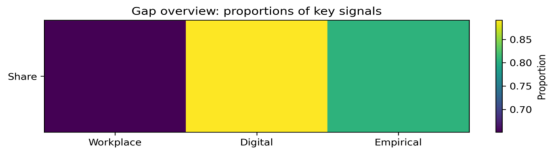
Operationalisation and Empirical Orientation (RQ5) The gap overview (Figure 7) showed that digital mediation was reported in approximately 89% of studies, while empirical studies accounted for approximately 75–80% and workplace-related studies for approximately 65%.
Figure 7: Proportion of studies across key dimensions (workplace, digital, and empirical), showing variation in their representation within the dataset.
Synthesis of Findings Across all analyses, consistent patterns were observed:
Uneven distribution of theoretical foundations
Dominance of educational contexts
Substantial but stable presence of workplace-related studies
High prevalence of digital mediation
Strong representation of empirical research
DISCUSSION
The findings offer a comprehensive account of the structure and evolution of research on knowledge creation and collaborative learning. The literature shows steady growth, with increasing attention to workplace contexts and digital mediation in recent years. However, this expansion is uneven: activity theory dominates the theoretical landscape, educational settings remain central, and digital mediation is highly prevalent. Although each dimension is well developed, they are rarely integrated. Rather than indicating a lack of research, the results point to partial development across domains, where theoretical, workplace, and digital strands coexist without forming a coherent framework. The main limitation, therefore, lies not in scarcity but in the absence of systematic integration across these dimensions.
The study’s novelty lies in its data-driven, large-scale synthesis that moves beyond traditional narrative reviews. By combining bibliometric analysis with text mining and topic modelling, it provides empirical insight into the structure of research on knowledge creation and trialogical learning. Identifying integration—rather than absence—as the key issue offers a more precise understanding of the field. While earlier work has emphasised collaboration, knowledge creation, and digital learning, this study shows that these elements are unevenly distributed and only partially connected.
These findings are broadly consistent with existing research and extend it. Prior studies in knowledge building and computer-supported collaborative learning highlight collaborative knowledge processes, particularly in educational settings. Similarly, activity theory and organisational knowledge creation provide robust accounts of learning in practice and workplace contexts. However, these traditions have largely developed within separate
Mapping Knowledge Creation in Digital and Workplace Environments 353 disciplinary boundaries. The present findings confirm this separation at scale, showing that educational, organisational, and digital perspectives form distinct clusters with limited overlap. At the same time, the growing presence of workplace and digital themes aligns with research emphasising the importance of knowledge work and technology-mediated collaboration.
The results also align with research on workplace learning and knowledge management, which emphasises the distributed and practice-based nature of learning in organisational contexts (Tynjälä, 2008). Bibliometric studies in knowledge management and organisational research similarly show that research is distributed across multiple thematic clusters with limited coherence (Gaviria-Marin et al., 2019; Massaro et al., 2015), suggesting a lack of systematic integration, a pattern also observed in the knowledge creation and collaborative learning literature. In particular, computer- supported collaborative learning research has been extensively examined, as demonstrated by systematic reviews of the field (Jeong et al., 2014). However, the present findings show that digitally mediated approaches, including CSCL, remain insufficiently integrated with workplace learning and organisational knowledge creation.
Several limitations must be noted. The analysis relies on Scopus-indexed publications and metadata, which may not capture the full depth of studies. Automated text mining and topic modelling impose interpretive constraints, and keyword-based measures may oversimplify complex concepts. Thus, findings should be seen as indicative. Future research should incorporate full-text and qualitative approaches, particularly to examine micro-level interactions in integrated workplace and digital contexts..
Despite these limitations, the study highlights the need for integrative approaches linking theory, workplace practice, and digital infrastructure. This is crucial for both research and practice in increasingly digital, knowledge- driven work environments.
CONCLUSION
This study examined the structure, evolution, and application of research on trialogical learning within the broader literature on knowledge creation and collaborative learning, with a focus on workplace and digitally mediated contexts. The findings indicate substantial growth across diverse theoretical traditions and application domains. While workplace learning is strongly represented and digital mediation is widespread, the operationalisation of trialogical learning remains uneven.
The central conclusion is that the key limitation of the literature is not a lack of research but insufficient integration across theoretical, workplace, and digital dimensions. Although many studies address aspects of knowledge creation, they remain fragmented and rarely connected within a coherent framework. This study contributes a data-driven mapping of the field and identifies integration as a central challenge for future research.
The implications are both theoretical and practical. Theoretically, there is a need for frameworks that bridge knowledge building, activity theory, organisational knowledge creation, and digital learning. Practically, the
354 Ogunyemi findings emphasise designing workplace environments and digital systems that support sustained, collaborative knowledge creation. These insights are particularly relevant in digitally transformed workplaces and the evolving future of work. Future research should focus on how such integration can be achieved by linking theory with workplace practices and digital technologies in real-world contexts.
ACKNOWLEDGMENT OF AI USE The author used generative artificial intelligence (AI) tools (ChatGPT, OpenAI, and Grammarly) to refine language and support drafting. All analysis, data processing, interpretation, and final manuscript preparation were carried out and validated by the author, who takes full responsibility for the accuracy, integrity, and originality of the work.
FUNDING This study was co-funded by the European Union and the Estonian Ministry of Education and Research through the TEM-TA26 project, “Digital Transformation Through Lifelong Learning.”
DATA AVAILABILITY The data supporting the findings of this study, including the codebook and analysis scripts, are available from the author upon reasonable request.
REFERENCES
Bereiter, C. (2002) Education and mind in the knowledge age. Mahwah, NJ: Lawrence Erlbaum Associates. Billett, S. (2001). Learning in the workplace: Strategies for effective practice. Crows
Nest, NSW: Allen & Unwin. Blei, D.M., Ng, A.Y. and Jordan, M.I. (2003) ‘Latent Dirichlet allocation’, Journal of Machine Learning Research, 3, pp. 993–1022. Donthu, N., Kumar, S., Mukherjee, D., Pandey, N. and Lim, W.M. (2021) ‘How to
conduct a bibliometric analysis: An overview and guidelines’, Journal of Business Research, 133, pp. 285–296. https://doi.org/10.1016/j.jbusres.2021.04.070 Engeström, Y. (2001) ‘Expansive learning at work: Toward an activity theoretical reconceptualization’, Journal of Education and Work, 14(1), pp. 133–156. https:// doi.org/10.1080/13639080020028747 Eraut, M. (2004) ‘Informal learning in the workplace’, Studies in Continuing
Education, 26(2), pp. 247–273. https://doi.org/10.1080/158037042000225245 Gaviria-Marin, M., Merigó, J.M. and Baier-Fuentes, H. (2019) ‘Knowledge management: A global examination based on bibliometric analysis’, Technological Forecasting and Social Change, 140, pp. 194–220. https://doi.org/10.1016/j. techfore.2018.07.006 Jeong, H., Hmelo-Silver, C.E. and Jo, K. (2014) ‘Ten years of computer-supported
collaborative learning: A meta-analysis of CSCL research’, Educational Research
Mapping Knowledge Creation in Digital and Workplace Environments 355 Review, 13, pp. 1–19. https://doi.org/10.1016/j.edurev.2019.100284 Massaro, M., Dumay, J. and Garlatti, A. (2015) ‘Public sector knowledge management:
A structured literature review’, Journal of Knowledge Management, 19(3), pp. 530–558. https://doi.org/10.1108/JKM-11-2014-0466 Nonaka, I. and Takeuchi, H. (1995). The knowledge-creating company: How Japanese companies create the dynamics of innovation. New York: Oxford University Press. Page, M.J., McKenzie, J.E., Bossuyt, P.M., Boutron, I., Hoffmann, T.C., Mulrow,
C.D., Shamseer, L., Tetzlaff, J.M., Akl, E.A., Brennan, S.E., Chou, R., Glanville, J., Grimshaw, J.M., Hróbjartsson, A., Lalu, M.M., Li, T., Loder, E.W., Mayo-Wilson, E., McDonald, S., McGuinness, L.A., Stewart, L.A., Thomas, J., Tricco, A.C., Welch, V.A., Whiting, P. and Moher, D. (2021) ‘The PRISMA 2020 statement: an updated guideline for reporting systematic reviews’, BMJ, 372, p. n71. https://doi. org/10.1136/bmj.n71 Paavola, S. and Hakkarainen, K. (2005) ‘The knowledge creation metaphor: An emergent epistemological approach to learning’, Science & Education, 14(6), pp. 535–557. https://doi.org/10.1007/s11191-004-5157-0 Paavola, S., Lipponen, L. and Hakkarainen, K. (2004) ‘Models of innovative
knowledge communities and three metaphors of learning’, Review of Educational Research, 74(4), pp. 557–576. https://doi.org/10.3102/00346543074004557 Scardamalia, M. and Bereiter, C. (2006) ‘Knowledge building: Theory, pedagogy, and technology’, in Sawyer, R.K. (ed.) The Cambridge handbook of the learning sciences. Cambridge: Cambridge University Press, pp. 97–115. Stahl, G., Koschmann, T. and Suthers, D. (2006) ‘Computer-supported collaborative
learning: An historical perspective’, in Sawyer, R.K. (ed.) The Cambridge handbook of the learning sciences. Cambridge: Cambridge University Press, pp. 409–426. Tynjälä, P. (2008) ‘Perspectives into learning at the workplace’, Educational Research Review, 3(2), pp. 130–154. https://doi.org/10.1016/j.edurev.2007.12.001
LISTED IN THE AHFE DIGITAL BOOKSTORE CATALOGUE
Explore the complete digital volume
Human Interaction and Emerging Technologies (IHIET-FS 2026): Future Systems and Design Applications
Read this individual research paper free through the original publisher, or explore the full digital proceedings book.
ISBN 979-8-950676-11-6
Explore this ISBN in the AHFE Bookstore ↗Listed in the July 2026 bookstore catalogue; search by ISBN to confirm current availability · Digital book purchase optional