Tsung Lin Yang, Wenhue Chou (2026). Investigating Sharing Intentions for Online Public Health Education Games. In: Human Interaction and Emerging Technologies (IHIET 2026). AHFE Open Access, vol. 236, pp. 302–312. https://doi.org/10.54941/ahfe1008105
Insomnia has become an important public health issue. In addition to affecting people’s physical mental health and quality of life, it has also increased the problem of sedative and hypnotic isuse. Recent studies have shown that the number of sedative and hypnotic users in Taiwan continues to increase, while the proportion of non-medical use (NMU) among adolescents and young females has also demonstrated an upward trend. The overall usage rate of hypnotics and NMU both show signs of continuous growth, highlighting the importance of Health Education regarding the proper use of hypnotics. However, most current Health Education campaigns still rely on one-way information dissemination, it lacks interactivity and entertainment, making it difficult to encourage the public to actively engage with and share health information. As Social Platforms have gradually become important channels for health information dissemination, how to enable the public to access Health Education knowledge through more attractive approaches has become an important issue.Therefore, this study used the online serious game The Nap Master’s Odyssey, developed by the Food and Drug Administration of the Ministry of Health and Welfare in Taiwan, as a case study to explore the relationships among Perceived Usefulness, Perceived Enjoyment, and Sharing Intentions among users of different genders after experiencing the game. The Nap Master’s Odyssey combines Health Education content with gamification design through narrative scenarios, interactive quizzes, and instant feedback to guide users in learning knowledge related to the proper use of sedative and hypnotic medications. In addition, the game ending interface includes personalized guardian characters, sharing interfaces, and recommended medication information, allowing players to receive personalized feedback results. This study collected data through an online questionnaire survey. Participants were required to experience The Nap Master’s Odyssey before completing the questionnaire. A total of 202 questionnaires were collected, of which 196 were valid. The results showed that both Perceived Usefulness and Perceived Enjoyment had significant positive effects on Sharing Intentions. This indicates that when users perceive the game content as practically useful and entertaining, they are more willing to share the game results on Social Platforms. In addition, the study found significant gender differences in Perceived Enjoyment and Sharing Intentions, with males scoring significantly higher than females, while no significant gender difference was found in Perceived Usefulness. These findings suggest that males may prefer game-based approaches to support learning in Health Education contexts.The main contribution of this study is confirming that serious games can serve not only as Health Education tools but also as effective health communication media when combined with personalized result presentation, character-based design, and sharing functions. In particular, the personalized guardian characters and result feedback design may not only increase the entertainment value of the game, but also encourage players to share their game results on Social Platforms, thereby improving the reach of Health Education games and enhancing the effectiveness of health promotion campaigns. The findings of this study may serve as a reference for the future design of digital Health Education games and health information communication strategies.
In recent years, the overall usage rate and non-medical use (NMU) of sedative and hypnotic medications in Taiwan have continued to increase, particularly among adolescents and women (Tsay, 2024). In addition, about one-fifth of community-dwelling elderly in Taiwan have experience using sedative sleeping pills, with approximately 5% using them without medical advice (Tseng et al., 2018). As the risks associated with inappropriate use of sedative and
Investigating Sharing Intentions for Online Public Health Education Games 303 sleeping pills continue to emerge, promoting correct medication knowledge has become an important public health issue. Although the government has promoted Health Education through pharmacists, lectures, and promotional activities (Hung & Hung, 2018), this one-way approach often fails to reach people who do not actively seek information and may even reduce message acceptance (Pan et al., 2024). Therefore, Kuncoro and Kusumawati (2021) suggested adopting more diverse and interactive communication approaches to improve public engagement and reduce resistance. In recent years, the use of serious games and social media for health knowledge dissemination has gradually gained attention (Anwar et al., 2020). Serious games use interactive and gamified processes to deliver knowledge, which can enhance learning motivation, learning outcomes, and continuous participation (Caliston, 2025; Facchino et al., 2025; Stofella & Fadel, 2022). On the other hand, social media demonstrates strong potential for the dissemination of health information, not only promoting the exchange of health knowledge among the public but also gradually changing the way medical information is conveyed (Arif et al., 2024). For individuals, social media provides instant, low-threshold health messages, enabling the public to actively search for, understand, and share health content relevant to their own lives (Kim et al., 2023). For the government and medical institutions, social platforms have also become important tools for health education and promotion (Wang & Lin, 2023). According to Wei Hanning et al. (2022) ,the Taiwan-ese government actively used new media such as Facebook, LINE, and YouTube during the COVID-19 pandemic to conduct health education and risk communication, thereby increasing information reach and enhancing public knowledge of epidemic prevention. Additionally, Wei Mixiu et al. (2023) pointed out that medical institutions can improve public health literacy and bridge the gap between medical professionals and the public through posts, videos, and interactive content. Over-all, social media offers real- time communication and can enhance public interaction and participation, making it an important tool for promoting health education. To ensure that the public is not troubled by insomnia and to prevent further harm, Taiwan’s Ministry of Health and Welfare Food and Drug Administration announced in 2024 the ‘Establishment of a Correct Usage of Sedative and Hypnotic Drugs Online Game Educational Program’. Subsequently, they launched an educational online game called ‘The Nap Master’s Odyssey’ which is designed to promote the proper use of sedative and hypnotic medications. Simply by opening this online game on a computer or mobile phone, users can participate. The aim is to develop an online educational game that makes it easier for the public to ac-cess, while also helping them understand the correct knowledge for using sedative and hypnotic drugs, the importance of following doctors’ or pharmacists’ instructions, and to prevent misuse and the diversion of these medications.
Based on this, the present study uses the online serious game ‘The Nap Master’s Odyssey’, developed by the Food and Drug Administration of the Ministry of Health and Welfare, as an example to explore whether there are significant differences between different genders in their perceptions of the actual learning benefits and entertainment value after experiencing this game. Additionally, it examines whether the perception that the game
304 Yang and Chou effectively combines educational content on the correct use of sedatives and sleep aids influences their intention to share the game results on social media platforms. Furthermore, the study investigates whether the enjoyment derived from the game process encourages individuals to voluntarily share their game outcomes on social media, thereby enhancing the effectiveness of health promotion and dissemination. Therefore, this study establishes the following research objectives:
(1) To explore whether there are significant differences in perceived usefulness and perceived enjoyment after playing ‘The Nap Master’s Odyssey’ across differ-ent genders. (2) To examine the impact of perceived usefulness on sharing intention after playing ‘The Nap Master’s Odyssey’. (3) To investigate the influence of perceived enjoyment on sharing intention after playing ‘The Nap Master’s Odys-sey’.
FACTORS INFLUENCING COMMUNITY SHARING ON SOCIAL MEDIA In addition to serious games being used as educational tools, social media has become the most direct and convenient channel for users to acquire health knowledge and share health content, thereby further promoting the dissemination of health information. Exploring the factors that influence users’ intention to share has become an important issue. Past research has often used the Technology Acceptance Model (TAM) as the theoretical basis, attempting to explain users’ information-sharing behavior on social platforms (Lee et al., 2025).
In the context of health information sharing, perceived usefulness is regarded as an important predictor that encourages users to share; that is, when users believe that health information has value and can enhance their own or others’ health knowledge, they are more likely to have the intention to share (Xiang et al., 2023).
Explaining user behavior solely from a functional perspective today is considered to overlook the entertainment aspect inherent in the game itself (Linares et al., 2021). There-fore, perceived enjoyment (PE) is often introduced as a supplementary construct to address TAM’s explanatory limitations regarding entertainment and to more comprehensively examine users’ adoption and behavioral mechanisms toward specific systems (Abdalla, 2024). Perceived enjoyment is regarded as an important factor influencing information-sharing behavior and is often defined as the degree of pleasure and enjoyment users experience when using a system, regardless of external rewards or negative impacts (Venkatesh, 2000). The systematic review by Hu and Noor (2024) also indicates that enjoyment is a key factor in promoting the intention to share knowledge, and Cai et al. (2021) further confirmed that when users experience a higher level of enjoyment during social interactions, their intention to share knowledge also increases. It can be seen that perceived enjoyment has be-come an important motivation for users to engage in sharing behavior. In terms of game usage behavior, if the aim is to enhance user engagement, ‘fun’ is also a key factor (Linares et al., 2021).
Investigating Sharing Intentions for Online Public Health Education Games 305 Therefore, both studies on health information sharing and gaming behavior indicate that perceived usefulness and perceived enjoyment significantly affect users’ engagement and sharing. The former represents an evaluation of functional benefits, while the latter reflects the entertainment aspect of fun. Together, they form the core basis of users’ behavioral intentions. Consequently, this study focuses on perceived usefulness and perceived enjoyment as the main dimensions, analyzing the public’s intention to share serious games. The intention to share is heightened when health information within the game provides educational value, and users can also experience enjoyment.
THE NAP MASTER’S ODYSSEY The research material used in this study was The Nap Master’s Odyssey, an online game developed by the Food and Drug Administration of the Ministry of Health and Welfare. The game can be played directly on computers and mobile devices without downloading. Its main objective is to promote the correct use of sedatives and hypnotics through a gamified learning approach (see Figure 1).
Figure 1: The Nap Master’s Odyssey main page, the left image is the computer version, and the right image is the mobile version (taken from: https://nightkeeper. net/questionnaire).
The gameplay lasts approximately 10–20 minutes and adopts narrative storytelling and interactive Q&A design. The game includes questions related to sleep habits and the correct use of sedative and hypnotic medications. The question design incorporates the “Five Core Competencies for the Correct Use of Sedatives and Hypnotics,” allowing players to learn medication knowledge during gameplay.
In addition, the game ending provides personalized guardian creature results and medication suggestions based on the player’s responses and performance. The ending screen also includes a sharing function that allows players to share their results on social platforms such as Facebook, Threads, and LINE, thereby enhancing interactivity and the dissemination of health education information (see Fig. 2).
Figure 2: The Nap Master’s Odyssey Game Ending Sharing Screen (taken from: https://nightkeeper.net/questionnaire).
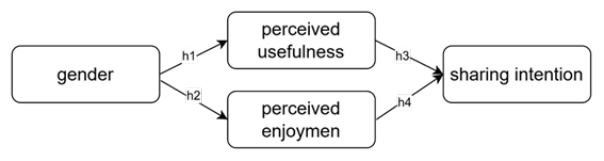
RESEARCH HYPOTHESES In learning contexts, males tend to find gamification tools more enjoyable and useful than females (Eppmann et al., 2018), but Subhash and Cudney (Subhash & Cudney, 2018) found no significant difference in perceived usefulness, suggesting that the design of gamified software appeals to both genders, though personal factors may also play a role. Regarding perceived enjoyment, females generally report lower enjoyment of gamification tools than males, and in nongamified situations, gender does not significantly relate to enjoyment (Mellado et al., 2024). Therefore, the influence of gender on perceived usefulness and enjoyment in gamified environments remains inconclusive, though most studies indicate potential differences in user experience. Consequently, this study further investigates gender differences in perceived usefulness and enjoyment within the context of serious games and proposes the following hypotheses:
In systematic reviews of social media knowledge sharing, perceived usefulness is considered a key factor influencing users’ sharing intentions (Hu & Noor, 2024). When users perceive health information as valuable and capable of enhancing their own or others’ health knowledge, they are more likely to share proactively (Xiang et al., 2023). Additionally, in gaming contexts, enjoyment is also a crucial psychological factor influencing participation. Linares et al. (2021) identified perceived enjoyment as a critical factor in increasing user engagement in games and suggested that, along-side perceived usefulness, it can explain users’ intentions and behaviors regarding game use. When users experience both practicality and entertainment during gameplay, they are more inclined to share health information conveyed through the game (Hu & Noor, 2024). Therefore, this study proposes the following hypotheses: H3: The higher the perceived usefulness, the greater the sharing intention. H4: The higher the perceived enjoyment, the greater the sharing intention.
Figure 3: Research framework diagram.
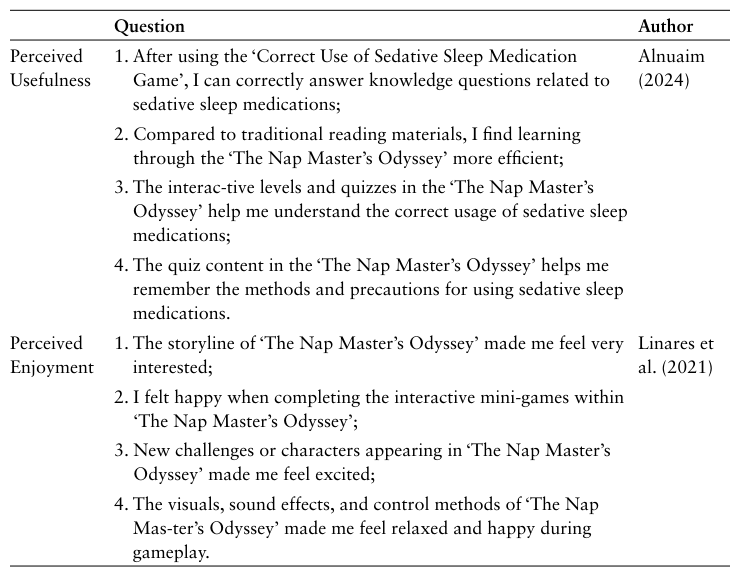
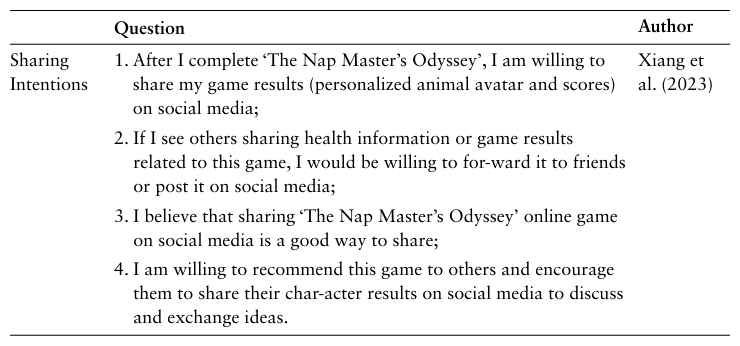
Questionnaire Design This study’s questionnaire consisted of three dimensions: perceived usefulness, perceived enjoyment, and sharing intention, with a total of 12 items measured using a five-point Likert scale. Higher scores indicated stronger agreement with each construct. Perceived usefulness measured whether participants considered the health education content in The Nap Master’s Odyssey to be practical and valuable. Perceived enjoyment assessed the level of enjoyment experienced during gameplay and interaction. Sharing intention evaluated participants’ willingness to share game-related health education information on social media platforms (see Table 1).
Table 1: Measurement scales and sources of the questionnaire.
(Continued)
Table 1: Continued.
This study employed a convenience sampling method, collecting data through an online questionnaire. Recruitment posters were disseminated via social media to attract participants to experience the game and complete the questionnaire. The questionnaire was distributed and collected using Google Forms, with partici-pants accessing the form through links in the recruitment posters. The primary recruitment platforms were Facebook, supplemented by Dcard.
Results
A total of 202 questionnaires were collected in this study. After removing invalid responses, 194 valid questionnaires remained for analysis. Among the respondents, 56.7% were female and 43.3% were male. In terms of age distribution.
Independent samples t-tests were conducted to examine Hypotheses H1 and H2. The results are presented in Table 3. The Levene’s test results for perceived usefulness and perceived enjoyment yielded F-test of 0.139 and 0.254, respectively, with significance levels greater than 0.05, indicating that the assumption of homogeneity of variances was satisfied. For perceived usefulness, the t-value was 1.352 with a significance level of 0.178 (p > 0.05), indicating that H1 was not supported. For perceived enjoyment, the t-value was 2.156 with a significance level of 0.032 (p < 0.05), indicating that H2 was supported (see Table 2).
Table 2: Independent samples t-test.
Table available in the original PDF paper.
Paired-Samples T Test
Levene’s Test for Equality of Variances F-test p-value T-value Sig. (2-tailed)
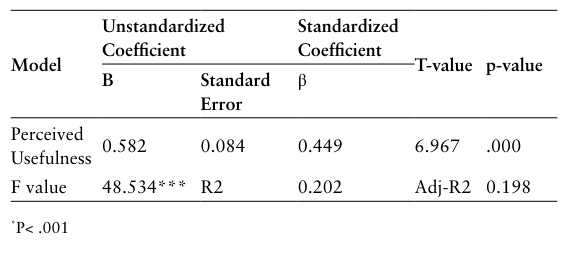
Investigating Sharing Intentions for Online Public Health Education Games 309 As shown in Table 4, the adjusted R² was 0.198, indicating that perceived usefulness explained 19.8% of the variance in sharing intention. The F-value was 48.534, with a significance level below 0.05, suggesting that the regression model was statistically significant. Furthermore, the t-value was 6.967, with a p-value of 0.000 (p < 0.001), indicating that perceived usefulness had a significant effect on sharing intention. The standardized regression coefficient (β = 0.449) suggests that perceived usefulness had a moderate effect on sharing intention. Therefore, Hypothesis H1, which states that “the higher the perceived usefulness, the higher the sharing intention,” was supported (see Table 3).
Table 3: Simple regression analysis of perceived usefulness.
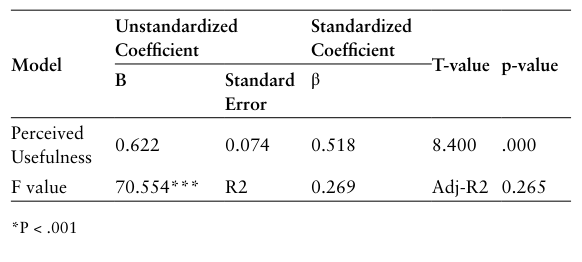
According to Table 5, the adjusted R² was 0.265, indicating that perceived enjoyment explained 26.5% of the variance in sharing intention. The F value was 70.554, with a significance level below 0.001, showing that the regression model was statistically significant. The t-value was 8.400, with a p value below 0.001, indicating that perceived enjoyment had a significant effect on sharing intention. The standardized regression coefficient was 0.449, indicating that perceived enjoyment had a moderate effect on sharing intention. Therefore, Hypothesis H4, which states that “the higher the perceived enjoyment, the higher the sharing intention,” was supported (see Table 4).
Table 4: Simple regression analysis of perceived enjoyment.
310 Yang and Chou CONCLUSION According to the results of H1, although males perceived higher usefulness than females, the difference was not statistically significant. This suggests that different genders did not significantly differ in their evaluation of the practical value of the health education content in The Nap Master’s Odyssey. Mellado et al. (2024) found that males in gamified learning environments achieved higher scores than females, although the difference was not significant. This finding may partially explain the higher perceived usefulness among males in this study. However, it remains difficult to determine which game design elements contributed to this difference (Aster et al., 2024). The lack of significant gender difference in H1 may also be related to the integration of both gamification and educational elements, which engaged males and females similarly (Subhash et al., 2018).
Regarding H2, males reported significantly higher perceived enjoyment than females, indicating gender differences in gameplay enjoyment. Previous studies suggested that the effects of gamification may vary depending on game elements and design approaches, such as points, badges, and competitive mechanisms (Koch et al., 2026). In addition, males tend to prefer challenging, competitive, and reward-oriented game content (Rapp et al., 2019). Although The Nap Master’s Odyssey focuses on health education, it includes mission progression, character transitions, and outcome feedback, which may explain the higher perceived enjoyment among males.
From a health information perspective, Xiang et al. (2023) noted that perceived usefulness influences people’s willingness to share health information. Consistent with H3, when users perceived the health education content in the game as beneficial, they were more willing to share their game results on social platforms. H3 also confirmed that integrating health education content with game design could increase sharing intention.
At the game level, H4 indicated that perceived enjoyment significantly influenced sharing intention. Linares et al. (2023) identified perceived enjoyment as an important factor affecting continued participation and behavioral intention. The Nap Master’s Odyssey enhances engagement and entertainment through story scenarios, interaction mechanisms, and personalized feedback. The character and score-based feedback presented at the game ending are also similar to the concepts of “badges” and “feedback” in gamification, which may strengthen user engagement (Fanfarelli & McDaniel, 2018). Since both H2 and H4 were supported, the findings may be related to the game-ending design, and future studies are recommended to further explore the influence of such feedback designs.
REFERENCES
Abdalla, Rania. (2024). Examining Awareness, Social Influence, and Perceived Enjoyment in the TAM Framework as Determinants of ChatGPT. Personalization as a Moderator. Journal of Open Innovation: Technology, Market, and Complexity. 10. 100327. 10.1016/j.joitmc.2024.100327. Alnuaim, A. (2024). The impact and acceptance of gamification by learners in a
digital literacy course at the undergraduate level: Randomized controlled trial. JMIR Serious Games, 12, e52017. https://doi.org/10.2196/52017
Investigating Sharing Intentions for Online Public Health Education Games 311 Anwar A, Malik M, Raees V, et al. (2020) Role of Mass Media and Public Health
Communications in the COVID-19 Pandemic. Cureus 12(9): e10453. doi:10.7759/ cureus.10453 Arif, Yunifa & Ayunda, Nisa & Diah, Norizan & Garcia, Manuel. (2024). A Systematic Review of Serious Games for Health Education: Technology, Challenges, and Future Directions. 10.4018/979-8-3693-3661-8.ch002. Aster, A., Laupichler, M. C., Zimmer, S., & Raupach, T. (2024). Game design elements
of serious games in the education of medical and healthcare professions: a mixed- methods systematic review of underlying theories and teaching effectiveness. Advances in health sciences education : theory and practice, 29(5), 1825–1848. https://doi.org/10.1007/s10459-024-10327-1 Cai, Y., Yang, Y., & Shi, W. (2022). A Predictive Model of the Knowledge-Sharing Intentions of Social Q&A Community Members: A Regression Tree Approach. International Journal of Human–Computer Interaction, 38(4), 324–338. https:// doi.org/10.1080/10447318.2021.1938393 Caliston, Noel. (2025). Evaluating the Effectiveness of Mobile Game-Based
Learning for Raising Adolescent Health Awareness: The Case of “AHlam Na 2.0”. 10.48550/arXiv.2501.15047. Eppmann, R., Bekk, M., & Klein, K. (2018). Gameful Experience in Gamification: Construction and Validation of a Gameful Experience Scale [GAMEX]. Journal of Interactive Marketing, 43, 98 - 115.Subhash, S., Cudney, E.A.: Gamified learning in higher education: a systematic review. Computers in Human Behavior 87, 192–206 (2018). doi:10.1016/j.chb.2018.05.028 Facchino AP, Marchetti D, Colasanti M, Fontanesi L and Verrocchio MC (2025)
The use of serious games for psychological education and training: a systematic review. Front. Educ. 10:1511729. doi: 10.3389/feduc.2025.1511729 Hedwika Avila Diva Putri Kuncoro, & Nurrani Kusumawati. (2021). A study of customer preference, customer perceived value, sales promotion, and social media marketing towards purchase decision of sleeping product in generation z. Advanced international journal of business, entrepreneurship and sme’s (aijbes), 3(9), 265–276. Retrieved from https://gaexcellence.com/aijbes/article/view/218 Hu, J.; Noor, S.M. Why We Share: A Systematic Review of Knowledge-Sharing
Intentions on Social Media. Behav. Sci. 2024, 14, 636. https://doi.org/10.3390/ bs14080636 Hung, M. Y., & Hung, T. S. (2018). Sleep disorders and hypnotics. Journal of Chung Hwa University of Medical Technology, 49, 14–24. Kim, J., Im, E., & Kim, H. (2023). From intention to action: The factors affecting
health data sharing intention and action. International Journal of Medical Informatics, 175, 105071. https://doi.org/10.1016/j.ijmedinf.2023.105071 Koch NN, Gebert R, Meißner N and Wirzberger M (2026) Exploring gender as a determinant of game element effectiveness. Front. Comput. Sci. 8:1694621. doi: 10.3389/fcomp.2026.1694621 Lee, A. T., Ramasamy, R. K., & Subbarao, A. (2025). Understanding Psychosocial
Barriers to Healthcare Technology Adoption: A Review of TAM Technology Acceptance Model and Unified Theory of Acceptance and Use of Technology and UTAUT Frameworks. Healthcare (Basel, Switzerland), 13(3), 250. https://doi. org/10.3390/healthcare13030250 Linares, M.; Gallego, M.D.; Bueno, S. Proposing a TAM-SDT-Based Model to Examine the User Acceptance of Massively Multiplayer Online Games. Int. J. Environ. Res. Public Health 2021, 18, 3687. https://doi.org/10.3390/ijerph18073687
312 Yang and Chou Mellado, R.; Cubillos, C.; Vicari, R.M.; Gasca-Hurtado, G. Leveraging Gamification
in ICT Education: Examining Gender Differences and Learning Outcomes in Programming Courses. Appl. Sci. 2024, 14, 7933. https://doi.org/10.3390/ app14177933 Pan Y-J, Chang S-H, Lee W-C, Chen Y-C. Medication-Seeking Behaviors and Correlated Characteristics of Zolpidem Users in Taiwan—A Shared Patient Network Analysis. Healthcare. 2024; 12(6):660. https://doi.org/10.3390/ healthcare12060660 Rapp, Amon & Hopfgartner, Frank & Hamari, Juho & Linehan, Conor & Cena,
Federica. (2019). Strengthening gamification studies: Current trends and future opportunities of gamification research. International Journal of Human-Computer Studies. 127. 1-6. 10.1016/j.ijhcs.2018.11.007. Stofella, A.,Fadel, L.M. (2022) Fidelity and play model: balancing seriousness. In: Bernardes, O., Amorim, V. (eds.) Handbook of Research on Promoting Economic and Social Development Through Serious Games, pp. 1–20. IGI Global Tsay, W. Y., Chen, L. Y., Wu, S. C., Hsiao, P. C., Ting, T. T., Yen, C. F., Chang, S. S.,
Li, C. Y., Yang, H. J., Yen, C. F., Chen, C. Y., Huang, J. H., Tu, Y. K., & Chen, W. J. (2024). Trends in the use and nonmedical use of sedatives-hypnotics in the population aged 12 to 64 years in Taiwan: a comparative analysis of the national surveys in 2014 and 2018. BMC public health, 24(1), 3262. https://doi. org/10.1186/s12889-024-20778-1 Tseng, H. Y., Yu, S. H., Lee, C. Y., Huang, W. H., Huang, S. L., Wu, C. S., Chiu, Y. F., & Hsiung, C. A. (2018). Sedative-hypnotic drug use among community-dwelling elderly in Taiwan. International psychogeriatrics, 30(7), 957–965. https://doi. org/10.1017/S1041610217002940 Venkatesh, V.: Determinants of perceived ease of use: integrating control, intrinsic
motivation, and emotion into TAM. Information Systems Research 11(4), 342– 365 (2000) Wang, C. W., & Lin, C. F. (2023). Management strategies of hospital Facebook fan pages: A case study of medical centers in the Greater Taipei area. Journal of Healthcare Management, 24(2), 185–201. [In Chinese] Wei, H. N., Dai, Y. S., Ke, H. Y., & Cao, K. L. (2022). Utilizing new media for health
education and communication related to the COVID-19 pandemic. Epidemiology Bulletin, 38(24), 939–947. [In Chinese] Wei, M. S., Chen, C. H., & Guan, J. W. (2023). The relationship between health literacy characteristics of Facebook posts by governmental and non-governmental health organizations and user responses. Journal of Health Management, 21(2), 45–64. [In Chinese] Xiang, M., Guan, T., Lin, M., Xie, Y., Luo, X., Han, M., & Lv, K. (2023).
Configuration Path Study of Influencing Factors on Health Information-Sharing Behavior among Users of Online Health Communities: Based on SEM and fsQCA Methods. Healthcare (Basel, Switzerland), 11(12), 1789. https://doi.org/10.3390/ healthcare11121789
SEARCH THE AHFE DIGITAL BOOKSTORE BY ISBN
Explore the complete digital volume
Human Interaction and Emerging Technologies (IHIET 2026)
Read this individual research paper free through the original publisher, or explore the full digital proceedings book.