Yann Kowalczuk, Jan Holub (2026). Past and future human-machine interfaces – a matter of present concern?. In: Human Interaction and Emerging Technologies (IHIET 2026). AHFE Open Access, vol. 236, pp. 370–377. https://doi.org/10.54941/ahfe1008112
Human-machine interaction has become a central part of life in modern societies. Facilitating labour, assisting with repetitive tasks, and creating significant gains of time and economic factors, computer assisted life is widely accepted as a necessity.However, with the proliferation of computers and artificial intelligence around humans, drawbacks and unexpected negative effects have been rising. Knowledge extinction, false resilience as well as induced complacency have become a serious concern in the transportation industry (specifically aviation and automotive industry). This research focuses on pointing out the direction taken by the industry, the danger of long-term exaggerated usage of automation, and the compromises that should be made to step-down from a pathway that seems hazardous for humanity.
The last century has seen the advent and development of human-machine interfaces to a state-of-the-art exceeding any past expectations. The evolution of systems, computerization and sophistication of every man-made object has created its own set of problems for the very people they should serve.
Aviation is an accurate example of such a challenge nowadays. Built around extremely complex systems to maintain and operate, the full range of artificial and human actors involved in air transportation has become the focus of safety regulations in our states.
The evolution of automation in cockpits and procedures, streamlining standardization and efficiency, has created a new set of problems by developing complacency among flight crews. Training requirements, traditional flight skills and technical knowledge took a turn back and regressed in a significant way, replaced by computer assisted operations.
Worldwide regulations, as well as economic factors, have forced the industry to maintain unprotected analogue systems, such as the Instrument Landing System (ILS) in service at the majority or airports around the world. Those systems require extensive knowledge by engineers and flight crews, that is not always anymore understood, taught or developed, while their reliable usage requires a laborious amount of investment, calibration, and monitoring.
Figure 1: ICAO defines standards for human performance in aviation. (International Civil Aviation Organisation, 2005).
On the other hand, the pinnacle of modern technology with satellite navigation, that became very popular, the basis of Unmanned Vehicles accessible to the common public, revealed its biggest weakness in the form of a global space system. Geopolitical instability created threats that would not have been even considered in a recent past. GNSS jamming and spoofing is now a key element of counter-electronic warfare in modern battlefields, disrupting large geographical areas essential to air navigation.
In this analysis, supported by two recent live events experienced by the author itself (as part of an attached conference presentation), we will remind ourselves about the degree of understanding or confusion that automation has created among us. We shall criticize our reliance on the availability of key technological systems, that also causes our loss of competence once they become unavailable. We will formulate recommendations, both on a human level (perception, consideration and usage of human-machine interfaces), as well as a technological level (what should we change, and in which way).
We believe this problematic is a very contemporary one in the advent of Artificial Intelligence (AI) growth, spreading in every field of activity.
To maintain a safe, sane and sustainable development of our human environment, we try to formulate some thoughts and directives that could help correct the current path that is taken by a wide range of industries and individuals connected to the human-machine evolution.
AUTOMATION AS A SAFETY MECHANISM PROCESS AND A TRIGGER OF COMPLACENCY In a world governed by ever accelerating technological growth, humans are anything but forced to adapt their habits to match those new social standards. The development of AI is a very contemporary representation of that problematic (Anderson et al., 2026).
Airlines and flight crews are the best projection that could be studied and extended to global human-machine relationships. No other market is more dependent on sophisticated automation systems, governed by resilient algorithms and procedures (Berglund, 2025).
372 Kowalczuk and Holub The most serious and observable consequence of this factor is the complacency towards automation, leading to unexpected accidents, that would most probably never be a factor under rational usage of manual / automatic flight skills. On the other hand, erosion of actual theoretical and manual flying skills contributes in an accelerated manner to the development of that situation. Finally, airline and company policies, encouraging the usage of automation, in parallel to a faster reduction of knowledge, favour capitalistic and economic factors (cost efficiency and humanity reduction) over absolute skills quality.
The situation has been evolving, since the mid-1980s, from a warning issued by experienced traditional airmen to an actual chain of concerns towards air safety within its very operations (Leonidov, 2025). This has led to unprecedent number of incidents / accidents where loss of situational awareness has taken place, resulting from the absence of availability of flight automation (Gawron, 2019).
Minimalistic amount of time and training is now dedicated to proper teaching of durable ways to handle basic situations in a degraded, or all- manual approach. Rather, extensive Computer Based Training (CBT) is being used to regularly refresh simplified knowledge of flight crews.
A very similar parallel could be pictured in the public sphere, by analysing the situation of road traffic and implementation of technological means to compensate for the ever-diminishing discipline and sharpness of drivers’ skills. AI driven systems are meant to replace drivers’ common sense, creating a false sense of safety and a failure to identify systemic deficiencies (Chu et al., 2023).
The analogy could be drawn further by projecting the exponentially growing density of traffic to the productivity of private companies requiring always faster results, at the cost of quality. By implementing technological measures in the name of safety and efficiency, human qualities may be sacrificed, leading to a constant downgrading of the human-machine relationship.
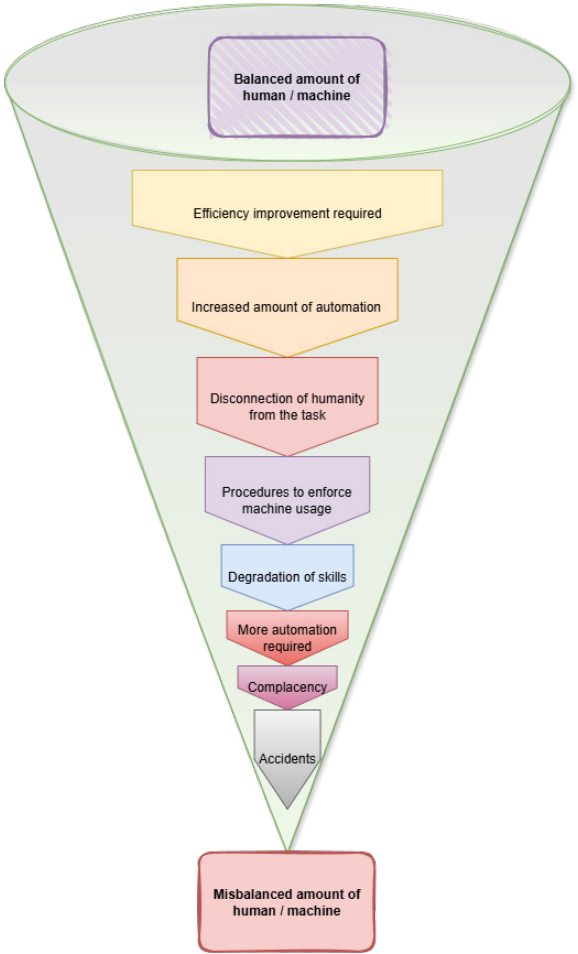
More accuracy expected with shrinking margins can be associated with a cone perceptive model of human skills. Ultimately, an excessive amount of sophistication tends to raise the number of risk factors.
From the statistics that have been released through the years, integrating aviation safety figures, a clear trend has been drawn, showing that accidents due to technical factors have become the least significant part of safety issues, while human factors have taken the main share of the distribution (Okine et al., 2026).
A bias should be noticed under this assumption: the shift of technological usage has transferred responsibility of accidents to humans. Indeed, since the flight crews are now far disconnected from their real duties (to aviate the airplane), they have taken the role of machine operators, instead of airmen. This is therefore a misconception of the “human-factor” role, since its primary task has been transferred to a machine. The industry has pushed flight crews in a role of spectator for most of the time, bringing up along multiple associated drawbacks (extended duty time leading to fatigue, extended usage of automation, and associated complacency).
From a historical perspective, another proof of role exchange could be well demonstrated with the advent of computerized flight decks, where
Past and Future Human-Machine Interfaces 373 three or more crews, dedicated to specific tasks (systems engineer, navigator, radio, etc…) were replaced by Flight Management Computers, reducing the requirements of skills and body count.
Evidently from all those proven factors, the human-machine balance is now in an unequilibrated state, bringing up multiple risks at an accelerated state. Serious reconsideration of current industry models will be necessary to avoid heading up in a direction that will only intensify this pathway.
Figure 2: Conical model of human-machine interface and automation deficiencies.
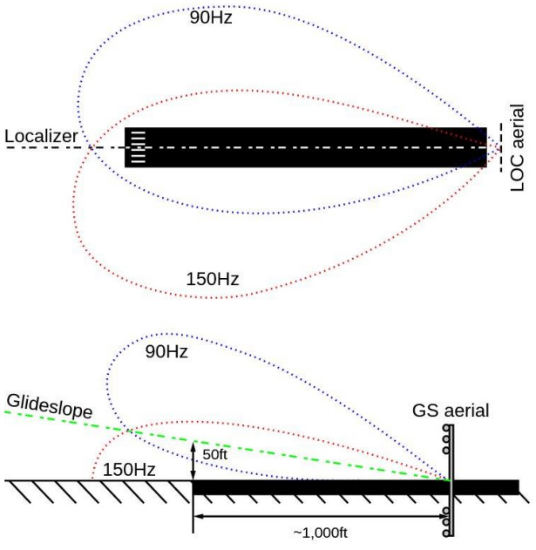
The Instrument Landing System (ILS) is a demonstration that efforts to replace historically functional and robust infrastructure has impinged significant investment and efforts without long-term results. Developed in order to give landing guidance to aircraft under adverse weather conditions, this technology has remained in force nowadays, remaining the most popular means of approach guidance in low-visibility conditions. Based on analogue amplitude- modulated radio waves, those ground transmitters require regular technical calibration, testing (using in-flight testbeds airplanes), and protection zones that prevent the signals to be disturbed (specifically for Low-Visibility operations) (ICAO, 2023). Without any sort of digital signal processing involved, despite being incredibly precise and allowing near null visibility landings, the ILS is subject to beam bending, potential unlawful disruption, or specific failure in horizontal or vertical guidance (in the form of a localiser or glide-slope signal).
Figure 3: Instrument landing system (Zdeněk Horčík, Czech technical university in Prague, 2023).
Onboard avionics are designed in order to make the best usage of the ILS ground station. Occasional signal losses may be accounted for in way that is not precisely covered inside flight crew operation manuals of airlines. A common strategy used by transport category airplane, that are commonly certified to operate in Low-Visibility conditions using Autoland systems (automatic landing capabilities based on equipment redundancy), is to revert temporally
Past and Future Human-Machine Interfaces 375 to a so-called inertial path (a typical 3-degrees descent path, or by default an attitude that was last established by the autopilot), until the signal validity is reestablished. However, there is no direct information given to the flight crew for temporary loss of signal, for small integration times, since it would give sporadic failure warning in a critical phase of flight, associated with attention division. Upon reaching a predefined timestamp with signal integrity failure, autopilot systems will finally be flagged as degraded or disconnect.
Such scenarii in typical critical phases as an approach to land, may lead to dangerous situation development when the previously “failure to identify” of an automation malfunction has not been detected. This example can be further expanded to many technological systems in place, where the observed medium seems to have evolved to a “hybrid” system between an (originally) fully human-controlled element, while automation has been implemented in order to supplement those humans.
SATELLITE RELIANCE: THE MODERN DEMONSTRATION THAT PAST SYSTEMS CANNOT BE FORGOTTEN Satellite based services, specifically telecommunication carriers, have taken an ever-increasing turn in the last decades, allowing the development of very precise, affordable and extended navigation systems. In parallel, mobile devices with voice carriers over satellite tend to become a real solution for the close future, presenting a whole set of benefits for end-users.
The release of GNSS from its original military-only usage of constellations has allowed hardware developers to effectively produce reliable devices, evolving in time-space defined by satellites now covering virtually all areas of the globe.
Adding the miniaturization of navigation sensors such as gyroscopes and accelerometers, high-performance professional or amateur carriers (drones, automatic vehicles, etc…) became very popular and opened a new dimension for end-user creativity. Military applications have demonstrated how powerful such a combination of technology may result using appropriate human support (operators).
One emerging challenge of GNSS deployment from different countries resides in the availability of proper receiver stacks, that defer from each other, requiring now extensive integration to cover all possible offered standards (GPS, Galileo, Glonass, BeiDou, etc…). Obviously limited by its original strategical intended usage, a universal system standard may not be envisioned by all nations in the world, since potential conflicts require exclusive usage, and even coarse / fine signal level deception.
Aviation regulators and aircraft manufacturers have seen into satellite navigation an opportunity to simplify operations and avionics developments, leveraging cost reduction to suppress existing ground-based systems. The cost- effectiveness of this solution has been prioritized to the extent that an increasing number of developments rely purely on satellite-based data. Several approach procedures at airports are now exclusively based on this type of technology, while some models of aircraft tend to stop integrating traditional systems (inertial navigation, ground-based signals receivers, etc…).
376 Kowalczuk and Holub Although this has proven to show extended reliability and allowed a step forward in a wide number of topics (traffic flow management, self-sustainable guidance, precision), having a single-ended oriented structure poses a serious risk in case of unavailability.
Indeed, the recent geopolitical context has shown increasing threats to the effectiveness of GNSS navigation, due to the deployment of cheap and extensive jamming or spoofing technology. Navigation accuracy, time stamping and various systems relying on satellite signals have shown degradation of their functions in such environments, sometimes resulting in a complete loss of performance, requiring a reversion to other means. The threat that could cause an exoatmospheric attack on orbiting devices is seen as a growing risk factor (Samson et al., 2026), potentially disrupting nations in their ability to carry on with transportation, power generation and other essential services (Gattis et al., 2026).
On the other hand, and as mentioned in our previous thoughts about automation, disregarding other means of navigation has led to high degree of complacency, a lack of knowledge and understanding of different (past) technology, and a sharp decrease in navigational skills among flight crews. Procedures that require practice and regular training are commonly left on a second or third order level, in favour of other topics, as such an outage is considered a small probabilistic event. Unfortunately, such occurrences would need to be covered back extensively, as it is with autopilot system usage.
The image from this situation in aviation can be observed with road traffic, where users are now relying almost exclusively on devices using GNSS for their own navigation. This has led to an increasing number of occurrences involving professional drivers using forbidden roads or ways (Brown et al., 2012). Reciprocally, orientation using maps and road signs is rather being decommissioned, effectively disconnecting the driver from his own task of navigating his vehicle. Autonomous vehicles obviously rely on that technology in an even more developed manner, which has shown, as well, to present serious issues in terms of validation (Breckers et al., 2022).
As it can be mirrored from our previous demonstration regarding automation, complacency is a topic that seems to be bonded to humans once they are subconsciously relying on a machine facilitating their task. This systematically leads to a disengagement from responsibility in the main associated task, and encourages separation and departure from it, ending ultimately to a disengagement of interest and proficiency.
CONCLUSION
Through this concise discussion of the challenges that are currently rising for humans, in their interactions with the machine they created to assist them, several points of concern are voluntarily highlighted. Opening the important topic of an objective review of the human-machine relationship, and their impact on our whole society, different chapters shall be considered as debatable in the foreseeable future.
Past and Future Human-Machine Interfaces 377 An essential part of this problematic shall reside in the question of how much assistance is contra productive for humans and rather degrading their own status / cognitive abilities.
A parallel could be easily drawn with the ideal stress level curve (“arousal”), where an ideal level is reached, and extrema provide negative results. A probable necessary future step in the design of any system should be to study the point where it triggers auto complacency for the user.
Debates would need to be open to discuss which transformation should be carried to avoid compromising and preserve human abilities, skills and capabilities of completing complex tasks. Education and training are seen as an essential mechanism of competency that should not be shadowed by excessive machine usage. Ultimately, humans need to be able to trust themselves in the way they can achieve and build a world where they remain master of themselves.
REFERENCES
Anderson, J., & Rainie, L. (2026). Building a human resilience infrastructure for the age of AI: Experts call for radical change across institutions, social structures. Imagining the Digital Future Center. Beckers, N., Siebert, L. C., Bruijnes, M., Jonker, C., & Abbink, D. (2022). Drivers of
partially automated vehicles are blamed for crashes that they cannot reasonably avoid. https://doi.org/10.1038/s41598-022-19876-0 Berglund, M. (2025). The Price of Reliability: Automation Complacency and its Implications for Aviation Safety. 10.13140/RG.2.2.27987.34088. Brown, B. & Laurier, E. (2012). The normal natural troubles of driving with GPS. In
Proceedings of the SIGCHI Conference on Human Factors in Computing Systems (CHI ‘12). https://doi.org/10.1145/2207676.220828 Chu Y, Liu P. (2023). Automation complacency on the road. Ergonomics. Gattis, B., Cydejko, J. & Akos, D. (2026). Baltic sea GNSS jamming and spoofing emitter detection and localization in real-time using a time difference of arrival (TDOA) system. https://doi.org/10.1007/s10291-026-02061-5 Gawron, V. (2019). Nothing Can Go Wrong—A Review of Automation-Induced
Complacency Research. International Civil Aviation Organization (2023). European Guidance Material on All Weather at Aerodromes. Leonidov, K. (2025). Methods for Preventing the Degradation of Manual Flying Skills
in an Automated Cockpit Environment. Collegiate Aviation Review International. 43. 10.22488/okstate.26.100218. Okine E. A., Zarei E., Roggow B. J., Dehghan N. (2026). Evolution of human factors research in aviation safety: A systematic review and bibliometric analysis of the intellectual structure. Journal of Safety Science and Resilience. https://doi. org/10.1016/j.jnlssr.2025.100249 Samson, V. & Brett, K. (2026). Global Counterspace Capabilities Report. Secure
World Foundation. https://www.swfound.org/publications-and-reports/2026-global- counterspace-capabilities-report
SEARCH THE AHFE DIGITAL BOOKSTORE BY ISBN
Explore the complete digital volume
Human Interaction and Emerging Technologies (IHIET 2026)
Read this individual research paper free through the original publisher, or explore the full digital proceedings book.