Thimo Florian Schindler, Simon Schlicht, Till Büchter, Jan-hendrik Ohlendorf (2026). Design, Implementation and Integration of a Mobile Sensor Platform for On-Site Ship Emission Measurements. In: Human Interaction and Emerging Technologies (IHIET 2026). AHFE Open Access, vol. 236, pp. 512–521. https://doi.org/10.54941/ahfe1008126
Maritime transport is a major contributor to air pollution in port areas, emitting nitrogen oxides (NOx), carbondioxide (CO2), particulate matter (PM), and ozone precursors. While high-precision reference stations provide accurate data, they are limited in spatial coverage and mobility. This paper presents the design, implementation, and field evaluation of a low-cost, portable immission monitoring system tailored for harbor environments. The system integrates electrochemical, NDIR, and laser scattering sensors within a modular hardware architecture as a weather-resistant external sensor unit. A lightweight software framework enables modular sensor integration, standardized data handling, and wireless transmission to a central server. Field tests alongside a calibrated stationary measuring system demonstrate that the NO2 sensor closely matches reference measurements in medium concentration ranges, while deviations occur at low levels, partly due to the applied moving average filter. The results confirm the system’s robustness, ease of deployment, and suitability for mobile air quality monitoring in ports. Future work will address energy independent operation, improved calibration of additional sensors, and integration with ship traffic data for emission source attribution.
The maritime transport sector plays a central role in global trade but also contributes significantly to air pollution, particularly in coastal and port regions. The combustion of marine fuels in ship engines releases a range of pollutants, including sulfur dioxide (SO2), nitrogen oxides (NO and NO2), carbon dioxide (CO2), and particulate matter (PM). These emissions arise primarily from fuel composition and high-temperature combustion processes (Zheng et al., 2010). Most commercial vessels operate on heavy fuel oil (HFO) or marine diesel, both characterised by high sulfur and carbon content. During combustion, sulfur is oxidized to SO2 and carbon to CO2. Nitrogen oxides are formed through thermal reactions between atmospheric nitrogen Received March 19, 2026; Revised June 16, 2026; Accepted July 3, 2026; Available online August 25, 2026
Design, Implementation and Integration of a Mobile Sensor Platform 513 (N2) and oxygen (O2) at elevated temperatures. Additionally, nitric oxide (NO) emitted from engines is further oxidised in the atmosphere to nitrogen dioxide (NO2) and can contribute to ozone (O3) formation under sunlight (Reda et al., 2015; Zheng et al., 2010). In response to the environmental and health impacts of these emissions, international regulatory frameworks have been established. The International Maritime Organization (IMO) introduced Emission Control Areas (ECAs) and defined global sulfur limits for marine fuels under MARPOL Annex VI (International Maritime Organization, 2017; Ćampara et al., 2018). Within the European Union, Directive (EU) 2016/802 further restricts sulfur content in marine fuels (European Parliament & Council of the European Union, 2016). These measures aim to mitigate the environmental and public health burden associated with ship traffic in densely populated coastal regions. Air quality monitoring in port areas is relevant to a broad range of stakeholders, including residents, port employees, regulatory authorities, and infrastructure operators. Although their motivations differ – from ensuring occupational safety to verifying compliance with emission limits – all depend on reliable and application- specific sensor technologies. While suitable monitoring solutions exist for indoor environments or roadside applications, harbor settings present distinct technical challenges. Monitoring ship emissions requires robust, mobile systems capable of operating under outdoor conditions, with sufficient precision and reliable wireless data transmission. To address these challenges, we developed a lightweight and portable sensor platform designed to detect ship-related air pollutants directly from the pier, including during short-term vessel maneuvers. Measurement data are transmitted wirelessly to a central server for processing and integration into a broader system architecture. This work contributes to the development of an intelligent port logbook, which seeks to enhance environmental transparency by combining operational shipping data with sensor-based air quality measurements (IHATEC, 2023). The objective of this study is to enable precise, location-flexible detection of ship emissions within harbor areas using a deployable sensor platform that can be installed at various points along port infrastructure.
RELATED WORK
Previous research has extensively investigated ship emissions and their impact on air quality. Existing studies can broadly be categorised according to
the pollutants considered,
the reported emission ranges, and
the applied measurement methodologies.
A wide range of gas- and particle-phase pollutants has been analysed, including NOx, SO2, CO2, hydrocarbons (HC), ozone (O3), methane (CH4), and particulate matter (PM). Mobile measurement campaigns report NOx emission factors between approximately 25–100 g/kg, SO2 between 2.5– 17 g/kg, and PM2.5 between 1–9 g/kg (Pirjola et al., 2014; Zhang et al., 2022; Peng et al., 2016). Detailed particle characterisation studies further identify dominant particle number size distributions in the range of 20–100 nm (Pirjola et al., 2014). Measurement approaches vary considerably.
Several studies rely on mobile laboratory platforms equipped with high- precision instrumentation (Pirjola et al., 2014; Zhang et al., 2022; Peng et al., 2016). Alternative approaches employ remote sensing techniques such as Differential Optical Absorption Spectroscopy (DOAS), LIDAR systems, and so-called “sniffer” methods for plume interception (Balzani et al., 2014; Kattner et al., 2015). Beyond individual plume measurements, broader investigations have addressed port-related emission inventories (Sorte et al., 2021) and assessed regional and global air quality impacts of maritime transport (Corbett et al., 2007; Merk, 2014). National-level analyses have examined temporal changes in air quality and their association with shipping activities (Kessinger et al., 2024), while forward-looking scenario studies propose zero-emission pathways and related regulatory strategies (Reusser & Perez-Osses, 2021). Quality assurance and methodological harmonization have also received attention. The SCIPPER project, for example, focuses on calibration, validation, and intercomparison of remote ship emission monitoring techniques, including uncertainty estimation and standardised quality control procedures (Fridell et al., 2008). Such frameworks are particularly relevant when benchmarking alternative measurement concepts against established high-precision reference systems. In summary, prior work comprehensively covers pollutant characterisation, emission factors, and advanced measurement technologies. However, low-cost, IoT-based sensor platforms designed for spatially flexible, long-term monitoring in harbor environments remain comparatively underexplored. Addressing this gap is the primary focus of the present study.
MATERIALS AND METHODS
This section describes the technical design of the mobile immission monitoring system and its main components. The system was developed to meet the specific requirements of port environments, including fluctuating pollutant concentrations, variable meteorological conditions, temperature gradients, and high humidity. Sensor selection and system design therefore prioritise robustness, stability, and reliable outdoor operation. The hardware architecture comprises a modular Multi Sensor Box based on a customised embedded platform (Cybercube) and an External Sensor Box that houses the pollutant sensors in a weather-resistant configuration. The software architecture enables modular sensor integration, standardized data acquisition and preprocessing, and reliable wireless transmission. Both real-time data streaming and redundant local storage are supported. Together, these elements form a mobile measurement platform for high-resolution air quality monitoring in harbor areas, while remaining adaptable to future hardware and software extensions..
Sensor Technology The selection of appropriate sensors is essential for reliable and representative immission measurements in a mobile setup. Port environments impose specific constraints, including fluctuating temperatures, high humidity, and variable pollutant concentrations. Sensors must therefore be robust, compact, and capable of accurate real-time detection under outdoor conditions. The
Design, Implementation and Integration of a Mobile Sensor Platform 515 system integrates gas and particle sensors selected for mobile operation, low power consumption, and compatibility with embedded hardware platforms. Table 1 summarises the implemented sensor components.
Table 1: Overview of integrated air quality sensors.
Table available in the original PDF paper.
Target Gas / Parameter Measurement Range: Accuracy / Resolution: Nitrogen Dioxide (NO2) 0–20 ppm −175 to −500 nA/ppm
PM2,5 0–500 µg/m³ 1 µg/m³ resolution To ensure accurate and representative air quality measurements in port environments, four specialized sensors were integrated into the mobile monitoring platform. These sensors target key pollutants associated with ship emissions, namely nitrogen dioxide (NO2), ozone (O3), carbon dioxide (CO2), and particulate matter (PM2.5). Selection criteria included sensitivity in low-concentration ranges, environmental robustness, low power demand, and compatibility with embedded hardware. The NO2 sensor is a high- precision electrochemical device optimized for low-concentration detection, offering high sensitivity (−175 to −500 nA/ppm) and stable operation. The O3 sensor measures combined O3 and NO2 concentrations; in conjunction with the dedicated NO2 sensor, differential analysis enables isolation of the O3 fraction, allowing reliable ozone quantification even under variable NO2 levels. CO2 is measured using a compact NDIR module covering a range of 400–5000 ppm and incorporating integrated temperature and humidity sensing to support compensation algorithms and environmental referencing. Particulate matter fractions (PM1.0, PM2.5, PM10) are detected via a laser- scattering sensor with a resolution of 1 µg/m³, enabling real-time monitoring of fine particles, particularly relevant near diesel-powered ship engines. The overall sensor configuration balances measurement accuracy, energy efficiency, and suitability for mobile maritime deployment.
Hardware Configuration This section describes the hardware architecture of the mobile immission monitoring station. It outlines the structural design based on the Multi Sensor Box and presents the components and functions of the customised hardware stack (Cybercube). The configuration of the system, including internal wiring, power distribution, and the integration of the external sensor housing, is then described.
Components of the Cybercube Based on the Multi Sensor Box The Multi Sensor Box (MSB) serves as the base platform of the measuring station. It is a modular framework developed within a research project at the BIK (Institute for Integrated Product Development Bremen) and can be adapted to various measurement applications. The MSB is built around a Raspberry Pi Zero 2 W and includes a Waveshare Ethernet/USB HUB HAT (B)
for extended connectivity, a Waveshare LoRa HAT for LoRa communication, a Joy-IT StromPi 3 for voltage regulation in battery mode, a Waveshare Sense HAT (B) providing inertial measurement functionality, and a Navilock NL-852EUSB u-blox 8 Multi GNSS module for GPS positioning. This hardware stack is referred to as the Cybercube, which controls the MSB. For use in the immission monitoring station, selected components were replaced to meet accuracy requirements. In particular, the selected O3 and NO2 sensors require high analogue-to-digital conversion precision. Although the 16-bit ADC integrated in the Waveshare Sense HAT (B) was initially considered, test measurements revealed excessive noise and insufficient resolution. It was therefore replaced by a Waveshare High Precision AD HAT with 32-bit resolution, providing adequate precision for the measured voltage ranges. In addition, fluctuating input voltages caused by the StromPi 3 during battery operation affected ADC readings. To ensure stable measurements, the system was operated via an external power supply, while the StromPi 3 remained integrated to preserve the overall Cybercube structure and future battery capability. Internet connectivity was realised using a UMTS stick connected via USB to the Ethernet/USB HUB HAT (B), providing stable mobile network access for reliable data transmission. Communication with external sensors is implemented via a dedicated Ethernet cable with eight fixed-configured lines supporting I2C and UART protocols, enabling integration of most selected digital sensors. To support analogue sensors, an additional Ethernet cable with a defined pin configuration connects directly to the ADC. The configuration specifies channel assignments, allowing measured voltages to be matched to the respective sensor characteristics. This structured cabling concept enables flexible configuration of the external sensor box while maintaining a defined and reproducible hardware interface.
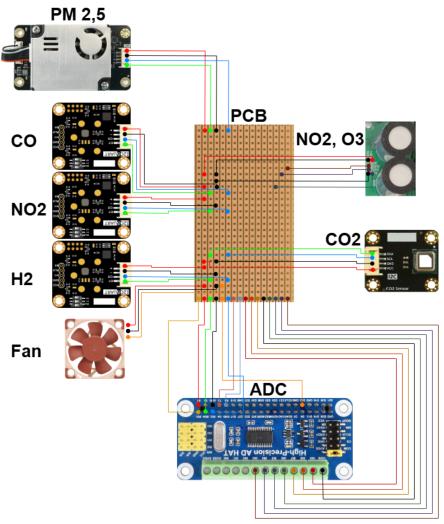
Components of the External Sensor Box The External Sensor Box was designed for seamless integration into the MSB system. Its enclosure is constructed from weather-resistant materials to ensure durability under maritime environmental conditions. The primary design objectives were secure mounting of sensors and wiring, sufficient ventilation while preventing rain ingress, reliable connection to predefined cable interfaces, and straightforward access for sensor maintenance or replacement. The design process began with a base plate accommodating all sensors and a circuit board. Sensors are mounted on four vertical supports interconnected at mid-height to increase structural stability while preserving space for PCB components, wiring, and airflow. The supports include screw fixtures for secure PCB attachment. The circuit board is guided by lateral rails and locks into position via a form-fit mechanism at the lower end. A fan mount and ventilation openings were incorporated into the housing design. Air inlets and outlets are positioned on multiple sides to promote effective airflow, while a fan mounted at the lower section actively supports air circulation. A strip-grid board is used as the PCB, enabling structured soldering of incoming cables to screw terminals. Sensor cables are soldered to the board and connected via plug connectors to facilitate maintenance. Figure 1 illustrates the connection scheme between ADC, PCB, and sensors, as well as the general sensor layout on the base plate.
Figure 1: Schematic representation of the sensor wiring within the External Sensor Box. The diagram illustrates the connections between the ADC (bottom), the strip- grid PCB (centre), and the connected components, including particulate matter and gas sensors, temperature and humidity sensing elements, and the ventilation fan. It visualises the distribution of power, data, and signal lines to provide clear documentation of the internal wiring structure.
Software Structure The software architecture follows the modular design of the Multi Sensor Box system. Each sensor is managed by a dedicated module that acquires measurements and publishes them via a ZeroMQ-based internal broker using a topic-based publish/subscribe mechanism. Sensor modules share a uniform structure: they access hardware through vendor-specific libraries, convert measurements into JSON format, enrich them with metadata such as timestamps, and publish the results. Configuration files allow adjustment of sampling intervals and sensor-specific parameters, ensuring extensibility. Measurements are acquired at defined intervals and distributed asynchronously through the broker for processing, storage, or transmission. For analogue sensors, a configurable moving average filter processes the ten most recent values, corresponding to 20 seconds at a two-second sampling interval, to reduce voltage fluctuation effects. To guarantee real-time availability and redundancy, data is handled in parallel: the fusionlog module stores measurements locally as CSV files, while the p2c module transmits them via HTTP to the digital port logbook. In case of connectivity loss, data is buffered locally and transmitted once the connection is restored. This separation of acquisition, storage, and transmission ensures reliability, fault tolerance, and deployment flexibility.
RESULTS
To evaluate the mobile immission monitoring station with respect to sensor accuracy and component stability, it was deployed near a harbour alongside a stationary monitoring station equipped with regularly calibrated reference sensors. This arrangement enabled performance assessment under realistic outdoor conditions, using the stationary system as a benchmark. The coastal setting was particularly relevant due to high humidity and saline air, which may affect sensor durability and measurement stability. The mobile station recorded data under these conditions, allowing evaluation of sensor suitability and comparison with the reference measurements. The field deployment also provided insight into potential long-term environmental influences, such as measurement drift or hardware degradation. Selected time windows from both systems are analysed to assess reliability and practical usability. Only NO2 and CO2 reference data were available from the stationary station. Although the CO2 sensor performed well in controlled indoor tests, substantial deviations occurred under outdoor conditions and are therefore not analysed further. O3 measurements cannot be evaluated due to missing reference data. Consequently, the following analysis focuses on the performance of the NO2 sensor.
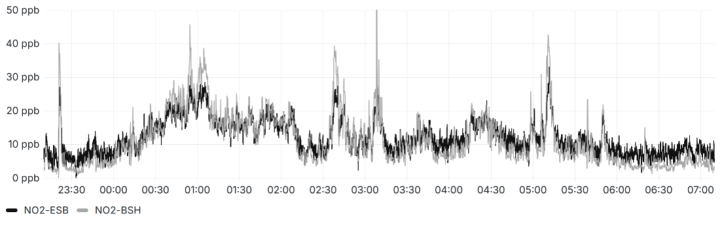
Figure 2: The NO2 measurements (black) are shown in comparison with data from the BSH1 (gray) reference station located next to the mobile immission monitoring station, covering the period from 26 May 2025 to 27 May 2025. During this time window, several spikes are visible, all of which were clearly captured by our sensor as well.
In Figure 2, the NO2 measurements recorded approximately one week after installation are shown. The readings obtained with the developed mobile sensor closely correspond to those of the reference sensor operated by BSH. Minor deviations are observable at low concentrations, particularly in the range of 0–8 ppb. Overall, the results indicate good agreement with the regularly calibrated BSH reference system. Short-term fluctuations visible in the reference data appear attenuated in the mobile measurements, which is attributable to the implemented moving average filter described in software structure.
1Federal Maritime and Hydrographic Agency.
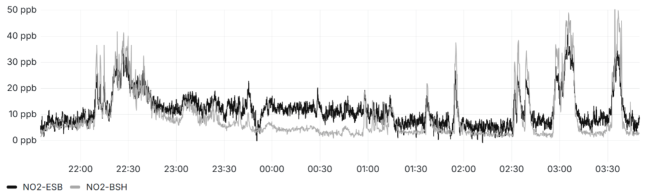
Figure 3: The NO2 measurements from the field test (black) are shown in comparison with data from the BSH (gray) reference station located next to the mobile immission monitoring station, covering the period from 3 June 2025 to 4 June 2025. During this time window, several spikes are observed, all of which are accurately captured by the sensor. However, the sensor exhibits reduced accuracy at concentrations below 8 ppb.
Figure 3 presents measurements obtained one week after those shown in Figure 2. At higher NO2 concentrations between 10 ppb and 30 ppb, the agreement with the reference data remains strong, indicating reliable sensor performance within this range. In contrast, lower concentration levels are captured less accurately. A possible explanation may be cross-sensitivity effects in the lower measurement range, although this assumption requires further investigation to confirm whether it is the primary cause or whether additional factors contribute. In the complete NO2 dataset, the temporal lag introduced by the moving average filter becomes clearly visible. The increase between 19:20 and 19:30 on 3 June 2025 illustrates that the mobile sensor does not reach the same peak levels as the reference. A smaller rise beginning around 20:35 on 3 June 2025 is reproduced accurately, whereas pronounced fluctuations between 20:40 and 21:00 are smoothed due to filtering. Despite this attenuation of short-term variability, the overall trend remains consistent with the BSH reference data. No indications of environmentally induced degradation or instability of the sensor are observed. There is no identifiable drift or systematic deviation that could be attributed to environmental influences.
CONCLUSION
The system was developed for mobile deployment in port environments and this requirement was validated during field testing, where installation was rapid and uncomplicated. A current limitation is the dependence on a 230 V power supply; future iterations could address this by integrating a battery system combined with solar panels to enable energy-autonomous operation. Stable measurement acquisition and reliable data transmission to a server infrastructure were additional core requirements and were successfully achieved, as the system has operated continuously for over three months without significant technical issues. The platform is intended to provide data of sufficient quality to support conclusions regarding ship-related emissions; however, further validation of sensor accuracy is required, particularly for components not yet analysed in detail. In addition, correlating sensor measurements with ship movement data is essential to
assess emission attribution, but this analysis lies beyond the scope of the present work and should be addressed in a subsequent study. Overall, the project establishes a solid basis for mobile emission monitoring in port areas, with future work focusing on energy independence, extended sensor validation under real-world conditions, and comprehensive evaluation of measurement data in relation to vessel traffic and meteorological parameters such as wind direction.
ACKNOWLEDGMENT
The authors would like to thank their project partners and the anonymous reviewers for their valuable input. This research has been funded by the Federal Ministry for Digital and Transport of Germany (BMDV) in the “Innovative Port Technologies” (IHATEC II) program as part of the projects Port2Connect (19H22008).
REFERENCES
Balzani, O. V., Alfoldy, B., Gast, L. F., Hjorth, J., Lagler, F., Mellqvist, J., . . . Borowiak, A. (2014). Field test of available methods to measure remotely SOx and NOx emissions from ships. Atmospheric Measurement Techniques, 7(8), S. 2597–2613. Ćampara, L., Hasanspahić, N., & Vujicić, S. (2018). Overview of MARPOL Annex
VI regulations for prevention of air pollution from marine diesel engines. SHS Web of Conferences, 58, S. 01004. Corbett, J. J., Winebrake, J. J., Green, E. H., Kasibhatla, P., Eyring, V., & Lauer, A. (2007). Mortality from ship emissions: A global assessment. Environmental Science & Technology, 41(24), S. 8512–8518. Eger, P., Mathes, T., Zavarsky, A., & Duester, L. (2023). Measurement report: Inland
ship emissions and their contribution to NOx and ultrafine particle concentrations at the Rhine. Atmospheric Chemistry and Physics, 23(15), S. 8769–8788. European Parliament & Council of the European Union. (2016). Directive (EU) 2016/802 relating to a reduction in the sulphur content of certain liquid fuels (codification). Official Journal of the European Union. Fridell, E., Steen, E., & Peterson, K. (2008). Primary particles in ship emissions.
Atmospheric Environment, 42(6), S. 1160–1168. IHATEC. (2023). Port2connect – intelligentes Hafenlogbuch zur effizienten und nachhaltigen Nutzung der Hafeninfrastruktur. Abgerufen am 11. August 2025 International Maritime Organization. (2017). MARPOL Annex VI and NTC 2008
with Guidelines for Implementation. International Maritime Organization. Kattner, L., Mathieu-Uffing, B., Burrows, J. P., Richter, A., Schmolke, S., Seyler, A., & Wittrock, F. (2015). Monitoring compliance with sulfur content regulations of shipping fuel by in situ measurements of ship emissions. Atmospheric Chemistry and Physics, 15(17), S. 10087–10092. Kessinger, S., Minkos, A., Dauert, U., Feigenspan, S., Wallek, S., & Schemmel, A. (2024).
Luftqualität 2023: Vorläufige Auswertung. Dessau-Roßlau: Umweltbundesamt. Merk, O. (2014). Shipping emissions in ports. Peng, Z., Ge, Y., Tan, J., Fu, M., Wang, X., Chen, M., . . . Ji, Z. (2016). Emissions from several in-use ships tested by portable emission measurement system. Ocean Engineering, 116, S. 260–267.
Design, Implementation and Integration of a Mobile Sensor Platform 521 Pirjola, L., Pajunoja, A., Walden, J., Jalkanen, J.-P., Rönkkö, T., Kousa, A., &
Koskentalo, T. (2014). Mobile measurements of ship emissions in two harbour areas in Finland. Atmospheric Measurement Techniques, 7(1), S. 149–161. Reda, A. A., Schnelle-Kreis, J., Orasche, J., & al., e. (2015). Gas phase carbonyl compounds in ship emissions: Differences between diesel fuel and heavy fuel oil operation. Atmospheric Environment, 112, S. 370–380. Reusser, C. A., & Perez-Osses, J. R. (2021). Challenges for zero-emissions ship.
Journal of Marine Science and Engineering, 9(10). Šaparnis, L., Rapalis, P., & Dauksys, V. (2024). Ship emission measurements using multirotor unmanned aerial vehicles: Review. Journal of Marine Science and Engineering, 12(7), S. 1197. SCIPPER Project. (2022). The SCIPPER project D2.3 – Quality assurance of remote
monitoring systems and harmonised reporting. SCIPPER Project. Sorte, S., Rodrigues, V., Lourenço, R., Borrego, C., & Monteiro, A. (2021). Emission inventory for harbour-related activities: Comparison of two distinct bottom-up methodologies. Air Quality, Atmosphere & Health, 14(6), S. 831–842. Zhang, Y., Zhao, K., Lou, D., & Fang, L. (2022). Study on the real-world emission
characteristics of gaseous and particulate pollutants from an inland ship using a portable emission measurement system. Marine Pollution Bulletin, 184, S. 114–205. Zheng, Z., Tang, X., Asa-Awuku, A., & Jung, H. S. (2010). Characterization of a method for aerosol generation from heavy fuel oil (HFO) as an alternative to emissions from ship diesel engines. Journal of Aerosol Science, 41(12), S. 1143–1151.
SEARCH THE AHFE DIGITAL BOOKSTORE BY ISBN
Explore the complete digital volume
Human Interaction and Emerging Technologies (IHIET 2026)
Read this individual research paper free through the original publisher, or explore the full digital proceedings book.