Toshiyasu Kato (2026). Development of an Experiential Physical Computing Kit for Learning Supervised and Unsupervised Machine Learning. In: Human Systems Engineering and Design (IHSED2026): Future Trends and Applications. AHFE Open Access, vol. 237, pp. 411–419. https://doi.org/10.54941/ahfe1008180
With the rapid advancement of AI technologies, including generative AI, artificial intelligence is becoming increasingly pervasive in society and everyday life. In Japan, national initiatives such as the Cabinet Office’s AI Strategy 2022 emphasize the importance of mathematics, data science, and AI education for all citizens, and teacher training materials for the high school subject Informatics II explicitly address unsupervised learning as a core AI mechanism. Unsupervised learning extracts latent patterns and structures from large-scale data without ground-truth labels and is widely used in real-world applications such as big data analytics. However, educational resources that enable high school students to concretely understand its learning process remain insufficient. Prior work has developed physical computing materials using autonomous robots to facilitate understanding of supervised learning, yet hands-on learning tools that deepen students’ understanding of unsupervised learning are still limited. To address this gap, this study extends prior educational designs by integrating unsupervised learning components into an experiential physical computing kit, enabling learners to engage with feature extraction and clustering processes in an intuitive and tangible manner. The developed kit is intended to support learners in forming a concrete understanding of both supervised and unsupervised learning through embodied interaction and data-driven experimentation.
In recent years, advances in artificial intelligence (AI) technologies, including generative AI, have rapidly expanded the use of AI in society and daily life. For example, it has been reported that the use of ChatGPT improves both the efficiency and quality of writing (Noy and Zhang, 2023). In addition, the Japanese government’s AI Strategy 2022 emphasizes the importance of mathematics, data science, and AI education for all citizens (Cabinet Office, 2022). Furthermore, the Teacher Training Materials for “Information II” in High School Informatics published by the Ministry of Education, Culture, Sports, Science and Technology introduces unsupervised learning as one of the mechanisms of AI (MEXT, 2020).
Unsupervised learning is a method for extracting features and tendencies from large amounts of data without using correct labels, and it is widely Received April 24, 2026 Revised June 21, 2026 Accepted July 15, 2026 Available online September 25, 2026
412 Kato applied in real-world contexts such as big data analysis. However, sufficient teaching materials have not yet been developed to help high school students concretely understand its learning process. To address this issue, previous research developed a physical computing teaching material based on supervised learning using an autonomous driving robot (Kato and Chino, 2024). Nevertheless, teaching materials that deepen learners’ understanding of unsupervised learning remain insufficient.
Therefore, this study extends previous research by newly incorporating elements of unsupervised learning into the teaching material so that learners can understand the mechanisms of feature extraction and clustering in unsupervised learning.
RELATED WORKS Scratch is one of the most well-known teaching materials for programming education. Since Scratch allows the development of extensions, some teaching materials focusing on machine learning have been created for it. One example is ML2Scratch, which enables image classification using MobileNet through TensorFlow.js (Ishihara, 2021). Furthermore, based on this, extension functions have also been developed that allow learners to study more advanced deep learning techniques such as transfer learning (Yagi and Yamaguchi, 2020).
Teachable Machine, provided by Google, is a web-based tool that allows users to easily create machine learning models (Google, 2019). It supports the creation of machine learning models using three types of input: images, sounds, and poses. Learners can collect training data on the website by taking pictures or recording sounds, and by pressing the training button, they can build and export a TensorFlow.js model.
Hu et al. (2015) developed a tangible programming game called Strawbies for children aged 5 to 10. In this system, programming is carried out using wooden tiles. Since the shapes of the tiles are specially processed rather than simple squares, incorrect connections cannot be made. Although this reduces the degree of programming freedom, it has the advantage of enabling learners to intuitively understand whether a connection is possible or not. Mehrotra et al. (2020) conducted classroom-based robot programming activities in which students rearranged printed programming blocks and evaluated multiple methods. However, their purpose was the evaluation of instructional methods, and they did not modify instruction in real time based on learners’ progress in order to promote knowledge retention. Kato et al. (2017) developed and evaluated a system that collects and analyzes learners’ programming progress so that teaching assistants can guide learners efficiently based on that information. However, because that analysis targeted programming languages, it cannot be directly applied to tangible teaching materials.
The position of this study can be summarized as follows. Teaching materials using Scratch are web-based, and their outputs are displayed on a screen. In this sense, they may be regarded as analogous to the first step of displaying strings in introductory programming learning. Teachable Machine,
Development of an Experiential Physical Computing Kit 413 by contrast, is specialized for creating models. Although exported models can be used for a wide variety of learning activities, applying them further requires knowledge of the destination application. Another common feature of these teaching materials is that they use transfer learning, and therefore produce relatively accurate results. While learners can easily obtain machine learning results, such materials may not be well suited for developing deeper understanding.
METHOD
This study extends the autonomous driving robot developed in previous research by introducing unsupervised learning and developing a teaching material, named Learnibot, that enables learners to compare and study supervised and unsupervised learning.
In the supervised learning material developed in previous research, image data and correct labels had to be prepared as paired training data. However, the objective of this study is to help students understand the process through which AI discovers patterns in data by itself and classifies them. Therefore, as an unsupervised learning approach, we adopted a method that combines feature extraction through dimensionality reduction with clustering. In addition to the combination of an autoencoder and clustering, unsupervised learning can also employ dimensionality reduction techniques such as principal component analysis and UMAP, as well as density-based clustering methods such as DBSCAN. However, these methods involve issues such as high computational cost and a tendency for the inference process to become a black box (Xie et al., 2016).
For the evaluation of the teaching material, the proposed material will be used in actual classroom practice at a high school by the teacher in charge. The participants will be high school students, and the material will be used in a four-class instructional format. In industrial high schools, the proportion of specialized subjects is relatively high, and students often face challenges in general academic subjects. Therefore, compared with general academic high schools, it is expected that a wider range of academic ability levels can be included.
Questionnaire surveys will be conducted before and after the lessons to collect students’ learning outcomes and changes in awareness gained through the teaching material experience, thereby examining the validity of the material. Evaluation indicators will include students’ level of understanding of AI, changes in interest and motivation, and improvements in self-efficacy. In addition, students’ behaviors and reactions during class will be observed, and qualitative data will also be collected.
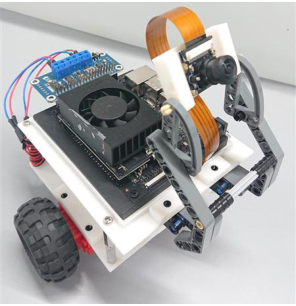
EXPERIENTIAL PHYSICAL TEACHING MATERIAL: LEARNIBOT This teaching material consists of a car-type robot equipped with a camera that recognizes traffic signs through image recognition and performs control actions according to the recognition results. A photograph of the developed robot is shown in Figure 1.
Figure 1: Learnibot.
As a teaching material using supervised learning, we used the traffic sign recognition system targeting a speed limit sign that was constructed in previous research. This system applies a pre-trained model using image data and corresponding labels while the robot is moving, and automatically decelerates when it recognizes the sign.
For the teaching material using unsupervised learning, this study developed a traffic sign recognition system in which features are extracted from captured images by an autoencoder and then clustered by the k-means method. In this system, the process by which images are classified based on data similarity without using labels is visualized so that learners can understand the differences between supervised and unsupervised learning in terms of learning methods and applicable situations.
The developed program was created in the .ipynb format and was designed to run on JupyterLab. This enables learners to check the learning process and inference results step by step together with the source code.
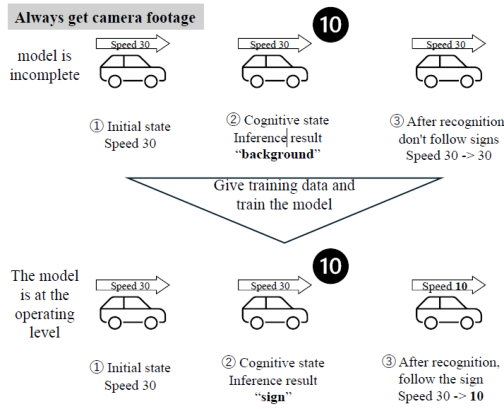
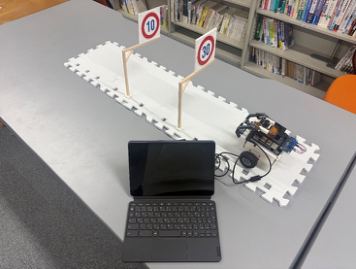
The teaching material developed in this study classifies two classes— background and sign. In the experiment, when a 10 km/h speed limit sign was classified, the robot slowed down. In addition, as an advanced version of the material, a program for classifying six classes was also prepared. Table 1 shows the correspondence between recognition targets and robot actions, and Figure 2 shows the image of the developed teaching material.
Table 1: Correspondence between recognition targets and robot actions.
Table available in the original PDF paper.
Recognition Objects Actions Background Normal operation
Stop Pause (1 second) No entry allowed End of operation
People Stop until no more people are classified
Figure 2: Image of the teaching material in operation.
Through this teaching material, students are expected to experientially understand the differences between supervised and unsupervised learning through the robot’s actual behavior and the flow of data processing.
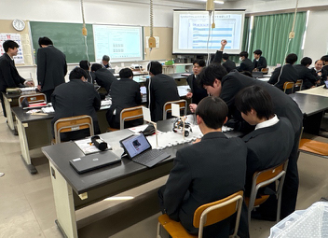
EVALUATION EXPERIMENT This experiment was conducted to clarify the usefulness of AI teaching materials in school settings and to identify practical issues in their classroom implementation. The participants were 24 students and one teacher from a public high school in Japan. A scene from the experiment is shown in Figure 3. The students were divided into six groups of four members each.
Evaluation was conducted by administering questionnaires to students before and after the experiment in order to examine changes in their perceptions. Both quantitative evaluation using a five-point Likert scale and qualitative evaluation based on free-response descriptions were employed. Example questionnaire items included: “Do you think your understanding of AI has deepened?” and “Were you able to understand why AI makes incorrect judgments?” In addition, the teacher in charge completed a post-experiment questionnaire consisting of open-ended questions. These questionnaires were used to clarify the educational effectiveness of the proposed teaching material as well as the issues associated with its implementation.
Figure 3: Experimental scene.
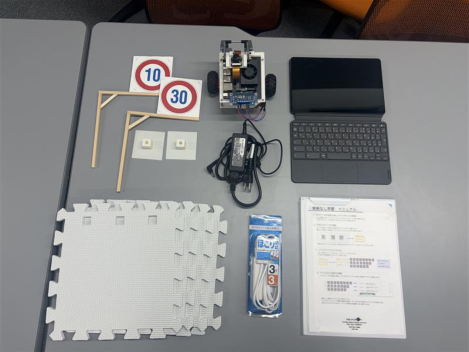
The teaching materials used in the experiment are shown in Figure 4. By arranging these materials as shown in Figure 5, students were able to operate the program while observing the behavior of the robot and learning from it.
Figure 4: Teaching materials used in the experiment.Figure 5: Example of the teaching material setup.
EXPERIMENTAL PROCEDURE The experiment was conducted over four 50-minute class periods (200 minutes in total). The procedure was as follows:
1. In the first class period, a pre-questionnaire survey was conducted, and a lecture-style class covering basic AI concepts was given. 2. In the second and third class periods, practical lessons on unsupervised learning and supervised learning using the robot were conducted. 3. In the fourth class period, the learning contents were reviewed, and a post-questionnaire survey was administered. 4. After the completion of the classes, a questionnaire survey for the teacher in charge was conducted.
EXPERIMENTAL RESULTS To examine the effectiveness of the lessons using the teaching material, histograms of the differences between the pre- and post-questionnaire results were created to check the distribution. Since the distributions were approximately normal, a t-test was conducted. The results are shown in Table 2.
Table 2: Questionnaire results before and after the lessons (n = 24).
Table available in the original PDF paper.
Survey Item Pre-Mean Post-Mean Standard Deviation of Difference Knowledge and understanding of AI 2.13 4.21* 0.93
Interest in and concern about AI 3.17 4.13* 1.37 Understanding of AI misjudgement 1.96 3.96* 1.29
Understanding of AI learning mechanisms 2.17 4.00* 1.83 *p < .05
In addition, according to the questionnaire results from the teacher in charge, the teaching material was evaluated as effective in increasing students’ interest and motivation and as useful as an introductory material for AI learning. On the other hand, the need for improved material stability and support both at the time of introduction and when technical problems occur was also pointed out.
DISCUSSION
The results of the awareness survey showed significant improvement in all survey items before and after the lessons. This suggests that the classes incorporating the AI teaching material used in this study had a certain positive effect on improving students’ knowledge and understanding of AI, as well as their interest in it.
The free-response comments in the teacher questionnaire highly evaluated the experiential learning activities using the robot, particularly for promoting students’ active trial-and-error processes and collaborative learning. On the other hand, several issues were also identified, including the stability
418 Kato of the software and hardware, the need for a teaching material design that does not depend on teachers’ technical expertise, and the enhancement of preparatory learning materials and worksheets. These results indicate that although the proposed teaching material has practical value for school settings, improvements in both operational aspects and instructional design are necessary for continuous implementation.
CONCLUSION
An experiment using the proposed teaching material was conducted at a high school, and classroom practice as well as pre- and post-questionnaires were analyzed. The results confirmed significant improvements not only in students’ interest in and knowledge of AI, but also in their understanding of why AI can make incorrect judgments and how AI learning mechanisms work. These findings suggest that experiential learning of the concept of unsupervised learning is effective in helping students understand the internal decision-making processes of AI.
Future issues include the development of tutorials to support the learning procedure, responses to equipment-related problems, and improvement of the teaching material design so that differences in learning pace during class can be accommodated.
ACKNOWLEDGMENT
This work was partially supported by JSPS KAKENHI, Grant Number JP24K06237.
REFERENCES
Cabinet Office. (2022) Government of Japan, AI Strategy. https://www8.cao.go.jp/ cstp/ai/aistrategy2022_honbun.pdf (In Japanese, Accessed 2025-4-29). Google. (2019) Teachable Machine. https://teachablemachine.withgoogle.com/
(Accessed 2026-4-24). Hu Felix, Zekelman Ariel, Horn Michael, Judd Frances. (2015) Strawbies: Explorations in tangible programming, in Proceedings of the 14th International Conference on Interaction Design and Children (IDC ’15), pp. 410–413, Boston, MA, USA. Ishihara Junya. (2021) ML2Scratch: An extension enabling the use of machine
learning from Scratch for handwritten digit recognition, Interface, vol. 47, no. 5, pp. 148–152. Kato Toshiyasu, Kambayashi Yasushi, Terawaki Yuki, Kodama Yasushi. (2017) Estimating Grades from Students’ Behaviors in Programming Exercises Using Deep Learning, in 2017 International Conference on Computational Science and Computational Intelligence (CSCI), pp. 1115–1119, IEEE. Kato Toshiyasu and Chino Yuuto. (2024) Evaluation of AI Learning Materials
Using Physical Computing, International Journal on Advances in Systems and Measurements, vol. 17, no. 3&4. Mehrotra Aditya, Giang Christian, Duruz Noé, Dedelley Julien, Mussati Andrea, Skweres Melissa, Mondada Francesco. (2020) Introducing a Paper-Based Programming Language for Computing Education in Classrooms, in Proceedings of the 2020 ACM Conference on Innovation and Technology in Computer Science Education (ITiCSE ’20), pp. 180–186, New York, NY, USA.
Development of an Experiential Physical Computing Kit 419 MEXT: Ministry of Education, Culture, Sports, Science and Technology. (2020)
Teacher Training Materials for “Information II” in High School Informatics. https://www.mext.go.jp/a_menu/shotou/zyouhou/detail/mext_00742.html (In Japanese, Accessed 2026-4-24). Noy Shakked and Zhang Whitney. (2023) Experimental evidence on the productivity effects of generative artificial intelligence, Science, vol. 381, no. 6654, pp. 187–192. Xie Junyuan, Girshick Ross, Farhadi Ali. (2016) Unsupervised Deep Embedding for
Clustering Analysis, ICML’16: Proceedings of the 33rd International Conference on International Conference on Machine Learning, vol. 48, pp. 478–487. Yagi Tooru and Yamaguchi Toshikazu. (2020) Construction of a machine learning experience system for beginners using Scratch, Bulletin of Edogawa University, vol. 30, pp. 473–485.
FIND THE COMPLETE VOLUME IN THE AHFE DIGITAL BOOKSTORE
Explore the complete digital volume
Human Systems Engineering and Design (IHSED2026): Future Trends and Applications
Read this individual research paper free through the original publisher, or explore the full digital proceedings book.