Toshiyasu Kato, Yasushi Kambayashi, Koji Oda (2023). A Proposal of Educational Programming Environment Using Tangible Materials. In: Human Systems Engineering and Design (IHSED 2023): Future Trends and Applications. AHFE Open Access, vol. 112, pp. 520–527. https://doi.org/10.54941/ahfe1004165
Recently, people started to pay attention on the education using tangible teaching materials. The field of programming education is not an exception. Researchers in education have found that tangible teaching materials improve students' logical thinking ability. Because the tangible teaching materials make students deepen their understanding by touching them with their hands and seeing them with their eyes. In other words, they appeal to students' all five senses. Programming language independent learning materials are used in several educational institutions around the world. Programming environments using some kinds of graphics are commonly used, but they restrict their users' operations due to the abilities of installed computers and their small screens. To overcome this problem, we have developed a tangible teaching material for programming education. This system makes it possible for the users to learn programming by using its tangible materials for either group education or individual learning. The purpose of this research is to solve one of the common problems widely seen among programming learners. That is letting the instructors know the learners' programming situations in classes. It is difficult for instructors to collect data about what progress each student makes and what obstacle makes them be delay. Our system takes advantages of tangible teaching materials and provides such data for instructors. In this paper, we report our experiences about the development of a tangible material for programming education. Since our goal is to support programming classes in higher educational institutes, our target is how to develop and improve individual programming methods. This research is a new attempt to support programming classes with limited time.The student using this tangible teaching materials is supposed to arrange a set of programming cards. Each card has a QR code that matches an operation procedure. Upon completion of the arrangement of QR codes, the student takes a photo of these cards using the camera of a tablet. The series of QR codes construct a Python program, and it is executed on the device. The instructor can monitor each student's progress remotely, since each QR code has annotation that informs the instructor what program element it is executing so that the instructor can collect detailed information about the program individual student constructing. The instructor can classify students into several categories based on the collected information, then set study points for the students corresponding to the categories. The collected information contains where the students failed in their programs and how they tried to correct the errors. Some corrections are right, and some are not. Then the instructor further classifies students in the same categories so that the instructor can recognize each student's weak points and give him or her careful guidance. To demonstrate the effectiveness of our tangible materials for programming education, we have conduct numerical experiments over college students. We have observed 80% of them improve their logical thinking ability. As a future work, we will implement stronger support features for instructors so that the instructor can analyze students' common errors and rightly guide them.
Researchers have found that tangible materials are useful for learning pro- gramming to develop reasoning skills (Wang et al. 2011). Tangible materials are characterized by their ability to be touched by the hands and seen by the eyes. This characteristic allows primary and secondary school students to learn programming. Many learning materials for programming have been proposed for students who have no prior knowledge for programming. Pro- gramming environments supported by graphical user interfaces are often used for this purpose. Computers’ small screens, however, tend to be an obstacle for beginners due to their complex operation. To address this issue, we have developed a set of tangible-based educational materials for programming education (Kato and Kambayashi, 2022) (Kambayashi et al. 2017, 2019). It consists of a set of cards, and each card has a QR code that represents a cer- tain operation of a program. These materials liberate users from the confines of the screen by allowing them to construct programs in an open space and run their programs on their smartphones, which are more readily available than PCs. We have, however, yet another problem for using these materials.
A Proposal of Educational Programming Environment Using Tangible Materials 521
Since our programming materials are designed for individual learning, when they are used in a classroom environment, it is difficult for instructors to capture the situation of learners in a large group. This leads to a research question that can be addressed in Goal 4 of the SDGs, “Quality education for all” (Transforming Our World, 2015).
The purpose of this study is to provide instructors with information about learners’ programming progress in classes using tangible materials, so that instructors can solve common problems that learners tend to face. Using our tangible materials as an example, we propose a method for classifying learners’ progresses.
RELATED WORKS Many of the related studies aim at developing and evaluating tangible teach- ing materials, and when the purpose is to support programming education, the goal is often to support programming methods. The reason is that it is difficult to collect data on tangible teaching materials.
Yashiro et al. developed and evaluated tangible teaching materials. Classes are developed with the theme of collaborative design, and programming can be learned in groups compared to Scratch. They, however, did not address a certain situation that multiple learners make similar errors (Yashiro et al. 2018). Melcer et al. have developed a set of tangible teaching materials that are applicable for teamwork and cooperation. The research does not consider group instruction in class where instruction time is limited. In addition, the point of teaching was focused to support how to use the material (Melcer et al. 2018).
LESSONS USING TANGIBLES TEACHING MATERIALS The following is a sample lesson sequence using our tangible materials.
1. The instructor presents a topic (problem). 2. Each learner thinks about the algorithm to solve the problem. 3. Each learner arranges the cards with QR codes in a sequence that corresponds to the algorithm. 4. The learners use their tablet PCs to read the sequences of QR codes (using the cameras on board). 5. Learners run their programs to check the algorithms. 6. If the results are not correct, go back to step 2. 7. The instructor checks each learners’ progress online and then teaches the class as a whole or gives advises individually as needed.
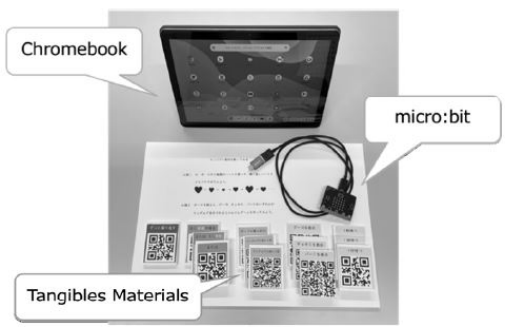
In this example, it is assumed that each learner has a tablet PC, a set of cards on which QR codes are printed, and a micro:bit for control, and works on the exercises alone. The QR code contains a program and objectives for learning programming, which we describe in later section. The micro:bit is a palm-sized educational microcomputer board made in England. The micro:bits are distributed free of charge to all children between the ages of
11 and 12 and are used in classrooms in England. In Japan, the Ministry of Education, Culture, Sports, Science and Technology’s High School Informa- tion Division’s published “Information I” teaching materials for instructor training (Ministry of Education, 2020). Its notable feature is that it can be programmed in traditional programming languages such as JavaScript and Python as well as in a visual programming language. Since commands can be written directly, it can be used as a tangible teaching material by converting the commands into QR codes.
We have employed ChromeOS tablet PCs for our experiments and dis- tributed each of them for each subject. The reason we have employed the ChromeOS is that it is widely used in primary and secondary schools.
PROPOSED CLASSROOM SUPPORT
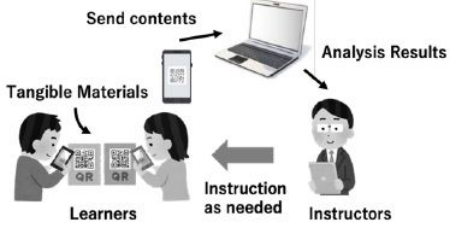
Figure 1 shows an example of instructional support using our proposed mate- rials. The objective of the analysis shown in Figure 1 is a classification of the learners’ programs. Specifically, the system sets the goals for learning programming, estimates potential errors, and then provides the corrections for them. The estimation is based on the records of the programs and the errors occurred in previous programming class. The proposed programming learning environment is shown in Figure 2.
Figure 1: Classroom support using tangibles materials.Figure 2: Proposed programming learning environment.
A Proposal of Educational Programming Environment Using Tangible Materials 523
With the proposed class support, the instructor can identify the common problems of learners and the number of learners who have problems, and confirm the points that need guidance. Depending on the number of learners, the class can be taught as a whole or individually.
PROPOSED LEARNER PROGRAMMING CLASSIFICATION METHOD There are several methods for classifying errors in traditional languages. Since we are not in a traditional language, we have created our own classification method. We have adapted “the goal of learning with computers for primary and secondary educational institutions” (British Computer Society, 2014). The objective has 8 levels, and each level has 3 to 6 levels. Table 1 shows an excerpt of the performance objectives.
Stage Level 1 Understand literals. 3 Can declare and initialize variables. Understand assignment operators. Understand if-else statements. 4 Understand relational operators. Understand that relational operators can be used to terminate a loop even in the middle of a loop. 5 Understand various operators. (arithmetic, logic) 6 Understand one-dimensional arrays. 8 Solving problems using recursion. Functionalize the process and use it.
By adding the stage and level of this goal to the QR codes, we can classify the stage at which learners stumble when errors occur, and the situation where it is necessary for the instructor to instruct the whole class.
EVALUATION OF THE PROTOTYPE
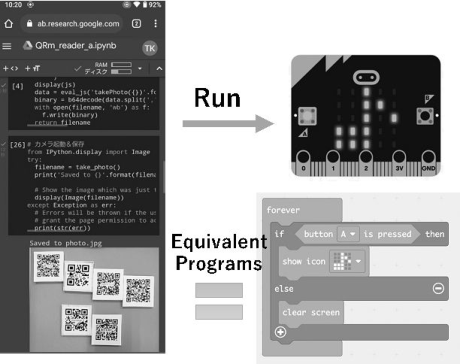
Figure 3 shows an execution example of the prototype based on this proposal. The system reads a sequence of QR codes and executes the corresponding program. When the system launched, the camera is activated and pho- tographs the tangible teaching materials. The read QR codes constitutes a program and the program is executed. At the same time, that the system reads and analyses the goals of programming learning embedded in the QR codes shown in Table 1, and provides the analysis results to the instructor.
In order to confirm the effectiveness of the proposed teaching materials, an experiment was conducted on 12 university students with programming experience. As for the evaluation, the subjects were asked to solve a task in 10 minutes. The content of the task was “Let’s make a rock-paper-scissors game in which one of rock, scissors, and paper is randomly displayed when
the board is touched”. This rock-paper-scissors game involves sequential, iterative, and branching processes.
Figure 3: Running programs from tangibles materials.
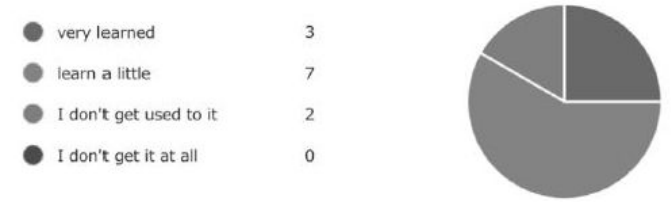
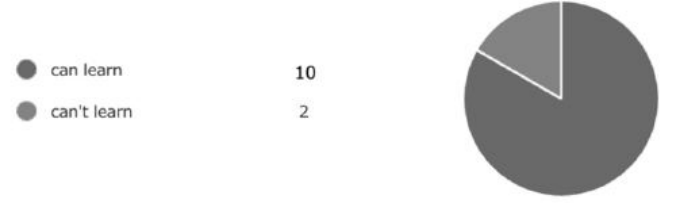
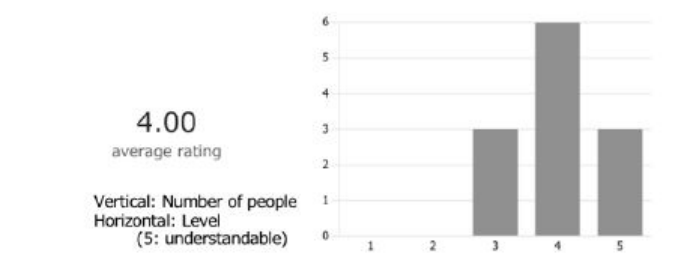
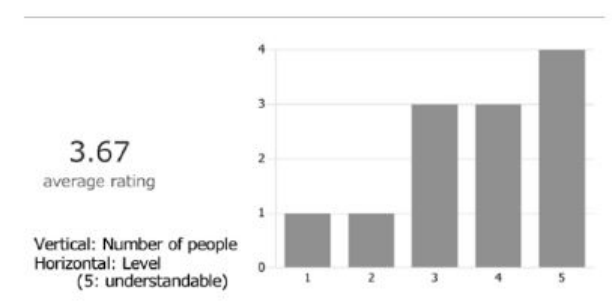
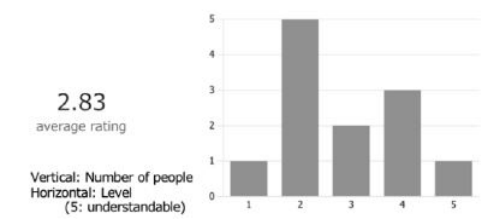
After completing the experiment, we asked the students to answer a five- question questionnaire. The contents of the questionnaire are as follows. The corresponding results are shown in Figures 4 to 8.
Q1 Will beginners be able to acquire logical thinking by using the proposed teaching materials? Q2 Do you think that people who are not good at text-based programming can learn with the proposed teaching materials? Q3 Please tell us the level of sequential processing that a beginner can understand. 5 levels: 5 understandable Q4 Please tell us the level of iteration processing that a beginner can understand. Same as level setting. Q5 Regarding branch processing, please tell us the level that a beginner can understand. Same as level setting. Q6 If you have any other opinions, such as improvements, please let us know.
Figure 4: Q1. Answer: Can you learn logical thinking.
A Proposal of Educational Programming Environment Using Tangible Materials 525
Figure 5: Q2. Answer: Compared to text-based.Figure 6: Q3. Answer: Can you understand the sequential processing.Figure 7: Q4. Answer: Can you understand iterative processing.Figure 8: Q5. Answer: Can you understand branch processing.
Several answers to Q6 are as follows.
Since the locations and content of the errors are not specified, it is difficult to locate where one fix them.
Regarding iteration processing, it is difficult to understand which area is the target of the iteration.
There are two paths from the branch point, but this teaching material has to line up in a straight line, so it may be difficult for beginners.
DISCUSSION
In this section, we discuss the results of this test evaluation questionnaire. First of all, since the target audience has programming experience, we can infer that they have some idea of how to learn programming. Therefore, the results may reflect some biases. Also, there was only one small problem, so it is necessary to increase the number of evaluations.
80% of the subjects answered Q1 and Q2 in affirmative. Those who responded that they could learn logical thinking in one task and in a short period of time, and that they could easily and more deeply learn than that of text-based environments, may be thinking on the premise that they should continue to use these materials.
Regarding the sequential processing of Q3, the teaching materials of this proposal are QR-coded in order. We believe that this system was highly rated because it can be programmed by arranging the codes.
In the iteration and branch processing in Q4 and Q5, the teaching mate- rials are rated low. Since the shapes of the teaching materials are the same in the process of arranging the QR codes, it may be difficult to visually grasp the structure of iteration and branching. It is desirable to express the constructs visually, such as a flow chart We have a large room for improvement.
This time the evaluation was from the learner’s perspective. In the future it is necessary to implement a support mechanism for instructors so that instructors can analyse common errors among learners.
CONCLUSION
This paper proposed a method for classifying learner programs with tangible teaching materials to support beginning programming classes. We have devel- oped a prototype system and have evaluated with 12 students. In order to automate the classification, we have incorporated the goal of learning in the tangible teaching materials (QR codes) that match with the program instruc- tions. Thus the system can provides instructors where the learner stumble and what the goals are difficult for the learners to comprehend. As a result of the experiments using the prototype, the students rated the system high when they programmed sequential processing, but they rated the system low when they programmed structural processing like iterative and branching proce- dures due to the uniform shape of the tangible materials. We are planning to overcome this problem by improving the shape of the teaching materials to stand out their meanings visually conscious.
A Proposal of Educational Programming Environment Using Tangible Materials 527
As a future direction, we redesign the teaching materials and implement support features for instructors so that the system can be used in actual programming classes.
ACKNOWLEDGMENT
This work was partially supported by JSPS KAKENHI Grant Number JP21K02805.
REFERENCES
British Computer Society. (2014) Computing Progression Pathways KS1 (Y1) to KS3 (Y9) by topic, Computing At School, https://www.computingatschool.org. uk/resource-library/2014/march/cas-computing-progression-pathways-ks1-y1- to-ks3-y9-by-unofficial-strand (Accessed 2023-5-4). Kato Toshiyasu and Kambayashi Yasushi. (2022) A Classroom Support in Smart-
phone Learning Environments Using Tangibles Materials, 12th International Congress on Advanced Applied Informatics, pp. 661–662. Kambayashi Yasushi, Furukawa Kenshi, Takimoto Munehiro. (2017) Design of Tangible Programming Environment for Smartphones, Proceedings of the Nineteenth International Conference on HCI International, HCII Posters 2017, Part II, CCIS 714, Springer, pp. 448–453. Kambayashi Yasushi, Tsukada Katsuki, Takimoto Munehiro. (2019) Providing
Recursive Functions to the Tangible Programming Environment for Smartphones, Proceedings of the Twenty-First International Conference on HCI International, HCII Posters 2019, Part III, CCIS 2034, Springer, pp. 255–260. Melcer, Edward F., and Isbister Katherine. (2018) Bots & (Main) Frames: exploring the impact of tangible blocks and collaborative play in an educational program- ming game, Proceedings of the 2018 CHI Conference on Human Factors in Computing Systems, ACM. Ministry of Education, Culture, Sports, Science and Technology. (2020), Chapter 3
Computers and Programming, Teacher Training Materials for the High School Information Course “Information I” https://www.mext.go.jp/a_menu/shotou/zyo uhou/detail/1416756.htm (Accessed 2023-5-4). Transforming Our World. (2015) The 2030 Agenda for Sustainable Development (2030 Agenda), https://www.mofa.go.jp/mofaj/gaiko/oda/sdgs/pdf/000101401. pdf (Accessed 2022-3-28). Wang, Danli, Cheng Zhang, and Hongan Wang. (2011) T-Maze: a tangible pro-
gramming tool for children, Proceedings of the 10th international conference on interaction design and children. Yashiro Tomohito, Mukaiyama Kazushi and Harada Yasushi. (2018) Programming Tool and Activities for Experiencing Collaborative Design, Information Processing Society of Japan, Vol. 59, No. 3, pp. 822–833 (In Japanese).
LISTED IN THE AHFE DIGITAL BOOKSTORE CATALOGUE
Explore the complete digital volume
Human Systems Engineering and Design (IHSED 2023): Future Trends and Applications
Read this individual research paper free through the original publisher, or explore the full digital proceedings book.
ISBN 978-1-958651-88-9
Explore this ISBN in the AHFE Bookstore ↗Listed in the July 2026 bookstore catalogue; search by ISBN to confirm current availability · Digital book purchase optional