Naoto Utusmi, Munehiro Takimoto, Yasushi Kambayashi (2021). Intuitive Body Operations Suppressing VR Sickness. In: Human Systems Engineering and Design (IHSED2021): Future Trends and Applications. AHFE Open Access, vol. 21. https://doi.org/10.54941/ahfe1001120
We propose a user interface that provides users feeling of immersion in virtual space. Recently technological progress of devices that give users illusions as if they were exercising their arms and legs in virtual space have been remarkable, and contents for such devices have been popular. Especially, Virtual Reality (VR) contents that provide interaction between users and objects in virtual space have attracted more and more attention. Some of them help users to immerse in virtual space. VR technology has put many interactions into practice that are impossible in physical space. In the current practice, however, most user’s behaviors in VR contents are limited to ones that are possible in physical space such as exploring a dungeon in a fantasy game. In this paper, we propose a novel and intuitive moving manner of users’ body in virtual space. Traditionally, in most VR contents, a user has moved by walking or riding a vehicle two dimensionally. If he would like to move three dimensionally, he has to rely on a conventional operation such as a joystick, mouse or keyboard other than intuitive body actions. Such three dimensional movements in the virtual space through conventional operations, however, causes VR sickness because of movement of the sight without any body action. There are measures of mitigation to prevent VR sickness. For examples, some systems suppress the VR sickness through a body action such as stepping to go forward. We have designed a moving manner including up-and-down movement with intuitive and highly immersive body actions. In our system, a user rides a popular fitness equipment, which has two pedals for left and right feet, and he or she can open or close his legs by sliding the pedals to the sides on it. On the equipment, the user can designate movement to any directions through body actions. If he wants to go forward, he can wave his arms as if he is walking. Also, if he wants to go up, he can shake his legs in a flurrying manner as if a bird flaps its wings. In order to stay in the air, he holds his legs widely. On the other hand, in order to go down, he holds his legs narrowly. Those movement of limbs’ actions give the user feeling of motions, which contributes to enhancing his immersion while suppressing VR sickness. In order to show the effectiveness of our approach, we conducted experiments to compare our method with a conventional method using a controller. We had the subjects move around the same course in a 3D virtual stage with these methods, and verified the degree of the sense of immersion and development of VR sickness. As a result, we observed that our method increases the sense of immersion and reduces VR sickness.
Human Systems Engineering and Design (IHSED 2021) https://openaccess.cms-conferences.org/#/publications/book/978-1-7923-8987-0
INTRODUCTION
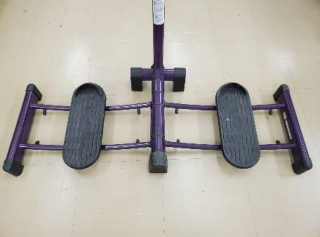
We propose a user interface that provides users feeling of immersion in a virtual space. These days, technological progress of devices that give users illusions as if they were exercising their arms and legs in a virtual space has been remarkable, and contents for such devices have also been popular. Especially, Virtual Reality (VR) contents that provide interactions between users and objects in a virtual space have attracted more and more attention. Some of them help users immerse themselves in the virtual space. The VR technology has enabled them to give many interactions that are impossible in a physical space. Users can experience such interactions only in the virtual space. In the current VR contents, however, most users’ behaviors are limited to ones that are possible in physical space such as exploring a dungeon in a fantasy game. In this paper, we propose a novel and intuitive moving manner of users’ body in a virtual space. Traditionally, in most VR contents, users have moved by walking or riding vehicles two dimensionally. If one would like to move three dimensionally, one has to rely on a conventional operation such as a joystick, mouse or keyboard other than intuitive body actions. Such three-dimensional movements in a virtual space through conventional operations, however, may cause VR sickness because of movement of the sight without any body action. There are several proposals for mitigating the VR sickness. For example, movements through body actions such as stepping forward suppress the VR sickness, and improve immersion through haptic feedback [1]. We have designed a moving manner including up-and-down movement with intuitive and highly immersive body actions. In our moving manner, the users ride a popular fitness equipment as shown in Fig. 1, which has two pedals for left and right feet, and they can open or close their legs by sliding the pedals to the sides on it. On the equipment, if the users want to go forward, they can wave their arms as if they are walking. If the users change their directions of movement, they can wave their arms opposite to the direction. In addition, if they want to go up, they can shake their legs in a flurrying manner as if birds flap their wings. In order to stay in the air, they hold their legs widely. On the other hand, in order to go down, they hold their legs narrowly. Those movements of limbs give the users feeling of physical motions, which contributes to enhancing their immersion while suppressing VR sickness.
Figure 1. Fitness equipment used in this paper.
Human Systems Engineering and Design (IHSED 2021) https://openaccess.cms-conferences.org/#/publications/book/978-1-7923-8987-0
COMPACTNESS OF THE EQUIPMENT There are some points that we need to consider when introducing a method of controlling movements in a VR space. Since users have to wear a VR Head Mounted Display (HMD) in order to make use of VR contents, the HMD hinders their real views, thus HMD prevents the users from specific body actions such as walking around. Our fitness equipment allows us to achieve body actions of movement without moving around. That is, the fitness equipment not only plays a role of a standard controller equipped with an accelerometer, but also enables a user to control movement in a VR space safely using hands and feet while saving space. Thus, in order to operate movements in a VR space, users get on the fitness equipment, put on the VRHMD, and hold the accelerometer-equipped controller in their hands.
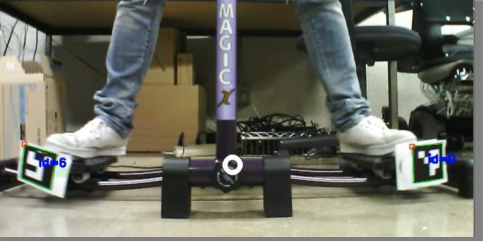
Capturing the Movement of The Feet As mentioned in the previous section our control system captures the movements of feet, and feedbacks them as a series of body actions to the VR space. The system achieves the feedback through sending a sequence of the movements of the fitness equipment as data to Unity. We use Unity to implement the VR space and the inter- face between users and the system. The control system captures the movements of pedals on the fitness equipment through image recognition. We have attached different markers on the pedals of the fitness equipment to detect the locations of the left and right pedals (see Fig. 2). The markers enable the system to capture the movement of the feet in almost real time without special sensor devices. This equipment requires no additional time for the virtual movement, thus our method does not affect the completion time.
Figure 2. Capturing the movements of pedals.
Human Systems Engineering and Design (IHSED 2021) https://openaccess.cms-conferences.org/#/publications/book/978-1-7923-8987-0
Capturing the Movement of The Hands Regarding movements of user’s hands, our system captures them through Oculus Touch, which is a hand-tracking controller specially designed for Oculus Rift. The hand tracker equips an accelerometer, which roughly capture degree of arm swing as acceleration value. We achieve an intuitive operational manner of movements in a VR space through feedbacking the values as velocity.
Implementation of movement methods We have designed operations in a VR space using physical limb movements for the following three kinds of movements:
1. Forward: If the users swing both arms, they will move forward in the virtual space. Arm swing is excellent in terms of performance and in regard to VR sickness.[2]
2. Rotation: If the users swing only their right arms, their viewpoints or movement directions will rotate to the left. Conversely, swinging only the left arm rotates the viewpoint or movement direction to the right. The rotation manner of direction of movement is the same as rowing a boat. Combining the rotation with the forward movement, the users can move in any directions.
3. Vertical movement: If the users repeat closing and opening their legs, the viewpoint will rise in the virtual space. If the users hold their legs widely, they will stay in the air. On the other hand, if they hold their legs narrowly, they will go down. Using the vertical movement, a user can go up to any height.
With these three kinds of operations, users can move freely in 360 degrees. In the process, in which they swing their arms or shakes their legs, the movement causes their bodies to sway a lot. This swaying contributes to helping the users get a certain sense of movement and increase the degree of immersion. In our approach, we did not implement sideways movement or backward movement, but the users can achieve such movements by combining the rotation and forward movement of the viewpoint. Of course, in order to achieve such movement, the user needs to perform operations of feet and arms simultaneously. The operations with all the limbs enable the user to move in even diagonal directions.
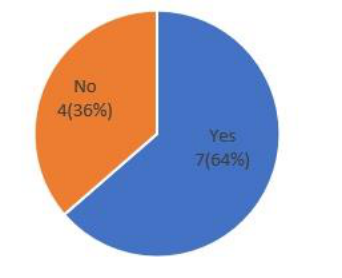
EXPERIMENTAL RESULTS In order to show the effectiveness of our approach, we conducted experiments to compare our method with a conventional method using a controller. As shown in Fig. 3, we employed seven users with experience of VR and four uses without experience of VR as subjects. We had them conduct the experiments, and then made them answer
Human Systems Engineering and Design (IHSED 2021) https://openaccess.cms-conferences.org/#/publications/book/978-1-7923-8987-0 a set of questions about their experiences. The questionnaire includes several questions about their subjective impressions in the operations, such as immersion and VR sickness.
We had the subjects move through preset course in the conventional method and the proposed method, respectively. To make it easier for the subjects to get a sense of movement, we used a free 3D model of a city and asked them to move around in it. The course takes the subjects from the start point to the goal point through two relay points. They are required to continue moving on the ground until reaching the first relay point, and then to go up in the air to the second relay point. Finally, they have to go down to the goal point on the ground. In the process of going along the course, all the operation of ascending, descending, rotating, and advancing are used to move. Through several experiments, we have found that there was a certain non-negligible difference in the level of immersion for movement in the air, which is an unimaginable situation in the real world. On the other hand, movements near the ground, where there are many buildings, easily give a sense of normal movement. For this reason, we asked the subjects to fill out the questionnaire about both experiences on the ground and in the air in a 10-point scale respectively. We used a standard gamepad as a conventional method, and the player operates an analog stick for moving back and forth, LR buttons for rotating the line of sight, and the AB buttons moving up and down.
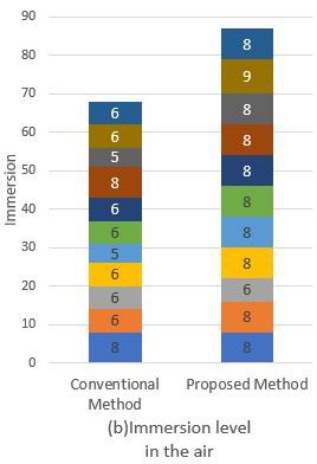
Fig. 4 shows the immersion levels of all subjects on the ground and in the air. As shown in the figure, the proposed method improves the degree of immersion greatly in both situations. In both situations, all the subjects evaluate the proposed method superior to the conventional method. In addition, three of the subjects, who have no experience of VR, complained of strong VR sickness in the experiment processes with the conventional method. On the other hand, through the questionnaire, we found that they did not feel any VR sickness when they moved in the proposed method. Thus, the intuitive operations using body action in the proposed method greatly con- tributes to the acquisition of the sense of movement, especially for VR beginners who are sensitive to VR sickness.
However, it took less time to reach the goal point with the conventional method than with the proposed method for all the subjects. The proposed method improves the level of immersion due to user’s body actions. The hyperbolical body actions take much more time than the finger operations on the gamepad does in terms of reaction speed.
One of the main causes of VR sickness is discrepancy with the actual experience [3]. We have conjectured that the users’ everyday behaviors may affect that discrepancy; therefore, we conducted a questionnaire survey about the frequency of walking to school and the frequency of playing action games. That is, we checked whether their frequency relates to the degree of immersion near the ground, or the degree of immersion in three-dimensional movement in the VR space. However, we could not find any evidence that the frequency of walking to school and the frequency of
Human Systems Engineering and Design (IHSED 2021) https://openaccess.cms-conferences.org/#/publications/book/978-1-7923-8987-0 playing action games relate to the level of immersion or VR sickness. This indicates that the users may perceive this method differently from their usual walking or moving in action games. The movement with the body actions, which contribute to the level of immersion, seems not to always be the same as usual experiences in the VR space.
Figure 3. Experience of VRFigure 4. Immersion level for each subject
Human Systems Engineering and Design (IHSED 2021) https://openaccess.cms-conferences.org/#/publications/book/978-1-7923-8987-0
DISCUSSION AND CONCLUSIONS We have proposed a novel and intuitive manner moving users’ body in virtual space. In this moving manner, while saving space, users can move intuitively and freely 360 degrees. We designed up-and-down movement with movement of the feet and back- and-forth movement with swing of the arms, through which body actions improved the level of immersion.
In order to show the effectiveness of our moving manner, we conducted experiments to compare our method with a conventional method using a joystick and gamepad. We had the subjects move around the same course in a 3D virtual stage with these methods, and checked the degree of the sense of immersion and development of VR sickness. As a result, we observed that our method increases the sense of immersion and reduces VR sickness.
We have implemented the new movement operation based on body actions that users can enjoy at home, without spacious room or special equipment. Lim et al. have proposed a method for the same purpose as ours [4]. They have found that solely restricting and contorting the users’ view mitigate their VR sickness. Their method is based on dynamic field of view processing. Since they focus their investigation to find the optimal view field, they have not tried physical actions. Combining their method with ours should provide much improving the remedy of VR sickness.
Currently, VR contents that we can enjoy at home are not very popular for various reasons, but one of them must be VR sickness. We believe that physical user interface as well as dynamic field of view would contribute to the popularization of VR contents.
REFERENCES
Chizuru Nakagawa, Mieko Ohsuga: The present situation of the studies in VE- Sickness and its close field, Transactions of the Virtual Reality Society of Japan, 1998, Volume 3, Issue 2, Pages 31-39 (In Japanese) Kirill Ragozin, Kai Kunze, Karola Marky, and Yun Suen Pai. 2020. MazeRunVR:
An Open Benchmark for VR Locomotion Performance, Preference and Sickness in the Wild. In Extended Abstracts of the 2020 CHI Conference on Human Factors in Computing Systems (CHI EA '20). ACM, New York, 1–8. Kyungmin Lim, Jaesung Lee, Kwanghyun Won, Nupur Kala, Tammy Lee: A novel method for VR sickness reduction based on dynamic field of view processing, Virtual Reality, 25, pp.331–340, 2021. Y.-H. Peng, C. Yu, S.-H. Liu, C.-W. Wang, P. Taele, N.-H. Yu, and M. Y. Chen.
Walkingvibe: Reducing virtual reality sickness and improving realism while walking in vr using unobtrusive head-mounted vibrotactile feedback. In Proceedings of the 2020 CHI Conference on Human Factors in Computing Systems, CHI ’20, p. 1–12.ACM, New York, 2020.
Human Systems Engineering and Design (IHSED 2021) https://openaccess.cms-conferences.org/#/publications/book/978-1-7923-8987-0
LISTED IN THE AHFE DIGITAL BOOKSTORE CATALOGUE
Explore the complete digital volume
Human Systems Engineering and Design (IHSED2021): Future Trends and Applications
Read this individual research paper free through the original publisher, or explore the full digital proceedings book.
ISBN 978-1-7923-8987-0
Explore this ISBN in the AHFE Bookstore ↗Listed in the July 2026 bookstore catalogue; search by ISBN to confirm current availability · Digital book purchase optional