Curtis Cripe (2026). A Neuroadaptive Cognitive Deployment Framework for Human–System Integration. In: Human Systems Engineering and Design (IHSED2026): Future Trends and Applications. AHFE Open Access, vol. 237, pp. 791–802. https://doi.org/10.54941/ahfe1008217
Human–system engineering has traditionally evaluated operator performance using metrics derived from workload, attention, or fatigue. While useful, these measures do not capture the dynamic neural processes through which cognitive resources are activated, stabilized, regulated, and recovered during task performance. This paper introduces the Neuroadaptive Cognitive Deployment Framework, which conceptualizes cognition as a dynamically deployable system resource within adaptive human–machine environments. The framework integrates baseline neural architecture estimation, derived from resting-state EEG and normative reference models, with real-time neural state monitoring to estimate cognitive deployability: the moment-to-moment readiness of neural systems to engage task-relevant processing under changing operational demands. A mathematical formulation of deployability is presented, together with a closed-loop system architecture that incorporates deployability estimates into adaptive control of human–system interaction. To characterize the temporal dynamics of engagement, the paper introduces the Cognitive Deployment Curve, which models transitions across baseline readiness, activation, sustained engagement, overload threshold, and recovery phases. By treating cognition as a deployable resource rather than a static capability, the framework extends traditional workload-based models and provides a foundation for neuroadaptive technologies in aviation, emergency response, complex engineering systems, and cognitive readiness training.
Human–system engineering seeks to optimize the interaction between human operators and increasingly complex technological environments. In domains such as aviation, emergency response, and large-scale infrastructure monitoring, human performance remains a critical determinant of system reliability and safety. Despite advances in automation and decision support, many operational systems still depend on the ability of operators to maintain situational awareness, regulate attention, and make timely decisions under varying cognitive demand.
Traditional human factors approaches have focused on measuring workload, engagement, or fatigue. Subjective instruments such as the NASA Task Load Index (Hart and Staveland, 1988) and the Subjective Workload Received June 12, 2026 Revised June 22, 2026 Accepted July 10, 2026 Available online September 25, 2026
792 Cripe Assessment Technique (Reid and Nygren, 1988) have been widely used to evaluate perceived demand, while physiological methods including electroencephalography (EEG), eye tracking, and heart-rate variability have been used to estimate operator state in real time (Fairclough, 2009). These methods have contributed substantially to safer and more efficient human– machine systems.
However, many existing models implicitly assume that cognitive capacity is relatively stable and that performance degradation primarily reflects increases in workload or fatigue. Human cognition is inherently dynamic, and fluctuations in neural coordination can significantly influence the ability of operators to deploy cognitive resources effectively as task conditions change (Parasuraman and Rizzo, 2008). Recent advances in neuroergonomics have highlighted the potential of integrating neural measurements into the design of adaptive human–machine systems (Parasuraman, 2011), yet current neuroergonomic models often focus on isolated indicators of operator state rather than modeling the dynamic lifecycle of cognitive engagement.
This paper introduces the Neuroadaptive Cognitive Deployment Framework, a model that conceptualizes cognition as a dynamically deployable system resource. The framework proposes that operational performance depends not only on cognitive capacity but also on the deployability of neural systems: their ability to activate, stabilize, regulate, and recover in response to task demands. Cognitive deployability is defined as the moment-to-moment capacity of neural systems to activate, sustain, regulate, and recover task-relevant processing under varying operational demands.
The framework integrates two complementary components. Baseline neural architecture estimation, derived from resting-state EEG and normative reference models, characterizes structural readiness and vulnerability within large-scale neural networks. Real-time neural state monitoring estimates moment-to-moment cognitive deployment using EEG-derived indicators of neural coordination and regulatory stability. Combined, these yield a Cognitive Deployability Index that can be embedded in adaptive architectures to support closed-loop regulation of task demands and interface behavior. To describe temporal dynamics, the paper introduces the Cognitive Deployment Curve, which characterizes the lifecycle of cognitive activation across five phases: baseline readiness, activation, sustained engagement, overload threshold, and recovery.
The contributions are threefold: a conceptual contribution introducing cognitive deployability as a measurable system variable; a modeling contribution integrating baseline neural architecture with real-time monitoring to estimate deployability; and a systems-engineering contribution incorporating deployability estimates into closed-loop adaptive human– machine interaction.
RELATED WORK
Human performance modeling has long emphasized mental workload, defined as the relationship between task demands and available cognitive resources. Workload-based models have been used widely in aviation, transportation, and command-and-control settings, supported by instruments such as NASA- TLX (Hart and Staveland, 1988) and SWAT (Reid and Nygren, 1988). Because these rely on subjective self-report, they are typically administered after task completion and cannot provide continuous estimates of operator state. To address this limitation, researchers have explored physiological indicators — heart-rate variability, eye tracking, electrodermal activity, and EEG — that can support real-time monitoring (Fairclough, 2009).
Neuroergonomics emerged as an interdisciplinary field integrating neuroscience, psychology, and engineering to understand the neural mechanisms underlying performance in real-world environments (Parasuraman and Rizzo, 2007). EEG has received particular attention for its non-invasive, high temporal resolution measurement of attention, workload, and vigilance; engagement indices derived from spectral power ratios have been proposed as indicators of operator state during automated tasks (Pope et al., 1995). Advances in signal processing and machine learning have enabled neuroadaptive systems in which neural signals dynamically modify system behavior (Parasuraman, 2011).
Related physiological-computing systems place physiological signals within the human–machine control loop (Fairclough, 2009) but often estimate a single-dimensional state — workload, stress, or fatigue — and EEG monitoring has tended to detect specific states rather than the broader lifecycle of engagement. Fatigue and vigilance approaches such as the Psychomotor Vigilance Test (Dinges and Powell, 1985) emphasize performance decline over time rather than the dynamic processes of activation, stabilization, regulation, and recovery.
Previous work by the author has used EEG-based measurements to evaluate cognitive function, neural connectivity, and cognitive resilience in clinical and performance contexts, examining how EEG-derived indicators of neural coordination relate to cognitive performance and resilience under varying demand (Cripe, 2025a; Cripe, 2025b; Cripe, 2026). The present paper extends this line of work with a systems-level model of cognitive deployability that integrates baseline neural architecture with real-time monitoring, providing a foundation for neuroadaptive human–system integration.
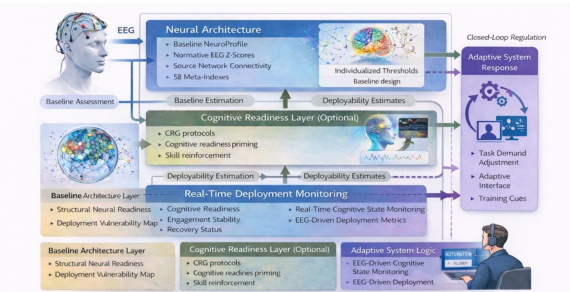
METHODS AND SYSTEM MODEL The Neuroadaptive Cognitive Deployment Framework integrates baseline neural architecture estimation with real-time cognitive state monitoring to enable adaptive human–system regulation. It combines resting-state EEG analysis, individualized deployment threshold estimation, real-time deployability monitoring, and adaptive interface control within a closed- loop architecture. Figure 1 illustrates the overall system architecture.
Figure 1: Neuroadaptive Cognitive deployment architecture. Baseline neural architecture is estimated from resting-state EEG using normative z-scores, source- network connectivity, and derived neural meta-indexes to establish individualized deployment thresholds. An optional cognitive readiness layer provides protocols for strengthening deployability. Real-time EEG monitoring estimates cognitive deployability during task engagement and drives closed-loop adaptive responses such as task-demand adjustment, adaptive interface behavior, and training cues.
Conceptual Model of Cognitive Deployability Performance in operational environments depends not only on cognitive capacity but on the ability of neural systems to activate, stabilize, regulate, and recover in response to task demands. We refer to this property as cognitive deployability and model it as a latent state variable D(t) in [0,1], where higher values of D(t) indicate rapid activation, stable engagement, effective regulatory control, and efficient recovery following cognitive strain. The framework models deployability as the interaction between baseline neural architecture and real-time neural state dynamics.
Baseline Neural Architecture Estimation Baseline neural architecture is estimated from resting-state EEG normalized to age-matched normative databases. It characterizes structural and functional properties of large-scale neural networks and provides individualized thresholds for deployment estimation, allowing real-time dynamics to be interpreted relative to a stable, person-specific reference and distinguishing transient task-related fluctuations from intrinsic neural vulnerabilities. Let the baseline neural architecture be represented by the vector
[ ]
Equation reproduced from the original PDF.
where each element b_i is a baseline neural index derived from normative EEG measures of network connectivity, oscillatory balance, and neural stability. Baseline architecture serves two functions: structural readiness estimation, identifying strengths and vulnerabilities in network organization; and individualized threshold calibration, defining personalized reference
A Neuroadaptive Cognitive Deployment Framework for Human–System Integration 795 values used to interpret real-time activity. Together these define a deployment vulnerability map that guides both adaptive training and real-time monitoring.
Real-Time Neural State Monitoring Advances in real-time EEG signal processing and wearable neurotechnology make it increasingly feasible to estimate neural state features with sub-second latency. Real-time cognitive deployment is estimated from EEG-derived feature vectors computed in sliding temporal windows, capturing dynamic activity associated with engagement, coordination, and regulation. Let the real-time neural state vector be
Equation reproduced from the original PDF.
where each r_i(t) represents a neural feature such as an oscillatory power distribution, a synchronization measure, or a temporal-stability metric. In a typical implementation, sliding-window features (band power and ratios, connectivity, and stability metrics) form r(t), which is evaluated against individualized thresholds derived from b before being passed to the deployability estimator.
Deployability Estimation Cognitive deployability is computed as a function of real-time neural features relative to individualized baseline thresholds:
( ) ( ( ( ) ( ))) T D t t σ θ = − w r b
where w is a weighting vector over neural features, θ(b) denotes individualized deployment thresholds derived from the baseline architecture vector b, and σ(·) is the logistic activation function
( ) x e
1 1 x
In effect, the model measures the difference between current neural activity and individualized baseline thresholds, weights those differences by their importance, and passes the result through a logistic function to produce a normalized value in the interval [0,1]. Baseline neural structure thereby parameterizes how real-time activity is interpreted. The resulting scalar, the Cognitive Deployability Index (CDI), is the primary control variable within the neuroadaptive architecture.
Deployment-State Decomposition To support interpretable system behavior, the neural state underlying deployability is decomposed into five functional components corresponding to phases of cognitive deployment,
Equation reproduced from the original PDF.
whose components — readiness, activation latency, stability, regulation, and recovery — are each derived from resting-state and task-related EEG
796 Cripe indices, as summarized in Table 1. The components form a mapping from neural measurements and baseline architecture, x(t) = f(r(t), b), and provide an interpretable view of the same estimate produced above: the normalized components combine as a weighted composite
D t w x t w R t w L t w S t w G t w U t
K ( ) ( ) ( ) ( ) ( ) ( ) ( ) k 1 1 2 3 4 5
k k with weighting coefficients w_k expressing the relative importance of each component. The decomposition and the logistic estimator are two views of one model — the components supply the interpretable structure of the neural state, while the logistic form maps that state, relative to baseline, onto the bounded deployability index used for control. In practice f(·) may be realized through signal-processing feature extraction, statistical estimation, or machine learning; the present paper specifies the system formulation rather than a particular estimator.
Table 1: Operationalization of deployability constructs from resting-state EEG indices.
Table available in the original PDF paper.
Construct Symbol Operational Definition (Resting-State NeuroCodex Index) Baseline architecture b Vector of normative meta-indexes: source-network connectivity, oscillatory balance, and neural-stability z-scores relative to age-matched norms
Readiness R Alerting attention-network index (readiness to initiate task engagement) Activation latency L Orienting attention-network index (speed of attentional engagement)
Stability S Engagement-stability index (persistence of coordinated processing) Regulation G Executive-control and reactivity-substrate index (regulatory capacity under load)
Recovery U Resilience composite (regulatory restoration following sustained effort)
Closed-Loop Neuroadaptive Control The deployability estimate is used as a control variable within a closed- loop human–system architecture. Task demand is represented as an external input d(t), while D(t) provides a continuous estimate of human capacity. An overload-risk estimate is defined as
Equations and mathematical formulas are available in the original paper PDF.
so that higher task demand increases overload risk while higher deployability decreases it. When overload risk exceeds a predefined threshold, the system
A Neuroadaptive Cognitive Deployment Framework for Human–System Integration 797 can initiate adaptive responses such as interface simplification, task-demand adjustment, decision-support assistance, or cognitive cueing. This supports appropriate reliance between operator and automation rather than abrupt failure (Lee and See, 2004).
Neuroadaptive System Architecture The architecture integrates three functional layers: a baseline architecture layer for structural readiness and vulnerability mapping; an optional cognitive training layer providing individualized readiness protocols to strengthen deployment capacity; and an adaptive deployment layer for real-time monitoring and control of human–system interaction. Its design principles are to separate baseline capacity from moment-to-moment deployability, to interpret monitoring relative to individualized baseline architecture rather than universal thresholds, to regulate demand through closed-loop adaptation, and to monitor the full engagement lifecycle. Grounding estimates in reproducible signal-processing models prior to interpretation lets adaptive control respond without relying on opaque inference.
Validation Study: Design and Analysis Baseline deployability was evaluated against standardized cognitive testing in a clinical dataset (described in Results). Because only resting-state data were available, the analysis evaluates baseline deployability — the architecture vector b and its components — rather than the real-time index D(t); real-time validation is reserved for future work. A baseline Cognitive Deployability Index (CDI) was computed as an equal-weight composite of the five components in Table 1, each standardized to age-matched normative values, with equal weighting specified a priori to avoid overfitting. Cognitive outcomes were the cluster scores of the Woodcock–Johnson III Tests of Cognitive Abilities (WJ III). Associations were examined across all available clusters with Benjamini–Hochberg false-discovery-rate (FDR) correction, and discriminant validity was tested with hierarchical regression entering age and a conventional band-power engagement index (beta/(alpha+theta); Pope et al., 1995) at Step 1 and the CDI at Step 2.
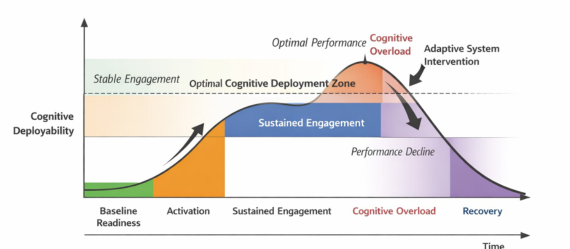
COGNITIVE DEPLOYMENT CURVE While the Cognitive Deployability Index provides a continuous estimate of neural readiness, operational performance also depends on the temporal dynamics through which cognitive states evolve. Cognition rarely operates at a fixed level of engagement; instead, neural systems transition through identifiable phases as task demands rise and fall. The Cognitive Deployment Curve models the temporal evolution of deployability across the lifecycle of a task episode (Figure 2), using the five deployment-state components defined above rather than re-deriving them.
Figure 2: Cognitive deployment curve. Conceptual representation of the temporal dynamics of cognitive deployability during task engagement, showing five operational phases. The central region is the optimal zone of stable, coordinated engagement; beyond the regulatory capacity of the system the curve enters the overload region, where instability and performance decline may occur; the recovery phase reflects restoration of neural regulatory balance.
Across these phases, deployability rises from the resting baseline as executive-control networks mobilize (activation), is sustained while stability dominates (the optimal operating region), and is challenged as demand approaches the overload threshold, where the regulation component becomes critical and rising overload-risk values can trigger adaptive responses such as changes to interface complexity, pacing, or decision support. The recovery phase reflects restoration of regulatory equilibrium, with stronger control yielding faster recovery across repeated task cycles.
By modeling the entire lifecycle of engagement rather than a single state, the curve allows adaptive systems to anticipate instability and respond proactively, aligning system behavior with the dynamic capabilities of the operator.
PRELIMINARY VALIDATION RESULTS The study received ethical approval from the Pearl Institutional Review Board (approval #20-NEUR-101). The framework was evaluated in a clinical sample of 243 adolescents and adults who completed resting-state EEG together with the WJ III. Cognitive standard scores showed normative spread (General Intellectual Ability SD = 14.1; Cognitive Efficiency SD = 17.3; normative SD = 15), indicating associations were not attenuated by range restriction. The CDI was related to each WJ III cluster with FDR correction across the six outcomes.
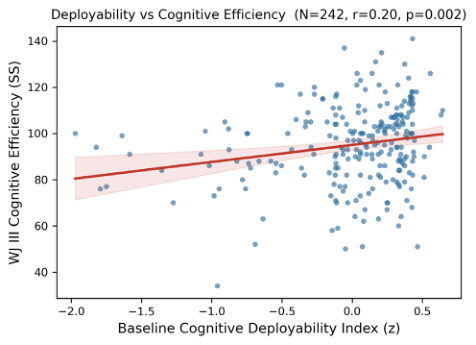
Association With Cognitive Performance The CDI was most strongly associated with the Cognitive Efficiency cluster (r = 0.20, p = .002), which remained significant after FDR correction (p = .010). Weaker associations appeared with general intellectual ability and fluid reasoning (Thinking Ability), whereas verbal, phonemic, and
A Neuroadaptive Cognitive Deployment Framework for Human–System Integration 799 working-memory clusters were unrelated (Table 2). The pattern is a dissociation: deployability tracked fluid and efficiency-related abilities but not crystallized verbal ability. Component-level analysis localized this to the activation component (L — cognitive flexibility, task-switching, and decision efficiency), which carried the largest correlations across outcomes (r = 0.24 with Cognitive Efficiency).
Table 2: Association between the baseline cognitive deployability index and Woodcock–Johnson III cognitive clusters (Pearson r; uncorrected and FDR-corrected p).
Table available in the original PDF paper.
WJ III Cluster N r p p (FDR) Cognitive efficiency 242 0.20 .002 .010
Verbal ability 241 0.01 .92 .92 To test whether deployability captured information beyond conventional EEG, hierarchical regression entered age and the band-power engagement index at Step 1 and the CDI at Step 2. For Cognitive Efficiency the CDI added significant incremental variance (ΔR² = 0.019, p = .018); for general intellectual ability it did not (ΔR² = 0.010, p = .092). The Cognitive Efficiency association was robust to exclusion of clients with extreme engagement values (r = 0.21, N = 236). Effects were small (about 4% of variance), consistent with a weak but reliable relationship (Figure 3).
Figure 3: Baseline cognitive deployability index versus WJ III cognitive efficiency (N = 242; r = 0.20, p = .002). The association is positive but small; the wide scatter reflects the modest effect size. The shaded band is the 95 percent confidence interval of the regression line.
COMPARISON WITH TRADITIONAL MODELS The proposed framework introduces cognitive deployability as a measurable system variable, modeling cognition as a deployable resource whose effectiveness depends on the dynamic state of neural networks — paralleling resource-management models in which performance depends not only on resource availability but on the ability to allocate and regulate resources as conditions change. Cognition can thus be viewed as a layered system in which structural capacity supports dynamic deployability, which in turn determines observable performance.
The stack introduces an intermediate layer between capacity and performance — Cognitive Capacity → Cognitive Deployability → Operational Performance — recognizing that individuals with similar capacity may differ substantially in their ability to deploy resources under real-world conditions. Adaptive human–system interfaces can then be understood as mechanisms for maintaining performance within the deployability layer, anticipating overload, adjusting demand, and supporting the operator before errors occur. This is particularly valuable in high-reliability environments — aviation, emergency response, and complex control systems — where small variations in operator state can have significant consequences (Weick and Sutcliffe, 2015).
APPLICATIONS AND FUTURE DIRECTIONS The framework targets human–system integration in environments where cognitive performance drives operational outcomes. In aviation and air- traffic control, real-time deployment monitoring could flag emerging instability in engagement and adjust automation, decision support, or task allocation before performance degrades, consistent with neuroadaptive cockpit concepts (Dehais et al., 2020). In emergency response and other high- reliability settings, it could identify regulatory strain and trigger workload redistribution or recovery protocols, aligning with efforts to improve organizational resilience (Weick and Sutcliffe, 2015) (Schmorrow and Fidopiastis, 2011). The preliminary results above also support a cognitive- readiness training application: individualized profiles can target specific deployment vulnerabilities to strengthen future deployability.
Several directions follow, framed by the present limitations: the validation is cross-sectional, uses a clinical sample whose generalization to operational populations is untested, and yields small effects. Real-time validation requires time-resolved EEG to instantiate the deployment curve from data and to test D(t) against within-task performance, extending these resting-state, baseline- level results. Multimodal integration — adding heart-rate variability, eye tracking, and electrodermal activity to EEG — could yield more robust state estimates (Fairclough, 2009), and adaptive interfaces that respond to operator state remain a priority. Real-world deployment will require artifact- resistant EEG and robust feature extraction.
CONCLUSION
Traditional human performance metrics focus on workload, engagement, or fatigue, offering valuable but partial insight into the neural processes governing performance. This paper introduced the Neuroadaptive Cognitive Deployment Framework, which conceptualizes cognition as a dynamically deployable system resource, integrates baseline neural architecture with real- time monitoring to estimate cognitive deployability, and embeds that estimate in a closed-loop architecture together with the Cognitive Deployment Curve. In a clinical sample of 243, baseline deployability showed a small but reliable association with cognitive efficiency — surviving multiple-comparison correction and adjustment for a conventional engagement index — within a broader dissociation favoring fluid and efficiency-related abilities over crystallized verbal ability. Effects were small and cross-sectional; operational and real-time validation remain the central next steps. As human–machine systems grow more complex, monitoring and regulating cognitive deployment may become a critical component of resilient human–system integration, shifting neuroergonomics from passive monitoring toward active regulation of deployability — with real-time, operational validation the central next step.
ACKNOWLEDGMENT
The author thanks colleagues at NTLGroup for discussion and feedback.
REFERENCES
Cripe, C. (2025a). Ensuring cognitive readiness and situational awareness framework for space and earth. Human-Intelligent Systems Integration, pp. 1–11. Cripe, C. (2025b). Real-time cognitive tools for space. In: Intelligent Human Systems
Integration (IHSI 2025): Integrating People and Intelligent Systems, Vol. 160, p. 87. Cripe, C. (2026). The performance triad: Cognitive readiness, situational awareness, and willpower in adaptive learning systems — operationalizing cognitive readiness, situational awareness and motivation through brain–computer interfaces. Dehais, F., Roy, R.N., Scannella, S. (2020). Neuroergonomics applications in aviation:
Monitoring pilot cognitive state. Human Factors, 62(2), pp. 195–211. Dinges, D.F., Powell, J.W. (1985). Microcomputer analyses of performance on a portable, simple visual RT task during sustained operations. Behavior Research Methods, 17(6), pp. 652–655. Fairclough, S.H. (2009). Fundamentals of physiological computing. Interacting with
Computers, 21(1–2), pp. 133–145. Hart, S.G., Staveland, L.E. (1988). Development of NASA-TLX (Task Load Index): Results of empirical and theoretical research. In: Advances in Psychology, Vol. 52, pp. 139–183. Lee, J.D., See, K.A. (2004). Trust in automation: Designing for appropriate reliance.
Human Factors, 46(1), pp. 50–80. Parasuraman, R. (2011). Neuroergonomics: Brain, cognition, and performance at work. Current Directions in Psychological Science, 20(3), pp. 181–186.
University Press, Oxford. Parasuraman, R., Rizzo, M. (2008). Neuroergonomics: A review of applications to physical and cognitive work. Theoretical Issues in Ergonomics Science, 9(1), pp. 5–20. Pope, A.T., Bogart, E.H., Bartolome, D.S. (1995). Biocybernetic system evaluates
indices of operator engagement in automated task. Biological Psychology, 40(1–2), pp. 187–195. Reid, G.B., Nygren, T.E. (1988). The subjective workload assessment technique: A scaling procedure for measuring mental workload. In: Advances in Psychology, Vol. 52, pp. 185–218. Schmorrow, D.D., Fidopiastis, C.M. (2011). Foundations of Augmented Cognition.
Springer, Berlin. Weick, K.E., Sutcliffe, K.M. (2015). Managing the Unexpected: Sustained Performance in a Complex World. 3rd ed. Wiley, Hoboken, NJ.
FIND THE COMPLETE VOLUME IN THE AHFE DIGITAL BOOKSTORE
Explore the complete digital volume
Human Systems Engineering and Design (IHSED2026): Future Trends and Applications
Read this individual research paper free through the original publisher, or explore the full digital proceedings book.